





Abstract
Introduction:
A minimally invasive approach for correction of congenital diaphragmatic hernia (CDH) in pediatric patients is hampered in cases of anterior or anterolateral presentation. We report a combination of simple, innovative, minimally invasive procedures that can facilitate the laparoscopic repair of a CDH: selective transperitoneal aspiration (STA), induced controlled pneumothorax (ICP), and use of magnetic devices (MDs).
Material and Methods:
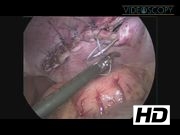
A 2-year-old male infant with diagnosis of left anterolateral CDH. Laparoscopy was performed using three trocars: a 5 mm epigastric trocar, a 6 mm left upper quadrant trocar, and 12 mm umbilical trocar for a 5 mm 30° laparoscope. CO2 pneumoperitoneum pressure was 12 mm Hg and flow was set at 5 L/minute. Upon entry, distended bowel loops made observation of the diaphragm very difficult. Through an STA, excess air in the colon was drained, allowing for an adequate operative field. Subsequently, a controlled pneumothorax was induced to counteract the diaphragmatic tension resulting from the muscle being forced upwards into the thorax because of pneumoperitoneum. Since pneumothorax can be increased or decreased, this maneuver is adaptable to the surgeon's needs and helps a tense-and-difficult-to-grasp diaphragm become easier to manipulate, plicate, and suture. Traction of the hernial sac was maintained through the use of a MD, composed of a magnet and a retractor (grasper). The MD inside the abdomen can be moved and repositioned as necessary with the movement of an external magnet, allowing for a comfortable resection and suture of the diaphragm. Finally, the lateral area of the defect was closed with transparietal knots using a Reverdin needle. No complications or adverse events were observed during or after the surgery. The patient was discharged on the fifth postoperative day with the last chest X-rays showing full expansion of the left lung. To date, no signs of recurrence are present.
Results and Conclusions:
The abdominal anterolateral approach to CDH can be used in combination with a set of innovative maneuvers such as STA, ICP, and MD. These maneuvers provide improved vision and access to the diaphragmatic defect and allow for a more comfortable resection of the hernial sac by the operator because of the continuous traction generated by the repositioning of the MD. Another important advantage is that it avoids the need of additional ports for surgical repair.
No competing financial interests exist.
Runtime of video: 3 mins 4 secs


Get full access to this article
View all access options for this article.
Supplementary Material
Please find the following supplemental material available below.
For Open Access articles published under a Creative Commons License, all supplemental material carries the same license as the article it is associated with.
For non-Open Access articles published, all supplemental material carries a non-exclusive license, and permission requests for re-use of supplemental material or any part of supplemental material shall be sent directly to the copyright owner as specified in the copyright notice associated with the article.
