





Abstract
Introduction:
Left diaphragmatic eventrations can be operated laparoscopically or thoracoscopically. The laparoscopic approach has one challenge: the left diaphragm, which is usually forced upwards into the thorax because of pneumoperitoneum, becomes tense and very difficult to grasp, suture, and plicate. The authors propose the use of induced controlled pneumothorax to reduce diaphragmatic tension. The video shows how this maneuver is performed in a 2-year-old male patient.
Materials and Methods:
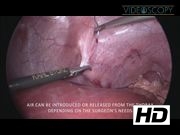
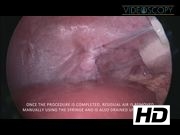
A 4.5-mm trocar is inserted in the umbilicus under direct vision and a pneumoperitoneum of 10 mmHg is created. Under laparoscopic observation, a 4-mm and a 6-mm trocar are introduced in both flanks. The diaphragm is seen under strain, hence, difficult to seize and manipulate, as it is pushed into the thorax because of the pneumoperitoneum. To induce the pneumothorax, a 20G teflon catheter is inserted at the level of the 11th intercostal space, on the midaxillary line. Special care is taken to avoid accidental piercing of the peritoneum. The catheter is then connected to an extension tube with a three-way valve and a 20 mL syringe. As shown in the video, when air is injected, pneumothorax is created and the diaphragm descends toward the abdomen, allowing for an improved grip and a more comfortable surgical correction of the defect. Air can be introduced or released from the thorax depending on the surgeon's needs. Once the procedure is completed, the residual air is removed and the wounds are closed.
Results and Conclusions:
Induced controlled pneumothorax is a useful aid in laparoscopic plications of left diaphragmatic eventrations because it helps to reduce the diaphragm's tension and facilitates manipulation.
No competing financial interests exist.
Runtime of video: 1 min 52 secs

Get full access to this article
View all access options for this article.
Supplementary Material
Please find the following supplemental material available below.
For Open Access articles published under a Creative Commons License, all supplemental material carries the same license as the article it is associated with.
For non-Open Access articles published, all supplemental material carries a non-exclusive license, and permission requests for re-use of supplemental material or any part of supplemental material shall be sent directly to the copyright owner as specified in the copyright notice associated with the article.
