





Abstract
Introduction:
A 16-year-old girl underwent laparoscopy to investigate a 3-month history of intermittent right iliac fossa pain associated nausea, vomiting, difficulty eating, and a loss of 3 kg in weight. She reported an intermittent right-sided abdominal mass, not identified on ultrasonography.
Methods:
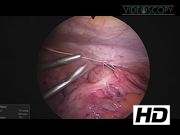
Standard port placement for a laparoscopic appendicectomy was used, with one secondary port placed suprapubically and the other in the left iliac fossa. The cecum was found to be very mobile and dilated. As demonstrated, the cecum could be freely rotated with the potential to cause intermittent cecal obstruction. Examination of the pelvis revealed unremarkable appearances of the fallopian tubes and ovaries. The appendix appeared macroscopically normal. A standard appendicectomy was performed with division of the mesoappendix using hook diathermy. The base of the appendix was ligated with 2 “0” vicryl endoloops. Cecopexy was then performed using three-point fixation. Three interrupted 2/0 Ethibond sutures were passed between the taenia coli and the peritoneum of the anterolateral abdominal wall. The senior author believes that the appendix stump in time is likely to form a fourth point of cecal fixation. Care is taken to avoid the inferior epigastric and external iliac vessels.
Result:
Appendiceal histology revealed no evidence of suppurative inflammation. The girl reported instant resolution of her nausea, vomiting, and difficulty eating. She reports only very occasional mild abdominal discomfort. She is now 1 year postsurgery, has regained the weight she had lost, and reports a dramatic improvement in her quality of life.
Conclusions:
Mobile cecum syndrome refers to a pattern of recurrent, intermittent symptoms, which results from failure of the right colonic mesentery to fuse with the lateral peritoneum, thereby allowing the cecum to rotate on itself causing intermittent obstruction. Patients most commonly present with chronic right iliac fossa pain, but can also present with intussusception and rarely cecal volvulus. Cecal volvulus usually involves the cecum, terminal ileum, and ascending colon. Cecal bascule is a variant of this condition and refers to the upward and anterior folding of the ascending colon. Mobile cecum syndrome is likely to be an under-recognized cause of chronic right iliac fossa pain, which can be effectively managed with laparoscopic cecopexy, preventing more serious complications such as intussusception and volvulus. It is difficult to ascertain whether this condition, or underlying appendiceal pathology, is responsible for chronic right iliac fossa pain. A concomitant appendicectomy is therefore advised.
No competing financial interests exist.
Runtime of video: 5 mins 35 secs


Get full access to this article
View all access options for this article.
Supplementary Material
Please find the following supplemental material available below.
For Open Access articles published under a Creative Commons License, all supplemental material carries the same license as the article it is associated with.
For non-Open Access articles published, all supplemental material carries a non-exclusive license, and permission requests for re-use of supplemental material or any part of supplemental material shall be sent directly to the copyright owner as specified in the copyright notice associated with the article.
