





Abstract
Introduction:
Traditionally, the Swenson pullthrough for Hirschsprung disease (HD) was considered potentially risky for sphincter injury and subsequent fecal incontinence. Recent studies have demonstrated that the continence mechanism can be well preserved when a HD case is approached transanally and it avoids any long-term problems related to the cuff.1,2 However, the anal canal can be overstretched, which can hurt the sphincter mechanism. It is clear that over time, the Soave done transanally is being performed with a shorter and shorter cuff, approaching a Swenson procedure. The laparoscopic approach is mostly used for biopsy and colon mobilization, but less so for the deep pelvic rectal dissection. We propose a technique of laparoscopic Swenson pullthrough that dissects the rectum deep into the pelvis to minimize the transanal dissection and then avoid overstretching and that takes advantage of the Swenson plane.
Materials and Methods:
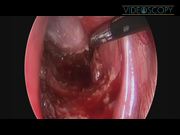
We present a 1-month-old female infant with HD, a transition zone at the rectosigmoid junction. Four ports were used for a laparoscopic approach: umbilicus, right upper and lower quadrants, and left upper quadrant. A biopsy from the proximal sigmoid colon confirmed ganglion cells and no hypertrophic nerves. A mesenteric window was made at the rectosigmoid junction, sigmoid branch vessels were divided, and marginal arteries were preserved. The left colon and splenic flexure were mobilized. Circumferential rectal dissection was accomplished laparoscopically, staying intimately close to the rectal wall. An avascular Swenson plane can be clearly identified between rectal serosa and mesorectum, which is the key plane required to avoid complications. Dissection can be carried out inferiorly. At this point, a transanal full-thickness dissection is performed with assistance from a lone-star retractor, which requires only a few centimeters of dissection to reach the previously dissected colon, allowing the ganglionic colon to be pulled through.
Results:
The postoperative recovery was uneventful. An episode of enterocolitis and transient constipation occurred, which was resolved by early implementation of bowel management. The patient developed regular bowel habit without enemas or laxatives at the age of 1 year.
Conclusions:
This technique is safe and feasible. Minimization of anal dissection is helpful to avoid overstretching of anal canal. No Soave cuff would be left behind.
No competing financial interests exist.
Runtime of video: 4 mins 36 secs
This work was presented at the International Pediatric Endosurgery Group meeting in Nashville, Tennessee on April 17, 2015.


Get full access to this article
View all access options for this article.
References
Supplementary Material
Please find the following supplemental material available below.
For Open Access articles published under a Creative Commons License, all supplemental material carries the same license as the article it is associated with.
For non-Open Access articles published, all supplemental material carries a non-exclusive license, and permission requests for re-use of supplemental material or any part of supplemental material shall be sent directly to the copyright owner as specified in the copyright notice associated with the article.
