





Abstract
Introduction:
Mesh erosion through the vagina is the most important complication of pelvic organ prolapse repairs using synthetic mesh. The initial surgical approach to treat this complication is usually the vaginal access. Nevertheless, transvaginal mesh excision may have some technical difficulties. Recently, some authors have described an innovative technique to treat mesh extrusion by vaginoscopy. 1 In this video, the authors demonstrate the surgical steps of this technique, confirming the feasibility and reproducibility of it.
Materials and Methods:
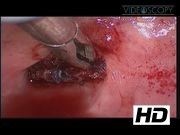
A 77-year-old lady submitted to total laparoscopic hysterectomy and promontofixation using synthetic polypropylene mesh, presenting mesh erosion through the vagina 3 years after the initial procedure. She complained about vaginal discharge and bleeding. On physical examination, the mesh could be visualized at the vaginal vault. Surgical treatment by vaginal access was then proposed. One single-port device (SILS port) was placed transvaginally using a purse-string suture at the vaginal introitus. The trocars were placed through the device: one 12-mm trocar for the laparoscope and two 5-mm trocars for the instruments. Carbon dioxide was insufflated creating the pneumovagina. Conventional laparoscopic instruments were used for the procedure. The magnification of the image provided by the laparoscopic approach facilitated the identification of the mesh and allowed for a very precise surgical procedure. The eroded mesh and the polyester sutures were removed using scissors. The vaginal vault was closed with interrupted stitches using 2-0 polyglactin 910 (intracorporeal knots).
Results:
The procedure was performed by vaginoscopy. The operative time was 73 minutes and the estimated blood loss was 10 mL. Oral feeding was started 6 hours after the surgical procedure and the patient was discharged 17 hours after the surgery. Postoperative evaluations on days 40 and 90 did not demonstrate any evidence of vaginal mesh erosion.
Conclusions:
Vaginoscopy is feasible and reproducible and is an alternative technique to approach transvaginal mesh erosions after pelvic organ prolapse repair using mesh.
No competing financial interests exist.
Runtime of video: 8 mins 59 secs


Get full access to this article
View all access options for this article.
References
Supplementary Material
Please find the following supplemental material available below.
For Open Access articles published under a Creative Commons License, all supplemental material carries the same license as the article it is associated with.
For non-Open Access articles published, all supplemental material carries a non-exclusive license, and permission requests for re-use of supplemental material or any part of supplemental material shall be sent directly to the copyright owner as specified in the copyright notice associated with the article.
