





Abstract
Introduction:
A novel adaptation of the established method for removing an appendix with a glove finger. The use of a glove finger to extract an appendix is well described. 1,2 However, this technique can prove problematic when trying to feed a long appendix fully into the narrow mouth of the glove finger. Use of a wider-mouthed purpose-built retrieval bag is an alternative, but is more expensive. This video demonstrates a modification to this technique, which facilitates rapid placement of the appendix, fully into the finger of a glove.
Materials and Methods:
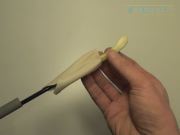
The largest finger from an 8.5 glove is cut free from the rest of the glove. The finger is then turned inside out. An open laparoscopic grabber is placed within the finger, with the jaws placed in such a way that they can cause the end of the glove to open and close (like a sock puppet). The grabber and glove finger are then inserted through a working port. The appendix is grasped by the above combination and pulled into the glove finger, while a second grasper stabilizes the open mouth and pushes it over the specimen. Finally, the open end of the glove finger is grasped and pulled out through the desired port.
Description of Video:
Run time 2.38: 00.01 preparing the glove finger; 00.51 placing the grasper in the reversed glove finger; 01.12 demonstration of the concept on the simulated appendix; 01.46 demonstration of the technique on the inflamed appendix.
Results and Conclusions:
The resulting technique has been successfully employed by the author to remove small, contaminated specimens such as appendixes and fecaliths. It has the advantage of rapid and accurate placement of the specimen in the glove finger, while minimizing the contact with the graspers and maintaining the cost savings of avoiding the use of a commercial specimen retrieval bag.
Runtime of video: 2 mins 38 secs


Get full access to this article
View all access options for this article.
References
Supplementary Material
Please find the following supplemental material available below.
For Open Access articles published under a Creative Commons License, all supplemental material carries the same license as the article it is associated with.
For non-Open Access articles published, all supplemental material carries a non-exclusive license, and permission requests for re-use of supplemental material or any part of supplemental material shall be sent directly to the copyright owner as specified in the copyright notice associated with the article.
