





Abstract
Background:
High-grade intestinal obstruction with massive abdominal distension is considered to be an absolute contraindication to laparoscopy. However, improvements in skill level and operator experience makes therapeutic laparoscopy in the above context possible. 1 –3
Aim:
To present video material demonstrating the diagnostic and therapeutic value of laparoscopy, for nonadhesive, high-grade intestinal obstruction, in children.
Methods:
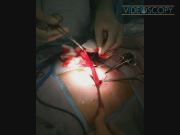
Two patients, a 4- and a 15-year-old, with no previous abdominal surgery, present with a 24-hour history of abdominal colic, bile-stained vomiting, and massive distension. Abdominal X-ray confirms high-grade distal small bowel obstruction. Emergency laparoscopy via an umbilical (10 mm) and 2 suprapubic ports (5 mm) established the cause of obstruction to be caused by a vitello-diverticular band and a constrictive Meckel's band with volvulus, respectively. A therapeutic division of the band and unravelling of the Meckel's instantly relieved the obstruction. Both diverticulae are delivered through the umbilical port wound and resected extracorporeally.
Results:
Successful diagnostic and therapeutic laparoscopy is possible notwithstanding massive small bowel distension with restricted intracorporeal space.
Conclusion:
Laparoscopic intervention for nonadhesive high-grade intestinal obstruction is not a contraindication although a superior laparoscopic skill level is a prerequisite.
No competing financial interests exist.
Runtime of video: 4 mins 2 secs


Get full access to this article
View all access options for this article.
References
Supplementary Material
Please find the following supplemental material available below.
For Open Access articles published under a Creative Commons License, all supplemental material carries the same license as the article it is associated with.
For non-Open Access articles published, all supplemental material carries a non-exclusive license, and permission requests for re-use of supplemental material or any part of supplemental material shall be sent directly to the copyright owner as specified in the copyright notice associated with the article.
