






Abstract
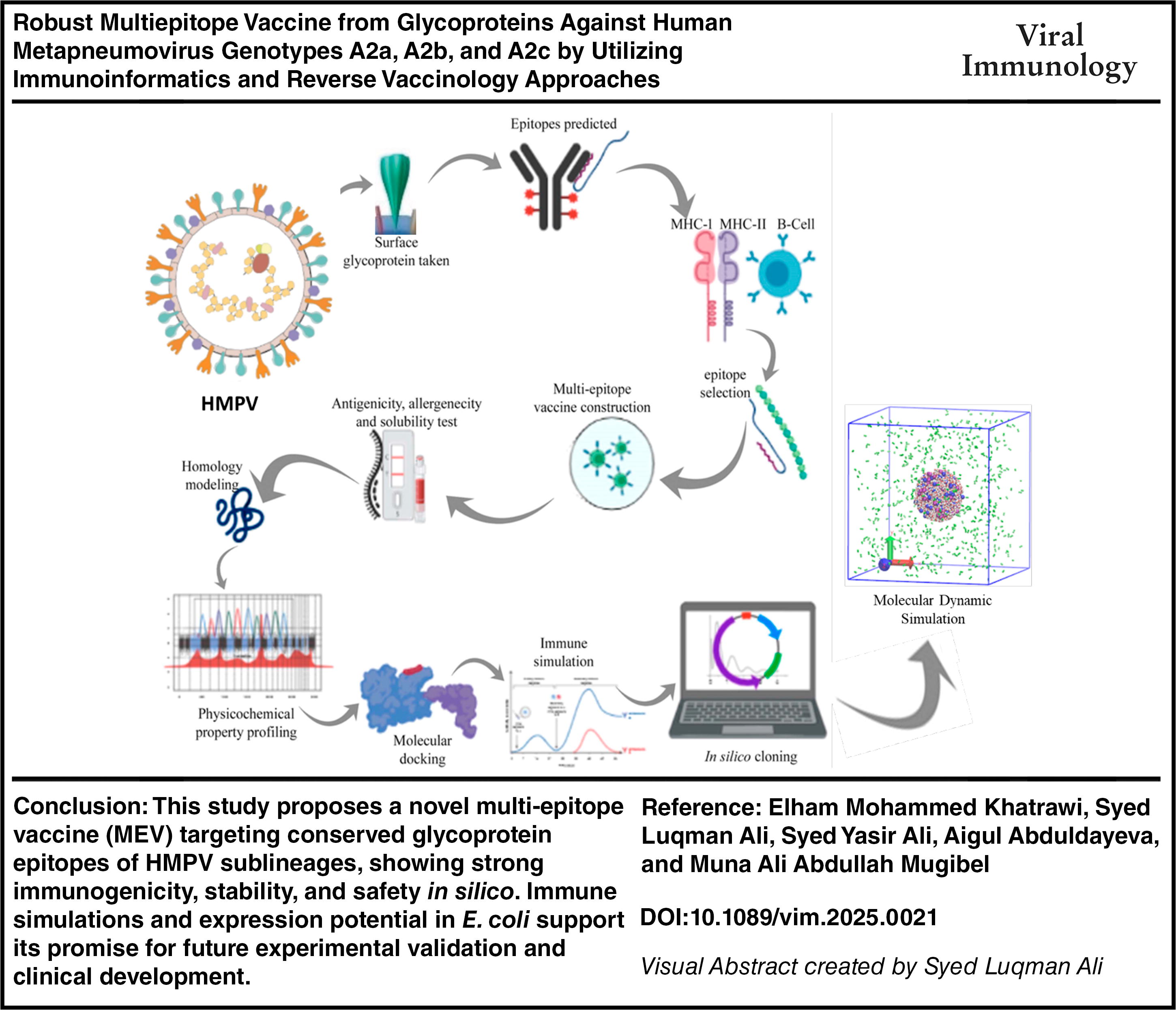
Human metapneumovirus (HMPV) is a prominent respiratory pathogen causing significant morbidity and mortality worldwide, mostly in young teenagers, the old, and immunocompromised individuals. Despite its clinical impact, no licensed vaccine is currently available, highlighting the urgent need for effective prophylactic strategies. This research aimed to design a multiepitope vaccine (MEV) targeting conserved and immunodominant regions of HMPV, leveraging immunoinformatics tools to ensure broad coverage and efficacy against the virus and its diverse sublineages. Glycoproteins from HMPV genotypes A2a, A2b, and A2c were analyzed to identify 18 highly antigenic and overlapping epitopes capable of eliciting robust B-cell, T-cell, and interferon-gamma (IFN-γ)-mediated immune responses. Toxicity and allergenicity studies confirmed the safety of particular epitopes, which were incorporated into two vaccine constructs using immunogenic linkers and adjuvants. The chimeric vaccines displayed high antigenicity, molecular stability, and nonallergenic properties. Structural refinement and Ramachandran plot analyses established the stability and accuracy of the 3D models. Molecular docking studies verified strong interactions with immune receptors, particularly toll-like receptor (TLR)2, TLR3, TLR4, TLR8, and human leukocyte antigen molecules, indicating robust immune stimulation potential. Molecular dynamics simulations further validated the vaccine’s stability and interaction dynamics, with immune simulations predicting promising responses. The designed vaccine constructs were shown to be highly soluble, stable, and suitable for recombinant expression in Escherichia coli, enabling further biochemical and immunoreactivity validation. These findings provide a foundation for next-generation vaccine development against HMPV, offering promising avenues for clinical application and future research.
Get full access to this article
View all access options for this article.
References
Supplementary Material
Please find the following supplemental material available below.
For Open Access articles published under a Creative Commons License, all supplemental material carries the same license as the article it is associated with.
For non-Open Access articles published, all supplemental material carries a non-exclusive license, and permission requests for re-use of supplemental material or any part of supplemental material shall be sent directly to the copyright owner as specified in the copyright notice associated with the article.
