






Abstract
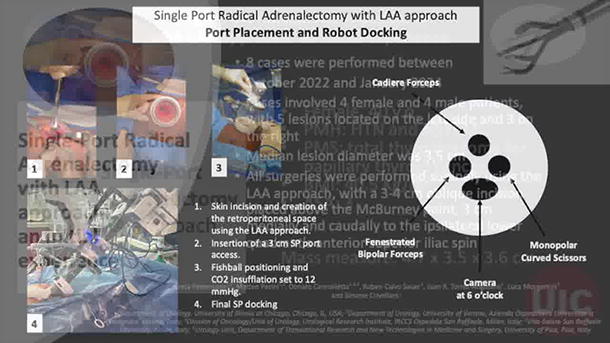
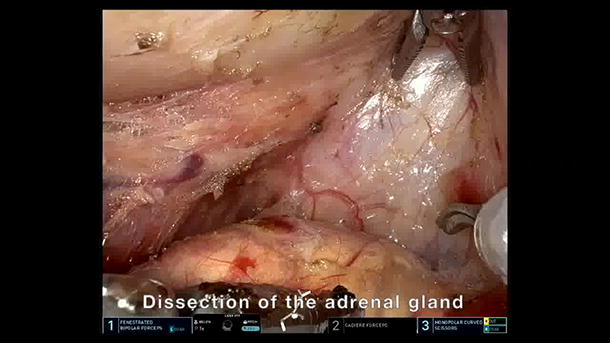
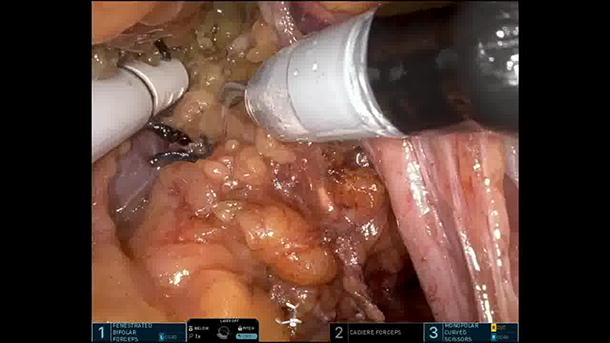
Introduction:
Adrenalectomies are widely regarded as the preferred treatment for adrenal tumors, typically conducted via laparoscopic or robotic transperitoneal approaches. 1 In contrast, posterior retroperitoneal approaches are less common, largely due to the constrained maneuvering space they offer. Single-port retroperitoneal radical adrenalectomy (SP-RRA) has become increasingly popular for the possibility to combine several advantages, such as reduced postoperative pain, shorter operative durations, decreased blood loss, and shorter hospital stays, 2 along with reduced instrument clashes and improved cosmetic results. 3 To overcome the necessity to placing the patient in a full flank position or a prone jackknife posture with hip joint flexion, 4 SP-RRA conducted through the innovative lower anterior access approach (LAA) 5 emerges as a secure and viable alternative, providing the advantages of the retroperitoneal approach without necessitating challenging patient positioning.
Material and Methods:
All patients presenting with an adrenal mass detected via CT or MRI scan who underwent SP-RRA using the LAA approach at our institution between October 2022 and January 2024 and with a follow-up of a minimum of 90 days were included in our case series. No exclusion criteria based on patient or lesion features were adopted. Variables in the study encompassed baseline population characteristics (age, sex, body mass index [BMI], and American Society of Anesthesiologists [ASA] score) as well as tumor features (side and size). Additionally, intraoperative outcomes (in-room time, skin-to-skin time, estimated blood loss, and intraoperative complications) and early postoperative results (pathology findings, major postoperative complications classified by the Clavien–Dindo classification, outpatient setting, and postoperative pain score (evaluated via the visual analogue scale [VAS] at discharge) were examined.
Results:
Analysis of our initial case series comprised eight patients who underwent SP-RRA with the LAA approach. Baseline characteristics revealed a median (IQR) age of 45 (38–58) years, with an equal distribution of 4 (50%) females and 4 (50%) males. The median (IQR) BMI was 28 (25–31) kg/m2 and the ASA score was 3. 2–3
Tumor sizes ranged from 1.5 to 5.4 cm, with a median (IQR) size of 3.5 (2.4–4.6) cm, with 5 (43%) located on the left side and 3 (37%) on the right. The median (IQR) in-room operative time was 175 (170–191) minutes, and skin-to-skin time was 132 (124–155) minutes, with only one (12.5%) minor intraoperative complication due to peritoneal infraction during LAA access dissection. All patients were discharged on the same day, with a median postoperative pain score of 3.5 on the VAS scale, and no postoperative major complications (Clavien–Dindo ≥3) were recorded. Most masses were benign tumors, predominantly adrenocortical adenomas. Only one patient had malignancy related to metastatic lesions secondary to prostatic cancer.
Conclusion:
Our experience contributes to the growing field of SP-RRA using the LAA approach for adrenal tumors. The observed outcomes and potential benefits, along with the adaptability of the SP platform, suggest promising implications for its application in adrenal treatment, showing its potential advantages in terms of hospital stay, cosmetic outcomes, postoperative pain, and patient satisfaction while ensuring surgical effectiveness. The main benefits could be attributed to the SP robot design, which requires only a single skin incision, and to the LAA approach, which eliminates the need for lateral patient positioning and the associated postoperative pain. This also facilitates simpler anesthesiologic management. Although the technical surgical steps of adrenalectomy remain the same as in standard approaches, it is important to consider the learning curve and the challenges of operating within a more confined space. Further research involving larger patient cohorts and longitudinal studies is necessary to strengthen the role of SP-RRA.
Statements and Declarations: Dr. Crivellaro is a consultant for Intuitive Surgical. The remaining authors have nothing to disclose.
Authors have received and archived patient consent for video recording/publication in advance of video recording of procedure
.
Source of music: Youtube, the music is instrumental music without copyright
.
Runtime of video: 8 mins 21 secs.
*These authors contributed equally.
Keywords
Get full access to this article
View all access options for this article.