






Abstract
Introduction and Objectives:
Salvage partial nephrectomy for recurrences after renal cryoablation is technically challenging secondary to varying degrees of peritumor, perinephric, and paranephric fibrosis, renal scarring, and adhesions. History of repeat cryoablation and complexity of the renal tumor besides patient's medical and surgical comorbidities pose challenge during salvage partial nephrectomy. Herein, we present our experience of robot-assisted salvage partial nephrectomy in patients who have undergone prior cryoablation for management of their renal masses.
Patients and Methods:
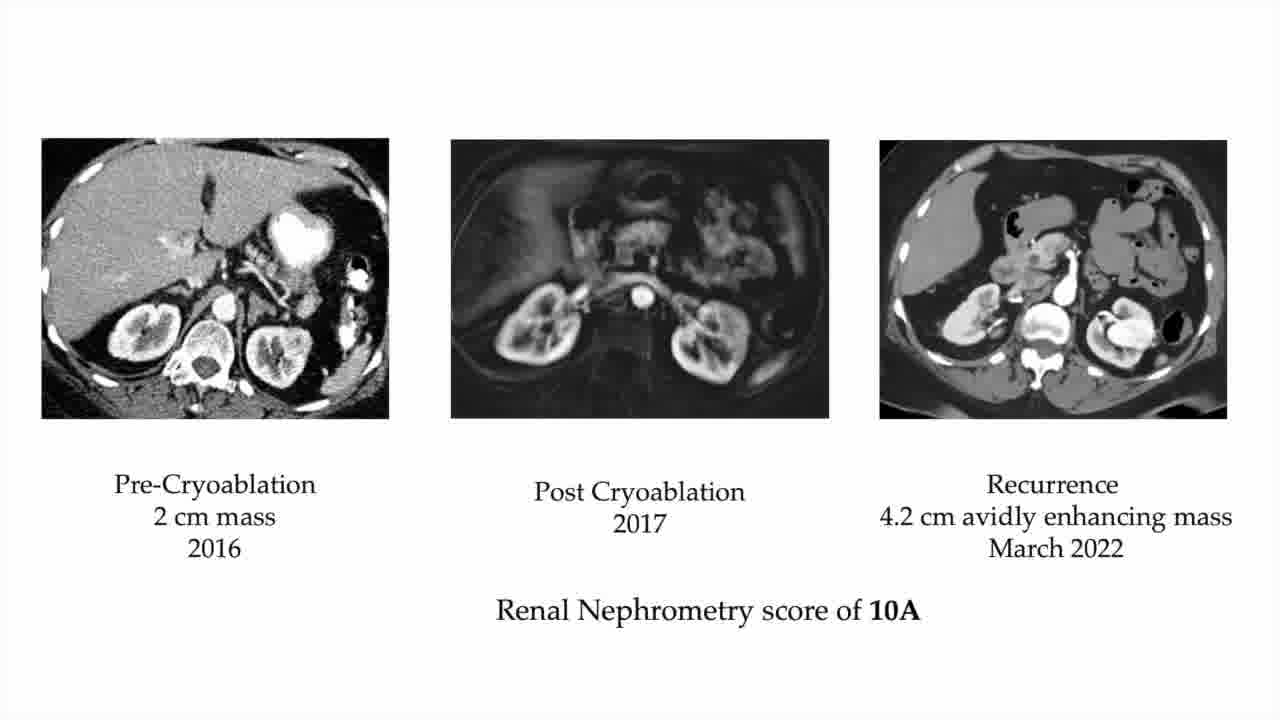
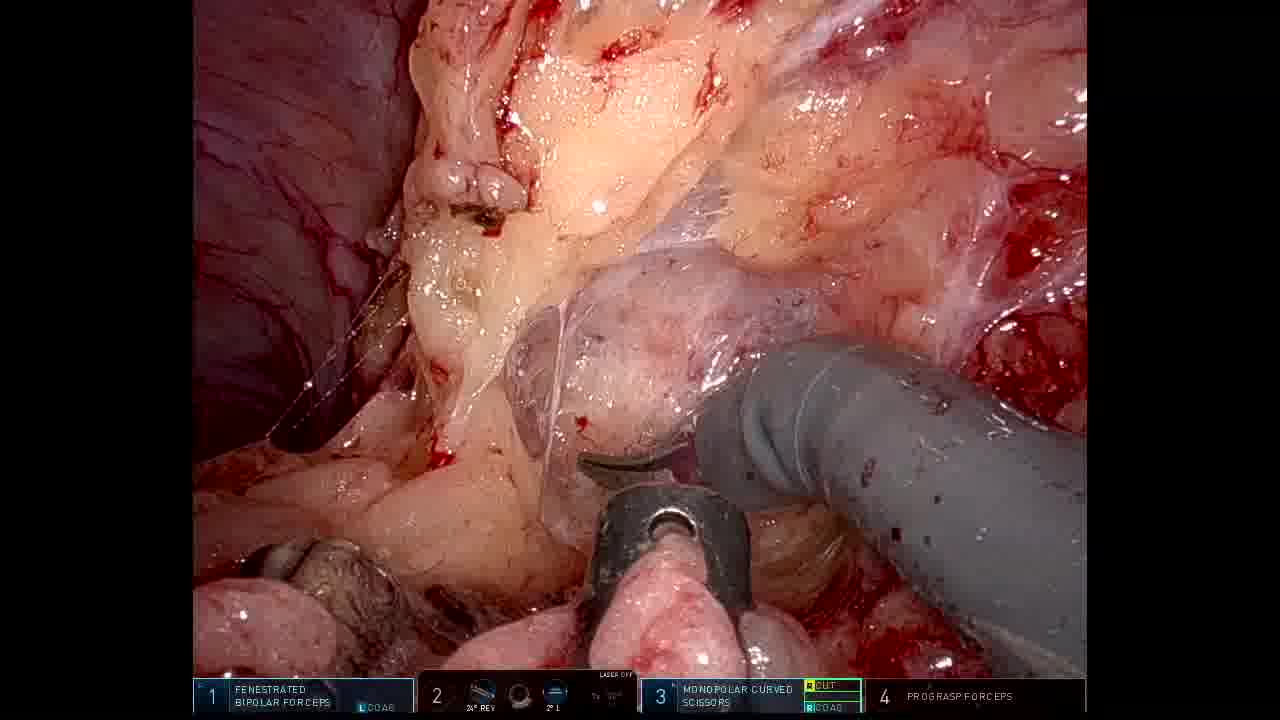
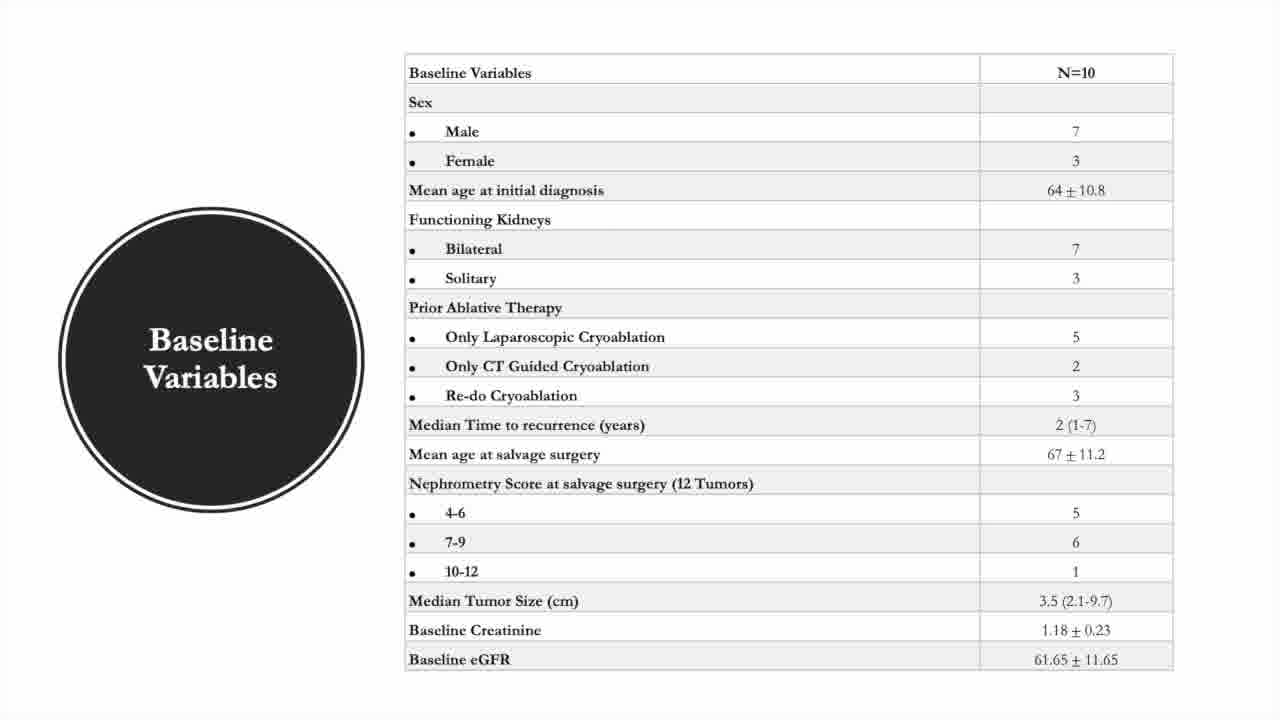
After reviewing our prospectively maintained institutional database between January 2013 and April 2022, we identified 10 patients with 12 tumor recurrences after cryoablation as the primary modality of management for their renal masses including 3 patients who also underwent repeat cryoablation. All these cases were referred to senior author (A.K.H.) for further management. The video presented herein demonstrates our surgical technique on an 83-year-old diabetic and hypertensive woman, with history of retro-peritoneoscopic cryoablation, who presented with local recurrence on follow up imaging (Nephrometry Score: 10A). We highlighted challenges during surgery and how to mitigate those problems. Given intense peritumoral fibrosis caused by variety of factors ranging from the patient-related factors, collateral damage, nearness of the tumor to the pelvicaliceal system, and segmental/hilar vessels, approach for the initial cryoablation (percutaneous vs. laparoscopic vs. retroperitoneoscopic) and intensity of the inflammatory response after cryoablation, meticulous attention is required for excision of the incompletely ablated or recurred tumor and we prefer cold scissors to cut and make all efforts to achieve negative surgical margins. 1 An effective utilization of intraoperative ultrasonography to identify tumor, its depth, and correct plane of dissection with excision given peritumor fibrosis and irregularity is helpful. Indocyanine green-near infrared fluorescence imaging (ICG-NIRF) helps in confirming ischemia after vascular clamping or selective clamping as needed, differential uptake of ICG between tumor and normal parenchyma allows maximum preservation of renal parenchyma, and finally reperfusion can also be evaluated after renorrhaphy. 2,3
Results:
Majority of our patients were male (7/10; 70%) and three patients had solitary functioning kidney. Dense perinephric adhesions were noted in five patients, and in another three patients, mild–moderate degree of perinephric fibrosis was observed. Median blood loss was 87.5 ml (30–1300) and mean warm ischemia time was 24.6 (±3.8) minutes. None of the patients developed major complications postoperatively. On pathologic analysis, clear cell renal cell carcinoma (RCC), clear cell papillary RCC, unclassified RCC, and fibrosis were found in 6, 2, 2, and 2 renal masses, respectively. All the surgical margins were free, and at median follow-up of 13 months (3–62), none of the patients developed any recurrence. All patients are alive till the time of analysis and no statistically significant difference was noticed between baseline and follow-up estimated glomerular filtration rate (p = 0.19).
Conclusions:
Although challenging, robot-assisted salvage partial nephrectomy after failure of cryoablation is technically feasible with excellent perioperative and follow-up outcomes. Preoperative planning with cross-sectional imaging, judicious use of intraoperative ultrasonography, ICG-NIRF imaging, meticulous dissection, and excision with cold scissors are paramount in such cases.
No competing financial interests exist.
Runtime of video: 6 mins 38 secs
Patient Consent:
The author(s) have received and archived the patient consent for video recording/publication before video recording of the procedure.
Authors' Contributions:
S.S. contributed to methodology, formal analysis, investigation, writing—original draft, and visualization. A.K.H. was involved in conceptualization, writing—review and editing, and supervision.
Keywords
Get full access to this article
View all access options for this article.