






Abstract
Clinical History:
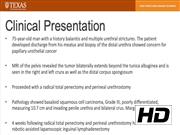
This patient is a 75-year-old man with a history of balanitis and multiple urethral strictures. The patient developed discharge from his meatus, and biopsy of the distal urethra showed concern for papillary urothelial cancer. MRI confirmed infiltrative tumor. Given concern for involvement of the entire penile shaft, we next proceeded with a radical total penectomy and perineal urethrostomy. Four weeks after this procedure, he underwent a robot-assisted laparoscopic inguinal lymphadenectomy.
Intervention:
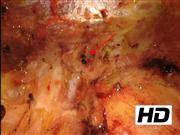
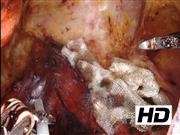
The surgical video begins by describing the robotic port placement for this procedure and the suggested manner to establish pneumoderma. The surgery then proceeds with creating the surgical plane and working space by marching toward the inguinal ligament. During the dissection, the sartorius and adductor longus muscles were identified and served as the lateral and medial borders of the superficial inguinal lymph node dissection. Meticulous hemo- and lymphostases were achieved throughout the dissection using the SynchroSeal device. The SynchroSeal works both as a dissecting tool and as a lymphatic sealer, which helps shorten the duration of the operation and also reduces the burden on the bedside assistant. The procedure was then completed on the opposite groin in an identical manner. Total operative time was 215 minutes (175 minutes of robotic console time).
Follow-Up:
Surgical pathology analysis revealed no evidence of metastasis in 22 nodes (10 left, 12 right). The patient was discharged home on postoperative day 2 with bilateral Jackson–Pratt (JP) drains, and these were removed after 2 weeks.
Author(s) have received and archived patient consent for video recording/publication in advance of video recording of procedure.
No competing financial interests exist.
Runtime of video: 4 mins 2 secs
Get full access to this article
View all access options for this article.