






Abstract
Introduction and Objective:
Ureterocalicostomy has been regarded as a well-established treatment choice for patients suffering from recurrent ureteropelvic junction (UPJ) obstruction refractory to previous surgical management, or in the presence of an anatomically intrarenal pelvis. We detail a case of robot-assisted laparoscopic ureterocalicostomy after failed renal pyeloplasty, with the incorporation of the Da Vinci robotic system.
Methods:
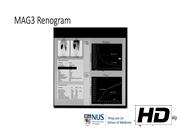
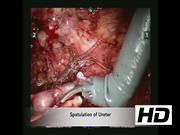
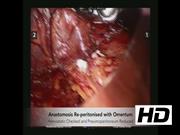
A 28-year-old female patient had a significant history of right proximal ureteral stricture, of which right pyeloplasty was previously performed to relieve the obstruction. Despite so, she subsequently presented with non-specific intermittent right loin pain of 6 months' duration. Prior imaging performed revealed gross hydronephrosis and UPJ narrowing in the right kidney, with cortical thinning and a minimal extrarenal pelvis. Relative differential right renal function was determined to be 30.4%. Bearing the findings, ureterocalicostomy was preferentially indicated because of the presence of cortical thinning and relatively poorer preservation of the lower pole calix. A transperitoneal approach was adopted in a left lateral position with five trocars. After the right ureter and renal lower pole calix were dissected and exposed, the hydronephrotic lower pole was incised at the lowest dependent area for creation of a wide opening for anastomosis. Retrograde intrarenal surgery was then done to rule out a narrow infundibulum to the upper and middle calices. Lastly, ureterocaliceal anastomosis was completed with continuous 4-0 absorbable Vicryl sutures.
Results:
Total operative duration was 185 minutes. The immediate postoperative course was uneventful. At 6 weeks follow-up, radiologic evidence demonstrated slight UPJ obstruction with diminished differential renal function. However, this was seen in the presence of normal creatinine levels and an asymptomatic clinical picture. Elective cystoscopy, ureteroscopy, and retrograde pyelogram were then performed and no strictures were observed. A patent anastomosis was also seen. She was stable post-procedure and discharged for stent removal in 4 weeks' time.
Conclusion:
Robot-assisted laparoscopic ureterocalicostomy is a safe and feasible option for patients with recurrent UPJ obstruction, rendering superior intraoperative field observation and freedom of wrist movement compared to the conventional laparoscopic method.
Patient Consent Statement:
The authors have received and archived patient consent for video recording/publication in advance of video recording of procedure.
Music:
Noncopyrighted music was retrieved from Epidemic Sound.
No competing financial interests exist.
Runtime of video: 7 mins 53 secs
Get full access to this article
View all access options for this article.