






Abstract
Introduction:
Until an ideal stent is reached, urologists make an effort to find a way of ureteral stenting that provides the best comfort and with few complications, whereas being affordable for the health system. Consensus on best practices for postoperative stenting has been difficult to reach. According to a recently published Cochrane analysis, most studies concerning this topic are limited by retrospective design and small sample size. 1 European and American guidelines on urolithiasis state that routine stenting after uncomplicated ureterorenoscopy (URS) is not necessary, and it is associated with higher postoperative morbidity and costs. 2,3 However, a recently published observational study (n = 17,129) from North America showed that guidelines and clinical practice appear to differ: Double-J insertion was performed in 86.2% of patients undergoing laser lithotripsy and in 70.5% of patients undergoing basket retrieval. 4 An empirical study from Germany showed that after a primary and secondary URS, 79.6%, respectively 62.2%, of the urologic departments insert a Double-J catheter (unpublished data). To omit the downsides of a Double-J placement, the European guideline on urolithiasis states that a ureteral catheter can be transiently placed with similar results. 3 We demonstrate an easily feasible and safe technique for the fixation of Mono-J-catheter to a Foley with a whistle tip.
Materials and Methods:
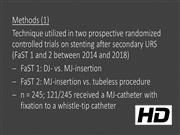
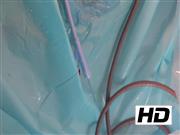
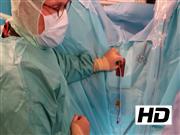
After URS and Mono-J-catheter (Coloplast®, Single loop ureteral stent, VORTEK® 6 Ch) insertion, a Foley (UROMED, Silicone Balloon Catheter with Whistle tip, 18 Charr.) was placed through the Mono-J-catheter. After 6 hours, both the Foley and the Mono-J-catheter were removed by a nurse. Endpoints were dislocation and difficulties during the removal of the Mono-J-catheter. The technique was utilized during FaST 1 and 2, two consecutive single academic center studies conducted between 05/2014–08/2015 and 05/2016–04/2018, 245 patients with renal or ureteral calculi were initially treated with Double-J insertion. 5,6 Before secondary URS, patients were prospectively randomized into two groups: Double-J-insertion for 3 to 5 days vs Mono-J insertion for 6 hours and Mono-J-catheter insertion for 6 hours vs tubeless after URS. One hundred twenty-one patients received a Mono-J-catheter. FaST 1 and 2 studied patients quality of life and reintervention rates.
Results:
No difficulties occurred during the removal of the Mono-J-catheter and Foley (0%; n = 0/121). In none of the cases, the Mono-J-catheter was displaced (0%; n = 0/121).
Conclusions:
The placement of a Foley with a whistle tip through a Mono-J-catheter is easily feasible. It increases patients' comfort, as only one urine drainage bag is needed and eases patients' mobility. The described technique allows an easy and trouble-free removal. None of the Mono-J-catheters dislocated.
No competing financial interests exist.
Ethical Approval and Consent: All procedures performed in studies involving human participants were in accordance with the ethical standards of the institutional and/or national research committee and with the 1964 Helsinki declaration and its later amendments or comparable ethical standards. Authors have received and archived patient consent for video recording/publication in advance of video recording of procedure.
Runtime of video: 4 mins 57 secs
Get full access to this article
View all access options for this article.