






Abstract
Background:
Forgotten stents with significant encrustation remain a unique surgical challenge. Adult studies suggest a mean of 1.5 operative interventions to achieve stone-free status and remove the encrusted stent. The degree of encrustation has been correlated with stent dwell time, need for multiple operations, operative times, and length of hospital stay. A combined antegrade and retrograde approach has been described in the literature to decrease operative times and avoid multiple operations. Our objective is to describe a technique where modified Barts flank-free supine position is utilized in a pediatric patient to allow two teams of surgeons to work simultaneously in both antegrade and retrograde manner to remove a forgotten stent in a pediatric patient with >10 cm of total calcification. Injuries to the peroneal, saphenous, obturator, and femoral nerves are avoided by meticulous padding using foam, gel rolls, and limiting operative time to the extent feasible.
Methods:
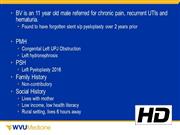
The patient was an 11-year-old boy referred for forgotten heavily encrusted stent status post pyeloplasty >2 years prior for congenital ureteropelvic junction obstruction. Preoperative CT imaging showed a distal coil calcification of 3 cm, numerous calcifications of the midportion of the stent (largest 1.2 × 4.2 cm), and 3.7 cm proximal coil calcification. The patient underwent simultaneous percutaneous cystolitholapaxy and percutaneous nephrolithotripsy followed by antegrade and retrograde ureteroscopy with laser lithotripsy. A Bart's flank-free modified supine position was utilized.
Results:
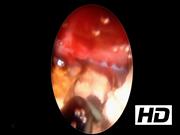
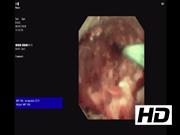
Total operative time was 333 minutes, which is above average for the average forgotten stent case in the adult literature; however, it must be noted that this patient is an outlier because of the extremely large stone burden (>10 cm of stone). The distal coil was freed of stone using a 550-µm holmium laser fiber through an 18F suprapubic access sheath placed at the beginning of the case through Seldinger technique. The proximal coil was similarly addressed using an ultrasonic lithotripter through a 30F access sheath. A 200-µm holmium laser fiber was used from both the antegrade and retrograde approach to free the calcifications of the midportion of the stent and remove it. Once all clinically significant stone burden was removed an 8.5F nephroureteral stent and a Foley catheter were placed. The patient experienced no complications intraoperatively and was radiographically free of stone at the conclusion.
Conclusions:
A combined antegrade and retrograde approach to the heavily encrusted forgotten stent allows for shorter operative times and higher opportunity for stone-free status in a single operation. The Bart's flank-free supine position is technically feasible for the pediatric population and allows simultaneous antegrade and retrograde access to the kidney, ureter, and bladder.
Runtime of video: 4 mins 40 secs
This study was presented as a moderated podium presentation at the 2019 Fall Conference of the Society of Pediatric Urology, held in Scottsdale, AZ, USA. It has not been published or otherwise presented.
Keywords
Get full access to this article
View all access options for this article.