





Abstract
Introduction:
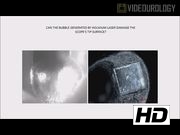
The costs of flexible ureterorenoscopes (fURS) and their repair oblige the surgeon to know the proper handling of instruments. There is a lack of evidence in the literature about the distance that the laser fiber should have once out from the scope to avoid instrumental damages. We are introducing the “safety distance” concept to preserve the fURS scope from laser energy injuries.
Materials and Methods:
We performed an
Results:
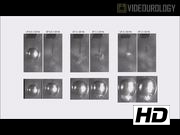
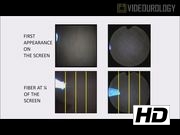
The first appearance on the screen of the laser tip is different in different scopes. When the laser fiber is out 3 mm from the scope, the energy bubble generated by the holmium laser never hit the scope's tip. In all the scopes, we observed that when the laser fiber was at one-fourth of the screen, it was already out from the scope at least 3 mm. At the same energy and frequency, bubbles generated with long pulse are smaller than those generated with short pulse.
Conclusion:
Even if there is a big limitation of this study due to the impossibility to measure and to evaluate the damage of the fURS tip surface, we observed that when the laser fiber tip reach one-fourth of the screen, the bubble generated by the laser activation is never rebounding on the camera of the scope. We have called this position the “safety distance.” In difficult cases, if we need to see barely the fiber, we suggest to use long pulse duration and low energy.
Runtime of video: 4 mins 42 secs
This video was presented at the World Congress of Endourology, 2016, in Capetown, South Africa, and won Best Video Award of the WCE 2016.
Get full access to this article
View all access options for this article.