





Abstract
Introduction:
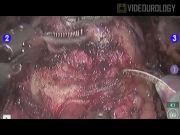
In this video, we demonstrate both the anterior and the posterior bladder neck dissection with tension stitch. Placing a suture in the posterior bladder neck is a common approach in patients with median lobes, whereby the median lobe is retracted with a figure-of-eight suture.
Materials and Methods:
The 30-degree down lens is utilized for the most optimal view of this dissection.
Results:
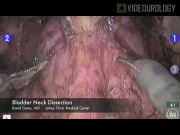
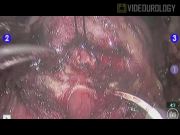
Multiple visual cues are utilized to determine the location of the bladder neck, including the limits of the anterior prostatic fat pad, excursions of the Foley balloon, and tissue response to pinching maneuvers. The initial dissection focuses primarily in the midline, aiming to get down to vertical fibers, which appear just before the catheter is exposed. If the lateral contours of the prostate are readily apparent, this tissue may be taken down as well, bearing in mind that bleeding is often encountered laterally as shown. Once the catheter is exposed, some lateral progression will help define the anatomy for the posterior bladder neck dissection and should be performed if the anatomy allows. For the posterior dissection, a 0-vicryl on an UR6 needle is used because the prostatic urethra is a tight space to place a stitch. Care is taken to place the stitch distally enough into the prostatic urethra that the suture will not be severed during the posterior bladder neck dissection. Two passes are taken, in a figure-of-eight manner. This tissue holds a suture tenaciously and almost never pulls out even with significant tension. For routine bladder necks, many surgeons place the Foley itself on traction and then lift the gland either with the fourth arm or the surgical assist. This technique does not always provide adequate lifting of the posterior prostate and can place significant pressure on the fossa navicularis with catheter traction. Since the median lobe retraction sutures provide such excellent posterior exposure, we began placing a stitch in the posterior aspect of prostate gland from within the prostatic urethra for all glands in lieu of catheter retraction.
Conclusion:
It should be understood that the bladder neck is a target that one aims to reach within the tissue and is not a surface landmark. One can see that excellent lifting of the posterior prostate is possible, and this can be continually adjusted as the dissection proceeds.
Source: David Canes, MD, Lahey Clinic.
No conflicts of interest. There are no commercial associations in connection with this video.
Running time: 9 mins 26 secs
Keywords
Get full access to this article
View all access options for this article.