





Abstract
Introduction and Objective:
Inferior vena cava (IVC) involvement with large or complex renal neoplasms occurs in 4%–10% of patients with renal cell carcinoma. 1 The gold standard treatment is radical nephrectomy and IVC tumor thrombectomy, which is usually performed in an open fashion due to the technical demands of the procedure. However, minimally invasive treatment options are attractive as they often offer less pain, improved convalescence, and faster time to hospital discharge. Pure laparoscopic radical nephrectomy with caval thrombectomy was first reported in 2006. 1 The robotic platform offers an advantage over laparoscopy with a three-dimensional vision and wristed movements, which allow for increasingly complicated procedures in a minimally invasive fashion. 2 This is especially helpful in the obese population, which can provide significant challenges with open surgical approaches. We present a video of a robot-assisted radical nephrectomy and level II IVC tumor thrombectomy.
Materials and Methods:
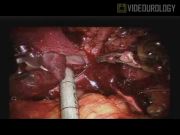
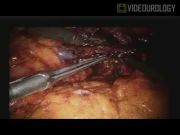
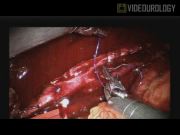
Our patient was a 67-year-old male with a centrally located 5-cm right-sided renal mass with a level II IVC thrombus, which was found during a work up for gross hematuria. Comorbidities included hypertension, morbid obesity with a BMI of 39, diabetes, and chronic renal insufficiency. Because of his obesity and comorbidities, we elected to treat this patient with a minimally invasive robotic approach. Our video highlights the mobilization and control of the IVC, as well as the technique for opening the vena cava and extracting the tumor thrombus. We demonstrate the use of varying vascular clamps and methods of IVC control as well as the closure of the vena cava all in a minimally invasive fashion. Transesophageal echocardiography was utilized intraoperatively to identify the proximal extent of the tumor thrombus. Alternatively, intraoperative laparoscopic ultrasound may be used. We utilized eight ports for the procedure: the standard four robotic ports, two assistant ports, and two separate ports for controlling the IVC, one for the long vascular clamp and one for the Rommel. A vascular surgery colleague was present at the bedside with the urology assistant for the vascular portion of the procedure.
Results:
The clamp time was 29 minutes. The patient did very well postoperatively and was discharged home on postoperative day number three. Final pathology revealed clear cell renal cell carcinoma, T3b, N0, M0, and negative margins. The patient was seen three weeks after the procedure and was noted to have recovered well.
Conclusion:
We share a video of a very unique case of a right-sided renal tumor with IVC tumor thrombus completely excised robotically. In the select patient with thrombus below the hepatic veins, a minimally invasive approach to such cases is an option. It should be remembered, however, that this is a very technically challenging case that has only been performed in a limited fashion thus far, such that, extreme caution should be taken before performing these and only by very experienced robotic surgeons.
Gwen Grimsby: none; William Stone: none; Erik Castle: speaker for Intuitive Surgical.
Runtime of video: 7 mins 39 secs
Abstract and video were presented at the American Urologic Association Western Section Meeting 2012, Big Island, Hawaii, October, 2012.
Get full access to this article
View all access options for this article.