





Abstract
Introduction:
The development of laparoscopy involves the advance of the technique as long as the experience of the surgeon. In localized prostate tumor the partial preservation of the seminal vesicles and the decrease of the traction during the prostate dissection are important to preserve the neurovascular bundles.
Methods:
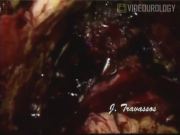
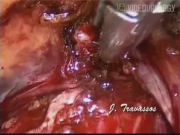
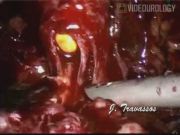
Starting from the complete liberation of the prostate base, laterally, to preserve the urethra and the circular fibers of the bladder neck. The Santorini plexus is ligated, avoiding any type of lesion of the rabdosphincter. The gland in the interfascial plane was liberated in a blunt and delicate way with minimum traction of the bundles. Only after the liberation of the bundles, the prostatic urethra is sectioned below the bladder neck, preserving most of the bundles. The maintenance of the urethra is important to avoid traction during the dissection of the bundles. The membranous urethra was exposed to identify its circular fibers, guaranteeing a safe site for its sectioning and avoiding the sectioning of the prostatic apex. The urethra shall be dissected in the cranial sense to obtain its largest length, so that the vesico-urethral suture can be performed the furthest from the rabdosphincter as possible.
Results:
The decrease of the traction during the dissection, the partial preservation of the seminal vesicles, and the distal urethra in its largest length are directly related with the recovery of the sexual potency and the urinary continence.
Conclusions:
The experience of the surgeon and the refining technique are determinant for the functional and oncological results.
No competing financial interests exist.
Runtime of video: 6 mins 55 secs
Keywords
Get full access to this article
View all access options for this article.