





Abstract
Objectives:
Laparoscopy has become the standard of care for most renal tumors but not yet for renal cell carcinoma involving the vena cava (IVC). Robotic technology may facilitate such complex procedures.
Methods:
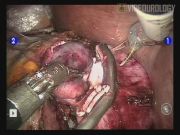
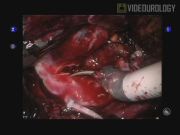
Two techniques for totally intracorporeal robotic nephrectomy for renal tumors with IVC tumor thrombus are described with video illustration. 1, 2 The first technique for smaller tumor thrombi involves tangential clamping of the IVC for preserved flow, whereas larger tumor thrombi are managed with IVC cross-clamping using modified Rummel tourniquets. In all cases, the IVC is circumferentially mobilized with all lumbar veins controlled. Laparoscopic ultrasonography is used selectively to evaluate extent of larger thrombi and to confirm lack of caval invasion. These techniques have been performed in five patients with one patient having two renal veins each with an IVC thrombus.
Results:
Robotic surgery has been applied safely for renal cell carcinoma with IVC tumor thrombus with the two described techniques in five patients with tumor sizes of 6 to 15.5 cm and thrombi protruding 1 to 5 cm into the IVC. Mean estimated blood loss was 170 mL (range, 50–400 mL). Mean operative time from incision to dressing including robotic full retroperitoneal lymphadenectomy in four patients was 327 minutes (range, 240–411 minutes). The largest incision used for extraction was 6 cm and as small as 4 cm. Four patients were discharged on postoperative day 1 and the other patient on day 2. There were no complications, transfusions, or readmissions.
Conclusions:
Further experience is necessary to validate this promising application of robotic surgery and to determine whether more extensive thrombi can treated in minimally-invasive fashion.
The author has no disclosures to report relevant to this publication. No competing financial interests exist.
Runtime of video: 6 mins 54 secs
Get full access to this article
View all access options for this article.