






Abstract
Introduction:
Hyperthyroidism during pregnancy is uncommon, with ∼95% of cases due to Graves’ disease and <1% toxic multinodular goiter (MNG).
Case:
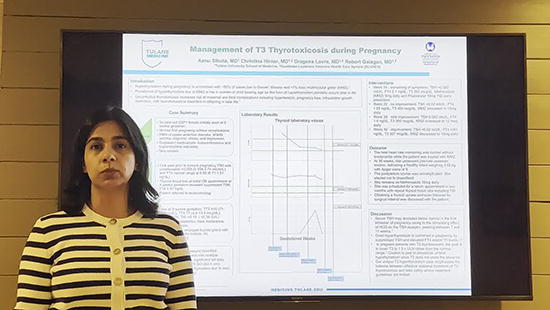
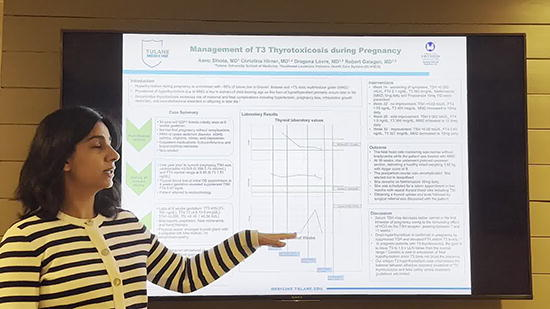
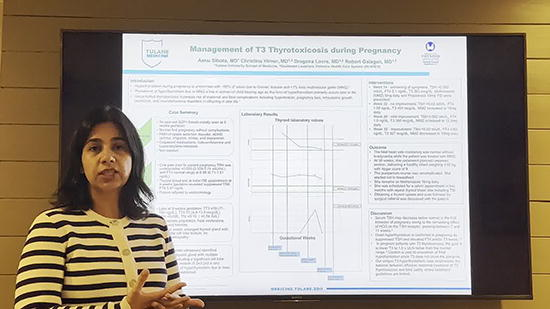
A 34-year-old female at 9 weeks gestation was referred to endocrinology for hyperthyroidism evaluation. She reported palpitations, heat intolerance, and hand tremors. Her medical history included asthma, opiate addiction disorder, and depression. She was a nonsmoker. Examination: weight 85 kg (BMI of 36.6 kg/m2), HR 102 bpm, BP 145/66 mm Hg, and enlarged thyroid gland with a palpable left lobe nodule, no exophthalmopathy. Labs: T3 419 ng/dL (71–180 ng/dL), T4 17 mcg/dL (4.8–13.9 mcg/dL), TSH <0.005 mIU/mL (0.358–3.74 mIU/mL), and TSI <0.10 IU/L (<0.54 IU/L). Ultrasound identified an enlarged thyroid gland with multiple nodules, including a significant left lobe hypoechoic nodule (5.0 × 3.2 × 2.4 cm). A diagnosis of hyperthyroidism due to a toxic MNG was established. Propylthiouracil was prescribed but not initiated by patient due to fear of side effects. By gestational week 14, her symptoms had worsened, T4 was 17 mcg/dL, free T4 (FT4) 2.1 ng/dL (0.71-1.51 ng/dL)T3 363 ng/dL, and TSH <0.002 mIU/mL. Methimazole (MMZ) 5 mg daily and propranolol 10 mg TID were prescribed. By week 22, her symptoms did not improve; FT4 was normal, and T3 remained elevated (FT4 1.05 ng/dL, T3 404 ng/dL, TSH <0.02 mIU/mL). MMZ was increased to 10 mg daily. By week 28, there was minimal improvement of symptoms: FT4 1.0 ng/dL, T3 390 ng/dL, propranolol was continued, and methimazole was increased to 12.5 mg daily. At 32 weeks gestation, FT4 was at the lower end of normal, and T3 remained high at 327 ng/dL; methimazole was reduced to 10 mg daily. At 36 weeks, she underwent a cesarean section, delivering a healthy infant weighing 3.66 kg with an Apgar score of 9. The postpartum course was uncomplicated.
Summary:
1. Serum TSH may decrease in the first trimester of pregnancy due to the stimulating effect of hCG on the TSH receptor, peaking between 7 and 11 weeks. 1 Overt hyperthyroidism is confirmed with suppressed TSH and elevated TT4/FT4 or T3 levels.1,2
2. In pregnant patients with T3 thyrotoxicosis, the goal is to lower T3 to 1.5 × ULN. 2 Caution should be paid to the prevention of fetal hypothyroidism since T3 doesn’t cross the placenta.
3. Our unique case emphasizes the balance between effective maternal treatment of T3 thyrotoxicosis and fetal safety, where treatment guidelines are limited.
Disclosure statement: The authors do not have any commercial associations during the past 2 years that might create a conflict of interest in connection with this case.
Portions of this abstract were previously published in Thyroid, Vol. 34, No. S1, https://doi.org/10.1089/thy.2024.59731.lb.abstracts.
Runtime of video: 5 mins, 9 secs.
Get full access to this article
View all access options for this article.