






Abstract
Objective:
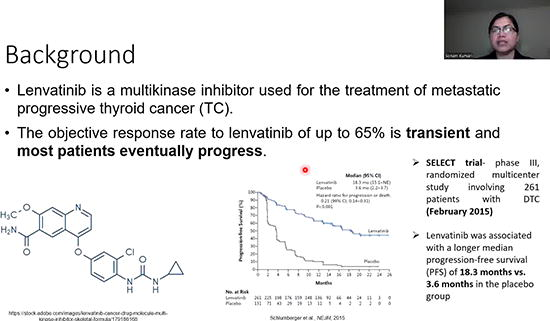
Lenvatinib is a multikinase inhibitor used for the treatment of metastatic progressive thyroid cancer (TC). The objective response rate to lenvatinib (LR) of up to 65% is transient, and most patients eventually progress. Epithelial to mesenchymal transition (EMT) in TC may play a role in resistance to LR. 1 Patients with progressive metastatic disease are characterized by increased glucose uptake, evidenced by 18-fluorodeoxyglucose positron emission tomography, suggesting enhanced metabolism. We hypothesized that changes in cancer metabolism and EMT may play a role in resistance to LR.
Methods:
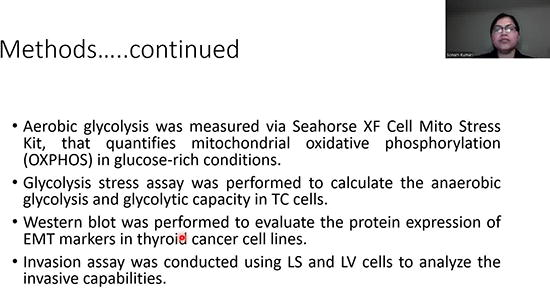
We induced LR in human TC cell lines (THJ29T and TPC1) by continuous exposure to increasing concentrations of the drug over several months, achieving a clinically relevant resistance factor of >2.5. RNA sequencing was done to compare the transcriptome in LR vs lenvatinib-sensitive (LS) cell lines. We performed unsupervised metabolomics using mass spectrometry and compared metabolic profiles of LR and parental LS cells using principal component analysis. Seahorse analysis was performed to analyze oxidative phosphorylation (OXPHOS) and glycolysis. Western blotting was performed to evaluate the expression of EMT markers. An invasion assay was conducted using LS and LR cells to analyze the invasive capabilities. p-values of ≤0.05 were considered statistically significant.
Results:
RNA sequencing revealed that the sensitive and resistant cells clustered separately. Among differentially expressed genes, there was a significant upregulation of genes involved in OXPHOS (COX7A2, COX7C, COX15, COX20) and EMT (MMP2, MMP9). Consistently, metabolism profiling showed a significant overactivation of OXPHOS in resistant cells (maximum oxygen consumption rate THJ29T LR vs LS: 4013 ± 306 vs 2293 ± 334, p < 0.001; TPC1 LR vs LS: 3999 ± 358 vs 1774 ± 208, p < 0.0001), while glycolysis rate remained similar (p > 0.05). In addition, unsupervised metabolomic analysis revealed that LR cell lines clustered separately from LS parental lines, suggestive of different metabolic signature. Also, enhanced metastatic potential of LR vs LS cells was observed, as evident by an increase in the expression of EMT markers (N-cadherin and Vimentin) and a decrease in E-cadherin expression. Moreover, there was a trend toward a greater number of invasive cells in the TPC1-resistant cell line with respect to the parental cell line.
Conclusions:
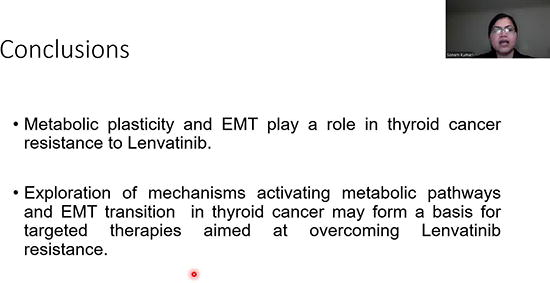
Metabolic plasticity and EMT play a role in thyroid cancer resistance to lenvatinib. Exploration of mechanisms activating metabolic pathways and EMT transition in thyroid cancer may form a basis for targeted therapies aimed at overcoming lenvatinib resistance.
The authors declare no conflicts of interest.
Runtime of video: 4 mins 59 secs.
Previous abstract presentations.
1. Poster 0210.
Thyroid Cancer, Basic, Poster.
Metabolic Reprogramming Contributes to Resistance Towards Lenvatinib in Thyroid Cancer.
Sonam Kumari*, Shilpa Thakur, Stephanie Cardenas, Andrew Makarewicz, Joanna Klubo-Gwiezdzinska, National Institutes of Health, USA.
Regular Call Oral Abstracts.
Pages: A-1–A-14, Published Online: October 25, 2024, Thyroid.
https://doi.org/10.1089/thy.2024.89756.rc.abstracts.
2. POSTER 265.
Thyroid Cancer Basic Poster.
METABOLIC PLASTICITY IS ONE OF THE MECHANISMS OF THYROID CANCER RESISTANCE TO LENVATINIB.
Sonam Kumari*, Shilpa Thakur, Stephanie Cardenas, Andrew Makarewicz, Joanna Klubo-Gwiezdzinska.
National Institutes of Health, USA.
Meeting Program and Abstracts.
Pages: P-1–A-124, Published Online: September 15, 2023, Thyroid.
https://doi.org/10.1089/thy.2023.29156.abstracts.
3. HIGHLIGHTED POSTER 122.
Thyroid Cancer Basic Highlighted Poster.
LENVATINIB RESISTANT THYROID CANCER CELL LINES ARE CHARACTERIZED BY INCREASED MITOCHONDRIAL RESPIRATION.
Sonam Kumari*, Shilpa Thakur, Stephanie Cardenas, Joanna Klubo-Gwiezdzinska.
National Institutes of Health, USA.
Meeting Program and Abstracts.
Vol. 32, No. S1.
Published Online: October 11, 2022, Thyroid.
Get full access to this article
View all access options for this article.