






Abstract
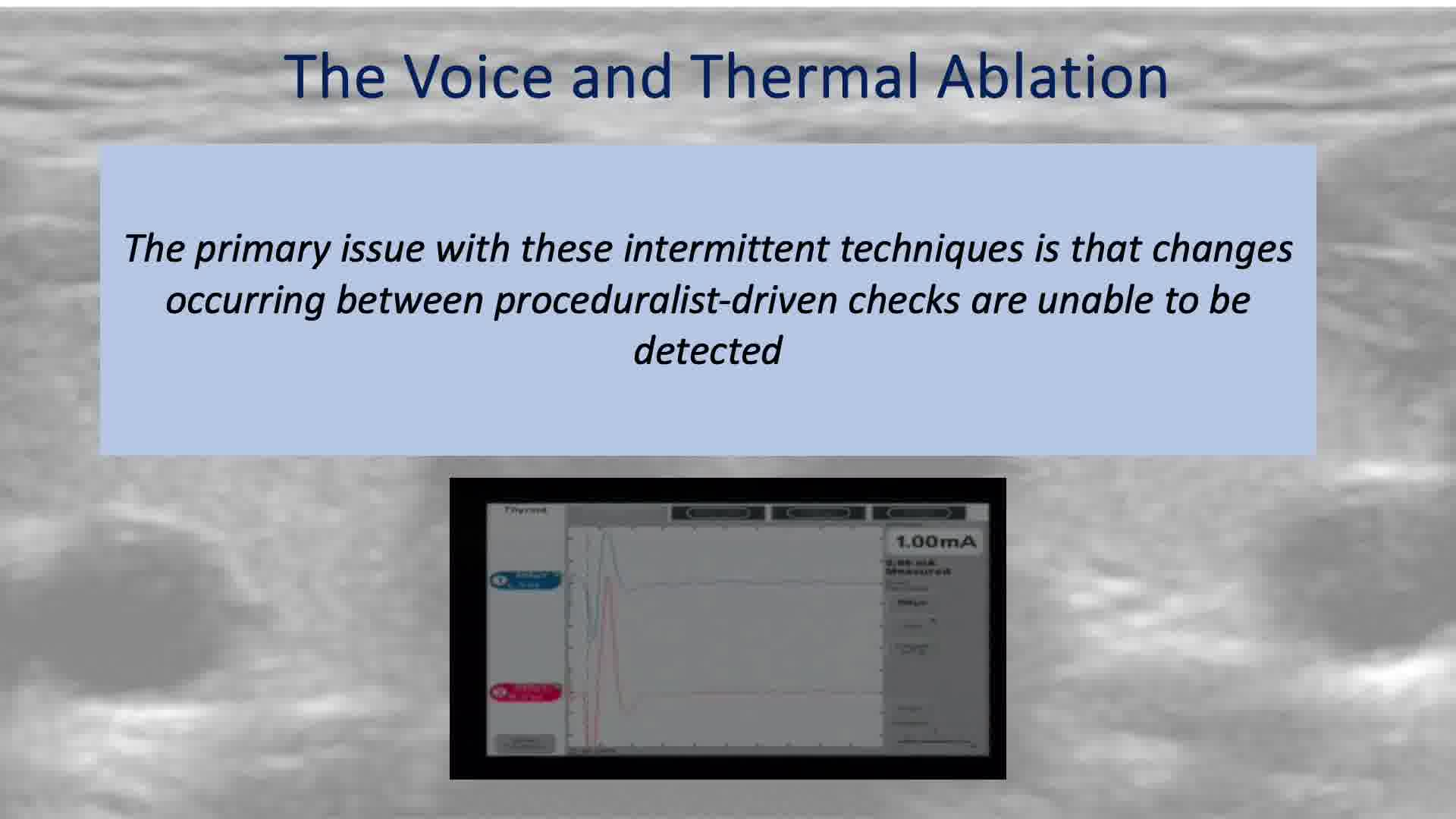
Injury to the laryngeal nerves is a possible complication of thyroid thermal ablation techniques. Existing ablation guidelines recommend checking a patient's voice intermittently during ablation procedures to assess for hoarseness. However, this is a similar scenario to the use of intermittent neuromonitoring during thyroid surgery, a technique that relies on surgeon-driven nerve stimulation at sporadic timepoints. The primary issue with these intermittent techniques is that changes occurring between proceduralist-driven checks are unable to be detected. This is in contrast to continuous intraoperative neuromonitoring where the laryngeal nerves are stimulated throughout the procedure, thereby providing real-time information about nerve functional integrity.
After neck endocrine surgeries, voice changes can be masked by two main effects:
1. Endotracheal intubation frequently creates some mild edema of the vocal folds that can mask symptoms of an immobile vocal fold in the first few days. The patient may still note some change in their voice, but it is not severe enough for them to complain.
2. Surgery is performed under general anesthesia and thus audible voice change at the time of nerve injury cannot be assessed. Over ensuing weeks until the first postoperative review, the contralateral vocal cord has some ability to compensate for the ipsilateral weakness by hyperadducting and the paralyzed vocal cord can assume a medialized position. This can mask externally perceived hoarseness and, if the larynx is not directly examined, miss a paralyzed cord.
As compared with surgery under general anesthesia, thyroid ablation is generally performed with the patient awake using local anesthesia. This allows the proceduralist to actually hear, in real-time, any voice change occurring as a result of laryngeal nerve thermal injury. There is no endotracheal tube-induced vocal fold edema to falsely and transiently compensate for incomplete vocal fold closure caused by vocal fold paresis or paralysis, and there is no masking effect from delayed ability to assess the voice.
Continuous Auditory Voice Assessment (CAVA) refers to the use of continuous voicing during thermal ablation of danger zones. CAVA can be safely performed during ablation without significant motion in the ultrasound image provided patients are asked to vocalize without large pitch inflections, thereby enabling continuous auditory feedback on vocal integrity.
This video introduces the concept of CAVA and demonstrates how it can be safely and effectively performed during thermal ablation of thyroid nodules. CAVA potentially lessens the risk of laryngeal nerve injury by allowing for immediate procedure cessation and remedial actions if voice change is heard. Further studies are necessary to better determine its utility in preventing recurrent laryngeal nerve injuries; however, its simplicity to perform and potential benefit make it a valuable addition to the current armamentarium of safety techniques in thermal ablation.
No competing financial interests exist for information contained within this video
.
Runtime of video: 9 mins 1 sec
Get full access to this article
View all access options for this article.