





Abstract
Abstract
Introduction:
Primary hyperaldosteronism is a surgically treatable disease that may be more common than previously recognized. 1 It is important to confirm the laterality of the aldosterone secretion before embarking on surgical resection. Here we present a case of primary hyperaldosteronism localized with adrenal vein sampling (AVS) and followed by posterior retroperitoneoscopic adrenalectomy (PRA). We also show our technique for entering the retroperitoneum.
Materials and Methods:
The aim of this video is to show the pertinent points of performing a PRA and AVS. There is a focus on entry into the retroperitoneum.
Results:
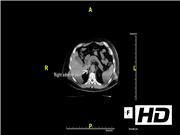
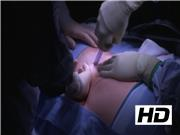
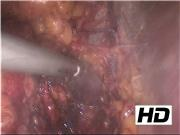
The patient is a 61-year-old man who presented with hyperaldosteronism complicated by an ICU admission for hypokalemia. He had a 1 cm left adrenal mass. Cross-sectional imaging has been shown to be inaccurate 2 in localizing aldosterone-secreting tumors. We, therefore, performed AVS on this patient. AVS is known to have a high failure rate. This is often because of variations in the anatomy of the right adrenal vein that can lead to incorrect vessel cannulation. We use on table CT scanning to confirm catheter placement into the right renal vein. 3 For the left renal vein, we procure the sample from the confluence of the adrenal and phrenic vein. This has been shown to be just as accurate as more proximal sample procurement. 4 When performing a PRA, 5 patient and port placement are crucial. We use a Cloward table to perform the procedure. It is important that the abdominal contents not be compressed into the retroperitoneum. It is also important that the knees and hips be at a 90° angle without displacement of the hip that can cause limitations in instrument range of motion. The first port is placed below the tip of the 12th rib. A scissor is used to bluntly enter into this location. Two “pops” confirm entry into the retroperitoneum. The area is bluntly cleared using the surgeon's finger. Ports are safely guided into place over the surgeon's finger.
Conclusion:
PRA is a safe method for resecting the adrenal gland.4 AVS is an important tool to ensure correct localization of the hypersecreting adenoma. CT scanning can be used to verify right adrenal vein cannulation and increases success rates of the procedure.
S.H. is a consultant for Neuwave Medical. For all other authors, no competing financial interests exist.
Runtime of video: 10 mins 50 secs
Get full access to this article
View all access options for this article.