





Abstract
Abstract
Introduction:
The rate of injury of the external branch of the superior laryngeal nerve (EBSLN) during thyroid surgery is reported to be as high as 58%, which can paralyze the cricothyroid muscle and inferior retractor. 1 Clinical symptoms mainly include vocal fatigue and diminished vocal frequency range, especially with respect to raising pitch. 2 Most surgeons avoid to expose the EBSLN routinely. 3 Intraoperative neuromonitoring provides a reliable approach to identify and preserve the EBSLN.
Materials and Methods:
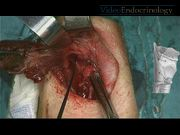
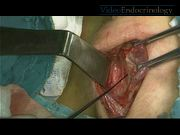
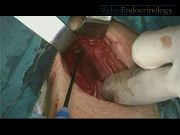
A 51-year-old female teacher was found to have thyroid nodule in the right lobe. The patient underwent ultrasound-guided fine needle aspiration biopsy, and papillary thyroid carcinoma was suggested. The thyroid function test and laryngoscopy findings were normal. Thyroid lobectomy with Wu Gaosong's procedure 4 was performed under general anesthesia. The patient demanded a nerve monitoring and the NIM-Response 3.0 System (Medtronic) was used during the operation. When we handled the superior pole of the thyroid, we placed the stimulation probe directly onto the muscle. A positive signal was defined as contractions of the inferior constrictor, contractions of the cricothyroid muscle, or hearing an auditory signal in some cases. Otherwise, it was defined as negative signal. We mapped the distribution of superior laryngeal nerve by connecting all the positive spots and confirmed the integrity of the superior laryngeal nerve at the end of surgery. Each ligation of superior pole must be based on a negative signal.
Results:
Postoperative pathology proved a papillary microcarcinoma (diameter = 0.5 cm). The patient was discharged without any complications.
Conclusions:
Intraoperative neuromonitoring and protection of the superior laryngeal nerve can be easily accomplished with meticulous dissection and monitoring.
Source of Foundation:
Hubei Province Natural Science Foundation of China (2008CDB179; WJ2015MA003).
No competing financial interests exist.
Runtime of video: 5 mins 11 secs
Keywords
Get full access to this article
View all access options for this article.
References
Supplementary Material
Please find the following supplemental material available below.
For Open Access articles published under a Creative Commons License, all supplemental material carries the same license as the article it is associated with.
For non-Open Access articles published, all supplemental material carries a non-exclusive license, and permission requests for re-use of supplemental material or any part of supplemental material shall be sent directly to the copyright owner as specified in the copyright notice associated with the article.
