





Abstract
Abstract
Introduction:
The role of minimally invasive surgery for large adrenal tumors remains a highly controversial problem. Risks of inadequate margin resection, increased risk of early local recurrence, peritoneal dissemination, and tumor spillage with the related possibilities of locoregional and port-site recurrence are documented by several authors.1,2 Many studies have demonstrated that in case of suspected large adrenal masses, laparoscopic adrenalectomy could have outcomes similar to open procedures when surgeon strictly adheres to standard oncologic principles.
Case Presentation:
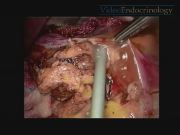
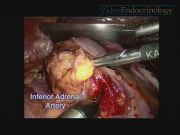
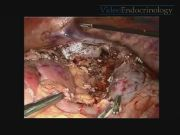
We report a case of a 75-year-old female patient presenting with a right-sided adrenal tumor of 75 by 70 mm, suspected for adrenocortical carcinoma, with no evidence of infiltration of periadrenal tissues or locoregional lymphadenopathy. Contrarily to the usual technique characterized by mobilization of the right triangular ligament and the retroperitoneal attachments of the right lobe, the size of the current tumor is an obstacle toward this standardized approach. To progressively mobilize the gland, minimizing the risk of capsular effraction, the dissection is carried out successively on the upper pole of the kidney and then on the right border of the vena cava. A gentle dissection of the mass from the periadrenal tissues was obtained by means of hydrodissection. This technique creates and displays the correct plane between adherent tissues, limiting blood loss. The introduction of saline under pressure into the plane of dissection facilitates the displaying of the surgical field, reducing the risk of capsular effraction and spillage of neoplastic cells. The suction device is used to progressively free the inferior vena cava and the adhesions around the main adrenal vein, controlled at the end of the procedure. Gross inspection of the specimen revealed a minimal parenchymal fracture in the uppermost portion of the gland. The main lesion was absolutely intact; cut surface revealed a variegated aspect due to hemorrhage and necrosis. Microscopic examination demonstrated cellular pleomorphism and high mitotic rate; vascular and capsular invasion were present. Thoracoabdominal CT scan at 15 months follow-up showed no signs of recurrence.
Discussion:
Large adrenal tumors without preoperative or intraoperative evidence of invasive carcinoma can be approached laparoscopically by experienced surgical team.3,4 The adrenal mass should be accurately explored at the beginning of the procedure. When difficult dissection is encountered or local invasion is suspected, open surgery should be strongly considered. To date, the decision whether or not to perform minimally invasive adrenalectomy in case of suspected large adrenal tumors should mainly be based on case-by-case multidisciplinary discussion and on clinical judgment. The adrenal vein control is achieved at the end of the procedure to obtain a large and almost complete mobilization of the gland, leaving the capsular intact during resection, reducing the possibility of local recurrence and peritoneal dissemination. 5 In addition, the standard teaching for early vein control has not been confirmed for laparoscopic adrenalectomy, and the type and timing of adrenal vein control depend on the surgeon's preference and are strictly correlated with anatomical variation. 6
No competing financial interests exist.
Runtime of video: 8 mins 24 secs
Get full access to this article
View all access options for this article.
References
Supplementary Material
Please find the following supplemental material available below.
For Open Access articles published under a Creative Commons License, all supplemental material carries the same license as the article it is associated with.
For non-Open Access articles published, all supplemental material carries a non-exclusive license, and permission requests for re-use of supplemental material or any part of supplemental material shall be sent directly to the copyright owner as specified in the copyright notice associated with the article.
