






Abstract
Environmental and socioeconomic risk factors associated with the incidence of human West Nile virus (WNV) cases were investigated in the Northern San Joaquin Valley region of California, a largely rural area. The study included human WNV cases from the years 2011 to 2015 in the three-county area of San Joaquin, Stanislaus, and Merced Counties, and used census tracts as the unit of analysis. Environmental factors included temperature, precipitation, and WNV-positive mosquito pools. Socioeconomic variables included age, housing age, housing foreclosures, median income, and ethnicity. Chi-square independence tests were used to examine whether each variable was associated with the incidence of WNV cases using data from the three counties combined. In addition, negative binomial regression revealed that the environmental factors of temperature and precipitation were the strongest predictors of the incidence of human WNV cases, while the socioeconomic factor of ethnicity was a significant predictor as well, and is a factor to consider in prevention efforts. Source reduction of mosquito breeding sites and targeted prevention and education remain key in reducing the risk associated with WNV.
Introduction
Mosquito-borne illnesses are a threat to global health and are known to affect ∼700 million people annually (Caraballo and King 2014). West Nile virus (WNV), an arthropod-borne virus of the family Flaviviridae, is transmitted to humans by mosquitoes (Kleinschmidt-DeMasters and Beckham 2015). Since the initial discovery in 1937, WNV has spread geographically to regions, including Europe, Australia, Asia, the Caribbean, and South America (Petersen and Roehrig 2001). In 1999, WNV reached the United States when its first reported case emerged in New York City with a group of patients diagnosed with encephalitis (Nash et al. 2001). By July 2003, WNV arrived in California, and shortly afterward its activity was detected across all 58 counties (Reisen et al. 2004).
WNV is maintained through a cycle between birds and mosquitoes, with humans being secondary hosts. It is transmitted primarily by mosquitoes that belong to the genus Culex. In California, the Culex pipiens complex and Culex tarsalis are the main vectors (Lindsey et al. 2010). Approximately 80% of humans who are infected with WNV are asymptomatic or experience minor symptoms (Hayes 2001). For cases that present symptoms, many consist of an undifferentiated fever, and <1% result in WNV neuroinvasive disease. A small proportion of human WNV infections can develop from blood transfusions, organ transplants, and transmittance from mother to child during pregnancy, delivery, or through breastfeeding (Kramer et al. 2007). WNV is considered the arthropod-borne pathogen responsible for the greatest number of neuroinvasive disease outbreaks that have ever been reported (Ciota and Kramer 2013). People who are ≥50 years of age are at the greatest risk of developing severe illnesses (Petersen and Marfin 2002). Currently, no vaccine exists for humans; treatments for mild cases such as over-the-counter pain relievers to reduce fevers or joint pains are available.
The importance of environmental factors and their influence on WNV human infections have been investigated in the United States since the occurrence of WNV (Gibbs et al. 2006). Several variables that previous studies found associated with WNV include temperature, rainfall, habitat, and avian population dynamics. In southern California, summer mean temperature, land surface temperature, elevation, landscape diversity, and vegetation water content were principal environmental factors that contributed to WNV propagation (Liu and Weng 2012). High temperature has been consistently associated with outbreaks of WNV (Hartley et al. 2012, Hoover and Barker 2016). Above-average summer temperatures were closely linked to hot spots of WNV activity in the United States from 2002 to 2004 (Reisen et al. 2006a).
Specific habitats also permit species of mosquitoes to thrive (Reisen et al. 1999). Culex pipiens and Cx. quinquefasciatus have been associated with urban habitats (Reisen et al. 2008, Savage et al. 2008). In the Los Angeles area, an increase in avian seroprevalence influenced numbers of reported human cases of West Nile neuroinvasive disease (Kwan et al. 2012). Above-average precipitation may also lead to greater mosquito abundance and an increase of WNV outbreaks in humans (Landesman et al. 2007, Soverow et al. 2009). Studies have also suggested that drought can be linked to WNV outbreaks (Paz 2015, Paull et al. 2017).
Socioeconomic variables and anthropogenic characteristics of the environment also contribute to predicting WNV prevalence. Areas with lower per capita income in Orange County had higher prevalence levels of WNV in vectors (Harrigan et al. 2010). The density of neglected swimming pools associated with housing foreclosures provided an explanation for years of high WNV prevalence in this area, as well as in Kern County (Reisen et al. 2008, Harrigan et al. 2010). Housing unit density, neglected swimming pools, mean per capita income, increased mosquito breeding sites and ditches, and housing average age were additional risk factors for Orange County, California (Liao et al. 2014). In Suffolk County, New York, increased WNV activity was associated with fragmented natural areas, increased road density, and areas where there were high numbers of people with a college education (Rochlin et al. 2011).
This study investigated environmental and socioeconomic factors associated with the incidence of human WNV cases in the Northern San Joaquin Valley region of the Central Valley of California from 2011 to 2015. The region is largely rural and comprised of three counties, each with several moderate-sized cities. Environmental variables included precipitation, temperature, and WNV-positive mosquito pools. Socioeconomic variables included age, housing age, housing foreclosures, income, and ethnicity. The objective was to determine whether the incidence of human WNV cases in each census tract was associated with these environmental or socioeconomic variables, and to examine which risk factors were significant predictors of WNV cases in the region.
Materials and Methods
Study area
The area of study consisted of three counties in the Northern San Joaquin Valley of California, which were San Joaquin, Stanislaus, and Merced County (Fig. 1). In this region, there are two primary mosquito vectors of WNV: the Cx. pipiens complex and Cx. tarsalis (Goddard et al. 2002). Demographic characteristics, including population size, education level, median income, and ethnic composition, vary among the three counties (Supplementary Table S1).
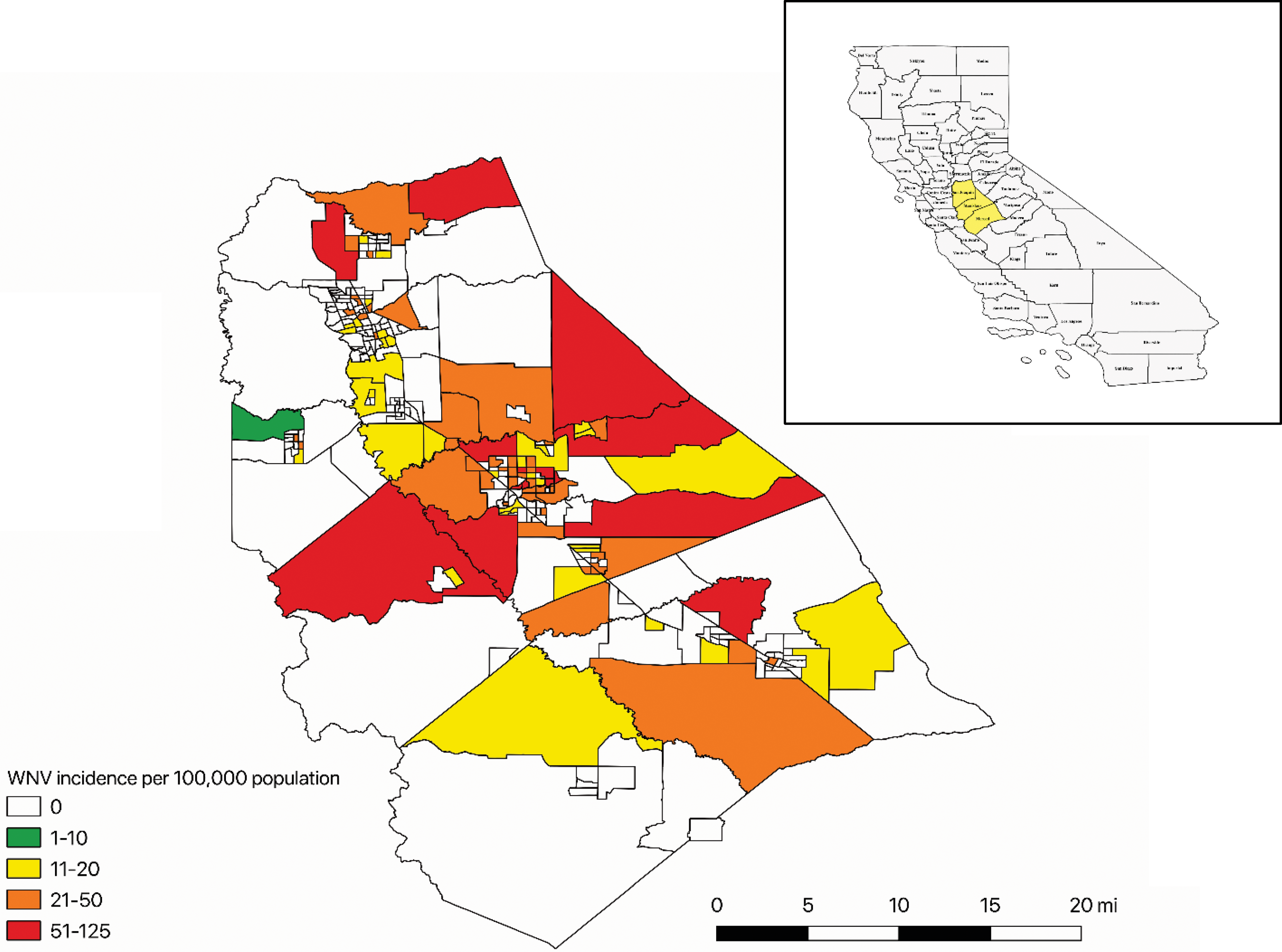
Map of the cumulative West Nile virus incidence per 100,000 from 2011 to 2015 for the census tracts in the three counties: San Joaquin, Stanislaus, and Merced, California. The small inset in the upper right corner is a map of California, with the three-county area highlighted in yellow. The larger central map is of the three counties from north to south, San Joaquin, Stanislaus, and Merced. Map was prepared using software QGIS 2.18.9 and census tract layers from the 2010 Census TIGER/Line files, accessed at
Data collection
Data used in this study include environmental and socioeconomic variables, and the number of human WNV cases from 2011 to 2015 in each census tract of San Joaquin, Stanislaus, and Merced Counties. The total number of West Nile cases includes both West Nile fever and West Nile neuroinvasive disease cases. A census tract is a geographic unit having on average 4000 people (US Census Bureau 2010a). Analyses were conducted using the incidence of WNV human cases per 100,000 in each census tract, over the time period of the study 2011–2015. The environmental variables considered included precipitation, temperature, and the presence of WNV-positive mosquito pools. Annual precipitation and temperature data for the years 2011–2015 were acquired from the Oregon State University PRISM Climate Group, and were determined for a central location in each census tract in the three counties (PRISM Climate Group 2018). From these data, the 5-year mean annual precipitation (cm) and the 5-year mean temperature (°C) were determined for each census tract.
The location (latitude, longitude) of WNV-positive mosquito pools in the three counties for years 2011–2015 was obtained from the California Vectorborne Disease Surveillance System (CalSurv), a database for mosquito management in California (CalSurv 2018); the location was used to determine the census tract where the WNV-positive mosquito pool was detected. Only Cx. pipiens and Cx. tarsalis mosquito pools that tested positive for WNV and that were included in CalSurv were used for analyses. The incidence of WNV-positive mosquito pools per 100,000 was included in the chi-square association tests and the negative binomial regression analysis.
Socioeconomic variables were obtained from the 2010 U.S. Census. The U.S. Census is conducted every 10 years; the census was used from 2010, since it preceded the years 2011–2015 in this study. Socioeconomic variables were determined for each of the 281 census tracts used from the three counties, and include the following: age, education, housing age, housing foreclosures, median income, population density, ethnicity, and language spoken. For the variable age, the percentage of the population over age 50 was used for each census tract. For education, the percentage of the population with a high school education or higher was used. The median year homes were constructed was used for the variable housing age. The number of housing foreclosures for each tract was determined using the U.S. Census housing vacancies-other category. For ethnicity, the percentage of population who identified as White was included. The variable language was defined as the percentage of households in a census tract speaking English. The number of human WNV cases in each census tract in San Joaquin, Stanislaus, and Merced Counties during 2011–2015 was obtained from the California Department of Public Health Infectious Diseases Branch, Surveillance and Statistics Section. All WNV human cases were completely anonymous, and only identified as a WNV case at the census tract level. Human subjects approval was obtained from Institutional Review Board (IRB) at University of California, Merced and from the California Department of Public Health.
Statistical analysis
Descriptive overview of West Nile cases in census tracts
The number of human WNV cases that occurred in each census tract during each year from 2011 to 2015 was determined for each of the three counties, as was the number of census tracts with and without human WNV cases. One census tract in Stanislaus County was dropped from analyses due to incomplete data. For each year from 2011 to 2015, the frequency of human WNV cases in each county was plotted for comparison. In addition, a map was created with the WNV incidence for each census tract for 2011–2015. The map was made using the software QGIS 2.18.9 (QGIS 2017). Census tract layers for each county were downloaded from the 2010 Census TIGER/Line files (US Census Bureau 2010b). All data were summarized and analyzed at the census tract level.
Association tests for factors and incidence of WNV
Chi-square independence tests were run to determine whether a significant association existed between each individual factor and the incidence of WNV cases in census tracts. Association tests were run for the data obtained from the three counties combined. Variables tested were age, housing age, housing foreclosures, income, ethnicity, and the incidence of positive mosquito pools per 100,000 people.
For each variable (e.g., age), the 2010 Census was used to first determine the mean for the variable for the three counties. For example, for age, the mean percentage of the population over age 50 was used to categorize the census tracts into those with a “lower” or “higher” than the average percentage of the population over age 50. The incidence of WNV cases in each tract was used to also categorize tracts into those with less than the mean WNV incidence rate and tracts with greater than the mean incidence rate. Subsequently, a chi-square independence test was used to determine if the incidence rate of WNV was associated with a variable, for example with age. For two variables, income and housing year, the U.S. Census provided median values, and the categorization of census tracts instead used the median values rather than mean. All chi-square tests were run using Stata 14.2 (StataCorp 2016). The result of an analysis was considered significant if p < 0.05.
Negative binomial regressions
Negative binomial regressions were conducted to examine the relationship between multiple variables and the incidence of WNV in census tracts. Negative binomial regression models are used for multivariate regression of count data, rather than using Poisson's regression models, when data are overdispersed, for example, when the variance is greater than the mean. Alpha tests are used to test for overdispersion, and when the alpha values are significantly different from zero, it is indicated that negative binomial count regression models should be used rather than Poisson's regression.
Analyses were run for data obtained from the three counties combined and were conducted using Stata 14.2. Environmental variables considered in analyses included the mean 5-year temperature and the mean 5-year precipitation in each census tract, as well as the incidence of WNV-positive mosquito pools. Socioeconomic variables considered included age, education, median housing year, housing foreclosures, median household income, ethnicity, and language. Three negative binomial models were run. Before running each model, multicollinearity was assessed with the variation inflation factor (VIF) statistic; the variables that had values <3 were included in the model. The first model consisted of the three environmental variables, which were the 5-year mean temperature, the 5-year mean precipitation, and the incidence of WNV-positive mosquito pools. Population density was included as a control variable in all three models.
The second negative binomial regression considered the socioeconomic variables age, education, housing age, housing foreclosures, income, population density, language, and ethnicity. For the second model, the multicollinearity test found the VIF values for education and language close to 6; both were excluded from models 2 and 3, the combined model. Two additional variables that were not significant in the chi-square independence analyses, housing age and median income, were also excluded from models 2 and 3. Model 2 of the socioeconomic variables included age, housing foreclosures, ethnicity, and population density.
The third and final negative binomial regression included the variables that were significant in the previous two models (5-year mean temperature, 5-year mean precipitation, WNV-positive mosquito pools, ethnicity, and population density). The output from each of the three models was used to examine the Wald chi-square statistic, and to examine whether the model was significant. Variables with p-values <0.05 were considered significant. For the final combined model, the incidence ratios were determined and reported. Incidence ratios estimate the rate of change in the dependent variable associated with each unit increase or decrease in the independent variable in the model.
Results
Human WNV cases overview
The number of human cases of WNV in 2011–2015 totaled 169 for the three counties (Table 1). The largest number of cases was in Stanislaus County (114), followed by San Joaquin County (39), and the lowest number of cases occurred in Merced County (16) (Table 1). The WNV cases were plotted for each county for 2011–2015 (Fig. 2). The cumulative incidence of WNV for the years included in the study (2011–2015) was 11.69/100,000. A map with the cumulative incidence of WNV for the census tracts in each county was used to highlight the incidence of cases (Fig. 1).
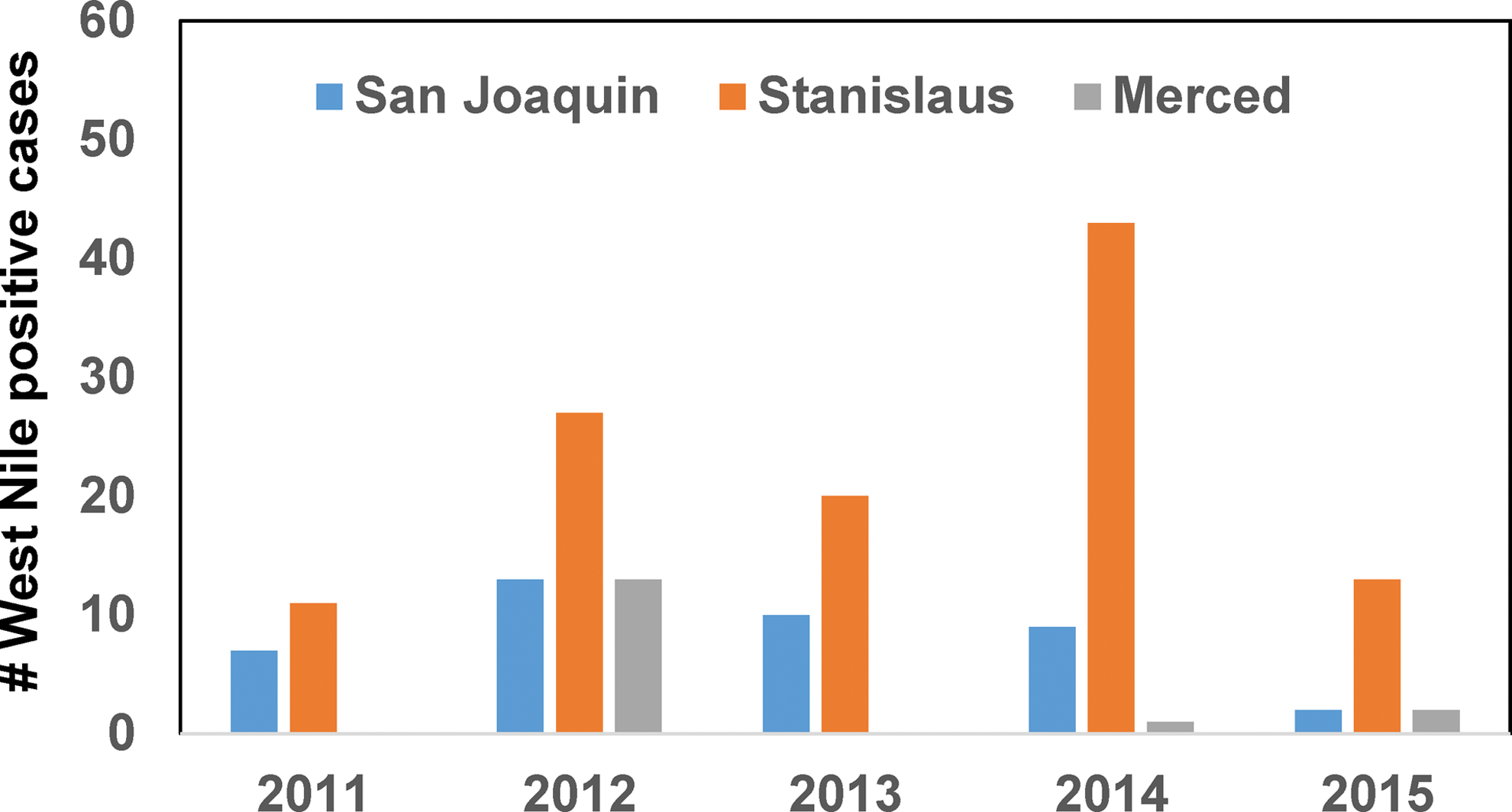
Human West Nile virus cases for San Joaquin, Stanislaus, and Merced Counties from 2011 to 2015. Color images are available online.
The Number of Human West Nile Virus Cases in San Joaquin, Stanislaus, and Merced Counties, from 2011 to 2015
Stanislaus has 94 total tracts; however, 93 tracts were used for the analysis. This led to 281 (rather than 282) census tracts used.
Association tests for factors and WNV incidence
Data from San Joaquin, Stanislaus, and Merced Counties were pooled to conduct a chi-square test of independence for the association of each variable with the incidence of WNV cases (Table 2). Ethnicity was significantly associated with WNV incidence (p < 0.001) (Table 2). Census tracts having a higher than average percentage White demographic had twice the number of tracks with one or more WNV cases (65 vs. 32, Table 2). The incidence of WNV was also significantly associated with age (the percentage of the population over age 50) (p = 0.018), as were housing foreclosures (p = 0.045) (Table 2); however, there was no association of the incidence of WNV cases with median housing year or median household income (p > 0.05, Table 2). The incidence of a WNV-positive mosquito pool in a census tract was also associated with a higher incidence of WNV (χ 1 2 = 23.06, p < 0.001).
Variables Tested for Association with West Nile Virus Cases in the Three Counties Combined
The chi-square and p-value are shown; p-values were considered significant for p < 0.05.
Mean is listed for all variables except income and housing year, where the U.S. Census used median values.
Negative binomial regression
A negative binomial regression of environmental factors was significant (χ 2 4 = 42.93, p < 0.001). The relationship between the incidence of WNV and the 5-year mean annual precipitation was significant (p < 0.001), as was the relationship with the 5-year mean temperature (p < 0.001) and with the incidence of WNV-positive mosquito pools (p = 0.032) (Table 3 and Supplementary Table S2). The negative binomial regression of socioeconomic factors and WNV incidence was also significant (χ 2 4 = 35.42, p < 0.001); the variable ethnicity was statistically significant (p < 0.001), housing foreclosure was marginally significant (p = 0.051), and age was not significant (p = 0.941) (Table 4). Finally, the combined negative binomial regression analysis of both environmental and socioeconomic factors was significant (χ 2 5 = 49.39, p < 0.001) (Table 5). The variable precipitation was significant (p = 0.003: IR 1.15); each unit increase in rainfall (cm) led to a 15% increase in the incidence of WNV cases. The 5-year mean temperature was also significant (p < 0.001: IR 10.48); every 1°C increase in the mean temperature resulted in ∼10 times the incidence of WNV. Finally, ethnicity was statistically significant (p = 0.011: IR 1.02), every 1% increase in the White population led to a 2% increase in WNV incidence (Table 5).
Negative Binomial Regression for Environmental Factors Associated with West Nile Virus (χ 2 4 = 42.93, p < 0.001)
The 5-year temperature (mean ± SE) was 17.07°C ± 0.016°C, and the 5-year precipitation (mean ± SE) was 26.93 ± 0.22 cm.
Negative Binomial Regression for Socioeconomic Factors Associated with West Nile Virus (χ 2 4 = 35.42, p < 0.001)
Negative Binomial Regression for the Combined Environmental and Socioeconomic Variables Associated with West Nile Virus (χ 2 5 = 49.39, p < 0.001)
p-values were considered significant for p < 0.05.
Discussion
The influence of environmental and socioeconomic factors on the incidence of WNV human cases reported in three counties in the Central Valley of California was examined. When considering all predictors in a multivariate analysis, the incidence of WNV cases was most strongly associated with several environmental factors, specifically precipitation and mean temperature, and additionally the socioeconomic factor ethnicity. The majority of previous studies examining environmental and socioeconomic factors have been conducted in urbanized areas (Ruiz et al. 2004, Gibbs et al. 2006, Brown et al. 2008, Harrigan et al. 2010). Rural areas such as the Northern San Joaquin Valley of California have been studied to a lesser degree in terms of research related to factors associated with WNV.
The environmental factors temperature and precipitation were significantly related to the incidence of human WNV cases, and this finding is consistent with previous studies (Reisen et al. 2006a, 2006b, Liu and Weng 2012, Paz 2015). Mosquitoes need water for larvae to develop, and insects grow more rapidly in warmer temperatures (Dohm et al. 2002, Turell et al. 2006, Zou et al. 2006). Standing water such as puddles, in gutters and storm drains, and habitats such as abandoned or neglected pools are ideal habitats for mosquitoes such as Cx. pipiens and Cx. tarsalis, both primary vectors associated with WNV (Reisen et al. 2008).
There was a marginally significant association overall of housing foreclosures and human cases of WNV; foreclosed homes may have neglected swimming pools, which can serve as larval habitats for Culex mosquitoes that transmit WNV (Reisen et al. 2008). Along with temperature and precipitation, the incidence of a WNV-positive mosquito pool in a census tract was associated with the incidence of human WNV cases. These findings highlight the importance of mosquito abatement, which conducts surveillance for WNV-positive mosquitoes, and focuses on source reduction of preferred habitats for mosquito development. When environmental factors were considered individually or together with socioeconomic factors in a logistic regression model, environmental factors were the most significant predictors associated with the incidence of WNV human cases in the region of this study.
In the negative binomial regression of socioeconomic variables, ethnicity was the only significant predictor of WNV cases. It is unclear why ethnicity (increase in percentage White) in the census tract is associated with the incidence of WNV cases. Ethnicity as a risk factor could relate to differences in health insurance and willingness to seek medical care, resulting in under-reporting. For example, Hispanics were frequently infected with St. Louis encephalitis virus in southern California, but cases were rarely reported (Reisen and Chiles 1997). Ethnicity could also be associated with a behavioral risk factor, which might increase the chance of contracting WNV, such as whether individuals work outside the home (Gibney et al. 2012). A retrospective study found that individuals spent more time indoors in the early evening, since the adoption of modern appliances such as television and air conditioning; this is related to a reduction in reports of mosquito-borne viral encephalitis cases (Gahlinger et al. 1986).
Behavioral risk factors could be further explored and ethnicity considered. In a report on WNV infections in Texas during 2012, a higher attack rate for WNV was observed in those of White/non-Hispanic ethnicity (11.1/100,000) compared with those of other ethnicities (Murray et al. 2013). Investigators in Chicago and Detroit found that middle-class neighborhoods were associated with high WNV activity and human infection (Ruiz et al. 2007). In contrast, the risk of WNV human infection was associated with low-income areas in Orange County, CA, Harris County, TX, and in Shelby County, TN (Rios et al. 2006, Savage et al. 2008, Harrigan et al. 2010). In this study, the three-county analysis did not find a significant association with the incidence of human WNV cases and household income.
WNV disease is a nationally notifiable condition; however, many cases are under-reported as the majority of infections are asymptomatic (Petersen and Marfin 2002, CDC 2013). Under the physician's care, patients may be tested if they are showing symptoms of West Nile fever; however, febrile cases may go undetected, especially if they occur during the flu season. Test results are reported to local public health authorities if there is a positive case. Testing must be done for WNV to confirm the etiology of disease and to differentiate it from other vector-borne diseases. It is imperative that members of the community are educated about prevention of vector-borne disease, and how to decrease their risk of being bitten and infected. The inter-relatedness of social factors including ethnicity is complex and requires further investigation. Awareness of vector-borne disease in this region of California is timely, as more invasive species of mosquitoes capable of transmitting additional vector-borne diseases are introduced into the area.
It has been previously reported that with advancing age, the incidence of neuroinvasive disease and death due to WNV increases (Hayes et al. 2005). For the three counties combined, the association tests of each individual factor found that the percentage of the population >50 (age) was associated with human cases of WNV. However, when age in the census tract was entered in the multivariate analysis and combined with other factors, it was not the most significant predictor of WNV in this region of study. People of all ages remain susceptible to infection, and surveillance should continue to target areas with all age groups. Other studies found that housing age was strongly associated with human cases of WNV, yet it was not significantly associated with the incidence of WNV in this study. Housing age has been a significant factor in prior studies as a result of old storm water sewer systems that can serve as a larval habitat for Culex mosquitoes (Ruiz et al. 2007, Liao et al. 2014, Lockaby et al. 2016). As mentioned previously, the environmental factors temperature and precipitation were the strongest predictors of the incidence of WNV cases in the region of this study.
Conclusion
This analysis of factors that influence human cases of WNV in the Northern San Joaquin Valley of California found that environmental factors were the strongest predictors of WNV cases. This supports the long-standing practices of mosquito abatement districts' efforts toward reducing mosquito populations and containing the risk factors associated with WNV. Education and communication are the key elements in public health prevention programs. Both are of primary importance during a disease outbreak to adequately inform citizens of the risk of WNV and how to protect themselves. Health education needs to be continuous to help members of all community populations to stay active in protecting themselves against WNV and other emerging vector-borne diseases in the area.
Footnotes
Acknowledgments
We thank the Merced County Mosquito Abatement District (MCMAD), and Alan Inman, Jason Bakken, Arlilla Bueno, and Rhiannon Jones of MCMAD for their feedback during the project. University of California Merced undergraduate laboratory assistants Karen Cedano, Andrew Loera, and Lindsay Robson assisted with various aspects of the study. David Heft and Monica Patterson of Turlock Mosquito Abatement District provided helpful discussions.
Author Disclosure Statement
No competing financial interests exist.
Supplementary Material
Supplementary Table S1
Supplementary Table S2
References
Supplementary Material
Please find the following supplemental material available below.
For Open Access articles published under a Creative Commons License, all supplemental material carries the same license as the article it is associated with.
For non-Open Access articles published, all supplemental material carries a non-exclusive license, and permission requests for re-use of supplemental material or any part of supplemental material shall be sent directly to the copyright owner as specified in the copyright notice associated with the article.
