






Abstract
Continuous cell lines derived from many of the vectors of tick-borne arboviruses of medical and veterinary importance are now available. Their role as tools in arbovirus research to date is reviewed and their potential application in studies of tick cell responses to virus infection is explored, by comparison with recent progress in understanding mosquito immunity to arbovirus infection. A preliminary study of propagation of the human pathogen Crimean-Congo hemorrhagic fever virus (CCHFV) in tick cell lines is reported; CCHFV replicated in seven cell lines derived from the ticks Hyalomma anatolicum (a known vector), Amblyomma variegatum, Rhipicephalus (Boophilus) decoloratus, Rhipicephalus (Boophilus) microplus, and Ixodes ricinus, but not in three cell lines derived from Rhipicephalus appendiculatus and Ornithodoros moubata. This indicates that tick cell lines can be used to study growth of CCHFV in arthropod cells and that there may be species-specific restriction in permissive CCHFV infection at the cellular level.
Introduction
Tick Cell Lines
Although the ultimate goal of most early attempts to cultivate tick tissues was continuous growth of cells in vitro, it took over 20 years for the first continuous cell lines, from the ixodid tick Rhipicephalus appendiculatus, to be achieved (Varma et al. 1975). Progress in methods for setting up primary tick cell and tissue cultures, and the gradual improvements in culture media and conditions that led to cell line establishment, were comprehensively reviewed by those directly involved in this research at the time (Rehacek 1971, 1976, 1987, Pudney 1987, Kurtti et al. 1988, Varma 1989). The first cell lines were derived from molting nymphal ticks, but subsequently most cell lines have been derived from tick embryos as these are easier to process (Yunker 1987, Kurtti et al. 1988). When the role of tick cell lines in tick and tick-borne disease research was last reviewed (Bell-Sakyi et al. 2007), 44 cell lines were available, derived from 13 ixodid and one argasid tick species. Since then a further 13 lines have been added to the list, including new lines from the argasid species Ornithodoros moubata (Bell-Sakyi et al. 2009) and the ixodid species Rhipicephalus evertsi, and the Dermacentor variabilis cell line RML-15 (Yunker et al. 1981b) has resurfaced (Table 1).
All tick cell lines are phenotypically and genotypically heterogeneous, having been derived from the tissues of multiple partial (molting nymphs) or complete (embryos and molting larvae) individual ticks. This diversity has obvious disadvantages, but as attempts to clone tick cells have so far been unsuccessful (Munderloh et al. 1994) there is currently no alternative to the existing cell lines. On the other hand, their heterogeneity can be advantageous when dealing with relatively unknown parameters such as which cell types within the tick support virus replication, isolation of new viruses from field or clinical samples, etc. In general, like the ticks from which they were derived, individual tick cell cultures can survive for long periods (months or even years) with minimal attention (Bell-Sakyi et al. 2007), making them ideal for isolation of low titer viruses and for studies on virus persistence. Tick cells are normally incubated at temperatures between 28°C and 34°C, making them suitable for isolation and propagation of arboviruses and valuable alternatives to traditional mammalian cell culture systems.
Tick Cell Culture and Arboviruses
As soon as techniques for reliably producing primary tick cell or tissue explant cultures were developed, propagation of both arboviruses and non–arthropod-transmitted viruses was attempted (Rehacek and Kozuch 1964, Rehacek 1965, Yunker and Cory 1967, Cory and Yunker 1971). Both tick- and mosquito-borne viruses were found to replicate well in cells derived from Hyalomma and Dermacentor spp. ticks, and surprisingly, the non–vector-borne lymphocytic choriomeningitis virus also grew in Hyalomma dromedarii primary cells (Rehacek 1965). With the advent of the first continuous tick cell lines (Varma et al. 1975, Guru et al. 1976, Bhat and Yunker 1977, Yunker et al. 1981b), there was an explosion in tick-borne arbovirus research (Table 2). These early studies in the 1970s and 1980s were limited to determining whether or not a particular tick- or mosquito-borne virus could replicate in tick cells and, in a few cases, examining the duration of persistent infection within the culture. Because at this time cell lines had only been developed from a limited number of tick species belonging to three genera-Rhipicephalus (including the subgenus Boophilus), Dermacentor, and Haemaphysalis-viruses were frequently propagated in nonvector cells. TBEV, for example, has been grown in cells from ticks of six genera in total: Hyalomma, Rhipicephalus, Dermacentor, Ixodes, Amblyomma, and Ornithodoros (Rehacek 1965, Bhat and Yunker 1979, Lawrie et al. 2004, Ruzek et al. 2008), but in nature it is predominantly transmitted by Ixodes spp. ticks. Moreover, many mosquito-borne viruses, particularly those of the family Togaviridae, also replicate well in tick cell lines, although the converse does not hold true, as only few tick-borne viruses replicate in mosquito cell lines (Pudney et al. 1979, Leake 1987, Pudney 1987, Lawrie et al. 2004).
As in most mosquito cells, for those arboviruses studied, infection does not generally produce any obvious cytopathic effect in tick cells in vitro, and cultures often become persistently infected. Leake et al. (1980) reported maintenance of LIV through 90 weekly subcultures of R. appendiculatus cells without loss of virus titer. Similarly, Langat virus was subcultured 12 times over 98 days in Rhipicephalus (Boophilus) microplus cells (Leake 1987). In our laboratory, an individual Rhipicephalus (Boophilus) decoloratus cell culture infected with the mosquito-borne alphavirus Semliki Forest virus (SFV) was still producing infectious virus after 12 months (G. Barry, personal communication). When R. appendiculatus cells persistently infected with LIV were superinfected with SFV, there was no change in the LIV titer and the pattern of SFV growth was similar to that seen in naive tick cells (Leake et al. 1980). Similarly, TBEV-infected H. dromedarii primary cultures superinfected with Lipovnik virus showed growth curves of both viruses similar to those in singly-infected cells; however, when cultures were infected with both viruses simultaneously, production of both viruses was lowered (Rehacek 1987). Some, but not all, cell lines from at least one tick species, Ixodes scapularis, are persistently infected with an orbivirus, St. Croix River virus (SCRV, Attoui et al. 2001) which has no known vertebrate host and can therefore be considered as a possible “tick-only virus” (Nuttall 2009). The presence of SCRV in the I. scapularis cell lines IDE2 and IDE8 does not prevent subsequent experimental infection with, and replication of, respectively, TBEV (Ruzek et al. 2008) and SFV (authors' unpublished observations). Although to date SCRV remains the only characterized “tick-only” virus reported to infect a tick cell line, it is likely that additional examples will be discovered as more cell lines are screened using both traditional electron microscopy and molecular methods such as polymerase chain reaction (PCR) with wide-spectrum primers (Moureau et al. 2007, Lambert and Lanciotti 2009, Johnson et al. 2010) and deep sequencing as applied to a Drosophila cell line (Wu et al., 2010a). Munz et al. (1987) discovered reovirus-like particles in the R. appendiculatus cell line RA243; their presence did not prevent replication of the bunyavirus NSDV. Using a PCR-based method, Grard et al. (2006) identified a novel flavivirus in R. evertsi and Rhipicephalus guilhoni ticks collected from small ruminants in Senegal; Ngoye virus failed to replicate in a range of vertebrate and invertebrate cell lines, including lines derived from embryonic R. appendiculatus and I. scapularis. Propagation of this virus in the recently established R. evertsi cell lines (Table 1) could be attempted to investigate its host species specificity and whether it is another candidate “tick-only virus.”
In total, 38 tick-borne viruses, 16 mosquito-borne viruses, one each transmitted by midges and sandflies, and one virus which is not vector-borne have been propagated to date in tick cells (Table 2). Much of this basic research was carried out prior to 1990; thereafter activity almost ceased until early this century, when advances in molecular virology coupled with new cell lines from additional tick species including the vectors of medically important viruses such as TBEV, enabled virologists to start to investigate the vector–virus relationship. Using electron microscopy and monoclonal antibodies specific for the E and NS1 proteins of TBEV, Senigl et al. (2004, 2006) revealed differences in the distribution of virus and viral proteins within mammalian and tick cells during virus maturation, which may relate to the different outcomes of infection in host (death) and vector (persistent infection) cells. Concurrent advances in arthropod genomics and proteomics, identification of host cell defense pathways and methods for genetic manipulation now allow us to begin to unravel the complex interactions between arboviruses and their vectors at the cellular and molecular levels, a process in which tick cell lines are playing a crucial role (Nuttall 2009).
Control of Arbovirus Infection by Vector Innate Immune Responses
One of the most rapidly progressing areas in understanding the interactions between arboviruses and their arthropod vectors is the vector immune response, which might be crucial in understanding viral host range, persistence, and transmission. Arbovirus replication and spread through the vector activates host defenses, which are important in controlling the invading pathogen. Most fundamental research on vector antiviral immunity has been carried out in Aedes aegypti and Aedes albopictus mosquitoes or cell lines derived from them (Fragkoudis et al. 2009). Cell lines derived from A. aegypti (Aag2) and A. albopictus (U4.4, C6/36, and C7-10) have been proven to be excellent tools to study fundamental immune responses under conditions more easily controlled than in live mosquitoes. Work on mosquito immunity has been strongly influenced by studies on antiviral defenses in Drosophila melanogaster, for which an impressive number of genetic mutants and tools are available (Huszar and Imler 2008, Kemp and Imler 2009, Ding 2010). Very little is known about the antiviral defenses of ticks and their possible role(s) against arboviruses. Here, our knowledge on vector immunity of mosquitoes against arboviruses will be summarized and we will discuss what appears to be relevant to ticks and what is required to advance this research in ticks and tick cells.
RNA interference (RNAi) is a key mosquito antiviral defense mechanism (Fragkoudis et al. 2009), and arboviruses from the main families—Togaviridae (genus Alphavirus), Flaviviridae, and Bunyaviridae—have been shown to induce this host response, although only the latter two families contain known tick-borne representatives. Antiviral RNAi in insects is initiated by the presence of double-stranded RNA (dsRNA) in infected cells; this dsRNA is recognized and degraded into virus-derived small interfering RNAs or viRNAs that are integrated into the RNA-induced silencing complex (RISC), which directs recognition and degradation of viral single-stranded RNA in a sequence-dependent manner (Fragkoudis et al. 2009, Kemp and Imler 2009, Ding 2010). The origin of the dsRNA substrate for RNAi has been a matter of much speculation as it could derive from nucleic acid secondary structures or two-molecule replication intermediates, or both (Myles et al. 2009). Recent work with alphavirus-infected mosquito cells suggests that most viral dsRNA fed into the RNAi response originates from replication intermediates (Siu et al. 2011), and it remains to be verified whether this is also the case for other arboviruses (including tick-borne pathogens), although at least for dengue virus this might be the case (Scott et al. 2010).
Orthologs of the key D. melanogaster antiviral RNAi proteins (Dcr-2, R2D2, Ago-2, and other RISC components) have been identified in A. aegypti and other mosquitoes; these are important in mosquito RNAi responses against flaviviruses and alphaviruses (Keene et al. 2004, Campbell et al. 2008a, 2008b, Sanchez-Vargas et al. 2009). Molecular mechanisms in insect antiviral RNAi have been mainly studied using D. melanogaster. The Dcr-2 protein (RNAse III enzyme and DExD/H-box RNA helicase) acts as a pattern recognition receptor that detects viral dsRNA and cleaves dsRNA into double-stranded viRNAs. During viRNA generation, Dcr-2 interacts with another dsRNA-binding protein, R2D2, which facilitates loading of viRNAs into the RISC. One of the viRNA strands (the guide strand; the passenger strand is degraded) is retained (and 3′-methylated) within the RISC, which then recognizes viral single-stranded RNA in a sequence-specific manner and mediates cleavage through the RISC protein Ago-2, thus limiting virus replication (Kemp and Imler 2009, Ding 2010). For the ticks R. (B.) microplus and I. scapularis, genomic information is available through ESTs or genome sequences, respectively, and 31 proteins with high homology to insect RNAi proteins (including key enzymes such as Dicer, Ago-2, as well as proteins potentially involved in dsRNA uptake) have been identified (Kurscheid et al. 2009). Of these, Ago-2 was previously described, and functional RNAi pathways that can be induced through introduction of dsRNA exist in ticks (de la Fuente et al. 2007b). Detailed studies of antiviral RNAi responses in ticks are therefore now possible by applying approaches successfully used in mosquitoes and mosquito cells, i.e., silencing expression of tick RNAi components and studying their effects on arbovirus replication (Keene et al. 2004, Campbell et al. 2008b).
The description of an RNA-dependent RNA polymerase, Ego-1, and other candidate genes potentially involved in amplification and systemic spread of RNAi and dsRNA uptake in ticks deserves further investigation (Kurscheid et al. 2009). A D. melanogaster protein with RNA-dependent RNA polymerase activity important in RNAi (D-elp1) has also been described (Lipardi and Paterson 2009, although this paper was recently retracted), and the presence of such a nucleic acid-amplifying enzyme in ticks could be an important determinant in arbovirus/tick interactions. Amplification and spread of the RNAi response through RNA-dependent polymerases has been described in plants and the nematode Caenorhabditis elegans (Ding and Voinnet 2007, Ding 2010). Intriguingly, uptake of dsRNA appears important in systemic antiviral RNAi responses in D. melanogaster (Saleh et al. 2009), and cell-to-cell spread of viRNAs also limits arbovirus spread through mosquito cells (Attarzadeh-Yazdi et al. 2009). How processes of amplification and systemic spread interrelate in insects remains to be investigated, but it would be surprising if ticks do not also rely on amplification and systemic spread of the RNAi response.
Cloning and sequencing of viRNAs from alphavirus-, flavivirus-, and bunyavirus-infected mosquitoes and mosquito (and other insect) cell lines showed that viRNAs are usually 21 nucleotides in length; interestingly, the A. albopictus cell line C6/36 was found to have defective RNAi responses, whereas the U4.4 cell line from the same mosquito species has intact immune responses (Myles et al. 2008, 2009, Brackney et al. 2009, 2010, Scott et al. 2010, Siu et al. 2011). These viRNAs map asymmetrically along the complete length of arbovirus genomes, with regions generating a high frequency of viRNAs (“hot spots”) and regions generating no or low frequency of viRNA (“cold spots”) interspersed in an apparently random manner. Interestingly, hot-spot viRNAs from mosquito cells infected with SFV were found to have poor antiviral activity, whereas cold spot-derived viRNAs are highly inhibitory; this suggests a decoy strategy against RNAi (Siu et al. 2011), and evasion of RNAi has also been suggested for dengue virus (Sanchez-Vargas et al. 2009). Studies on tick cell lines derived from embryos and also lines derived from postembryonic tissues (molting larvae or nymphs) could prove to be simple but powerful models to study tick responses to infection with arboviruses including CCHFV. Identification of biologically active viRNAs, for example, through these relatively simple cell culture-based assays, could lead to the targeted design of highly active small interfering RNAs.
The absence of potent inhibition of antiviral RNAi—important for pathogenic insect viruses (Kemp and Imler 2009, Wu et al. 2010b)—appears necessary in the case of arboviruses to ensure a balance between vector survival and virus replication, as inhibition of RNAi would apply negative selection pressure on vector survival. This was demonstrated through infections of mosquitoes with recombinant alphaviruses expressing insect virus RNAi inhibitors (Myles et al. 2008, Cirimotich et al. 2009). Work to characterize viRNAs from arbovirus-infected tick cells is now in progress and this should generate important insights into how antiviral RNAi is induced in ticks. Considering how antiviral RNAi can control replication, spread, and transmission of arboviruses in mosquitoes (Sanchez-Vargas et al. 2009, Khoo et al. 2010), this mechanism is also likely to be important in regulating tick/arbovirus interactions. Experimental infection of tick cells with replicons derived from mosquito-borne SFV leads to production of virus-derived small RNAs in the expected size range and induction of antiviral responses (Garcia et al. 2005). As SFV replicon replication can be rescued by heterologous RNAi inhibitors, antiviral RNAi to arbovirus infection in tick cells appears to be similar to that of insects (Garcia et al. 2006). However, infections of ticks and tick cells with tick-borne arboviruses are required to fully investigate these questions.
The arthropod innate immune response to arbovirus infection, however, is not limited to RNAi. Analysis of gene expression changes in mosquitoes and mosquito organs infected with alphaviruses and flaviviruses has revealed that a multitude of genes and pathways differentially respond to arbovirus infection. These responses are separate from antiviral RNAi responses, as proteins mediating the latter are continuously expressed in cells, underlining their major role. Most strikingly, immune pathways involved in responses to bacterial and fungal pathogens such as Toll, JAK/STAT, and IMD signaling are differentially regulated in response to arbovirus infection (Sanders et al. 2005, Xi et al. 2008, Souza-Neto et al. 2009, Bartholomay et al. 2010, Girard et al. 2010). In particular, Toll and JAK/STAT signaling mediate activity against dengue virus (Xi et al. 2008, Souza-Neto et al. 2009), whereas studies on immune-responsive mosquito cells have revealed that innate immune signaling pathways other than Toll (presumably JAK/STAT and/or IMD) inhibit replication of SFV (Fragkoudis et al. 2008). Evasion or inhibition of these non-RNAi host responses has been described or suggested and may be important in arbovirus/vector interactions (Lin et al. 2004, Sanders et al. 2005, Fragkoudis et al. 2008, Bartholomay et al. 2010, Sim and Dimopoulos 2010). However, the contribution of these pathways relative to antiviral RNAi remains to be investigated. Similar studies on tick/arbovirus interactions are within reach, especially with the sequencing of the I. scapularis genome (
Arbovirus replication in alternating vertebrate and arthropod environments has considerable consequences for their evolutionary dynamics, which we are only now beginning to understand, albeit for mosquito-borne arboviruses (Greene et al. 2005, Vasilakis et al. 2009, Coffey and Vignuzzi 2011). For medically important tick-borne viruses such as CCHFV, these studies are now within reach, although the basic parameters for virus propagation in tick cells must first be determined (see later). Many techniques discovered by studying host responses in mosquito cells should be easily transferable to study of antiviral responses in tick cells and should advance this area of research rapidly.
CCHFV in Tick Cell Lines: Establishing Basic Parameters
Crimean-Congo hemorrhagic fever is a severe, often fatal, tick-borne zoonosis caused by the arbovirus CCHFV, a single-stranded negative-sense RNA virus in the genus Nairovirus, family Bunyaviridae (Ergonul 2006). CCHFV has been detected in or isolated from over 30 species of ticks (Hoogstraal 1979, Shepherd et al. 1989, Whitehouse 2004); however, isolation from a tick should not be taken to imply that the tick is an actual vector. Ixodid ticks of the genus Hyalomma are assumed to be the main vectors of CCHFV (Hoogstraal 1979), and its natural hosts are believed to be small- or medium-sized mammals such as hares and hedgehogs (Whitehouse 2004). CCHFV also replicates in large mammals such as domestic cattle. CCHFV is apathogenic in its natural hosts, but highly pathogenic in humans; transmission to humans occurs through tick bite, crushing of engorged ticks, or contact with infected animal blood (Whitehouse 2004). There is insufficient knowledge of the role ticks play in the pathogenesis, transmission, and perpetuation of CCHFV in nature. Indeed, CCHFV has been rarely studied in its tick vector since the discovery of the disease nearly 70 years ago, because of the requirement for a biosafety level 4 laboratory, the availability of specific pathogen-free tick colonies, and the expertise to maintain ticks and perform in vivo feeding assays in a maximum containment setting. Tick cell lines offer an alternative approach to examine the interaction between CCHFV and ticks at the cellular level and can be valuable tools to study the vector competence of different tick species. To date there are no published reports of in vitro propagation of CCHFV in tick cells. Here we present the results of preliminary experiments carried out to determine the susceptibility of cell lines derived from different tick species to CCHFV infection and the level and pattern of virus production in susceptible tick cells.
A panel of 10 tick cell lines (Table 3) were tested for their susceptibility to infection with CCHFV at the National Microbiology Laboratory, Public Health Agency of Canada, Winnipeg. Analysis of virus RNA in the supernatant of the 10 cell lines (Fig. 1) revealed that CCHFV RNA was below the detection limit in three of the lines: OME/CTVM21 and 22 derived from the argasid tick O. moubata, and RAE/CTVM1, derived from the ixodid tick R. appendiculatus. In the remaining seven ixodid tick cell lines, CCHFV RNA was detected in the supernatant on days 2, 5, and 7 pi. Virus RNA titers ranged from 3.6×10³ to 5·5×104 genome equivalents (GEQ)/mL in all seven cell lines on day 2 pi; however, virus RNA titers dropped incrementally on days 5 and 7 pi in the three R. (Boophilus) spp. cell lines, whereas virus titers increased 2.5- to 8-fold from day 2 to 5 pi in AVL/CTVM13, HAE/CTVM8 and 9, and IRE/CTVM20. Titers doubled in HAE/CTVM8 and HAE/CTVM9 cells from day 5 to 7 pi. None of the 10 tick cell lines showed any cytopathic effect for 21 days following CCHFV infection. Virus RNA was detected up to day 21 pi in cell pellets analyzed by quantitative real-time reverse transcription-PCR (Wolfel et al. 2007) from all cell lines, except OME/CTVM21, OME/CTVM22, and RAE/CTVM1 (data not shown), the same lines in which virus RNA was not detected in the supernatant.
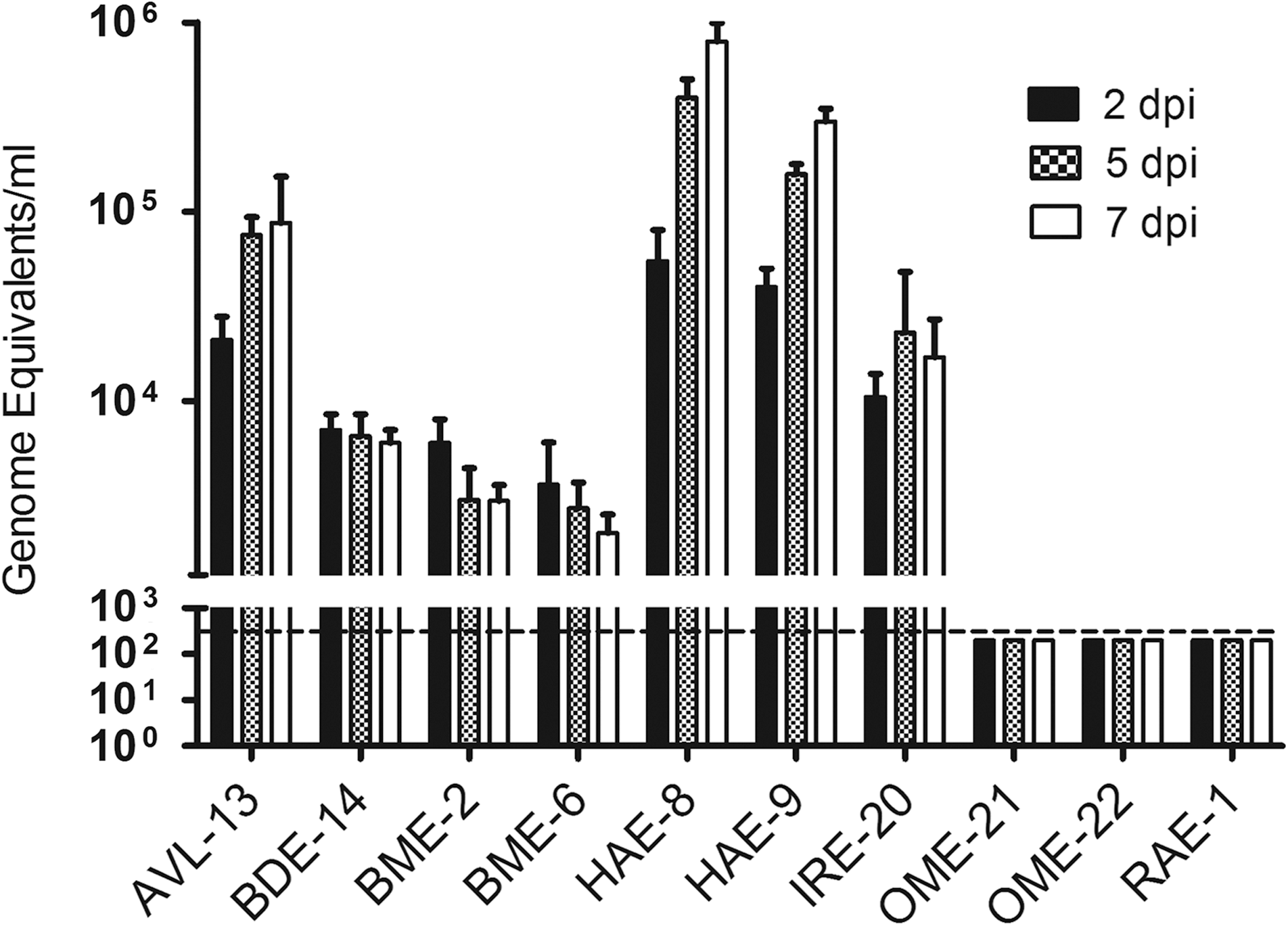
CCHFV virus titers in cell culture supernatant of 10 tick cell lines. At biosafety level 4, tick cells were infected with 4,000,000 genome equivalents (GEQ) equaling 4000 plaque-forming units (PFU) of CCHFV strain IbAr 10200 (kindly provided by Dr. Michael Holbrook UTMB, Galveston, TX) in 500 μL of L-15 (Leibovitz) medium. IbAr 10200 had a titer of 6.2×10⁸ GEQ per mL (4×10⁵ PFU/mL). After incubation for 60 min at 31°C, the cells were centrifuged, the virus inoculum was carefully removed, appropriate culture medium was added, and the cells were incubated at 31°C for 21 days. Supernatant was collected from three replicate tubes on days 2, 5, and 7 postinfection (pi) and 140 μL aliquots were mixed with 560 μL of AVL buffer (QIAamp Viral RNA mini kit; Qiagen). A CCHFV-specific quantitative real-time reverse transcription–polymerase chain reaction using a recombinant RNA standard was performed (Wolfel et al. 2007). Assays were run on StepOnePlus (Applied Biosystems) and analyzed with StepOne Software v2.1. Virus titers (n=3 for each time point; mean+standard deviation) are reported as GEQ. Virus levels in supernatant were below the detection limit of the assay (dashed line; 3×10² GEQ/mL) in cell lines OME/CTVM21, OME/CTVM22, and RAE/CTVM1. CCHFV, Crimean-Congo hemorrhagic fever virus.
L-15: Leibovitz medium supplemented with 10% tryptose phosphate broth (TPB), 20% fetal calf serum (FCS), 2 mM
Hank's balanced salt solution supplemented with 0.5% lactalbumin hydrolysate, 20% FCS, L-g, and p/s.
A 1:1 mixture of L-15 and H-Lac.
A 1:1 mixture of L-15 (Leibovitz) and minimal essential medium with Hank's salts supplemented with 10% TPB, 20% FCS, L-g, and p/s.
A 1:1 mixture of L-15 and L-15B (Munderloh and Kurtti 1989) supplemented with 10% TPB, 5% FCS, 0.1% bovine lipoprotein concentrate (MP Biomedicals), L-g, and p/s.
All tick species are ixodid except O. moubata. Cell lines were maintained in flat-sided tubes (Nunc) at 31°c with weekly medium changes (Bell-Sakyi 1991, 2004, Bell-Sakyi et al. 2000, 2009, Lallinger et al. 2010). All medium components were obtained from Sigma-Aldrich except where indicated. Before infection with Crimean-Congo hemorrhagic fever virus, cells were seeded in flat-sided tubes at 2×10⁵ cells/mL in 2 mL of appropriate culture medium.
These results demonstrate the susceptibility of some of the tick cell lines to CCHFV infection and their potential in CCHFV research. The virus titers detected in the tick cells were lower than those normally seen in mammalian cell cultures; however, in contrast to mammalian cell lines, tick cells tolerated the virus infection without displaying any obvious cytopathic effect. The growth kinetics of CCHFV in the different tick cell lines suggest two different outcomes. First, in the three R. (Boophilus) spp. cell lines (BDE/CTVM14, BME/CTVM2, BME/CTVM6) and the Ixodes ricinus cell line IRE/CTVM20, there is early virus replication that is not sustained over time; CCHFV has been isolated from R. (B.) microplus ticks (Mathiot et al. 1988), but this species has not been implicated in natural transmission. Second, in the Amblyomma variegatum and Hyalomma anatolicum cell lines, initial virus replication was high on day 2 and increased with time. The highest titers occurred in HAE/CTVM8 and HAE/CTVM9 cells derived from one of the main vector tick species H. anatolicum (Hoogstraal 1979). Interestingly, CCHFV replicated in the A. variegatum cell line AVL/CTVM13 to titers nearly as high as in HAE/CTVM8 and 9 cells, but failed to replicate in the R. appendiculatus cell line RAE/CTVM1, although both tick species have been shown to be capable of transmitting CCHFV infection following experimental intracelomic inoculation (Logan et al. 1990, Faye et al. 1999). Other bunyaviruses, including Dugbe virus and NSDV, do replicate in R. appendiculatus cells in vitro (Pudney et al. 1979, Munz et al. 1980). The failure of CCHFV to replicate in the two O. moubata cell lines is less surprising; Ornithodoros spp. ticks have not been incriminated as vectors of this virus (Shepherd et al. 1989, Durden et al. 1993, Whitehouse 2004). Genetic analysis of tick-borne nairoviruses revealed two major monophyletic lineages, with an ancient divergence between viruses transmitted by ixodid ticks, such as CCHFV, and those transmitted by argasid ticks (Honig et al. 2004). The heterogeneous nature of tick cell lines (Bell-Sakyi et al. 2007) could be an additional factor in determining whether or not virus replication occurs. Although the sites of virus replication in naturally infected ticks are unknown, it is likely that CCHFV replicates in tissues such as midgut and salivary gland cells and possibly hemocytes and ovaries. Virus titers in adult Hyalomma truncatum ticks experimentally infected by intracelomic injection increased 10-fold during blood-feeding in salivary glands and reproductive tissues, while remaining low in other organs including midgut (Dickson and Turell 1992); the authors speculated that this increase was due to tissue proliferation rather than increased viral replication in existing cells. It is unknown to what extent these specific cell phenotypes may be present in the tick cell lines used in the present study or whether CCHFV host cell tropism in vitro mirrors the in vivo situation. In this preliminary study, we looked at viral output in cell culture supernatant, but not at production of infectious virus in the different cell lines. Further studies are needed to elucidate how different parameters such as infective dose, initial incubation periods, and different cultivation temperatures influence virus replication in these cell lines. It would also be interesting to determine whether the ratio of GEQ to infectious particles (plaque-forming units) is the same as in mammalian cells.
Discussion and Prospects
These preliminary results demonstrate the potential of tick cell lines in CCHFV research. The virus titers achieved in the tick cells were lower than those normally seen in mammalian cell cultures; however, in contrast to most mammalian cells that undergo cell death following infection (Karlberg et al. 2011), tick cells tolerated the virus infection without displaying any obvious cytopathic effect. This tolerance by tick cells of arbovirus infection has been widely noted previously, for both tick- and mosquito-borne viruses (Pudney 1987). Cell lines are now available from the tick vectors of many of the major arboviruses of medical and veterinary importance (Table 4); however, for in-depth in vitro studies of comparative vector competence for viruses such as CCHFV and TBEV, cell lines from additional Hyalomma and Ixodes species, respectively, are needed. Haemaphysalis spp. ticks are important vectors of human and animal pathogens including the flavivirus Kyasanur Forest disease virus, but the H. spinigera and H. obesa cell lines established by Guru et al. (1976) have, as far as is known, been lost. Therefore, new cell lines should be established from Haemaphysalis ticks and other arboviral vectors, especially the argasid ticks Ornithodoros savignyi and Argas spp.
Charrel et al. 2007.
Characterization of antiviral responses in several tick cell lines, including lines derived from I. scapularis and I. ricinus, is now underway in our laboratories, and more work on the nature of antiviral RNAi and also on immune signaling pathways (largely unknown) in these and other cell lines is required. The absence of cytopathic effect in tick cells, which results in the need for secondary tests for virus multiplication, as previously highlighted (Kurtti et al. 1988), has now been partially overcome through the availability, for some arboviruses, of genetically modified virus constructs expressing fluorescent proteins such as enhanced green fluorescent protein, which permit rapid visual assessment of virus growth in live cell cultures (Fig. 2). Recent work with replicons derived from tick- and mosquito-borne arboviruses (or using their sequences) has shown that tick cells can be useful tools to study mechanisms of virus replication and tropism in the arthropod vector (Yoshii et al. 2008, Schrauf et al. 2009). The increasing availability of complete or partial tick genome sequences and ESTs, especially from important arbovirus vector species, will also contribute to analysis of virus–cell interactions.
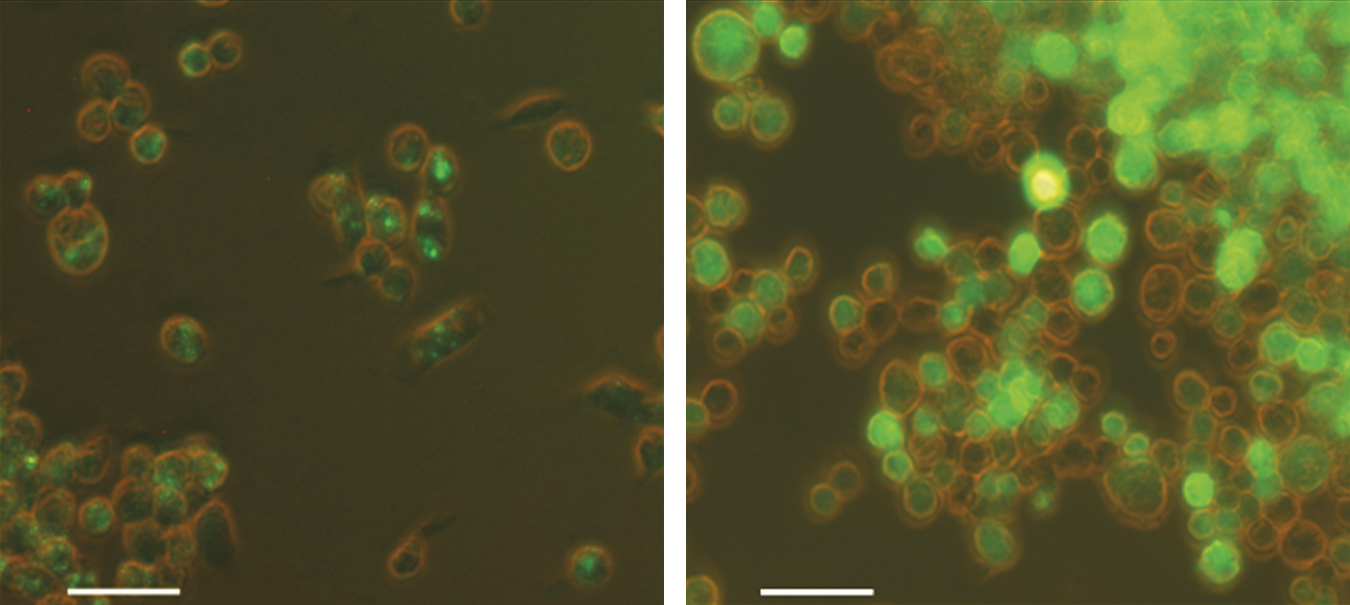
Tick cell lines infected with constructs of the mosquito-borne alphavirus Semliki Forest virus (SFV) (Tamberg et al. 2007) incorporating enhanced green fluorescent protein (eGFP), which facilitates identification of infected cells. Left panel: Rhipicephalus (Boophilus) decoloratus cell line BDE/CTVM14 at 24 h after infection with SFV4(3F)-eGFP, in which the eGFP is inserted into the nonstructural protein ORF and therefore localizes to virus replication complexes. Right panel: Ixodes scapularis cell line IDE8 at 24 h after infection with SFV4st-eGFP, in which the eGFP is inserted into the structural protein ORF and therefore is produced extensively in the cytoplasm of infected cells. Photomicrographs taken on an Axio Observer inverted microscope (Zeiss) with concurrent bright-field and UV illumination. Scale bar=50 μm. (Color images available at
Inevitably, the findings from in vitro studies in tick cell lines must be translated to the in vivo situation in whole ticks, which is particularly difficult for highly pathogenic viruses such as CCHFV. Questions relating to tissue tropisms, transmission, and vector competence in vivo cannot be adequately addressed in cell culture; tick organ cultures (Bell 1980, 1984) could be usefully employed as an intermediate stage in this transition. However, cell lines and molecular tools are available now to study the interactions between tick-borne arboviruses such as CCHFV and the cells of their arthropod vectors, and the next few years should see an increased understanding of how tick cells respond to virus infection.
Footnotes
Acknowledgments
Research in our laboratories was financed by the Wellcome Trust (The Roslin Wellcome Trust Tick Cell Biobank, grant number 088588; LBS), a BBSRC Strategic Program Grant (to A.K. and J.K.F.), and the Natural Sciences and Engineering Research Council of Canada (to D.A.B.). The authors thank Rennos Fragkoudis for help with artwork, and Ulrike Munderloh for the IDE8 cell line.
Disclosure Statement
No competing financial interests exist.