Restricted accessLetterFirst published online 2023-03
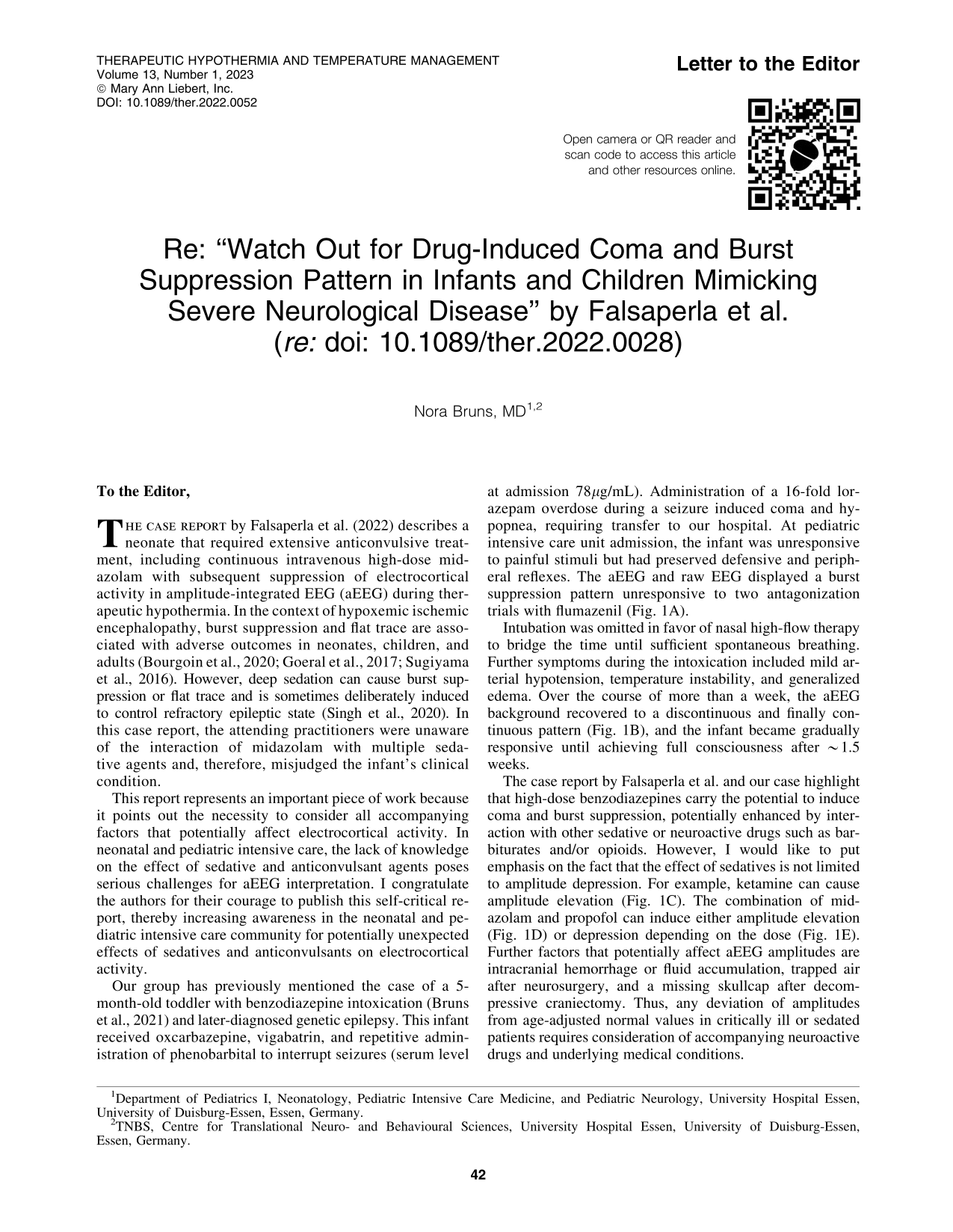
Re: “Watch Out for Drug-Induced Coma and Burst Suppression Pattern in Infants and Children Mimicking Severe Neurological Disease” by Falsaperla et al. ( re: doi: 10.1089/ther.2022.0028)
BourgoinP, BarraultV, JoramN, et al.The prognostic value of early amplitude-integrated electroencephalography monitoring after pediatric cardiac arrest. Pediatr Crit Care Med, 2020; 21(3):248–255; doi: 10.1097/PCC.0000000000002171
2.
BrunsN, Felderhoff-MüserU, Dohna-SchwakeC. aEEG as a useful tool for neuromonitoring in critically ill children—Current evidence and knowledge gaps. Acta Paediatr (Oslo, Norway: 1992), 2021; 110(4):1132–1140; doi: 10.1111/apa.15676
3.
FalsaperlaR, ScaliaB, LiottaEA, et al.Prolonged background suppression induced by anticonvulsants misleading amplitude-integrated encephalography's interpretation: A single case report. Ther Hypothermia Temp Manag, 2022; 12(4):240–244; doi: 10.1089/ther.2022.0028
4.
GoeralK, UrlesbergerB, GiordanoV, et al.Prediction of outcome in neonates with hypoxic-ischemic encephalopathy II: Role of amplitude-integrated electroencephalography and cerebral oxygen saturation measured by near-infrared spectroscopy. Neonatology, 2017; 112(3):193–202; doi: 10.1159/000468976
5.
SinghA, StrednyCM, LoddenkemperT. Pharmacotherapy for pediatric convulsive status epilepticus. CNS Drugs, 2020; 34(1):47–63; doi: 10.1007/s40263-019-00690-8
6.
SugiyamaK, KashiuraM, AkashiA, et al.Prognostic value of the recovery time of continuous normal voltage in amplitude-integrated electroencephalography in out-of-hospital cardiac arrest patients treated with therapeutic hypothermia: A retrospective study. J Intens Care, 2016; 4(1):25; doi: 10.1186/s40560-016-0152-5