






Abstract
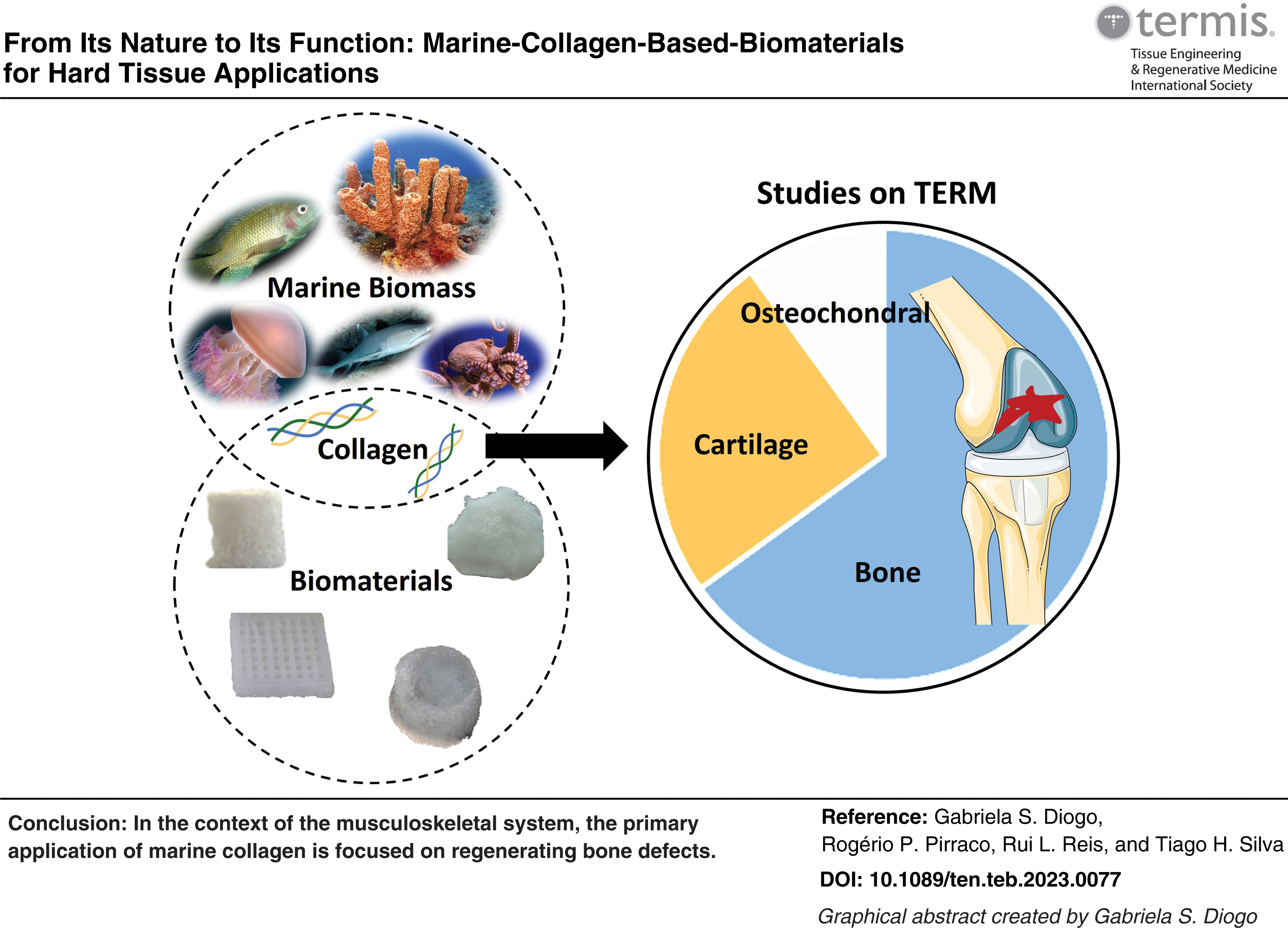 (Color images are available online)
Rapidly growing demand for collagen-based therapeutic applications requires a great amount of collagen stock. Commercial collagen is mainly confined to mammalian sources, which have concerns about zoonotic disease transfer and, additionally, the problem of terrestrial animals' overexploitation, which, even so, does not meet the crescent demand for collagen. The extraction of collagen from marine organisms, including the wastes of vertebrates and invertebrates, has both economic and environmental benefits. Marine collagen (MC) is easy to extract, has excellent biocompatibility and good absorption properties, is low in zoonotic and immunological risks for patients, and has fewer religious and regulatory restrictions. This review discusses the research done using MC on biomaterials for bone, cartilage, and osteochondral tissue regenerative applications and the underlying technologies that enable their development. The main challenges on processing MC associated with specific features, such as the low denaturation temperature and weak mechanical properties, are also addressed. A combination of blends and physical or chemical crosslinking treatments with conventional processing methodologies is still traditionally used to prepare MC biomaterials. However, the growing role of MC in the health care-related field, particularly in the treatment of musculoskeletal defects, has been pushing the scientific community to explore advanced techniques to design and develop safe, yet functional materials to better meet tissues' functionality.
Impact statement
This review discusses the research done using marine collagens (MCs) on biomaterials for bone, cartilage, and osteochondral tissue regenerative applications with the underlying technologies that enable their development, and explains the methodologies used to characterize MCs highlighting their importance, namely regarding the performance of derived biomaterials, and the inherent properties of such collagens. In the second part, the applicability of MCs as biomaterials for hard tissue applications was studied, focusing on the mostly applied fabrication techniques. In conclusion, this review describes the major challenges to be overcome and the forecast for the upcoming years concerning the use of MCs.
Get full access to this article
View all access options for this article.
References
Supplementary Material
Please find the following supplemental material available below.
For Open Access articles published under a Creative Commons License, all supplemental material carries the same license as the article it is associated with.
For non-Open Access articles published, all supplemental material carries a non-exclusive license, and permission requests for re-use of supplemental material or any part of supplemental material shall be sent directly to the copyright owner as specified in the copyright notice associated with the article.
