






Abstract
Peripheral nerve injury is prevalent and has a high disability rate in clinical settings. Current therapeutic methods have not achieved satisfactory efficacy, underscoring the need for novel approaches to nerve restoration that remains an active area of research in neuroscience and regenerative medicine. In this study, we isolated platelet-rich plasma-derived exosomes (PRP-exos) and found that they can significantly enhance the proliferation, migration, and secretion of trophic factors by Schwann cells (SCs). In addition, there were marked changes in transcriptional and expression profiles of SCs, particularly via the upregulation of genes related to biological functions involved in nerve regeneration and repair. In the rat model of sciatic nerve crush injury, ultrasound-targeted microbubble destruction (UTMD) enhanced the efficiency of PRP-exos delivery to the injury site. This approach ensured a high concentration of PRP-exos in the injured nerve and improved the therapeutic outcomes. In conclusion, PRP-exos may promote nerve regeneration and repair, and UTMD may increase the effectiveness of targeted PRP-exos delivery to the injured nerve and enhance the therapeutic effect.
Impact statement
Platelet-rich plasma-derived exosomes (PRP-exos) have gained attention in tissue repair and regenerative medicine, but their therapeutic efficacy for peripheral nerve injury remains unclear. This study demonstrated that PRP-exos positively impacted nerve regeneration, while ultrasound-targeted microbubble destruction (UTMD) enhanced the targeted delivery efficiency of PRP-exos, further improving efficacy. Therefore, UTMD-assisted PRP-exos delivery could establish a novel, effective strategy for nerve repair.
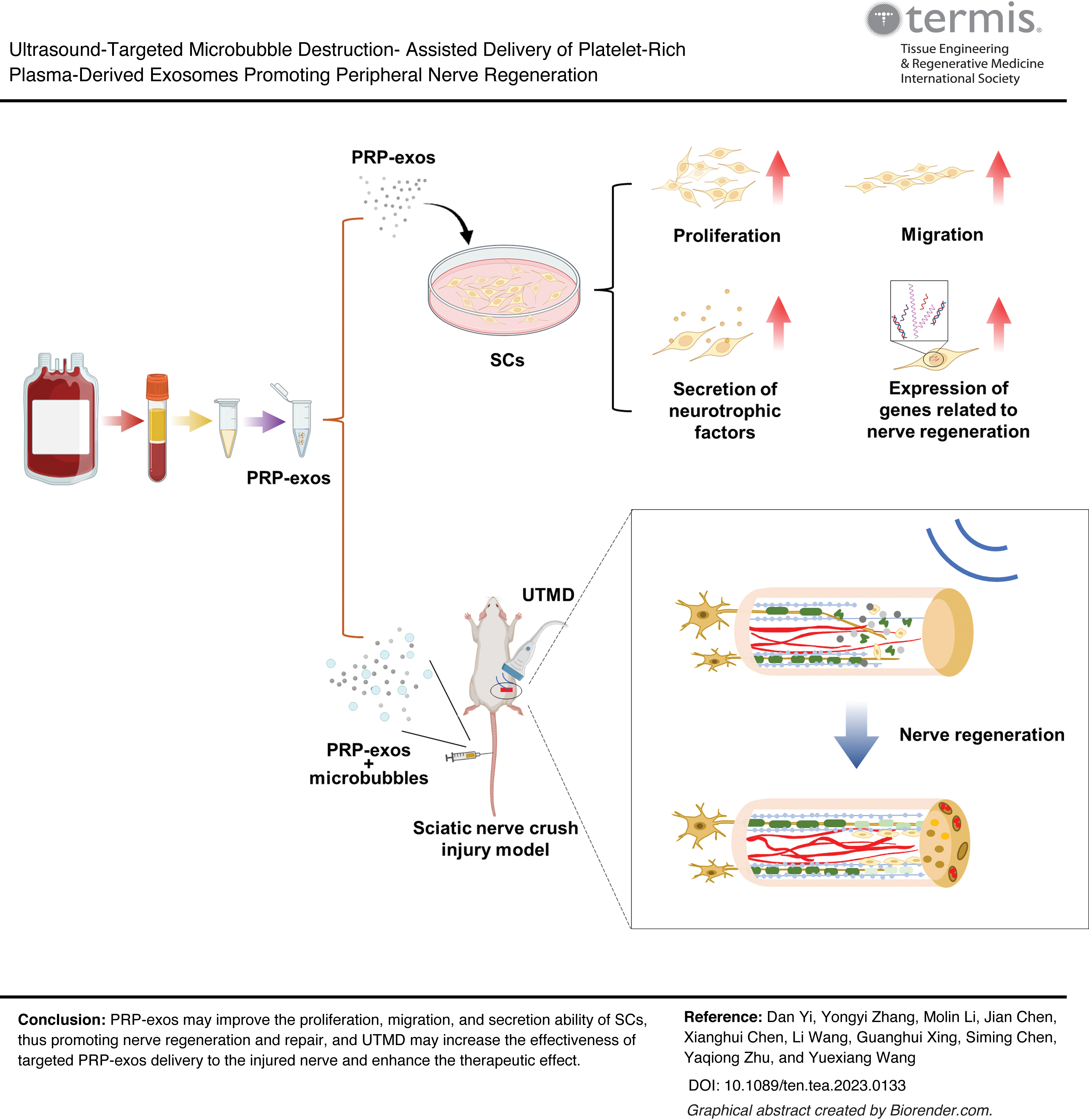
Color images are available online.
Get full access to this article
View all access options for this article.
References
Supplementary Material
Please find the following supplemental material available below.
For Open Access articles published under a Creative Commons License, all supplemental material carries the same license as the article it is associated with.
For non-Open Access articles published, all supplemental material carries a non-exclusive license, and permission requests for re-use of supplemental material or any part of supplemental material shall be sent directly to the copyright owner as specified in the copyright notice associated with the article.
