






Abstract
Background
: Vibrio vulnificus infections develop rapidly and have high mortality and disability rates. Vibrio vulnificus can cause local wound infection, gastroenteritis, or septicemia.
Case Presentation:
In this case, an 86-year-old male was accidentally stabbed in the middle of his right thumb while cleaning whitewater fish and came to the emergency department with high fever and painful swelling of the right hand. Physical examination revealed hemorrhagic bullae in the right hand. Emergency surgery and bacterial culture were performed. Because of timely antibiotic use and surgical treatment, the patient eventually recovered and was discharged from the hospital.
Conclusions:
This case suggests that the possibility of Vibrio vulnificus should be considered in cases of severe infection of the extremities, even without a history of seafood consumption or seawater exposure. Early recognition, rational choice of antibiotic agents, and timely wound debridement can substantially improve the prognosis of patients and reduce mortality.
V
Case Description
An 86-year-old man, who was a retired, presented to the emergency department a day after sustaining a puncture wound to his right thumb while handling whitewater fish. Vital signs on admission included a temperature of 39.6°C, a heart rate of 110 beats per minute, a breathing rate of 17 breathes per minute, and a blood pressure of 117/65 mm Hg. Oxygen saturation in ambient air was 100%. He had a history of pain in his right hand, which he described as being an 8/10. He had a history of type 2 diabetes mellitus and hypertension. He had 4 × 4.5 cm hemorrhagic bullae on the palm of his right hand (Fig. 1) and erythematous swelling with dense tension bullae and petechiae on the back of his hand and forearm.
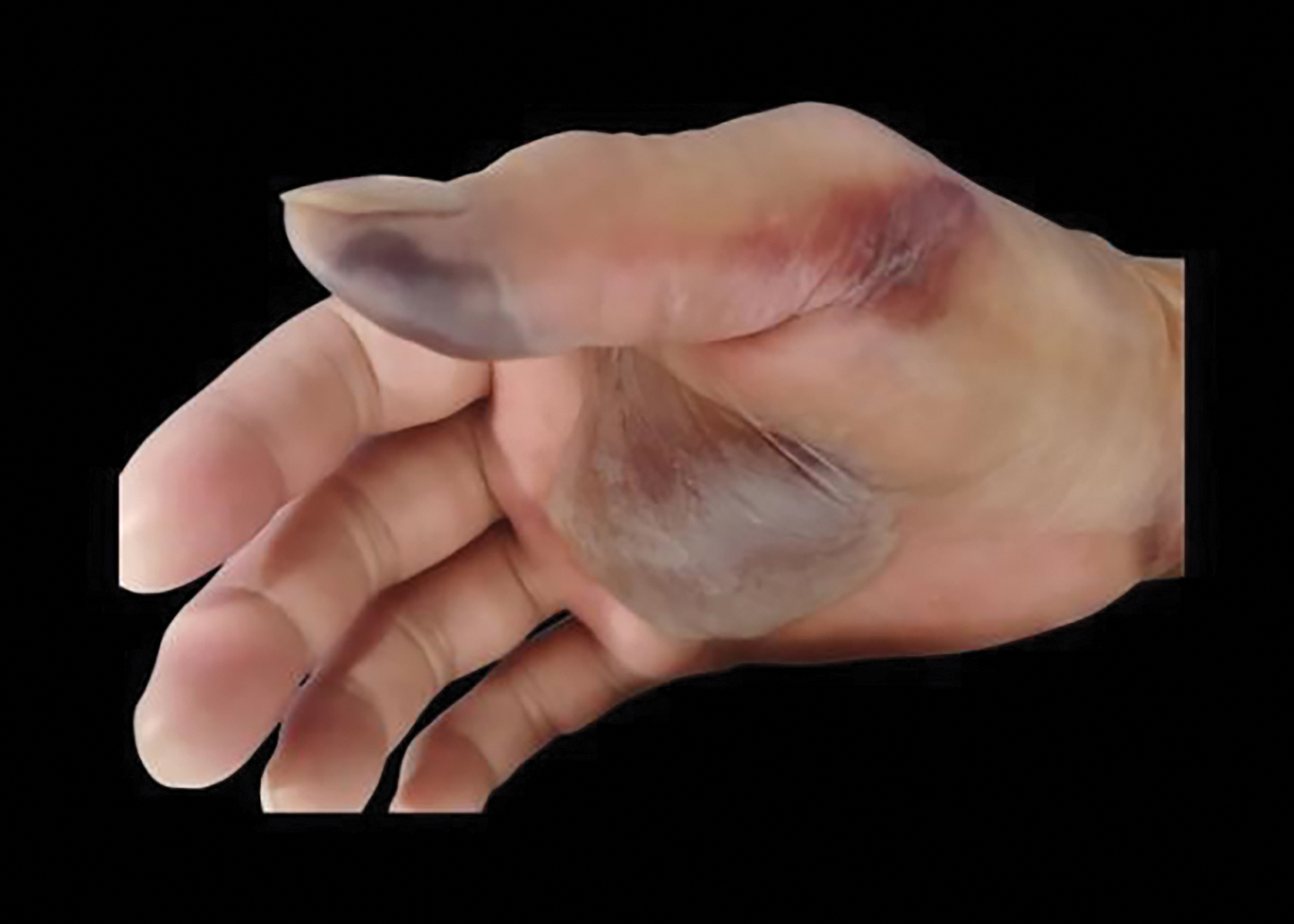
Admission day: there is obvious swelling in the palm and thumb of the right hand. And the base of the right thumb shows inflammation, and there is a huge hemorrhagic bullae on the right palm.
Relevant laboratory data included a white blood cell (WBC) count of 26.5 109/L, 94% neutrophils, and a C-reactive protein (CRP) level of 16.9 mg/L. We performed urgent debridement and isolated the Vibrio vulnificus from the hemorrhagic bullae. The diagnosis of septicemia in the patient was clear. The patient received empirical intravenous antibiotic therapy (piperacillin sodium tazobactam sodium), and over the next 72 hours, a necrotic ulcer developed on the finger (Fig. 2). The CRP level increased to 200 mg/L. The finger was again cleared to remove the necrotic tissue, and histologic examination confirmed the diagnosis of necrotizing fasciitis. After simultaneous consultation with an epidemiologist and according to the antimicrobial atlas, the patient received intravenous dual therapy consisting of piperacillin sodium tazobactam sodium and levofloxacin for 10 days. The temperature was later reduced to normal with a CRP level of 15 mg/L. The patient was doing well at the time of this report and was in our rehabilitation department for further functional hand exercises.
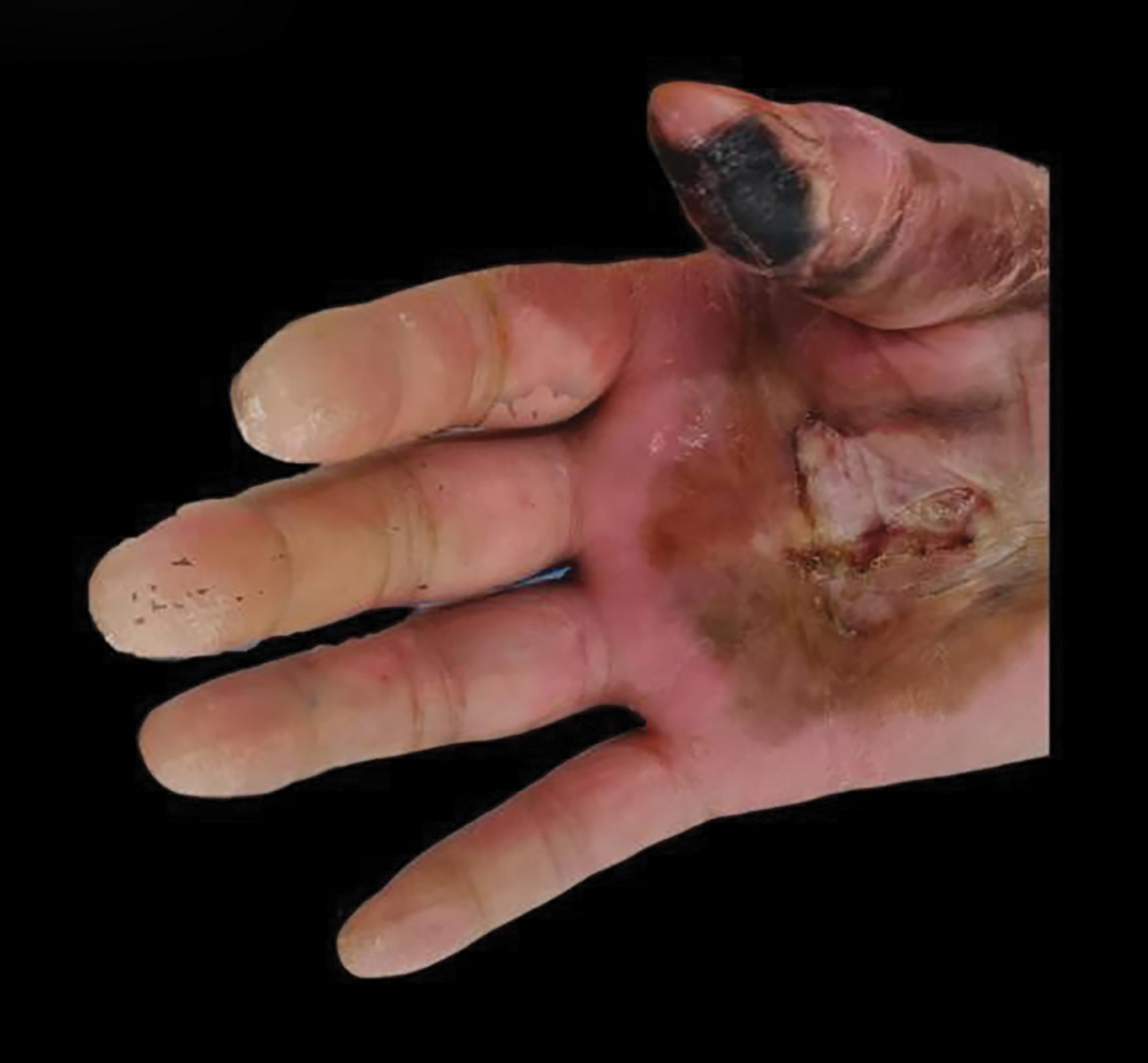
Seventy-two hours after admission: there is necrosis in the abdomen of the right thumb and ulceration in the right palm.
Discussion
Vibrio vulnificus is a gram-negative saline, basophilic marine bacterial pathogen. It usually lives in plankton and shellfish, especially oysters. It grows in water temperatures of 15°C to 27°C and salinities from 0.7% to 1.6% in harbors, stream and ocean connections, and inland salt lakes. 6 Contamination of wounds with Vibrio and the consumption of raw seafood contaminated with Vibrio can lead to both primary septicemia and necrotizing fasciitis. 7 Trauma-related septicemia is a fatal disease with a mortality rate of more than 50%, which is more severe in patients with chronic liver disease. Therefore, the early prevention and treatment of Vibrio vulnificus infections are particularly important.
Vibrio vulnificus is a fatal and opportunistic human pathogen that usually infects human beings through the consumption of seafood or direct contact with open wounds. In our cases, the patient had a history of puncture wounds from freshwater fish, and the possibility of Vibrio vulnificus contamination during transportation and storage was considered. There were also patients with a Vibrio vulnificus infection that caused necrotizing fasciitis in Hong Kong, China, and these patients did not have any history of wound exposure to seawater or seafood consumption. 8 Therefore, the possibility of Vibrio vulnificus infection cannot be excluded despite the absence of a history of seafood consumption and seawater contact.
In this case, the patient had high fever at the time of hospital visit, and immediate blood culture assessments and drug sensitivity tests were performed. Cultures of blood, exudate, blister fluid, and cerebrospinal fluid can be used to isolate Vibrio vulnificus, which is the gold standard for clinical confirmation of the diagnosis. When there are obvious hemorrhagic bullae or necrotic tissue in the infected area of the patient, we can improve the isolation rate of Vibrio vulnificus from these areas. If the patient is accompanied by high fever symptoms, blood culture testing is necessary. Among these cultivation methods, we cannot determine which one is the best. We need to choose methods based on the clinical symptoms of patients. Additionally, rapid and aggressive treatment of the infection is imperative, and we empirically use piperacillin sodium tazobactam sodium until the specific bacteria are identified and their susceptibility is known.
Concerning the treatment of Vibrio vulnificus, surgery is the main treatment for cases of necrotizing fasciitis, followed by appropriate intravenous antibiotic agents, especially combined intravenous doxycycline plus ceftriaxone or cefotaxime 9 or third-generation cephalosporins plus fluoroquinolones.10,11 In our case, the immediate debridement as well as the use of appropriate antibiotic agents ultimately preserved the patient's limb and improved the quality of life.
Concerning prognosis, a history of underlying diseases, such as long-term alcohol abuse and chronic liver disease with Vibrio vulnificus, is likely to result in poor outcome. 5 Additionally, Vibrio vulnificus infection is highly correlated with age, 12 with a higher chance of disease at older ages. Early debridement and a necessary amputation as well as the appropriate use of antibiotics play a crucial role in the prognosis. The earlier they are performed, the lower the mortality rate.
Conclusions
Vibrio vulnificus is a fatal bacterium. Here, we report a case of Vibrio vulnificus infection resulting from a puncture wound sustained from a freshwater fish. In this patient, there was no history of seafood consumption or seawater exposure, which needs to be taken into account. Bacterial culture is the gold standard for diagnosis. Vibrio vulnificus infection can progress rapidly to septicemia, shock, and even death. Therefore, early identification, rational selection of antibiotic agents, and timely wound debridement can improve the prognosis of patients and reduce mortality substantially.
Footnotes
Acknowledgments
The authors would like to thank Dr. Yongxin Mao, photographer, for the assistance he provided in taking photos.
Authors' Contributions
Su and Hu contributed to the planning and organization, collected clinical data, supervised the findings of this work, analyzed the results, and prepared the manuscript. Lui aided in the data collection and supervision. All authors contributed to the article and approved the submitted version.
Date Availability
The raw data supporting the conclusions of this article will be made available by the authors, without undue reservation.
Funding Information
This work was supported by the Natural Science Foundation of China project [82002537].
Author Disclosure Statement
The authors declare that the research was conducted in the absence of any commercial or financial relations that could be construed as a potential conflict of interest.
Written informed consent was obtained from the patient for the publication of this case report. Written informed consent was obtained from the patient for the publication of any potentially identifiable images or data included in this article.