






Abstract
New paradigms that quantify and document an increasingly “digital” era of exploration within the dominantly digital economy present opportunities to think and act in new ways over the upcoming decades, especially within the space domain. The concept of a “forever frontier” [FF], that is defined here as “Space,” can be merged with “digital exploration” to construct the concept of digital exploration of the forever frontier that is space (DEFF-S) as a framework for evaluating strategic business opportunities in space that today are either unimagined, too hypothetical to be attractive, or not measurable with existing metrics and approaches. Through DEFF-S, we can avoid the setbacks, and missed opportunities of unimagined futures especially involving space as a boundless frontier, by embracing an exploration inspired toolkit, mindset, and digital language approach that limits what has been called “equilibrium thinking.” We suggest that DEFF-S, and its more generalized variant DEFF-X, represents an efficient and effective architecture for evaluating pathways in various emerging business domains (including space) with direct application to the evolving digital economy. Specific examples of potential outcomes for this approach guided by consideration of the role of civil space (NASA) from now into the 2040’s and beyond are discussed.
INTRODUCTION AND BACKGROUND
Today, we increasingly operate and reside within the context of a digital economy facilitated by the convergence of computing (IT) and communication technology advancements. The data, code, and algorithms running on our computers, smartphones, and laptops, are reshaping our organizations and society, recalibrating human and machine roles, relationships, responsibilities, and realities, as well as expanding and extending the physics of human exploration beyond the purely “being there” approach of the past ∼60 years. Humans have always been explorers and always will be, even though, as Frederick Jackson Turner explained in the late 19th century [Turner, 1920]: “the frontiers of our domains and environments are oftentimes initially too strong for the women and men who try to pass through them, we find ways to push past today’s frontiers in pursuit of tomorrow’s.” 1
In this era of extending frontiers, we propose that the present and next phases of the digital economy will enable new and significant opportunities for digital exploration (denoted as “DE”). We also suggest that domains within “DE” for expanding business beyond Earth (hence into Space) require consideration of the concept of a “forever frontier”, (denoted herein as ‘FF’) [Garvin, 2013]. 2 Space is a tangible example of a “FF” in the strictest sense (physics and chemistry), yet it is not alone. DEFF-S, the Digital Exploration of the Forever Frontier that is Space, has a series of existing and emergent companions (for example, DEFF-B (Biology); DEFF-C (Computing); DEFF-I (Intelligence), whose shared first principles of exploration and experimentation lead not only to individual domain evolution, but critically provide significant opportunities for cross-pollination and spin-off innovation across multiple domains that delivers new value to our organizations, institutions, and societies (Fig. 1).
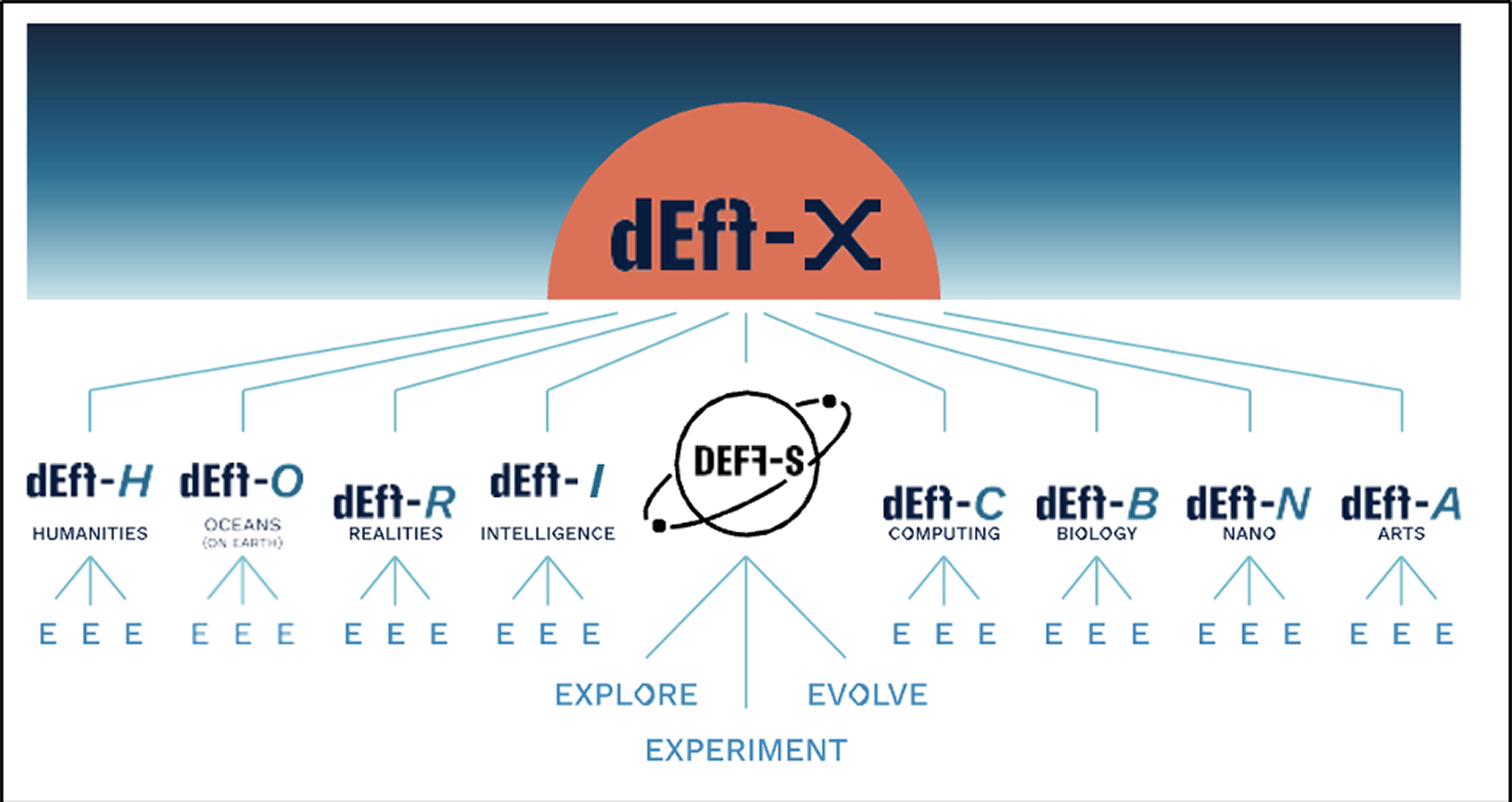
Example domains (denoted by X) within the Digital Exploration (DE) framework, with the 3E’s (Explore, Experiment, Evolve). The DEFF-S (S = Space) is featured at the center as the theme of this work in progress. Please see text for details.
WHAT IS DEFF-S AND WHY DOES IT MATTER?
DEFF-X (with X denoting domain agnosticism) and DEFF-Space belong to a broader digital toolkit, mindset, and digital language researched and built around the concept of Algorithmic Business Thinking, or ABT for short [McDonagh-Smith, 2021]. 3 ABT looks to unify and unite the competencies, potentialities, and intelligence of the 2 worlds we live and operate in today; that is, the physical and the digital (i.e., virtual, or cyber) in ways that are complementary rather than competitive. ABT helps us frame our problems and then with its 4 cornerstones (borrowed from computational thinking) of decomposition, pattern recognition, abstraction, and algorithms (i.e., with ABT are sequenced instructions of human and machines tasks which) enables us to progress towards resolving these problems. ABT captures patterns of success and failure in an individual domain and then offers those patterns and any related datasets to help frame and fix problems in another domain. It is about figuring things out and making them work in ways that provide positive outcomes and deliver shareable and translatable organizational, societal, and economic benefits. ABT invites us to reshape how we address large (and complex) challenges in ways that fit the evolving geometries of the digital society, and domains including Space exploration. It also provides clear signposts to the new organizational and workforce adaptations that will be required to convert the potentialities of digital economy advancements into sustainable and robust value particularly well suited to job creation.
DEFF-X recognizes that digital exploration’s reach will always exceed its grasp and our viewpoint is that this reality is critical to the impact of the concept. Humans and machines working together in partnership extend our forever frontiers, and this is where the past, current, and future endeavors of NASA are so inspirational and important. The women, men, and machines that have written NASA’s history (since 1958 and the Civil Space Act) provide humanity with evidence that each one of us lives in a universe of forever frontiers whose horizons are unbounded and evolving. This is akin to some of the mechanisms discussed in Stephen Jay Gould’s concept of “punctuated equilibria” within evolutionary biology (i.e., with long periods of apparent equilibria, later punctuated by rapid transition periods of extreme change), but here applied to digital economies and exploration, rather than to terrestrial biological processes over time [Gould, 2007]. 4 Thus, punctuated equilibria in a space business context facilitates consideration of rapid transitional states in between times of slower evolution and adoption. This can be witnessed today as commercial crew and cargo are giving way to more entrepreneurial opportunities in robotic spaceflight (e.g., Commercial Lunar Payload Services or CLPS).
In this pathfinder “concept” article, we outline DEFF-Space (hereafter referred to as DEFF-S) and what it can teach us about how to navigate personal and collective Digital Forever Frontiers in our teams, within our companies, but also outside of them, for the benefit of society and the planet(s) we share. DEFF-S aims to provide a potentially unifying framework for expanding and interconnecting business frontiers that embrace multiple sectors, especially the nascent space business aspects created by the expanding digital economy.
We therefore define space not as a final frontier, (i.e., ala Star Trek), but rather as a profoundly forever frontier. No matter what we do, the countably infinite character of space is important to recognize, and so whether we go to another world, another galaxy, or another time in the space-time continuum, there will be an infinite aspect to it, and that’s why it’s “forever.” Furthermore, that’s why it’s always there for us, perhaps intrinsically. Space is the ultimate place for interconnectivity as it is the medium in which we reside, work, and imagine and create. DEFF-S is intrinsically linked to how we now use our environment, which itself is constantly interacting with space. We use space as a tool for navigation, for communications, for situational spatial awareness, for security, for economics, and much more besides its core value for scientific discovery (i.e., as initiated via the creation of NASA via the “Space Act” in 1958).
We hypothesize that without the DEFF-S toolkit (or equivalent constructs), mindset, and digital language, the ability to automate and augment the somewhat ad hoc and “organic” pattern of growth into space by programs such as NASA’s Commercial Crew and Cargo, CLPS, and others will be either limited or sub-optimally organized, even if effective in today’s context (mid 2020’s). Similarly, in applying DEFF-S to help develop a digital economic response to the very real threats of climate change as a domain for exponential business growth over the next ∼25 years, we create not only an important objective but also a significant opportunity that we can begin harnessing today.
DEFF-S approaches drive consilience between transformational space exploration and scientific discovery in multiple domains and industries, sometimes in ways not imaginable under the limits of today’s stovepipes. DEFF-X’s “multiverses” of interconnected forever frontiers are critical when facing up to, and progressing towards, our most pressing challenges and opportunities because by using (and reusing) patterns of success and failure in multiple domains such as the example DEFF-X domains captured in Figure 1 we create new opportunities for inspiration and innovation.
DEFF-X DOMAINS
We consider an ensemble of DEFF-X domains (i.e., X being the domain in question) and how the space example (DEFF-S) connects with each via a 3E model (Explore, Experiment, and Evolve), in the broadest context of a digital economy and as “digital exploration” advances (Fig. 1). While X = S (for space) is an obvious domain, with a historical precedent, the others can and should be developed as well, and in some cases are already under consideration. Another example may be the SeaBed 2030 initiative [https://seabed2030.org/] as a nascent scenario in which the DEFF-Oceans communities are working together to expand understanding and effective utilization of our oceanic domains on our home planet Earth, which itself represents an “ocean world.”
DEFF-S SHARED LESSONS: PRELIMINARY EXAMPLES
Table 1 describes DEFF-S: 10 Key Attributes as a point of departure, with several examples of impact. The selected DEFF-S principles within this Table are illustrated so that they might act as catalysts for cross-disciplinary examples of individual, team, and organizational digital explorations in the context of a future digital space economy. Their impacts are preliminary and can be expanded upon in a variety of contexts. These 10 initial examples (Table 1) can be further enumerated and increased in scope organically depending on the problem of interest within the space exploration domain. Consideration of 3 more specific examples is discussed in an upcoming section.
DEFF-S Primary Attributes with Impact as Example Illustrations
DEFF-S APPLICATIONS
The following 3 examples are intended as provocative “first look” thought experiments that might enable evaluation of the potential of the DEFF-S framework and its parent concepts of DEFF-X and ABT, if further developed. They are not exhaustive nor intended to be but are “catalytic” in spirit. They represent points of departure for further community consideration.
Example 1
Adaptive environmental/climate sensor web for Earth as a value-added monitoring system for climate health and quantifiable improvement as a new digital economy opportunity beyond the current state of commercial and government space platforms (e.g., NASA’s Earth Observing System as “Mission to Planet Earth”).
DEFF-S provides one example of a framework for evaluating whether the digital economy “business case” is at hand to invest in and implement this system of measurement-information nodes in Earth orbit with a results-driven digital scoreboard for “grading” (i.e., beyond the scope of the extant 2024 NASA Earth Information Center [EIC] system: https://earth.gov/) Is there a potential “Google Environmental Health of Earth” type system built around measurement nodes, data mining, and predicting outcomes (akin to a smart search engine) that could be transformative for business as climate-relevant markets emerge that incentivize the betterment of the sustainability of planet Earth for humanity? How could this network of networks be enabled via existing and emergent innovation ecosystems, entrepreneurship, venture capital, and other investment and is there a recalibrated role for government investment as part of infrastructure and services, with links also to security (e.g., for food, water, energy)?
This example builds on concepts that could extend government-enabled capabilities today including NASA’s EIC, and others at National Oceanographic and Atmospheric Administration, and in commercial space. By integrating a series of advanced technologies (including Artificial Intelligence/Machine Learning, Internet of Things, Blockchain, Augmented Reality/Virtual Reality and Compute) in a ’Periodic Table of Digital Elements type approach [McDonagh-Smith, 2021] 5 where the ordering of technologies is based on their key attributes and affinities, DEFF-S approaches can contribute to the creation of a real-time model of Earth’s environmental health and help predictively prescribe sustainable pathways to improve existing key metrics and potentially unearth new ones. This presents a future “business case” for the digital economy.
Example 2
Cislunar deep-space network with inter-node communications, positioning, navigation, timing, delay-tolerant networking, and situational awareness monitoring (including of crew and robotics on the lunar surface via various imaging/sensing approaches).
The intellectual framework that we are defining herein as DEFF-S offers a potential vision beyond traditional telecom/PNT network architectures under planning by NASA and partners (e.g., LunaNet [2021]
6
) for the Artemis As commercial space imagines low-Earth-orbit entrepreneurial space stations (a la Axiom space concepts in development now) and lunar eco-tourism, how would this adaptive, intelligent “network” bring more lunar economic opportunities to light, with plug-and-play (yet secure) connectivity with a level of situational awareness needed for lunar resources utilization and other activities of potential future value (e.g., private lunar «visitors» as eco-tourists in a deep space ecosphere)? How does this lunar “internet of things” with situational awareness encourage new digital economic opportunities beyond government-incentivized ones so that the business of space embraces the Moon much more broadly with benefits directly back to our Earth-based society, including infrastructure to imagine new research in pharmaceuticals (mostly robotic) on the Moon as a safe approach for R&D into potential medical breakthroughs that cannot be tested and validated on Earth?
This example would expand humanity’s reach into lunar orbit with a sensor/telecommunications web that could offer business, technology, innovation, and science opportunities far beyond those imagined in the first wave of the Artemis program as humans return to the Moon (e.g., LunaNet). Imagine a network of lunar orbital imaging and intercommunication nodes that provide rapid situational awareness of key parameters related to human activities on the Moon as basecamps and outposts are established, and which offer connectivity opportunities that advance capabilities beyond Low Earth orbit to cislunar space, with off-ramps that could eventually build up a robotic situational awareness presence at Mars. If such a system were to exist, then business opportunities beyond those now operating in low Earth orbit with commercial imaging systems (e.g., Maxar WorldView, Planet, Capella) could be expanded at the Moon as humanity returns, with value-added benefits for the deep space (lunar) economy but with collateral benefits associated with science and exploration. DEFF-S with ABT principles could develop this opportunity space beyond traditional governmental acquisition practices to incentivize the capabilities and spin-off benefits, which apply directly to digital exploration in the 2030’s and beyond.
Example 3
Space-based universal Quantum computing centers for multi-purpose applications within the digital economy.
Current supercomputing capabilities presently here on Earth could be accelerated by in-space implementation of quantum-computing “super-systems” that use the collateral benefits of the environments of space and advanced quantum telecommunications to provide services at the higher end needs of an evolving digital economy with business opportunities beyond the traditional IT industry players (e.g., IBM, D-wave) and their investments. Via DEFF-S, this space-based quantum IT (SQIT) system could start as a catalyst for moving next generation quantum computing from cryogenic chambers on Earth to solar-energy enabled variants in space and ultimately within cold-traps (at 25K) on the Moon, perhaps tied to outcomes of the Artemis program (and associated infrastructure). Incentivization by government investments and private venture capital could develop the first “nodes” in an expanding SQIT network, that could become a tool in all DEFF-X domains as new ideas are tested at limits of what computing can do, and to evolve a ground-based IT capability on Earth as a system of local backups (like cell towers for cellular networking vs. satellite-based versions). There are many pathways for achieving this, but as conceived it could mobilize the quantum engineering and computing sectors into Space where power and environments could open new possibilities, especially by the 2030’s and 2040’s, with extensibility to unique environments on the Moon and Mars.
This example provides the potentiality for a leap forward in computational capabilities and spin-off innovation across a wide array of fields including, but not limited to, research (given unique conditions of Space); secure communications (with quantum key distribution); Earth observation (including climate monitoring); acceleration of Space exploration (via enhanced simulation) and quantum internet (through the connection od space situated quantum computing centers).
These 3 examples are provocative and yet notably incomplete, but they highlight some specific aspects of the DEFF-S catalytic thinking we have described herein (Table 1) with more concrete and specific potential applications [see also Supplementary Figure S1, Figure S2]. Further examples involving a space-based energy economy that harvests energy relevant resources from space (Helium-3, dark energy, solar power, safer energy storage etc.) could also be developed and evaluated, as well as many others often considered in ongoing visioneering studies by NASA and other space-faring nations. The aim here is to illustrate potential applications and trends associated with the space domain within a digital economy and not provide all the so-called answers, as they must await a wider level of engagement across relevant communities going forward.
DEFF-S SUMMARY AND CONCLUSIONS
DEFF-S is not a silver bullet, nor is it a one-size-fits-all solution to the challenges of Space exploration within the digital economy. It does not pretend to provide all the answers, but it does help us frame key questions to which we can apply humans and machines increasingly connective, collective intelligence to unlock potentialities of Space exploration via business model innovations to deliver new jobs and prosperity.
Where are we today? In the post-WWII era, futurists such as Vannevar Bush (Weisner, 1979) 7 and Werner von Braun imagined a new era for people on Earth potentially capitalizing aggressively on the so-called Space Age circa 1980 to 2000 (e.g., the Hanna Barbera cartoon, « The Jetsons »), but for various reasons missed the digital exploration aspect altogether. Why was that? Perhaps we were too human-centric and not properly extrapolating the exponential advancements in information technology and computing.
Today, amidst the mid 2020’s, we need to guard against the flipside of that historical blind spot. To capitalize aggressively on Space 2025–2045, we need to recognize the ‘Potentiality Paradox’ of the current and next generations of transformative technology which will increasingly rely on human centric capabilities to translate their promise into productivity. DEFF-S invites us to lean further into human-centricity by extending organizational creativity quotient in adaptive ‘double helix’ constructs where the ‘uprights’ of the ‘twisted ladder’ represent the physical and digital worlds we operate within, and the ‘rungs’ of the ladder are human-centric capabilities (or algorithms) such as creativity, curiosity, critical thinking, and collaboration key to combining technology with human ambitions responsibly and sustainably.
A good barometer of where we are today may be viewed in the recent partial-success of NASA’s CLPS program with the recent (2024) Intuitive Machines IM-1 robotic landing on the Moon (via the lander Odysseus). In 1969, humanity landed metric tons on the Moon with Apollo 11 with limited IT and digital exploration tools but an abundance of creative brute-force and good will to make it happen, and the NASA Apollo program landed 6 times with precision during 1969–1972. None of these landings tipped over or experienced performance issues, nor did the NASA robotic Mars landings in 1976 (Viking), 1997 (Pathfinder), 2004 (Mars Exploration Rovers), 2008 (Phoenix), 2012 (Curiosity rover), 2018 (InSight), and 2021 (Perseverance rover). A key DEFF-S message is that by leveraging the patterns of success (and failure) of the past, we can better translate todaýs ambitions into definitive action. The lesson’s learned of these pre “digital exploration era” achievements can be harnessed and fed forward to enable nascent programs such as CLPS (and similar ones for lunar orbit, Mars, etc.) to succeed in new ways, expanding access and utilization of the forever frontier.
How will we move from this mindset of ambition to definitive action? We will begin by “never waiting to wonder” in approaching complex problems, whether they be in the space domain (DEFF-S), or each of the domains in which others dedicate their efforts (DEFF-X) armed with the capability of an evolving human and machine partnership and the confidence that gives us (Fig. 1). DEFF-S will advance us towards our challenges not expecting to always overcome, or resolve them, but committed to making progress that those that follow can build upon. We will be inspired, not intimidated by the “shifting sands,” or moving horizons of the digital economy and its evolving marketplace. We will ask ourselves questions for which we have not yet designed models or measurement systems to adequately explain. We will share our answers and try our very best to improve the human condition on our home planet Earth, and ultimately on other worlds (the Moon) we will share.
The DEFF-S paradigm provides a toolkit and mindset for better “imagineering” what could come on decadal timescales, as nascent breakthroughs are evaluated, enhanced, enabled, evolved, and ultimately executed. The forever frontier that is space (DEFF-S) features an apparent digital exploration barrier because of its apparent physical magnitude, even with digital telecommunications and in-space IT infrastructure. Fundamental physics appears to challenge, or limit us, so how can we look beyond such hurdles to invent solutions that extend to the broadest cross-section of society? That is the ultimate challenge. Will it be the insertion of quantum computing, telecommunications, and all that into the equation, or simply non-linear scaling of the relationships? With DEFF-S, we can explore and experiment with these questions and frame new questions to scaffold our progress upon.
In closing, by means of this conceptual pathfinding missive, we aim to provide an outline of what DEFF-S is, why it is relevant today, and how it will provide value both within the domain of Space Exploration but also as a signpost for the potentialities of its DEFF-X counterparts. Clearly, there is considerable work to be done but equipped with our DEFF-S toolkit, mindset, and digital language, we will make progress and expand the value of the space frontier in ways not possible during the past ∼66 years of the “space age.” We will live within Space as a forever frontier with distinctive benefits if we develop the toolkits to create discoveries, capabilities, and opportunities that advance digital economic development, and enable an upcoming era of profoundly digital exploration that expands exponentially beyond today’s state-of-the-art (see Supplementary Materials: Supplementary Fig. S1, Fig. S2).
Footnotes
ACKNOWLEDGMENTS
This work was motivated by NASA connections with MIT Sloan School of Management over the past 4+ years, and via the creative opportunities suggested by NASA senior leaders during summer of 2022 (i.e., the innovation challenge by the NASA CFO). It represents a new flavor of partnership for the digital transformation at hand for NASA and for space exploration. We are grateful to the Reviewers of New Space for providing constructive feedback and comments that substantially improved our article.
AUTHOR DISCLOSURE STATEMENT
No competing financial interests exist.
AUTHORS’ CONTRIBUTIONS
J.B.G.: Ideation, data acquisition, writing, reviewing, editing. P.M.-S.: Ideation, data acquisition, writing, reviewing, editing.

References
Supplementary Material
Please find the following supplemental material available below.
For Open Access articles published under a Creative Commons License, all supplemental material carries the same license as the article it is associated with.
For non-Open Access articles published, all supplemental material carries a non-exclusive license, and permission requests for re-use of supplemental material or any part of supplemental material shall be sent directly to the copyright owner as specified in the copyright notice associated with the article.
