






Abstract
Over the past several years, a quiet evolution has been unfolding at the “final frontier” as governments around the world take action to implement New Space policies for their respective states and open space to commercial activity led by private capital. Privy to only a few elite groups until recently, access to space for new players is broadening as a result of the passage of new regulations such as the NASA Transition Authorization Act of 2017 by the U.S. government or proposed draft regulations such as the Space Activities Bill by the Indian government.
Low Earth orbit space offers a unique vantage point and a persistent microgravity environment that can be leveraged by private companies and researchers to facilitate new discoveries, inventions, and innovative business models. For educators, space can inspire the next generation of humanity via a partnership with entrepreneurs. India has demonstrated leadership in the information technology, pharmaceutical, and biotechnology industries. Here, we provide a brief history of India's presence in space, an overview of its key industries, a perspective on New Space, and India's strategic opportunity in the rapidly growing space ecosystem.
Introduction
The launch of Sputnik, the world's first satellite, by the Soviet Union on October 4, 1957 and then cosmonaut Yuri Gagarin, the first human to orbit Earth on April 12, 1961, officially marked the beginning of human space exploration. 1 This was followed by increasingly complex visits to the low Earth orbit (LEO) capped by a series of Apollo Moon missions by the United States, culminating in humans landing on the Moon in 1969. 2 The 1980s ushered in the Space Shuttle era and the Russian Mir Space Station. 3 And the new millennium has reveled in the glory of the International Space Station (ISS) orbiting the planet at 400 km above. 4
Now in humanity's 60th year of space exploration, the landscape is fundamentally different. The “democratization” of space has led to a global paradigm shift from “old” to “New Space.” 5 Some states have swiftly embraced this shift as an opportunity on many fronts. There is no playbook for the next era of human presence in space. We believe that space presents opportunities for innovation and entrepreneurship for an emerging nation such as India, which has a track record of visionary thinking as demonstrated by its global leadership in the information technology (IT), pharma, and biotech industries of today.
A Brief History
India's Interest in Space
India gained independence from British colonialism on August 15, 1947. However, it was the 26th of January 1950 when India's constitution, adopted previously on 26th of November 1949, came into effect and India fully transitioned into a republic for its ∼376 million citizens. 6 For comparison, in 1950, the U.S. population was 152 million with a per capita gross domestic product (GDP) of $9,573 whereas India ranked 14th in the world after the United States with a per capita GDP of $597. 7 More recent data indicate that India's population has nearly quadrupled, putting it at 1.3 billion inhabitants compared with the 2 × growth in the United States over the past 70 years. However, India's per capita GDP increased by only 3.5 × to $2,100 whereas the United States experienced nearly twice that at 6.8 × , resulting in $65,100 per capita GDP (Table 1).
A comparison of population GDP per capita in 1950 and 2019 between India and the United States
GDP, gross domestic product.
Given the striking differences in economic conditions between India and the United States, India's steadfast focus on space is notable and curious. This begs the question “why?” Why divert $2B (0.7% of the Indian government's total budget) toward the Indian Space Research Organisation (ISRO), when millions of Indian citizens still live in extreme poverty 8 ?
Career scientist and former president of India, A.P.J. Abdul Kalam, defended the Indian space program with this: “Very many individuals with myopic vision questioned the relevance of space activities in a newly independent nation which was finding it difficult to feed its population. But neither Prime Minister Jawaharlal Nehru nor Professor Vikram Sarabhai had any ambiguity of purpose. Their vision was very clear: If Indians were to play a meaningful role in the community of nations, they must be second to none in the application of advanced technologies to their real-life problems. They had no intention of using it merely as a means of displaying our might.” 9
Indian Space Program
India is no stranger to space. Within 1 year of its independence, and King George VI still the head of state, India formed the Department of Scientific Research on August 10, 1948 with a specific focus on space research. Through a series of organizational transitions, ISRO was eventually created in 1969 to serve as India's equivalent to America's National Aeronautics and Space Administration (NASA). India launched its first sounding rocket for a suborbital flight in 1963. Next, India focused on launching satellites to orbit and achieved a key milestone on April 19, 1975 by launching the first Indian-designed and built satellite. 10
In the 1980s, India transitioned to designing and building Satellite Launch Vehicles (SLV) to carry payloads up to 88 pounds to LEO and in the same decade completed its first human spaceflight mission to the Russian space station Salyut 7 on a Soyuz rocket. 11 The SLV evolved into the Augmented Satellite Launch Vehicle with payload capacities of 330 pounds, and ultimately the Polar Satellite Launch Vehicle (PSLV) became the primary focus in the 1990s. 12 On November 5, 2013, the PSLV launched India's first Mars Orbiter Mission, successfully inserting into the Martian orbit on its first attempt on September 24, 2014. 13 The most successful of India's launch vehicles, an advanced version of the PSLV called the Geosynchronous Satellite Launch Vehicle (GSLV), launched India's first moon mission—Chandrayaan-1 in 2008. 14
More recently, the GSLV carried the Vikram lunar lander to the moon on the Chandrayaan-2 mission in 2019. 15 This brief history of India's space activities is demonstrative of India's commitment to its space program through earnest, methodical, and successful deep space missions, and done so in a cost-effective manner compared with other space-faring nations. Now, India is pursuing an indigenous path to LEO and microgravity research. The Indian human spaceflight program was launched in 2020, and there are plans to build a space station by the 2030s with transport provided by an Indian-built crewed orbital spacecraft called the Gaganyaan by 2023. For a nation not even 75 years old, India's aspirations for a presence and leadership in space are astronomical.
This vision of being “second to none in the application of advanced technologies to their real-life problems” still holds true three-quarters of a century later at the dawn of the “New Space” age. With leadership and expertise already established in information technology and business process management (IT-BPM), biotechnology, and pharmaceutical contract research and manufacturing services (CRAMS), Indian companies are well positioned to quickly become a fierce competitor in the emerging “New Space” ecosystem, if they so choose. Indians can be leaders in space tech, because Indians have a track-record of successful visionary thinking when it comes to establishing new markets and ecosystems.
Information Technology
India's IT sector, born out of a partnership between Tata Consultancy Services and Burroughs in 1967, reached prominence around 2000 when the Indian workforce was tapped to avert a global IT crisis related to Year 2000 (Y2K) issues. 16 Foreign clients continued to flock to India for support with pre-Y2K legacy systems, ultimately establishing India's dominance in the IT industry. In 2020, India's IT-BPM industry generated $191B in revenues and expects that figure to increase to $350B by 2025. 17 Twenty years into the new millennium, India's “IT-BPM” has evolved into a vibrant, innovative industry driven by the rising global need for complex IT systems management. 18
Pharmaceuticals and Biotech
In parallel, during the 1970s, India delved into the life science industry and emerged as a global leader in both pharmaceutical drug manufacturing and biotechnology research and development. India's pharmaceutical industry is currently valued at $41B and poised to grow to as much as $130B by 2030. 19 India ranked third in volume and 13th in value for its $20B worth of exported medicines in 2020. Today, India's pharmaceutical activities are primarily focused on CRAMS, which include drug formulations.
With total exports at 20%, India is the leading manufacturer of the world's supply of generic and branded active pharmaceutical ingredients (API) as well as biosimilars. 20 Separately, the Indian biotech industry—comprising five major sectors that include biopharmaceuticals, bioservices, bioagriculture, bioindustrials, and bioinformatics—is expected to grow from $55B in 2020 to more than $100B by 2025. 21 It was the early visionary government funding for infrastructure, educational training programs, research, and policy that laid the foundations for a strong biotech industry in India. 22
And, although the global COVID pandemic has been devastating for the 1.4 billion Indian residents, it has been a boon to India's pharmaceutical and biotech industry, which has stepped up to the challenge of formulations, manufacturing, and packaging vaccine doses. 23 In doing so, key gaps in the supply chain have been identified, such as the availability of raw materials for API manufacturing. 24 In addition, a draft of the Science, Technology, and Innovation Policy authored by India's Department of Science and Technology was released in 2021 that calls for “open” and decentralized discovery and innovation efforts as a step toward democratization of science. 25
Old Space Versus New Space
Space activities with government at the helm are now referred to as “old space” or “traditional space” to distinguish between space activities led by the private sector. 26 Unlike old space, there is no specific date or event that marks the beginning of “New Space” but rather a convergence of several events around the late 2000s such as the NASA Authorization Act of 2010, the final Space Shuttle mission in 2011, and private contracts awarded to commercial launch providers for cargo resupply services to the ISS. However, there are clear characteristics that define New Space—missions and projects led by commercial players, investment of private capital, an entrepreneurial spirit, and the emergence of new markets. 27 Old space was privy only to governments of elite states, whereas New Space is open to a diverse group of users. 28
The Indian government has recognized this shift in space culture and responded by approving the creation of Indian National Space Promotion and Authorization Center (IN-SPACe) in June 2020. 29 IN-SPACe will cater to nongovernmental private entities to encourage and support their participation in the space ecosystem by opening access to the ISRO's space infrastructure, capabilities, and services. 30
This policy reform aims at addressing the missing legal, regulatory, and administrative framework necessary to drive private investments in the Indian space community while also significantly lowering the barrier of access to space for the Indian private sector.31–33 The Indian space industry is speculated to be valued at $7B, or about 2% of the global space economy, and it is primarily defined by launch vehicles, ground systems, spacecraft systems, and applications services.34,35 Although this is a sizeable market share of the space industry for this young nation, other untapped opportunities in space, such as space-based biotech, pharma, and IT infrastructure and services, hold potential for India.
India has consistently focused on space research for the purpose of exploration beyond the Earth and practical applications back on Earth. With aspirations to fly government-sponsored astronauts to space on 7-day missions inside the Gaganyaan, India is now considering microgravity research. In preparation for human spaceflight missions, ISRO released a call for research proposals in July 2020, which included “simulated microgravity” as one area of research focus. 36 Still missing from India's space vision is the opportunity to leverage the microgravity environment to spawn a space-based biotech and pharmaceutical industry.
As the Indian government matures plans for its own space station, it can, in parallel, lay the foundation for space entrepreneurs to capitalize on the current global interest in space. The Indian government is poised to play an important role in spawning a thriving space-based economy in the future, both as an investor and as a customer.
The Space Environment
LEO is a unique environment defined by extreme conditions such as ionizing space radiation, extreme temperatures that cycle 260°C between the hot and cold extremes, a near-complete vacuum with no atmosphere, and an abundance of atomic oxygen. 37 Spacecraft in LEO, such as the ISS, can provide a unique vantage point from 400 km above the Earth with an orbital path that covers 90% of the planet's surface. 38 The ISS is a place with persistent weightlessness—or commonly known as “microgravity”—which is achieved as a result of continuous freefall. 39
This unique space environment presents an equally unique opportunity for research, discovery, and innovation supporting India's human spaceflight and exploration efforts off the planet, and more importantly opportunities for improving the health and well-being of Indian citizens on the ground.
Space to Invest
The Space startup marketplace is growing rapidly worldwide. According to a 2020 report from a market research group called Bryce Technologies, venture capital accounted for 71% of the $5.7B total investment pool for space startups in 2019. 40 That number increased to $12.1B in 2020 according to reports from Space Capital. 41 With private and venture capital becoming a popular mode of fundraising, investments in the space sector have reached an all-time high in 2021 and are expected to increase even more in the coming years. 42
At the local level, India is also experiencing a rise in New Space startups. At the time of this writing, our research returned 29 space-focused companies with Indian origins (Table 2). We organized these companies into six broad categories based on commonalities observed between them. We combined satellite manufacturers, launch vehicles, and landing systems into the “space infrastructure” category. Two of the 29 Indian New Space startups (Bellatrix and Pixxel) are “minicorns” or high-growth early stage ventures. 43
A List of 29 Indian New Space Companies Organized by Category Based on Service or Product Offering
Asterisks indicate potential for “unicorn” valuation.
ReOrbit, originally headquartered in India, re-established its operations in Helsinki, Finland where funding opportunities are more promising because, according to ReOrbits founder, space is more “application-driven in Europe” and the regulatory environment is more transparent, unlike in India where space is defense-based and there is no clear path for entrepreneurs to seek startup venture capital. 44 Further, it is interesting to note that the Indian New Space companies are primarily focused on hardware and software engineering (via space infrastructure and data science) and education. There is only one company—Astromeda.in—that provides biological payloads to space via partnership with a U.S. entity.
These data suggest that space is a source of new opportunities for entrepreneurs to innovate and create value. According to a survey conducted by The Economic Times, India is the third largest startup ecosystem. 45 How can India leverage the growing global trend toward space and a rising interest in domestic entrepreneurship to strengthen its economic position as a space-faring nation?
Space and Microgravity as an Innovation Platform
Space can be viewed as a new tool for innovation in the life sciences for biotech, pharma, and agriculture. Continuous human presence aboard the ISS in LEO over the past two decades has enabled more than 3,000 research experiments that have revealed an entirely new understanding of the physical and biological sciences and a new perspective on conducting scientific research as a result of these extreme space conditions. 46 Biological research in microgravity has relied on a variety of organisms such as microbes (e.g., yeast, bacteria, viruses), plants, fish, worms, fruit flies, rodents, and even humans to model and predict risks of spaceflight.47,48
Interestingly, this research has also revealed novel ways to apply the on-orbit platform for ground-based benefits. Due to the unique features provided by continuous weightlessness (Fig. 1), a number of global pharmaceutical companies have begun exploring microgravity as an innovation platform (Table 3). For example, microgravity is showing promise for accelerating drug discovery. In space, organisms undergo systemic cellular and physiological adaptive changes that are similar to those observed during normal aging on the Earth, with the main difference being that space adaptation is accelerated compared with Earth-based aging.49,50 This reversible, accelerated aging phenomenon observed in space diversifies the available toolset for disease modeling in drug discovery.
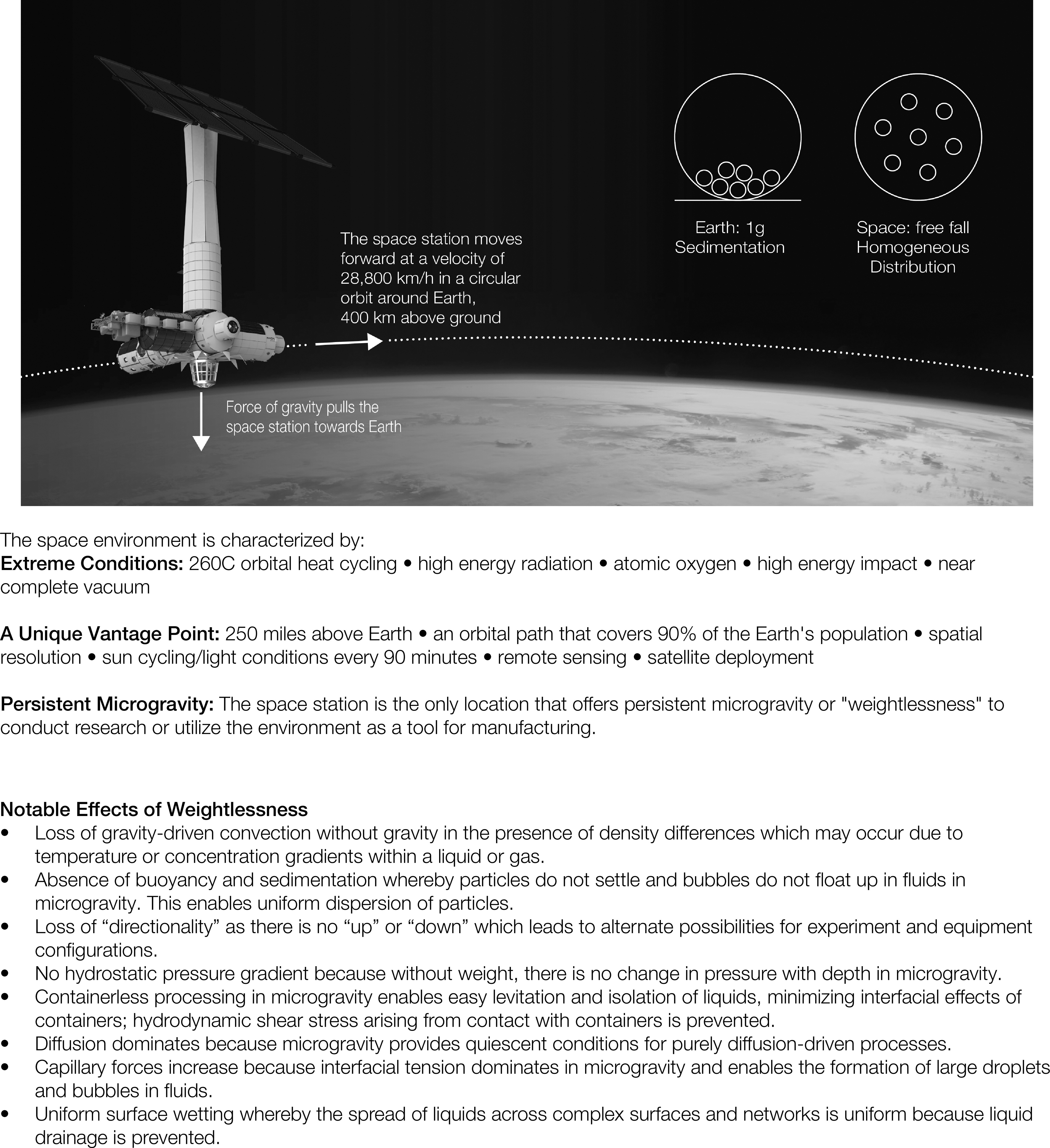
Key features of the space environment and notable effects of weightlessness.
Examples of Pharmaceutical Companies and Respective Space-Based Projects in Microgravity
BMS, Bristol Myers Squib; ISS, International Space Station.
The microgravity environment provides a clear advantage, specifically for bone and muscle disease modeling, because the confounding effects of continuous weight-bearing forces are eliminated without any genetic manipulation. 51 These accelerated aging phenotypes also provide opportunities for modeling age-related diseases such as Alzheimer's, Parkinson's, and heart disease in a minimally invasive manner.
Amgen conducted experiments in space to validate their bone loss prevention drugs Evenity and Prolia.52,53 More recently, Sanofi has used the orbital platform to study viral replication during an immune response. 54 Other types of investigations in space have sought to understand drug delivery. Astra Zeneca investigated nanoparticle formation to aid in the development of a drug delivery device whereas Eli Lilly has used space to understand issues with lyophilization where stratification of freeze-dried matter is observed.55,56
Microphysiological tissues chips have been adapted for space experiments as novel tools for disease models and/or drug screening in a miniaturized format. 57 Interestingly, space may confer an advantage for regenerative medicine whereby the possibility of symmetric stem cell renewal may be enhanced in microgravity. 58
Similarly, three-dimensional (3D) bioprinting and growth of 3D human tissues maybe more advantageous in microgravity, because the environment enables more complex geometries and networks, thereby producing more physiologically relevant products. 59
Microgravity has also demonstrated value for protein crystallization, allowing the growth of larger, more highly organized crystals compared with the Earth. 60 This has implications not only for accelerating medicinal chemistry efforts, but also for re-formulating protein-based biologics (such as monoclonal antibodies) from intravenous to subcutaneous injection, which then results in a significant positive economic impact. 61 Small molecule crystallization in the microgravity is the next innovation for API development.
The space environment can also be leveraged for pharmaceutical process improvement. For example, levitation without a container, known as “container-less processing,” is useful in the manufacturing of APIs that holds the risk of reacting with the container. The weightless environment provides a direct means for container-less processing of pharmaceutical ingredients. 62 In addition, the production of certain APIs is a highly toxic process that poses an occupational hazard to the operator and is thus an important challenge to address in pharmaceutical manufacturing. 63
Interest in high-potency active pharmaceutical ingredients or HPAPIs has been increasing because HPAPIs elicit a biological response at a very low dose and with fewer side effects. 64 However, HPAPIs are also highly risky to manufacture and despite their continued rise, a gap in manufacturing capabilities persists. 65 Adapting the continuous manufacturing process for HPAPI production is a path forward, yet it is slow to take off. 66 “Off-shoring” manufacturing to an off-the-planet facility, such as a commercial space station, provides an alternative for reducing toxic pollutants into the terrestrial environment while taking advantage of persistent microgravity to conduct complex chemical syntheses that may be challenging to execute on the Earth. 67
Axiom Space is building the first private space station for commercial use that is human-rated and designed to be modular with each module equipped to act as an independent spacecraft. Thus, these modules can also serve as autonomous spacecraft to carry out fully automated activities such as HPAPI manufacturing in orbit. This futuristic vision of pharmaceutical drug manufacturing offers innovative potential and presents a unique opportunity for Indian drug manufacturers to collaborate with fellow Indian engineers and biotechnicians to develop novel technologies adapted for on-orbit operations.
Bioagriculture research in space can have applications for crop production in “extreme” environments and conditions on Earth such as resourced-constrained communities in developing countries such as India. According to the Food and Agriculture Organization of the United Nations, India was the leading producer and exporter of wheat and millet worldwide, and second to China for rice in 2019. 68 India is also the leading producer and exporter of a variety of fruits, vegetables, and spices. The agriculture industry employed 43% of the total Indian workforce and accounted for 20% of India's GDP in 2020.69,70
However, although food is the most important consumer product produced in the world, Indian farmers are among the poorest and struggle to earn a living wage. 71 In India, this is a result of several key challenges facing Indian farmers that include: low seed quality, poor soil health, unreliable water supply, lack of advanced affordable farming technologies, fragmented land holdings, and insufficient or altogether absent storage facilities. 72 Space-based technologies have already demonstrated value to farmers via remote-sensing satellites that can be used for “precision farming” by providing data on weather patterns; land use; identification of nutrient deficiencies; and plant damage due to disease, insects, chemicals, weeds, or inclement weather. 73
Studies on plants in space have led to innovations in vertical agriculture, use of light-emitting diodes to improve photosynthesis, more effective fertilizers, and improvements in water delivery systems. 74 At the molecular level, a study of plants in a weightless environment has revealed novel insights into plant root formation, seed formation, reproduction, and gene expression, which provide a greater understanding of how plants respond, acclimate, and adapt to extreme environments. 75 Taken together, remote-sensing technology in combination with in-space research on seeds and plants can result in optimized solutions for a greater return on investment for the Indian farming community and the larger global population.
A future in space is inevitable. Taking the long view will help position India to be among the leaders in the New Space ecosystem.
Building for Spaceflight
Space is an extreme environment. Building for an extreme environment requires unconventional “outside the box” thinking. Innovative products that can be applied to other “extreme” environments and conditions on Earth are a by-product of this unconventional thinking. For example, with limited water capacity in space, researchers have focused on exploring more efficient water-delivery systems, or newer approaches to processing and recycling waste whereas other efforts have focused on improving crop yields.
Building for space also presents a unique opportunity for expanding terrestrial markets. Terrestrial bench science must first be translated into orbital science before spaceflight. However, presently, astronaut-assisted experiments and processes on-orbit are constrained by the physical limits of available crew and time. Thus, one approach to building for spaceflight involves translating terrestrial science to into automated systems on Earth and then into remote-controlled automation in space. Finally, orbital automation systems for manufacturing are scaled up.
Building for spaceflight also pushes the boundaries of innovation. For example, due to mass and size constraints as well as exposure to the rigors of launch, space-bound technologies must be “ruggedized” or “flybridized.” This involves miniaturizing the technology; reconsidering material selection toward lighter-weight, more durable materials; automating operations; revising and adapting microfluidics for weightlessness.
These new product features can result in tangible benefits such as a smaller footprint, increased mobility, lower product cost, increased ease of use via automation, increased accessibility ultimately resulting in new uses in new markets such as extreme environments on Earth (e.g., deserts, oceans, mountains, arctics), and underserved communities in remote or rural areas (Fig. 2). The ruggedized product versions can be applied for education and do-it-yourself projects as well. Thus, building for spaceflight can result in innovation and expansion of secondary and tertiary markets on the ground, which may result in job creation and economic benefits.
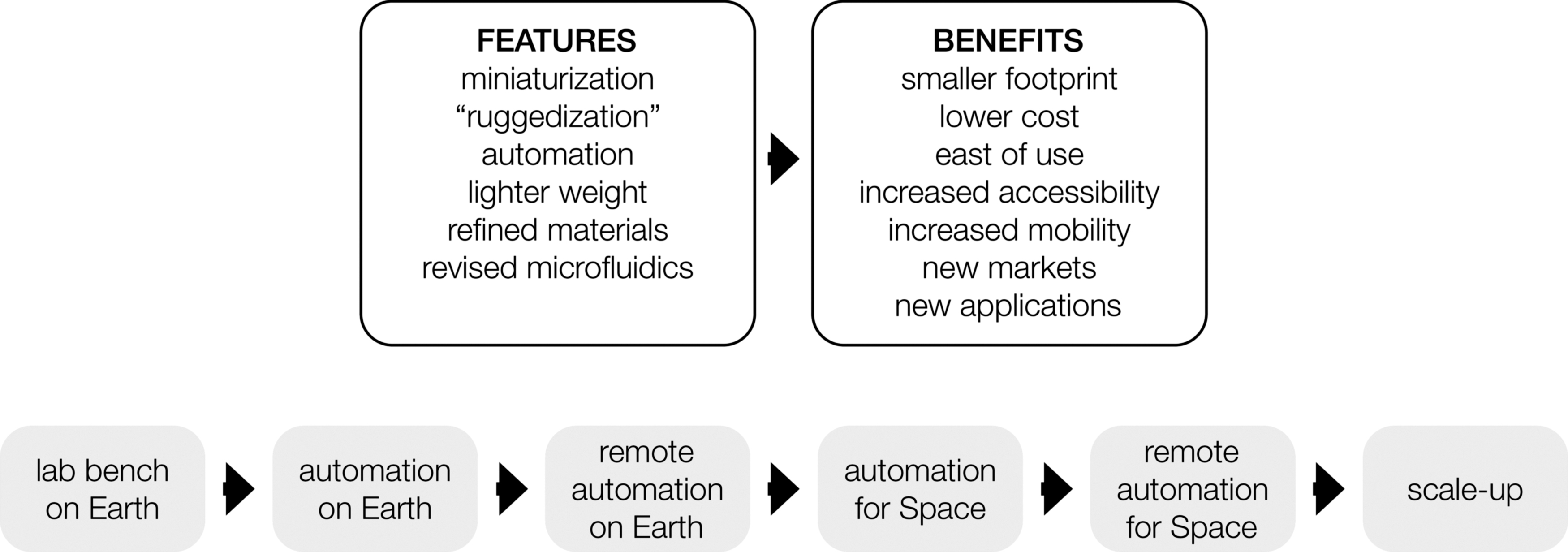
Space value chain. Top: Building for spaceflight leads to development of new products, with new applications, and subsequently launch of new markets. For example, spaceflight-validated systems can be used in extreme environments on the Earth such as hot desserts, deep oceans, the cold Arctic, and high mountain altitudes. These “ruggedized” and miniatured products also have potential for utility in new markets such as STEM education, do-it-yourself or “DIY” projects, and in remote under-served or rural areas. Bottom: Translating Earth science to space science is a multi-step process. STEM, Science, Technology, Engineering, and Math.
Space Entrepreneurship as a Means to Economic Growth
Startups are known to drive entrepreneurship, innovation, and economic growth.76–79 Space entrepreneurship is one way to do that. India's culture of “frugal innovation” provides Indians an advantage and positions it to disrupt the status quo and expand the emerging space ecosystem into new markets that are currently inaccessible to space. 80 Often, new research in microgravity demands specialized hardware to adapt science to microgravity application and automated systems when crew time is not freely available. Although several U.S. and European companies provide such spaceflight hardware development and integration services, the costs may be prohibitive for the emerging Indian markets.
Seed funding for new technology development led by Indian entrepreneurs is a longer-term and more sustainable strategy for building a space ecosystem on the ground that extends into space. Lack of availability of affordable technologies for orbital science investigations is a critical gap for Indian space scientists and an opportunity for “frugal innovators.”
Launching into orbit in 2024 and flying commercial payloads and human spaceflight missions to the ISS today, Axiom Space presents an immediate opportunity for Indian entrepreneurs to fly and validate their space hardware and services in a true microgravity environment. Immediate development of regional space value chains (Fig. 2), which involve multiple components and services, creates an entirely new industry.
For example, service-based companies can provide expertise for translating terrestrial science into orbital science. In parallel, hardware engineering firms can develop the appropriate hardware to meet spaceflight requirements for various types of biological payloads. Additional spaceflight hardware is required for ground-based operations. A spaceflight experiment typically involves developing, testing, refining, and validating every step of the experiment on the ground with the same equipment to be used in orbit to develop protocols and address any potential issues. In addition, the same equipment is also used in parallel for conducting a “ground control” experiment as a means for comparison to the spaceflight experiment.
Further, spaceflight hardware equipment can serve a variety of organizations for purposes of training terrestrial space laboratory technicians or teaching students in space-based academic programs and curricula. Taken together, spaceflight hardware has a broad market.
In addition to hardware engineering and service consulting, an IT infrastructure needs to be extended to space for a space-based market. The already existing brainpower and expertise in IT provides Indians with an entrepreneurial edge to take a leadership position in this realm. For example, life science technologies, whether in biotech, med-tech, health-tech, or diagnostics, have advanced to generate more granular data and thus much denser datasets. On-orbit remote processing and analysis of such data require innovative solutions, such as space IT infrastructure aimed at reducing large digital data footprints to more economical sizes.
In addition, due to the physical distance between a ground user and the payload in orbit, software interfaces to the hardware technologies are required not only for an optimal user experience, but also for remote control of equipment and automation for scale-up. And, as new data are generated from experiments, novel analysis methods will be required to extract insights, thus creating a need for software programmers. Remote-sensing and Earth observation applications such as those for farming also result in enormous amounts of data, which can be both slow and costly to download to Earth. Space-based cloud networks to perform data analysis can result in orders of magnitudes higher efficiencies in time to processing, transmittal, and cost.
Similarly, image data generated via high-resolution optical imaging microscopy on-orbit can be analyzed in the “space-cloud” rather than being transmitted back to the Earth in large file formats. These are only a few examples of how spaceflight creates additional value chains in a local market.
Activation of these value chains in India extends beyond the country's borders into regionally adjacent emerging economies with similar price sensitivities and accessibility challenges. This will serve to expand the space marketplace even further by creating a greater demand for products and services, and subsequently revenue for Indian New Space companies. Rather than waiting on the sidelines until indigenous space infrastructure is available, Indian companies have an opportunity to engage as an active player in the New Space economy today. Activation and incentivization of commercial space activities encourage Indian entrepreneurs to remain in India, provide an avenue into the booming space startup economy, and attract investment capital to the Indian region.
Working with leaders in the space industry who are spearheading the development of the space ecosystem provides Indian entrepreneurs access to insights, capabilities, infrastructure, and networks that may not be available otherwise. As Axiom Space works toward building out its future space station and orbital lab, Indian IT, biotech, pharma, and agrotech entrepreneurs have an opportunity to contribute to New Space markets and establish early footholds in the growing space economy. Figure 3 show how various industries in India can come together to develop an ecosystem from the ground to space in LEO.
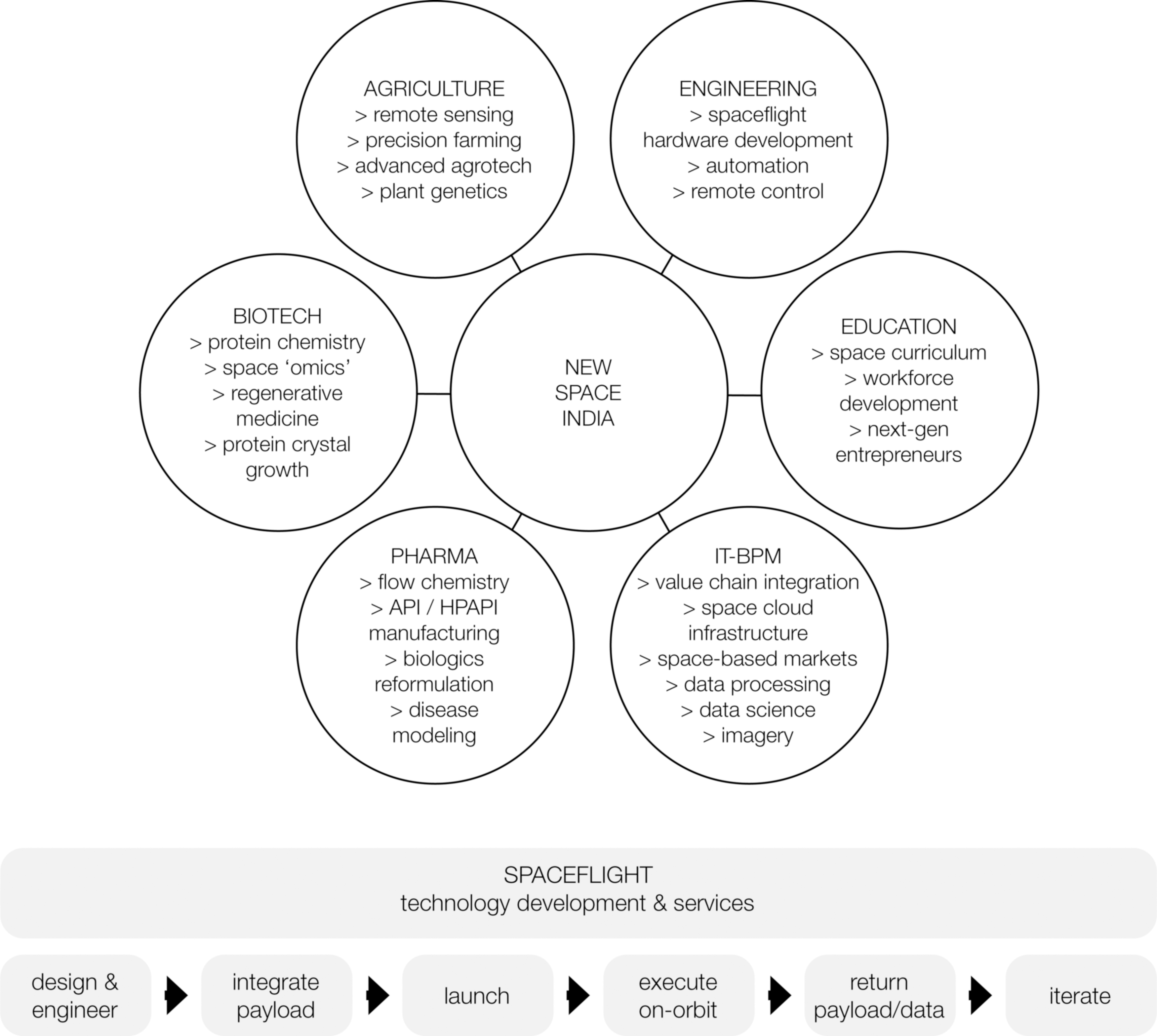
Top: Opportunities in New Space for various Indian industries. Bottom: Typical sequence of processes involved in payload spaceflight. These processes can be applied to space hardware and software technology development and associated with commercial revenue-generating services offered as part of a ground-based space ecosystem. API, active pharmaceutical ingredients; HPAPI, high-potency active pharmaceutical ingredient; IT-BPM, information technology and business process management.
The Time is Now
Since the start of the new millennium, biotech has produced unprecedented breakthroughs. For example, publication of the first complete sequence of the human genome ignited a revolution in the life science industry and launched the field of genomics.81–83 The ability to induce pluripotent stem cells from somatic (skin) cells launched regenerative medicine. 84 Creation of the first artificial DNA molecule laid the groundwork for synthetic genomics. 85 Trachea derived from stem cells and then transplanted into a human recipient launched the field of 3D bioprinting. 86
Numerous gene editing paradigms have been discovered, with CRISPR technology at the forefront. 87 Advances in next-generation sequencing technology have lowered the cost of sequencing and opened the door to personalized medicine as well as consumer genomics. 88 Immunotherapy has led to significant advances in cancer treatments. 89 Rapidly advancing single-cell sequencing and spatial “omics” technology is further granularizing molecular genetics. 90 Advances in RNA biology have resulted in RNA vaccines and the most rapid development of a clinical therapeutic approved for human consumption on record. 91
This noncomprehensive list aims to illustrate the remarkable and rapidly evolving biotechnology landscape. Although these inventions have roots on Earth, the weightless space environment can be used as (1) a tool for further development or refinement of products and processes for these Earth-based applications, or (2) a manufacturing platform for continuous production capabilities.
For example, if crystal growth is more advantageous in space, then perhaps scaling-up manufacturing of crystals in space may be a better alternative. If symmetric stem cell renewal is the norm in a weightless environment, then perhaps stem cell expansion in space is a better alternative. If layer-by-layer manufacturing of thin films for retinal implants leads to a higher quality product because sedimentation and gravity-driven convection currents are eliminated, then perhaps space is a better alternative to Earth-based manufacturing.
Just as with the Internet, which provided a communication platform that eventually changed the way humanity now connects and interacts, the space platform has similar potential. The future is being invented in labs around the world faster than ever before. Now, the future can be invented in an orbital lab in space where continuous microgravity can lead to discovery of new insights and development of new applications because barriers to accessing the unique space platform are lowering.
Roadmap to Space
The market conditions are ripe for India to take steps toward new market creation and leadership in an emerging space economy. One needs to only look to India's deliberate steps in the pharma, biotech, and IT sectors for a roadmap to success in space. Just as with those industries, the Indian government's involvement should be a public–private partnership for space-based enterprises to accelerate the pace of local economic development and discovery. Further, lessons learned by other states and private space companies can be leveraged as guidelines for establishing the best space ecosystem.
Ideas for establishing a space ecosystem are summarized here:
Encourage public–private partnerships between academia, government, and industry: a. establish clear policies, rules, and standards for translating space-based research projects into commercial technologies, products, and services. b. encourage space entrepreneurship through progressive policies including tax incentives and attractive patent laws. c. establish government-based seed funding for entrepreneurship. d. incentivize pharmaceutical and biotech industry to engage with space academics and start-ups via funding grants and tax incentives. e. establish a centralized space industry organization to foster networking opportunities and attract funding from private industry, venture capital, and other sources. f. encourage foreign partnerships and investments via open-border policies. Cultivate space-based education through curriculum development and other programs: a. establish accredited space-focused degree programs for undergraduate and graduate students, with a clear path for space-based careers. b. provide educational grants for both educators and students. c. develop an inter-disciplinary space curriculum in partnership with local companies in the biotech, pharma, and IT industries.
New Space is now accessible to the private sector, not just governments. As a result, “space” can be perceived as a platform for innovation for a broad range of users and uses. Just as with the Internet 25 years ago or the sequencing of the human genome 30 years ago, the space platform is a tool in the early stages for innovation with entrepreneurs as the primary drivers.
States around the world are already encouraging access to space through education, awareness, funding, and revised government policies. 92 India should do the same for its citizens and position itself to be a strong regional player in the space-based economy by looking to commercial players for partnerships and private investors for capital. In doing so, India will diversify its space ecosystem from primarily government-sponsored, defense, and exploration-focused activities, to a strong commercially driven, applications-based economy supported by private industry customers such as big pharma, biotech, IT, and engineering to benefit both, Earth and space, needs. Invoking Sir Arthur C. Clarke's second law: “The only way of discovering the limits of the possible is to venture a little way past them into the impossible.” Now is the time.
Footnotes
Author Disclosure Statement
No competing financial interests exist.
Funding Information
No external funding was obtained for this work.