






Abstract

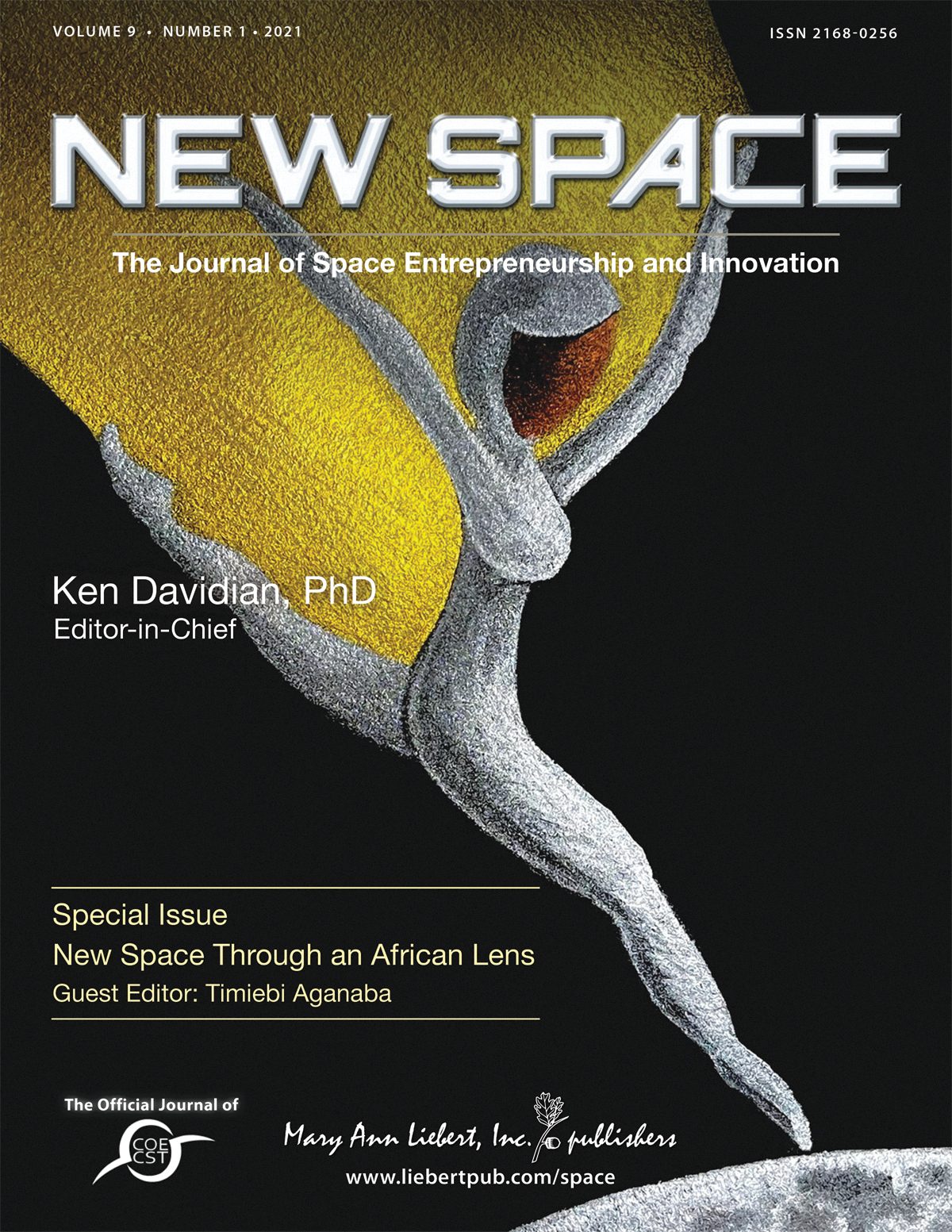
So far, the story of the Global South in space has been written not as they have told it, but how it has been heard by the Global North 1 and global institutionalists. 2 Efforts have been made to address this, 3 but the editorial perspective has still been largely European. Although this special issue of the New Space journal is itself published in America, it has prioritized the perspectives of African youth, and its guest editor, Timiebi Aganaba, a Nigerian, Canadian, British scholar, started her career at the Nigerian space agency in the department of legal affairs and international cooperation. Also as a former legal counsel representing the Nigerian Ministry of Finance in the establishment of the Nigerian Sovereign Wealth Fund and investment authority, she saw first hand how colonial and imperial relationships between Global North and Global South have caused and affected law's structure and substance, which set her on a path to study how international law replicates these power dynamics to the Global South's continued disadvantage. 4 In response, she sought to investigate a perspective through her doctoral studies called Third World Approaches to International Law (TWAIL), 5 which “seeks to formulate an international law that might hold good to its ideals and serve the cause of global justice.” 6 In short, TWAIL reconstructs international law to center hope—that the past can be healed, that international law could be better. 7 . By retelling international law's origin story to include the Global South, 8 TWAIL scholars hope to reshape its future. 9
This introduction’s coauthor, Cristian van Eijk, is an American-Dutch international lawyer whose (self-)critical approach is situated in allyship, but also in his queerness, neurodivergence, youth, and third culture background. After nearly seven years of space law research in three degrees, he hopes to further develop this approach in a doctoral dissertation.
From this collaboration of diverse perspectives, we hope to build within TWAIL III a new approach to space law analysis. Historically, TWAIL critiques in space have been limited by the need for agreement. To quote a TWAIL maxim, “if you don't do international law, international law will do you.” 10 For the more contentious issues, pragmatism has often forced the Global South to compromise to secure U.S. and U.S.S.R. agreement. 11
We consider this to be a hurdle, not a hamartia. Rather than force Global South states to compromise principles or complicate progress, let us re-examine the fundamental values at stake. We propose to supplement and develop TWAIL in space through a cosmopolitan approach to international law (CAIL). 12 Cosmopolitanism, though itself a term with colonial history, frames humanity as “overlapping communities of fate”—an enmeshed system of interdependent people, distinct but fundamentally similar. 13 Cosmopolitans see the world as a planet of individuals who possess a “diversity within sameness.” Asymmetries in geopolitical power, resources, and capacities have not disappeared, but addressing them requires underscoring our fundamental commonality. 14 CAIL recognizes the reciprocal, though not identical, obligations all stakeholders have—states and otherwise—and holds these obligations to be prerequisite to real progress for all parties.
Because European cosmopolitanism has been used to ‘universalize’ Eurocentric ideals, we must also look to cosmopolitanisms from beyond Europe. The African philosophy of Ubuntu, a relative of strict moral cosmopolitanism, 16 considers the duty to relate humanely with others as prerequisite to one's own personhood. From the outset, this philosophy precludes divisions between “us” and “them,” or between “I” and “we.” 17 Where Kantian cosmopolitanism examines law, Ubuntu speaks of justice, where Kantian cosmopolitanism relies on the (Eurocentric) concept of the individual, Ubuntu addresses the collective. 18 Considering these diverse stakeholders, CAIL then asks who is able to participate in global governance, and tasks those with greater capacity to take concrete steps to ensure access for those without access. 19 This “requires beginning, not ending, with relationships and asking who the stakeholders in dark skies and space are, followed by soliciting their input in an equitable way so we can understand what fair participation in space might look like without appropriation or assimilation.” 20
By understanding indigenous and subaltern cosmopolitanisms such as Ubuntu, we can better understand Global South positions and priorities, as well as the law more generally. 21 For example, the modern formulation of international legal principles such as the common heritage of mankind has been deeply limited by the Global North's failure to consider African ideas of community and ownership. 22 By recognizing African legal cultures and African agency in international relations, CAIL helps strike a balance between the premise and promise of TWAIL. 23 Our dual approach relies upon this cross-pollination of TWAIL and CAIL. CAIL alone risks universalizing or prioritizing Eurocentric concepts, ideals, and categorizations—recreating the disadvantages TWAIL critiques. 24 A dual approach incorporates these systems of law, governance, and values to create an international law that reflects, rather than restricts, the world it governs. 25 Third World Cosmopolitanism formalizes the place of the now popular stakeholder-centric approaches to space within TWAIL. Together, this dual approach helps us reconsider notions such as equity and distributive justice in space in more hopeful register.
This special issue takes us through a journey of that imagination by highlighting African youth perspectives. The lead article by Aganaba et al. 26 titled “African Youth Engagement with Global Space Governance Concerns in the New Space Ecosystem: The Case of the ASU Interplanetary Initiative Space Governance Innovation Contest” sets out the vision of the Arizona State University Interplanetary Initiative Space Governance Innovation Contest that sought to have an impact on African young people, 27 and provided the inspiration for this special issue. The article utilizes the 8-element framework developed by Gaughen et al., which are necessary for sustainability in the context of youth engagement initiatives, to document the method and findings of the contest as an experiment of open innovation. 28 These perspectives will be of interest not only to emerging actors who want to coach the next generation to think more broadly about international governance, but will also be of interest to the United States as the current administration thinks about how to operationalize equity in a whole of government approach. 29
The best submissions from the contest are published in this special issue as “Voices of the New Space Generation.” The winning submission by Haroun et al. 30 titled “Towards the Sustainability of Outer Space: Addressing the Issue of Space Debris” buttresses the conclusion that environmental considerations, in the form of regulation, have philosophical and moral foundations. Coyle and Morrow argue that despite profound societal change, only a fundamental shift in thinking that re-establishes the central importance of intrinsic value can fully articulate and justify modern approaches to regulating the environment. 31 That said, the moral significance of intrinsic value itself must also be considered because it is the account of a moral right that determines the acceptability of a given set of legal rights. 32
Also published in this special issue, Ishola et al. in their piece “Legal Enforceability in International Space Policy: An Appraisal of 1967 Outer Space Treaty” highlights the Outer Space Treaty's failure to provide for remedies and sanctions in case of breach and the lack of reference in the space treaties to the United Nations Committee on the Peaceful Uses of Outer Space. Does it mean that the time has come to look at what can be done for merging actors in other appropriate bodies for global governance; perhaps that takes a more executive approach, 33 like the G20? 34
In “Towards African Space Autonomy: Developmental Framework and Incorporated Synergies,” Asiyanbola et al. argue that there is a need for African space autonomy before being able to impact any of these other issues of global space governance. Other insights from unpublished submissions included that view that the current space governance regime does not make allowance for space tourists, allows for development of antisatellite tests, lacks institutional frameworks to control outer space activities, and does not adequately support or regulate private activities in outer space. The final article in the new voices section by Onwudiwe & Newton titled “Africa and the Artemis Accords: A Review of Space Regulations and Strategy for African Capacity Building in the New Space Economy” was not part of the contest, but represent perspectives from African youth on emerging issues such as the implications for Africa of the U.S. Artemis Accords. Although there are varying perspectives to the merits of the Artemis Accords, the club approach is tested in other global governance regimes, 35 and there are merits if we take a CAIL perspective.
These submissions from these first-time authors published in this special issue complement the contributions by more established authors in the field. In “Roadmap for Integrated Space Applications in Africa,” Adebola & Adebola propose a hierarchy-based roadmap for progressively growing sector capacity to advance the current models by expanding the scope and depth of applications, expanding regional and global partnerships, and establishing a plan for sustainable growth of technological capacity. The article also discusses legal and policy requirements that must be aligned to ensure the success of the roadmap. In his piece “Should Space Be Part of a Development Strategy? Reflections Based Upon the Brazil Experience,” S. Nakahodo questions whether space should be part of a development strategy with lesson learned from Brazil, recognizing that Brazil and Africa share deep historical, social, and cultural roots. The section ends with a contribution from W. Peeters of the International Space University on “The Role of Space in Education in Africa.”
The story of space governance has so far been told by the Global North. This is clear in the characters involved, the issues on its agenda, and the futures it imagines. 36 Our approach, like TWAIL and CAIL, aims to retell that story to inspire a more equitable “Africanfuturist” ending. 37 We are not only reconsidering how we approach the law, but also reconsidering our approach to ourselves and the futures “we” seek. Including Africa, the world's most youthful and most quickly developing continent, requires us all to reconstruct historical critiques in light of their aims, and to consider the needs of more diverse global stakeholders. Most importantly, our approach asks us to reimagine our humanity as dependent on our humane relationships with others. That, we imagine, is a future to hope for.