






Abstract
For decades, the International Space Station (ISS) has operated as a bastion of international cooperation and a unique testbed for microgravity research. In recent years, private industry has also been affiliating with NASA and international partners to offer transportation, logistics management, and payload demands. As the costs of flying projects to the ISS decrease, the barriers limiting nontraditional partners from accessing the ISS also decrease. However, the ISS in its current form cannot be sustained forever. As NASA looks toward commercialization of low Earth orbit (LEO) and the development of a cislunar station, concrete plans for shifting the public–private relationship of the ISS are unclear. With the consistent need to continue microgravity research—from governments and private industry—understanding the socio-technical and policy issues that affect the ecosystem for future microgravity platforms is essential to maintaining an accessible and sustainable space economy. Through this work, the authors seek to evaluate the accessibility of the evolving microgravity research ecosystem. To measure accessibility, the authors propose a new framework in which accessibility is defined along new metrics of economic and administrative openness. Through case study research, the authors conducted interviews with industry experts and organizational representatives and reviewed publicly available data about microgravity research platforms from the ground to LEO. This article then leverages Systems Architecture methods to examine the stakeholders, needs, objectives, system functions, and forms for the ISS and microgravity research platforms now and in the future. Particular attention is paid toward the market dynamics affecting barriers to entry for emerging space nations and nontraditional spaceflight participants. Evaluations found that end users utilize a variety of fully public, mixed public/private, and fully private pathways to gain access to microgravity research platforms and that mixed public/private pathways fostered the highest levels of economic and administrative openness.
Introduction
For decades, the International Space Station (ISS) has operated as a bastion of international cooperation and a unique testbed for microgravity research. Beyond enabling insights into human physiology in space, the ISS has served as a microgravity platform for numerous science experiments, technology demonstration projects, and outreach programs. 1 But just how “international” is the ISS? How accessible is it to different types of user groups around the world? The ISS is one of the largest and most expensive construction projects in human history. The development of the ISS took decades and is characterized by evolving priorities and socio-technical issues. Today, it is an immensely complex conglomeration of technical systems, public and commercial modules, and public–private partnerships. And yet it works, maintaining operations coordinated across the globe for the past 20 years. Because of the ISS and the efforts to develop it, humans have lived in space continuously since the year 2000. 1
In recent years, a combination of decreasing flight costs and the emergence of new models that invite participation of nontraditional actors have contributed to reducing the barriers of access to the ISS platform. As these nontraditional groups—such as startups, non-NASA and early career academics, emerging space nations, and education outreach groups—seek to participate in microgravity research, we begin to push at the edges of asking just how “international” the ISS actually is. How accessible is it to different types of user groups (whether by technology sector or geography)? In addition, the ISS in its current form cannot be sustained forever and current hardware will eventually reach the end of its lifetime. As NASA looks toward commercialization of the low Earth orbit (LEO) space, concrete plans for shifting the public private relationship of the ISS and development of a commercial economy in LEO are unclear. With possible increases in demand for microgravity research—from governments and private industry—understanding the socio-technical and policy issues that affect the marketplace for future microgravity platforms is essential to maintaining an accessible and sustainable space economy. Through this work, we seek to understand how nontraditional groups could navigate the microgravity ecosystem, especially in efforts to participate in microgravity research, build local capacity, explore customized research topics, and build scientific partnerships with other countries.
Spectrum of Microgravity Research Platforms
A microgravity environment is an environment in which gravity-related phenomenon can be studied, assessed, and utilized. Microgravity research is not limited to just the ISS. Different terrestrial, sub-orbital, and orbital platforms provide microgravity environments to do research at different time scales. On the ground clinostats, drop towers, and parabolic flights simulate microgravity environments. Clinostats are typically used to rotate a cell culture or plant sample at different speeds to simulate microgravity along the axis (or axes) of rotation. However, rotation speed and incorporating multiple axes of rotation are difficult to optimize under the constraints of centrifugal forces and mechanical stresses on different types of samples. Drop towers consist of dropping samples vertically within the chamber of a tall tower or vertical shaft. Drop towers exist around the world and usually offer less than 5 seconds of microgravity time while an experiment is in free fall. Parabolic flights are typically operated in modified aircraft flying series of parabolas. At the apex of the parabola, the aircraft is in free fall, providing a microgravity environment for less than 30 seconds. Sounding rockets and sub-orbital vehicles carry experiment and instrument payloads to sub-orbital space, providing about 5–20 minutes of microgravity time before the payload re-enters the atmosphere. Experiment time depends on the vehicle size, design, and launch profile. High-altitude balloons have also been used for microgravity research. A payload dropped at high altitude experiences free fall that can simulate microgravity for 3–30 seconds.2–4 Orbital platforms can provide microgravity time for days to years. Platforms include research satellites, free-flying capsules, and space stations.
Theoretical Framework
The ISS, as the primary platform for current microgravity research, is a complex socio-technical system. Its performance depends on complex interactions between institutions with evolving policy objectives and technical constraints to maintain its operation in LEO. 5 Complex technological systems can both create particular social orders depending on how the technology is arranged and enforce particular power systems based on technology requirements or compatibility. 6 For example, Apollo spacecraft were designed under the expectation that they would be piloted by military test pilots, limiting the early astronaut corps to only men. Even today, the continued use of ill-fitting suits, due to design and institutional funding issues, impacts the performance of smaller astronauts, who predominantly end up being female.7–10 Similarly, the complexity behind building up space launch capability can also reinforce power systems between space agencies. Wood and Weigel posit that countries with space-based infrastructure or launch capability tend to participate more in space activities. 11 Today, such countries with launch capability also have the largest space agencies, including the space agencies within the European Space Agency (ESA), NASA, Japan Aerospace Exploration Agency (JAXA), Indian Space Research Organization (ISRO), Russia, and China (although some other countries may be working on experimental launch capabilities). However, there is also evidence of many countries—some that could be characterized as developing nations, but not all—that do not have their own launch capability, but are still investing in space participation particularly via satellite, science research, and other capacity-building programs.11–15
The microgravity research sector does not purely involve the exchange of goods and services; but rather, is a complex socio-technical system spanning ground to space-based platforms aimed toward increasing research value under the context of existing power systems. 16 Therefore it is more accurately described not just as a marketplace, but as an innovation ecosystem. 17 As accessibility to the ecosystem increases so do the number of actors, resulting in more possibilities for competitive, collaborative, complementary, and substitutive relations between actors. Thus, increasing accessibility to the microgravity research ecosystem not only increases opportunities for research value creation and capture, but it also promotes responsible and inclusive innovation.17,18
Opportunities for responsible innovation are presenting themselves within the evolution of the marketplace in the microgravity research ecosystem. Van den Hoven describes responsible innovation as “an activity or process which may give rise to previously unknown designs pertaining either to the physical world…, the conceptual world…, the institutional world (social and legal institutions, procedures, and organization) or combinations of these, which—when implemented—expand the set of relevant feasible options regarding solving a set of moral problems.” 19 Valdivia and Guston go a step further to extend responsible innovation in a policy context as a project to reform the governance of innovation that “seeks to imbue in the actors of the innovation system a more robust sense of individual and collective responsibility.” 20 Responsible innovation can refer to products themselves or internal innovation practices to develop products. But it can also be applied to how we think of new designs of institutions or reforming the procedures and operations of a current one like the ISS. The European Commission discusses metrics of responsible innovation for industry and research in terms of gender equality, education, public engagement, ethics, open access, and governance.
In the context of spaceflight and space systems, discussions on open access typically center on reducing costs (launch and resource return) for commercial interests or maintaining redundancy for national security needs.21–23 The economic theory also typically focuses on accessibility via terms such as market penetration for sellers or willingness-to-pay for groups on the demand side. However, theoretical frameworks and empirical evidence demonstrate that in some cases an emphasis on corporate social responsibility can both serve stakeholder interests and support a business case.24–29 The proliferation of emerging technologies also engenders a need to discuss ethics and responsibility in science overall30–32 and space exploration.33–35 Within the emerging marketplace for microgravity research in LEO, there is an opportunity to further explore the dimensions of accessibility for nontraditional user groups on the demand side and examine how interactions between market economics and regulatory procedures affect accessibility for these user groups.
The microgravity research ecosystem is a complex socio-technical system within which the ISS exists. The technical development and use of platforms within the ecosystem are strongly influenced by social considerations that equal, and sometimes surpass, the technical concerns. 36 To analyze and interpret this ecosystem, system architecture methodology will be used. As Crawley, Cameron, and Selva propose, system architecture is “the embodiment of concept, the allocation of physical/informational function to the elements of form, and the definition of relationships among the elements and with the surrounding context.” 37 Key to this methodology are the principles of form–function relationships and emergence. Different entities of the system take on system forms to meet system functions aimed toward meeting stakeholder objectives. Functions can be met via several different forms; depending on intentional design or unintentional evolution. Stakeholders are the people, groups, and organizations that impact a system or are impacted by a system. 24 Understanding stakeholder needs and inputs to the systems depends on whether they are classified as primary and secondary stakeholders, whose decisions and outputs shape the system, or tertiary stakeholders (beneficiaries) whose needs are met by the outputs of the system. 37 The principle of emergence incorporates the idea that the functionality of these system entities and their relationships as a whole is greater than the sum of the individual entities.36,37 Understanding the context within which the system operates is also important, since context can be a source of uncertainty and risk. Context can be evaluated at different levels, such as international, national, and organizational, and can evolve beyond the control of individual system entities. Interpreting context is also useful for defining the boundaries of what the system is; in this case, defining what falls under the spectrum of microgravity research. 37 In a technology-oriented complex system, key areas of interpreting context include technology, policy, collaboration, and economics. 14
Drawing from systems architecture methodology work from Maier, Crawley, Wood, and Pfotenhauer,14,36–38 the microgravity ecosystem is analyzed by using the six stages outlined in Figure 1. In defining the boundaries of the system, this analysis scopes the microgravity research ecosystem to research platforms within the LEO environment and below. Military-oriented platforms are not considered, but some of the stakeholder interests from this sector are briefly discussed. To evaluate the systems architecture, stakeholders, forms, and functions of the ecosystem, case study research methods are used to collect data. Publicly available information is reviewed about different entities in the ecosystem, the context they operate within, and their inter- and intra-relationships. Expert interviews were also conducted with organizational representatives, subject matter experts, and industry experts. The information and discussion presented are nonexhaustive of the entirety of the research ecosystem.
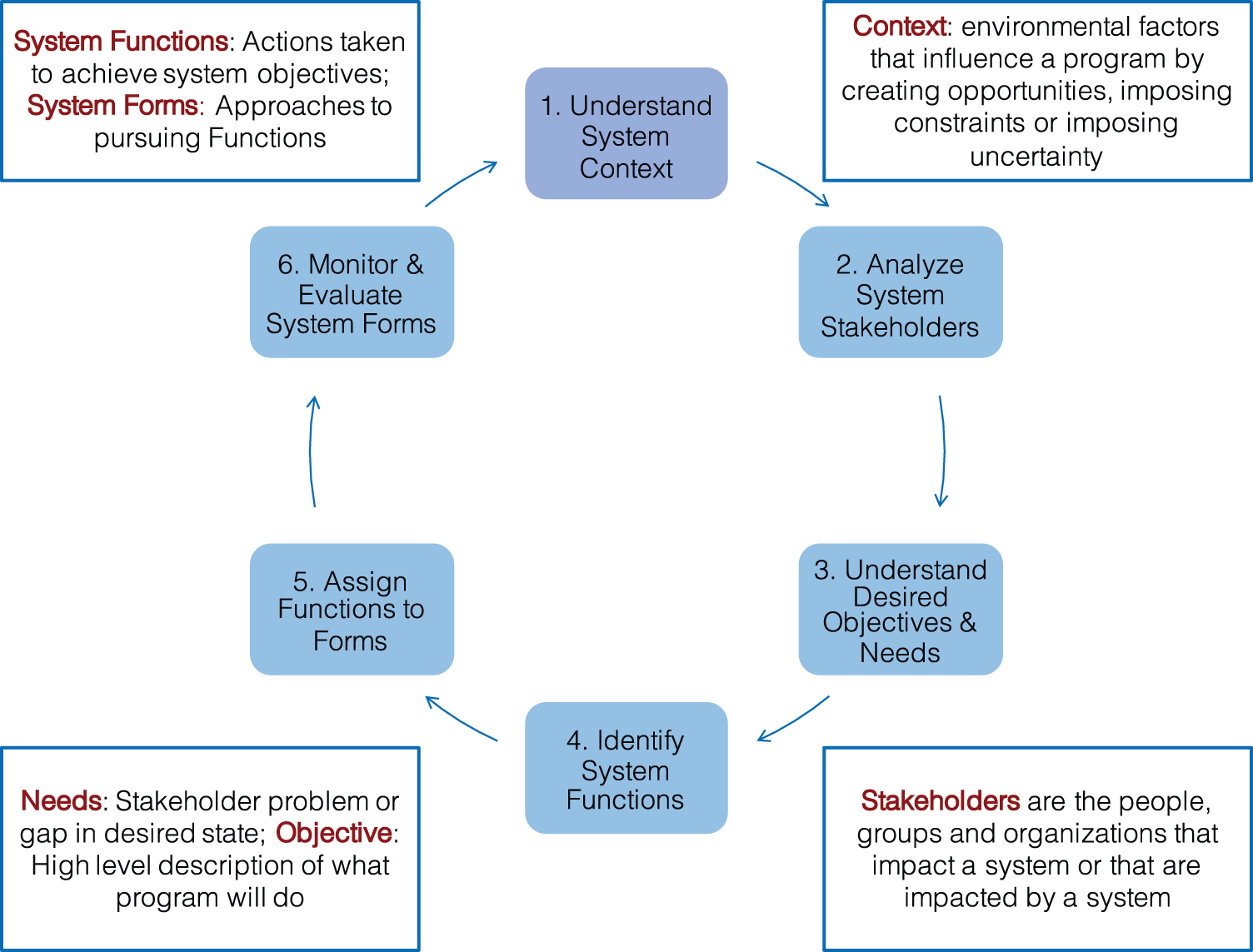
Systems architecture processes utilized—Each stage of the cycle represents different questions that are asked to interpret and evaluate the microgravity research ecosystem. Image credit: Danielle Wood. Color images are available online.
Understanding the system context requires understanding both the environmental factors in which different microgravity platforms operate in and the sociopolitical environment that influences different entities. As the discussion will demonstrate, the stakeholders of interest for this analysis—nontraditional partners and users of microgravity research—can be classified as secondary or tertiary stakeholders and beneficiaries. Therefore, to understand the desired outcomes and objectives of the system, the analysis seeks to evaluate the ecosystem in reference to the objectives of the beneficiaries instead of the primary stakeholders. In terms of granularity and scale to describe forms and functions, the analysis focuses not at an individual entity-based level but at a more abstract level. A key contribution of this theoretical analysis is describing the stakeholder models and using such models to help system users understand future paths. The systems architecture analysis describes different firms and entities in terms of models that they fit into, such as public space agencies and multi-use commercial platforms. To monitor and evaluate the systems metrics of accessibility are proposed and a framework is utilized to evaluate current and future models of microgravity research against these metrics.
Dimensions of Accessibility
Assessing levels of accessibility can be difficult if metrics do not capture the nuances of a particular complex system and the needs of the end users in the system. Prior work has analyzed the use of different cost- and distance-based accessibility metrics for online web content, health care systems, transportation networks, and food markets.39–42 Today's microgravity research ecosystem has complexities that obscure what the actual costs are to the end user. Flight costs comprise a large portion of project costs, but sometimes these costs end up being covered by a public agency. Other development costs include prototyping the proof-of-concept for a project on the ground, developing the project to be flight ready and capable of withstanding hyper- and hypo-gravity levels, compatibility with the platform's power, communications, and data handling protocols, and coordination of how to manifest (install and uninstall) the project in a timely manner. Some of these development costs are financial, but others are temporal and procedure oriented. Other regulatory costs could involve dealing with safety testing and certifications required by the platform supplier. Different types of platforms also allow for varying amounts of microgravity time and human-presence capabilities. For example, current sub-orbital platforms do not consistently allow for a human presence with the project payload, thereby limiting the type of projects to autonomous payloads and limiting the type of microgravity activity that can occur. Users may also face barriers depending on their nationality, the size and technical capabilities of their organization, and whether they are public, commercial, or nonprofit oriented. For microgravity research, and the LEO space economy in general, there are no generally accepted and utilized metrics to evaluate accessibility for end users.
To capture these different nuances with accessibility in the microgravity research ecosystem, we propose metrics that can be used to rate current and future forms of access and designate whether they foster increased or decreased accessibility to new countries and organizations. This analysis proposes that accessibility can be assessed along the two dimensions of economic openness and administrative openness. Economic openness refers to the extent to which a future microgravity marketplace has high costs of access. This includes the costs to design an experiment; engineer it to be safe and functional; launching to space; accessing a facility that provides environmental control, data and power; operating the experiment; and possibly returning it to Earth. Administrative openness refers to the type of gatekeeping that determines who can participate, which may include access based on features such as nationality, type of organization, or type of microgravity activity. For example, citizens from countries that are not ISS partners would need their own space agency to form a partnership with an ISS partner country or work through an international program. Also, certain types of microgravity research platforms, such as sub-orbital vehicles, do not currently allow for microgravity experiments that need a human operator. Such projects have to involve an autonomous experiment.
Current Microgravity Research Ecosystem and Marketplace
This section presents the Systems Architecture analysis of the current microgravity research ecosystem for platforms used for civil and commercial purposes within LEO. Data are collected by using case study research methods. 43 Information presented is drawn off of publicly available documentation and field interviews, current as of April 2019. Interviews were conducted with 20 individuals who were selected based on their experience as organizational representatives and industry subject matter experts in microgravity research. All interviews were conducted with the approval of the MIT Committee on the Use of Humans as Experimental Subjects (COUHES) is the MIT IRB. Approval was secured. A contextual overview of the current ecosystem is presented in prior work by the authors. 16 Using these data and interview data, a simplified Systems Architecture analysis of the stakeholders is demonstrated, highlighting what the stakeholders' needs and objectives are and the different pathways through which they interact with the microgravity ecosystem. Emphasis is placed on the different access points for customers and user groups on the demand side.
System Context
The system context involves understanding the environmental factors that influence a program by creating opportunities, imposing constraints, or imposing uncertainty. Understanding the context also aids in defining the boundaries of the system to be analyzed. In this analysis, the microgravity research ecosystem is defined to include microgravity research platforms operating in LEO (less than 1,000 km in altitude) and below for nonmilitary purposes. Transportation service providers and small satellite operators are briefly considered as stakeholders and contextual influences. For example, recent increasing competitiveness in the launch industry, decreases in launch costs, and rideshare opportunities have reduced some of the costs and increased opportunities for transportation to orbit. The proliferation of small satellite technology and applications has resulted in a growing nontraditional user base of space technology, due to lower build costs and modularity of components.
For years, the ISS has operated as a unique orbital platform for microgravity research and a symbol for international cooperation. In recent years, private industry has also been affiliating with NASA and international partners to offer transportation, logistics management, and payload demands. However, the ISS in its current operational form cannot be sustained forever. NASA has proposed ending direct federal funding of the ISS in 2025 and redirecting the $3–$4 billion it yearly spends on ISS operations toward deep space exploration efforts. 44 As NASA looks toward commercialization of the LEO space and the development of a cislunar station, concrete plans for shifting the public–private relationship of the ISS are unclear.
From different entities, there are many future proposals for public, public/private partnered, and private platforms on microgravity research. Coupled with a possible increase from the demand side of microgravity research, a marketplace for microgravity seems to be emerging, which provides opportunities to reduce costs of access through competitive innovation. 45 However, the complexity and relationships between different public and private entities in the ecosystem also results in uncertainty as to what pathways nontraditional end users should pursue for access to microgravity research platforms.
System Stakeholder Analysis
Stakeholders to the microgravity research ecosystem can be classified as primary, secondary, and tertiary (beneficiaries) stakeholders. Primary stakeholders make decisions that can shape the ecosystem. Secondary stakeholders both make decisions to shape the ecosystem and influence the decisions of the primary stakeholders. Tertiary stakeholders, or beneficiaries, are impacted from functions and emergent properties of the ecosystem. In general, the impact to tertiary stakeholders may be positive or negative. The goal of the analysis is to identify functions that positively impact beneficiaries. After analysis of public documentation and interview data, firms within the microgravity research ecosystem were organized into categories. These categories were then further classified as primary, secondary, or tertiary stakeholders. The stakeholder categorizations are shown in Appendix Figure A1. Stakeholders will continue to be referred to at the level of these categories instead of the firm-based level. Though not always explicitly listed, it should be noted that some firms exhibit characteristics and functions of multiple stakeholder categories. The following is a brief summarization of the stakeholders and their functions.
For the current microgravity ecosystem, primary stakeholders include critical suppliers of research platforms because their actions have physical and policy implications on whether and how microgravity research is possible. Critical suppliers of research platforms include the public space agencies that own the ISS, private parabolic and sub-orbital flight operators, and private facilities onboard the ISS. The ISS public space agencies maintain utilization of the ISS to achieve inter-governmental agreements and domestic agendas. Doing so requires clear priorities, public support, funding, and a competent workforce. Along each sector of the microgravity research spectrum, such as parabolic and sub-orbital space, the operators of flights to that altitude are also primary stakeholders. Through agreements with ISS space agencies, operators of private on-ISS facilities operate external and internal platforms on the ISS for customers. Some of these operators also work with public interfaces or take on integration services roles as well.
Secondary stakeholders include transportation service providers, public policy makers, commercial end users, public end users, integration services, funding entities, and nonorbital platforms, all of whom influence the decisions and operations of the primary stakeholders. Transportation service providers can supply commercial or governmental vehicles (excluding the rocket on which they are launched). The capacity, re-entry capabilities, and environmental control systems of these vehicles influence the quantity and type of payloads that can be transported to orbital platforms.
Public policy makers affect the ecosystem by appropriating funding of the ISS space agencies, setting domestic strategies, and regulating launch licenses and communications spectrum allocations. Examples include members of a congress or parliament (some individuals may hold more influence than others) or an executive body such as the U.S. National Space Council (who are considering developing a National Microgravity Strategy).46,47 Public policy makers can also influence legislation and enforcement of export control regulations (such as export control restrictions on the type of projects or nationality of project personnel for the United States).
Public interfaces are governmental or noncommercial entities that connect end users with public, public–private, or completely private platforms. The process of connecting users could involve a solicitation call for projects, brokerage with technical experts at the interface firm or platform firm, upmass/downmass allocations, and occasionally some level of funding. Examples of public interfaces include the ISS National Lab (managed by Center for the Advancement of Science in Space, Inc. [CASIS]), NASA Flight Opportunities Program, Translational Research Institute for Space Health (TRISH), United Nations Office of Outer Space Affairs (UNOOSA), and the Asia-Pacific Regional Space Agency Forum (APRSAF).
Commercial end users execute projects and payloads on research platforms for product R & D and demonstration, life and physical sciences (including pharmaceuticals), remote sensing, and entertainment/promotion purposes. They work either directly with a platform supplier or through a public interface to execute projects on a platform. Public end users include space-oriented agencies (including the ISS space agencies), nonspace-oriented agencies, and higher academic research. Different offices and divisions within NASA, such as the Division of Space Life and Physical Sciences Research and Applications (SLPSRA), the Human Research Program (HRP), Advanced Exploration Systems (AES), and the Space Technology Mission Directorate (STMD),44,48 drive the research equipment needs and schedule of operations on the ISS. NASA also purchases parabolic flights from ZERO-G (during such flights, the ZERO-G aircraft is considered a government aircraft; for all other flights, the aircraft is considered commercial) and payload space on sub-orbital Blue Origin and Virgin Galactic flights. Nonspace-oriented agencies also execute projects and fund research teams to do microgravity research that aligns with their own missions, such as cancer or regenerative medicine research. Research at the graduate level and above tends to be publicly disseminated and sometimes funded by one of the other public agencies.
Integration services are stakeholders that provide services such as experiment preparation, regulatory affairs assistance, certification tests, payload manifestation and return logistics, and data, communications, and power handling during flight. Some stakeholders provide domain specific services, such as for the biological sciences. Others provide end-to-end services that may be geared more toward end users who have never taken on a microgravity project earlier. Funding entities can be governmental or involve private financing. Depending on the stakeholder or which governmental funding source is used, different levels of intellectual property protections exist. Some public interfaces, integration services, and research platform suppliers also take on the functions of a funding entity. Nonorbital platforms providers such as drop tower, parabolic, and sub-orbital flight operators and are also secondary stakeholders in that they are often used as proving grounds to test the capabilities of orbital payloads.
In other systems, secondary stakeholders such as the public and commercial end users would typically be classified as tertiary stakeholders since they benefit from the functions of the system. However, analysis of the microgravity research ecosystem demonstrates that such end users are also aptly classified as secondary stakeholders because they actively influence the suppliers that make up the primary stakeholders. Primary suppliers and other secondary stakeholders change their protocols and operations (now and in the past) to better meet the needs for public and commercial end users. This is particularly pertinent for early end users, or adopters, that are the first to go through the primary suppliers' processes. For some primary stakeholders, these end users help set the demand and value proposition for the suppliers to exist. Tertiary stakeholders, or beneficiaries, include the public and commercial end users along with nontraditional users of microgravity research. For the current ecosystem such nontraditional beneficiaries include emerging space nations, education groups (K-12, undergraduates), non-NASA and early career academics, startup firms, and public outreach groups.
Forms of Accessibility
Systems forms are organizations, people, physical or virtual objects, programs, and processes that execute functions.36,37 Forms can also be transformed by functions. In systems architecture analysis, stakeholders allocate forms that execute functions to meet their own objectives. In the analysis of accessibility within the microgravity research ecosystem, we focus particularly on what forms end users and tertiary stakeholders utilize to meet their objectives. These pathways, or forms of accessibility, are modelled in Figure 2.
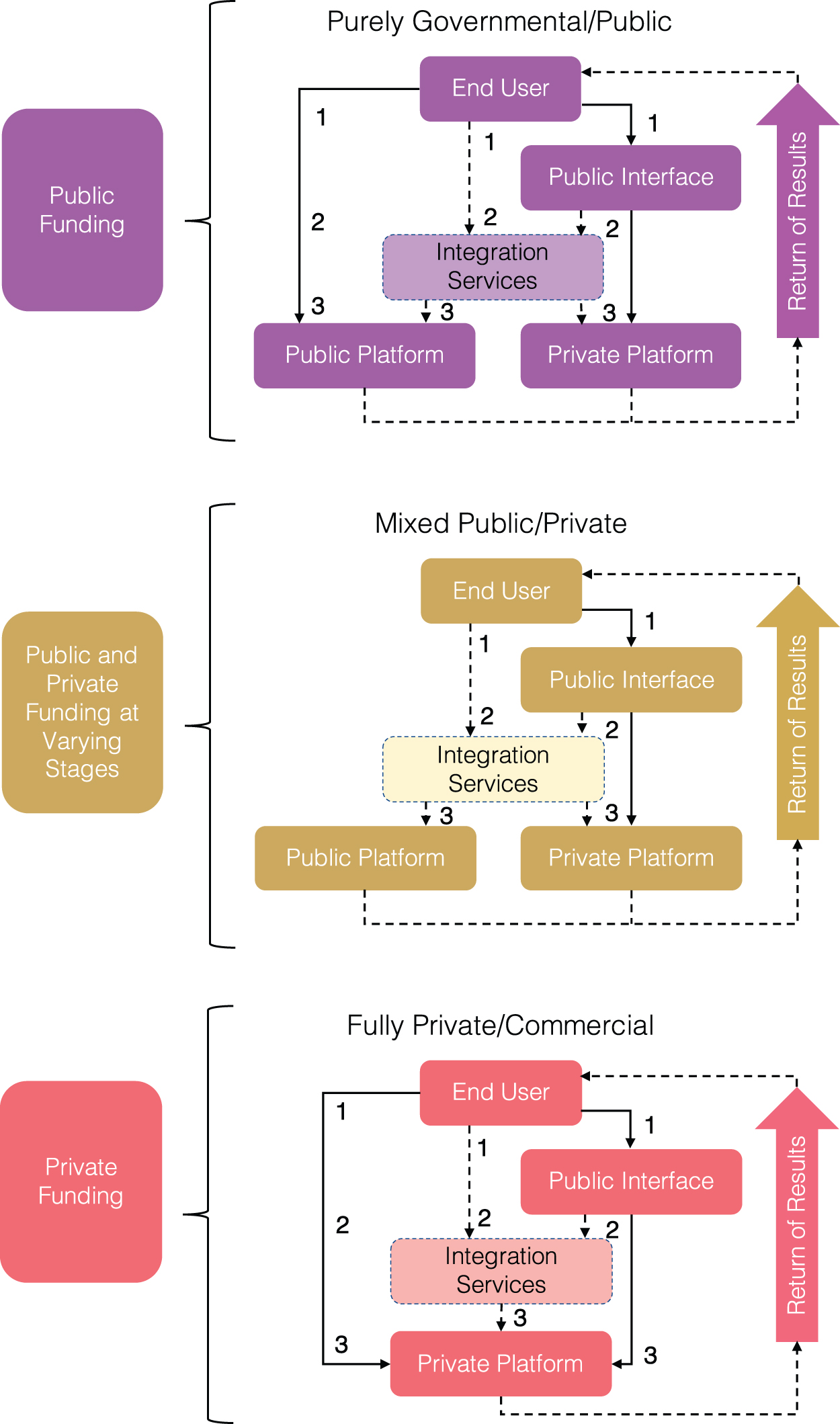
Forms of accessibility—Pathways end users and beneficiaries utilize to meet their objectives in microgravity research. Forms can be categorized at Purely Governmental/Public, Mixed Public/Private, and Fully Private/Commercial. Along the pathway a project will move from the end user to the platform through a development chain. Along this chain, projects progress from the conceptual stage (1) to technical development (2) to manifestation on a platform (3). Almost all end users will seek results to be returned to the ground in some form. The rate of return can vary between pathway types. Solid arrows represent nominal methods of progressing along the development chain, whereas dashed arrows represent less common methods. Color images are available online.
Based on example scenarios from the data analysis, pathways are categorized as purely governmental/public, mixed public/private, and fully private/commercial. The pathways express the processes and stakeholders that end users work through to place their research project on a microgravity research platform. From the end user, projects start out at the conceptual proposal stage. Through work on their own, or via a public interface and integration services, end users technically develop their projects to become compatible and/or flight ready for a platform. Finally, the project is manifested (scheduled operations, allocated space and resources, and installed) on the platform. Different funding sources are involved for the pathway categories and for all pathways certain processes can be followed in reverse to return results or payloads back to the end users. All the pathways involving orbital platforms require upmass, downmass, and on-orbit resource allocations from a government, even the fully private/commercial pathway. In this sense, the government is providing transportation and logistics infrastructure for research and commerce to be conducted.
A purely governmental/public pathway utilizes public funding throughout the entire process. Public end users, particularly if they are from a division within an ISS space agency, have the option to directly manifest projects on a public platform due to technical familiarity of internal systems and processes. End users may also interact with a public interface program to coordinate with a public or privately operated platform. Depending on the technical familiarity of the end user, integration services may be utilized before a payload can be manifested on a platform. Since government funding is utilized throughout the pathway, there is limited intellectual property protection for the end user. Projects are also subject to governmental timelines and manifestation priorities. To receive funding, end user projects often must also be aligned with the needs of the governmental funding source.
Along a mixed public/private pathway, public and private funding sources are utilized at various stages, depending on the capabilities and needs of the stakeholder end user. For example, a mid-size commercial user may utilize public funding from a public interface for some integration services and rack space on a private platform, but also raise a portion of project funds privately to prototype on the ground. As shown in Figure 3, if the private platform that the commercial user chooses has in-house integration services, the user does not need to go through a separate integration services provider and may get access to the payload more quickly after flight. Or an education group may receive a combination of public funding to seed a project and a lower cost from a private platform due to their educational status and simpler project goals.49,50 End users go through a process similar to that within the purely governmental/public pathway, with the exception of direct access to a public platform. Regarding intellectual property, protection can be dependent on the funding source and at what stage the funding is given. The project purpose does not necessarily have to be aligned with a government need, such as addressing a milestone in a strategy roadmap, but is more commonly aligned with a public interface objective, such as a biotechnology project or capacity building for an emerging space nation.
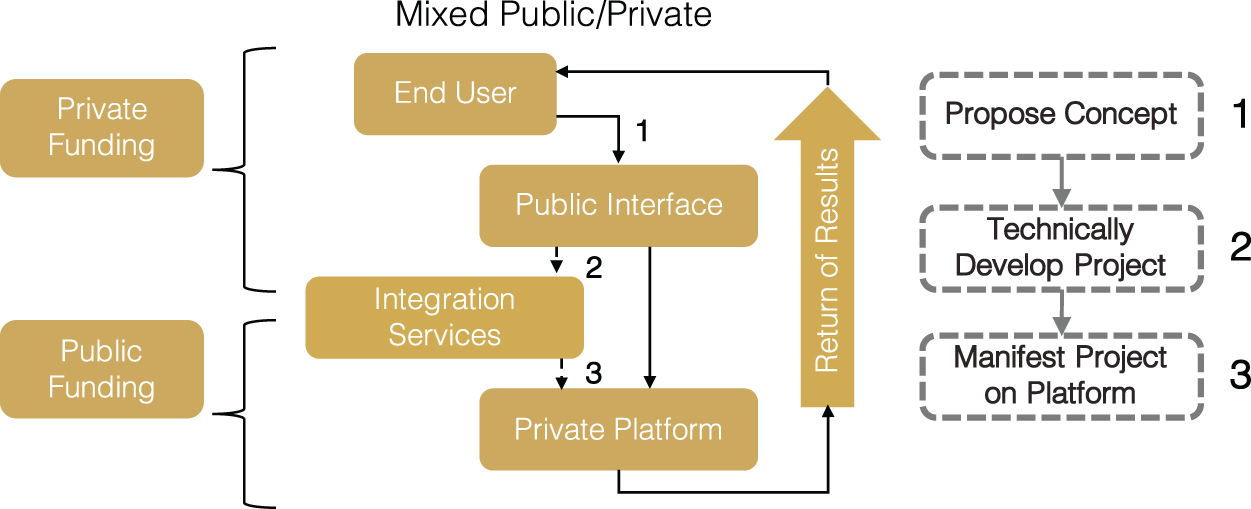
Detailed example of how a mixed public/private pathway may be utilized by a mid-size commercial end user who requires public funding for some amount of integration services and manifesting the project, but can prototype and do some of the technical development privately. The end user receives return of results via the integration services or directly from the private platform provider. If a public platform had been used instead, the end user would have waited for the government to do payload unloading. Color images are available online.
A fully private/commercial pathway utilizes private funding throughout all processes. An end user would raise their own funds, utilize funding from a private competition, or rely on philanthropy. Typically end users directly communicate and coordinate with the private platform operator, although depending on technical capability integration services may be utilized if they are not already provided by the private platform operator. Some private platform operators may have their own agreements for on-ISS platforms and do not require coordination with a public interface. Other end users may choose to utilize a public interface for coordination, but do not need public funding, or may choose a privately operated platform that requires coordination with a public interface. The fully private/commercial pathway provides a higher level of intellectual property protection due to being privately funded. End users' projects do not necessarily have to align with a government mission or strategy, but they do need to comply with domestic regulations. In some instances for on-ISS private platforms, end user projects may need to demonstrate some type of relationship to benefiting humanity (ISS public space agency mission) or an education component.
Evaluate System Forms
To evaluate the levels of accessibility for these different pathways, or forms of access, we utilize the metrics of accessibility discussed earlier, specifically the dimensions of economic and administrative openness. By evaluating the pathways, we seek to investigate whether the pathways utilize responsible innovation in terms of governance processes and accessibility. Figure 4 presents a framework on which forms can be evaluated along the accessibility metrics. Forms can be mapped onto different quadrants, depending on whether their characteristics and functions foster high or low economic and administrative openness. The different forms also have tails extending out along the axes. These tails visualize that there is a spectrum of openness within the forms themselves. Dependent on the end user, project purpose alignment, and type of final platform there is variability in levels of openness as well.
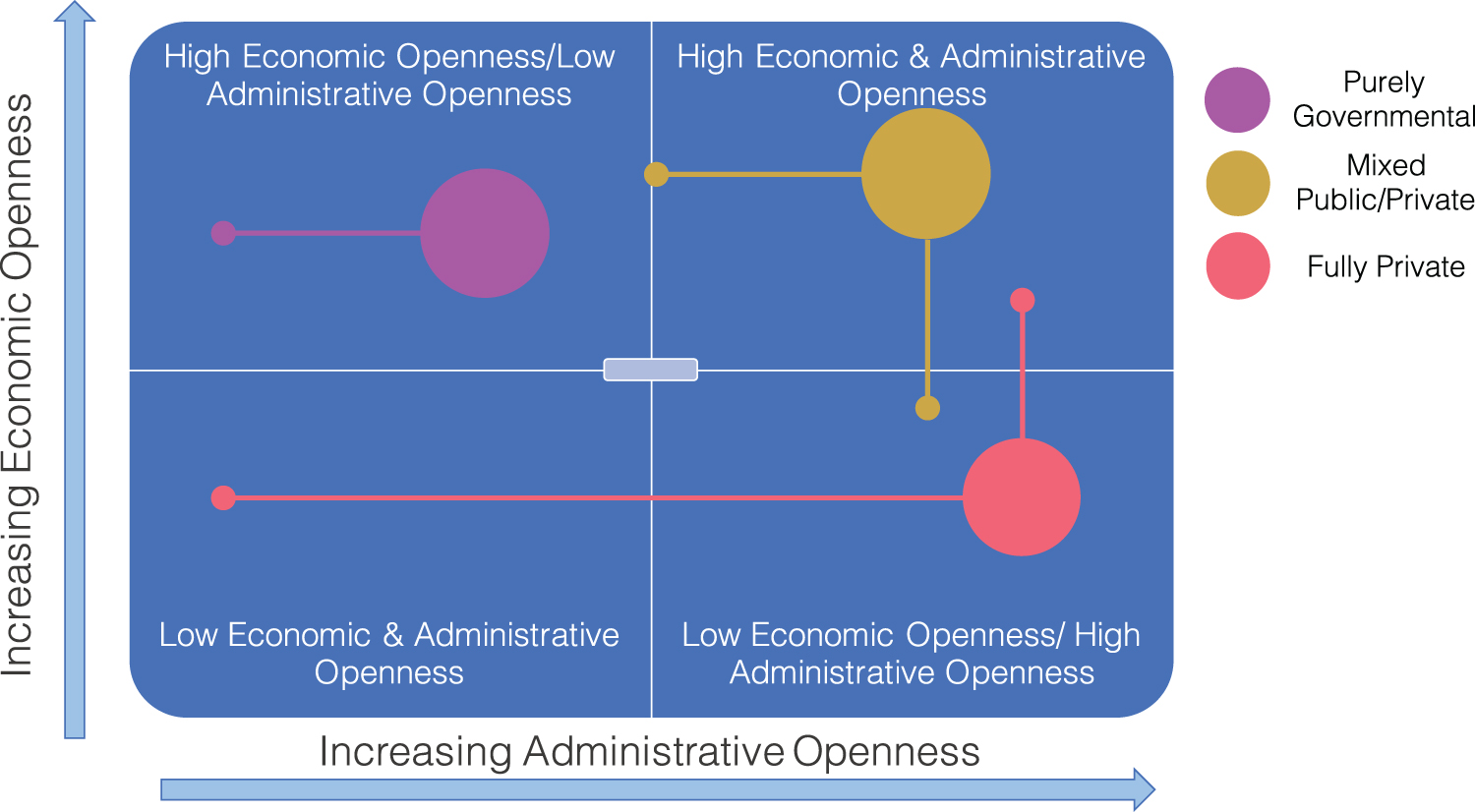
Evaluation of current forms of access. Color images are available online.
The purely governmental pathway has relatively moderate administrative and economic openness. This form of access is one of the primary modes of access that end users currently utilize to gain access to a microgravity research platform. For example, the ISS is a multi-partner and multi-use facility. The ISS is a large-scale, multi-purpose infrastructure that provides capabilities for a variety of activities. Some of these uses were anticipated during the early stages of developing the ISS; however, new opportunities and applications have been identified since ISS construction was completed. The modularity of the ISS and later standardization of its docking ports facilitates the introduction of new hardware and activities that were not envisioned in the original design. However, its level of administrative openness is variable and dependent on the nationality of the user. Users of the nationality of a public platform can receive public funding (which increases economic openness). Governments are incentivized to fund access for their own citizens; for those citizens there is a high level of economic openness. Through the purely governmental pathway, public funding also entails project alignment with strategic goals of the domestic government. In some cases, this could also limit the type of activity that end users take on and thus also limit administrative openness.
The mixed public/private pathway has relatively high economic and administrative openness. The private platforms increase administrative openness if they allow participants from all nations; and the public/private partnerships provide a minimum level of economic openness if they do not charge high costs for participants from their nations. Administrative openness could be decreased if the public interface utilized has restrictions on the type of project or nationality of the end user. Economic openness could also be decreased depending on the resources and technical capabilities of the end user and whether funding sources are available for integration services.
The fully private pathway currently provides relatively high administrative openness and relatively lower economic openness. Currently, this pathway is smaller, or there are less methods and platforms to utilize this pathway by, relative to the other forms of access. On the administrative dimension, this pathway has high administrative openness because access is much less restrictive on the basis of nationality. However, this also means that without public funding, access is limited to those who can afford it or privately obtain funding, thus limiting economic openness. Economic openness can increase dependent on an end user's ability to obtain private funding or if they have the internal capacity to utilize less integration services. Administrative openness can decrease if the private platform is single purpose, limiting the type of project that can be manifest, or dependent on other domestic regulations.
Monitoring System Forms
Through systems architecture analysis methods, the current microgravity research ecosystem was categorized into the different stakeholder categories and forms of accessibility were identified and evaluated along the proposed metrics of accessibility. Utilizing the systems architecture methods enables abstraction of the complex socio-technical system and evaluation of the system functions that affect accessibility for end users. To continue to monitor accessibility of the ecosystem, in the next section we look toward how such methods and evaluation metrics can be applied toward the future microgravity research ecosystem.
Future Microgravity Research Ecosystem and Marketplace
The systems architecture analysis is updated to reflect new stakeholder categorizations and changes in the forms of accessibility. These new pathways are again evaluated along the metrics of accessibility to measure how they might foster participation in microgravity research from nontraditional user groups.
System Context
For the future microgravity research ecosystem, the boundaries of the system remain the same as the previous analysis to include microgravity research platforms operating in LEO and below for nonmilitary purposes. With all the new proposals for platforms and operational changes, this results in the system growing, particularly in the quantity of orbital platforms. However, there also changes in the socio-political and economic contexts for the future ecosystem.
The United States, ISS partner countries, and China have shown increasing interest in fostering a commercial LEO economy for strategic reasons. It is economically beneficial for these countries to foster new marketplaces and economic growth. If a commercial provider can effectively meet the public end user needs, the public agencies can redirect funds from operating their own platforms to other efforts. A global commercial LEO marketplace could also expand the customer base and increase international cooperation engagements. The private sector is also interested in developing a commercial LEO economy, particularly through the supply of microgravity platforms. However, some of the main uncertainties for public agencies and private entities are whether there is enough demand from nonpublic end users and whether a future LEO economy can support the number of platform suppliers that have been proposed. On the demand side for microgravity research, one of the main concerns from all end user types is the rate of return on payloads and experiments. The rate of return is affected by the policies and procedures of the platform provider, any public interface or integration services utilized, and compatibility with different launch service providers to meet launch frequency needs.
Governmental focus on fostering accessibility seems to be focused on commercial end users, including startups, but not very oriented toward other nontraditional partners. In fact, when prompted with the research goals of evaluating accessibility for nontraditional partners, most interviewees initially took this to mean startup companies or the just the nonspace oriented commercial sector. When further prompted that, in this analysis, nontraditional partners include education outreach groups and emerging space nations, some interviewees pointed out that if a commercial LEO economy is allowed to grow on both the supply and demand side, overall prices could be reduced, which may decrease some of the cost barriers for nontraditional partners. Although this may or may not occur in the future, most of the intentional public policies and private platforms are being developed to serve the demands of the commercial sector and not all nontraditional partners.
Although national security-based platforms are not considered in the system, national security concerns do affect the political context of the microgravity research ecosystem. During the development of the ISS, national security concerns influenced how international partners were brought onto the project and the motivations behind bringing Russia on as a partner. Today, the United States has experienced increasing political tension with China, and NASA is legislatively barred from federally funding any bilateral projects with China. Meanwhile, China has cooperated with almost every major public space agency, except NASA, on projects. 51 Increasing the number of overall international partnerships could not only increase security through alliance building, but also help ensure sustainability in LEO as more countries will have a stake in keeping it open and operable for a marketplace and research ecosystem.
System Stakeholder Analysis
The stakeholders are again identified and categorized into primary, secondary, and tertiary stakeholders, which are shown in Appendix Figure A2. Most of the stakeholder categorizations remain the same. The current stakeholders are still present, since none have publicly announced or authorized plans to completely withdraw from operations. Although several of the ISS public agencies have publicly discussed a desire to redirect funding efforts away from the ISS and allow the private sector to provide more services, they have yet to stop authorizing involvement with the ISS and still maintain multiple public–private partnerships regarding launch services and private on-ISS facilities.
The biggest change is seen in the number of stakeholders operating as critical suppliers of research platforms. Additional categories now include single government, multi-partner, private ISS docked, and private orbital free flying. Single government represents space station proposals where the current design is wholly owned by a single government such as the China Space Station. The multi-partner categorization encompasses the current ISS public agencies (from Appendix Fig. A1). If one of the single government platform designs evolved to include ownership of a module by another country, the platform may be re-designated as a multi-partner. Private ISS docked refers to private orbital platforms for which the public designs currently rely on docking with the ISS for initial construction. Private orbital free flying platforms do not necessarily need to dock with the ISS, but they may have the capability of docking with their own modules to become more complex or docking with another orbital platform. Many of the private platform operators on the ISS or otherwise also aim at providing integration services as part of their operations.
Similar to the current ecosystem, commercial and public end users are tertiary stakeholders because they benefit from being able to perform microgravity research on platforms and secondary stakeholders because they influence how some of the platform suppliers design policies and procedures. For the future ecosystem, commercial and public end users (particularly early adopters) strongly influence the primary stakeholders as many of the future platform proposals are specifically designed to meet those end user needs. For example, Space Tango's ST-42 proposal is oriented toward mission specific research and materials manufacturing goals. The firm is already taking into account FDA regulations on production processes to meet the needs of possible pharmaceutical customers.52,53 At least from public documentation and commentary, Axiom Space's space station designs seem to have evolved from hotel and entertainment services to also having modules purposed toward research and manufacturing and extending the overall capacity of the ISS.54,55 Looking at a broader scale in analysis, public comments from space agency officials and interviewees reflect that the demand for microgravity research from these types of end users is one of the biggest uncertainties and barriers to having a sustainable commercial marketplace in LEO with minimal government involvement.56,57
Forms of Accessibility
The forms of accessibility discussed (Fig. 2) largely remain the same. As the future microgravity research ecosystem currently stands, forms of access, or pathways, can still be categorized as purely governmental/public, mixed public/private, and fully private/commercial. Funding-wise, there may be a larger number of private funding entities with interest in financing microgravity research projects for the private sector. 58 Although there is projected to be an increase in the number of orbital platforms, this does not necessarily change the pathways that end users will utilize to develop their project. What may change is whether end users have to utilize distinct public interfaces or integration services within the pathway, since more platform providers are proposing to offer in-house integration services. The speed by which an end user can progress through the pathways may also increase due to increased launch frequency and the freedom that free flying platforms have from ISS schedules. The relative size of the mixed public/private and fully private/commercial pathways is also projected to increase due to an increase in the number of private platform operators and the reliance of some on public–private partnerships. It's possible that mixed public/private and fully private/commercial pathways will involve reduced costs for end users, but this is largely dependent on the amount of future demand.
Evaluate System Forms
The metrics of accessibility are again utilized to evaluate the future forms of access. Figure 5 presents the different pathways evaluated for economic and administrative openness. The pathways are mapped onto the quadrants that align with how that pathway fosters openness. Tails extend out from the pathway circles to capture the variability and nuance within the pathways. The size of the circles represents the gross amount of methods for end users to utilize that pathway relative to each other.
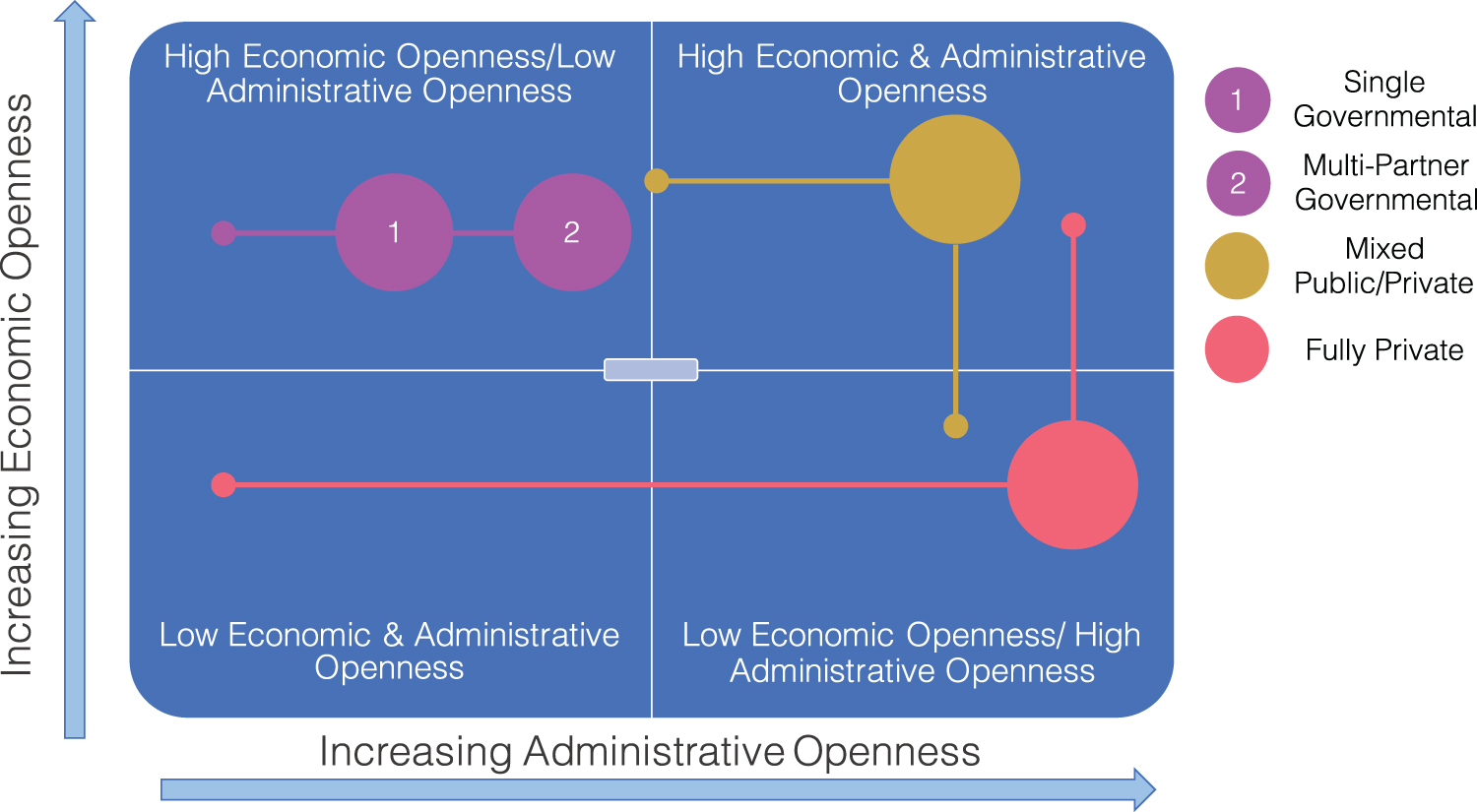
Evaluation of future forms of access. Color images are available online.
In contrast to the previous analysis, the purely governmental pathway is split into single government and multi-partner governmental to distinguish the differences in administrative openness between the two types of platform providers that could be involved. A multi-partner governmental pathway (2) mostly closely resembles the purely governmental pathway in the previous analysis. This pathway has relatively high economic openness, but only by working through one of the governmental pathways or being a citizen of one of those governments. Administrative openness can also decrease depending on internal government funding mechanisms, processes, and schedules. A single governmental pathway (1) resembles the pathway that would be taken to use a public platform such as the China Space Station. Administrative openness is further decreased in this pathway since just one government acts as a gatekeeper for access. For a platform such as the China Space Station that has a partnership with UNOOSA and has desires to cooperate with other space agencies, administrative openness could increase.
The mixed public/private pathway has relatively high economic and administrative openness. This pathway has characteristics similar to that in the previous analysis. Administrative openness is increased relative to the governmental pathways since there would be more flexibility on the nationality of an end user developing the project and end users would not be restricted to government schedules and procedures. In addition, for future sub-orbital and orbital platforms, it is assumed that the platforms will have increased capabilities for a human presence. If a private platform is involved, there could be less restrictions on the nationality of the private astronaut by avoiding government ITAR and export control restrictions. However, depending on the nature of the public–private partnerships made, administrative openness could also decrease dependent on the portion of public funding used and if the public platform is utilized. Economic openness could also decrease depending on the capabilities of the end user, previous experience with microgravity research, and fundraising opportunities from public and private entities. The most significant change from the previous analysis is the size of this pathway. A majority of the proposals for future platforms either currently utilize a public–private partnership or rely on docking with the ISS. For the proposals that have current operations, many of their science and education-related payloads utilize some level of funding and coordination from a public interface. Relative to the other pathways, the mixed public–private pathway may be more likely to be utilized by end users in the future.
Also, similarly to the previous analysis, the fully private/commercial pathway has relatively high administrative openness and low economic openness. This pathway would have more administrative openness than the mixed public/private pathway since it would not be bound by any governmental schedules or procedures and possibly less export control. However, this pathway could also vary to low economic openness if the private platforms only served specific types of payload projects. Although this pathway could be open to any type of end user, it is also only open to any type of end user that can afford it. But in contrast to the previous analysis, the fully private pathway could also vary to have high economic openness. If there is enough demand present to foster a competitive marketplace, it is possible that prices could decrease for all types of end users, thereby increasing economic openness.
Conclusions
To assess accessibility in the microgravity research ecosystem for nontraditional partners (startups, non-NASA and early career academics, emerging space nations, and education outreach groups), metrics of economic and administrative openness were proposed. Systems architecture methods were utilized to analyze the stakeholders, functions, and forms that emerge in the ecosystem to meet different stakeholder objectives. From this analysis, general findings about the research ecosystem were observed and different forms of access, or pathways were identified. Using the accessibility metrics, these pathways were evaluated for whether their characteristics engender openness. The evaluation found that different public, public/private, and private pathways exist for different types of end users to gain access to microgravity research platforms. For now and the near future, mixed public/private pathways seem to foster relatively high economic and administrative openness. There exist future opportunities for private pathways to reach this same level of accessibility, but as proposals stand now, this is could be dependent on whether private funding opportunities, such as philanthropic programs, exist for nontraditional users to use for funding. Otherwise, some level of public funding is needed to interface with nontraditional partners, provide them the resources to use some level of integration services, and manifest their projects. Both primary stakeholders and public interfaces can also increase awareness of the pathways that do currently exist. Often, public documentation of successful projects from nontraditional partners failed to simply list the public interfaces, funding mechanisms, and partnerships involved to make the project successful. Better dissemination of such information about the different entry points end users can use to enter a pathway can lead to more utilization.
Even though many interviewees took the phrase “nontraditional partners” to only refer to commercial end users or nonspace oriented public agencies, almost all recognized the importance of maintaining pathways for Science, Technology, Engineering, Mathematics (STEM) education and outreach groups. Whether it be to meet a public agency mission, grow a future STEM workforce, or simply demonstrate corporate social responsibility, there appears to be some level of commitment among stakeholders to maintain and foster pathways for these user groups. For emerging space nations many economic barriers to access still exist; however, public interfaces and public-private partnerships offer opportunities to foster administrative openness.
The metrics of economic and administrative openness were proposed to capture different aspects of accessibility in the microgravity research marketplace. Using systems architecture methods, the metrics were used to analyze forms of access, but the metrics can also be utilized to evaluate the systems at a lower or higher scale. For example, previous work utilized the metrics to analyze research platform suppliers themselves and the overall marketplace. 16 However, the metrics do not necessarily reflect some of the more nuanced and temporal-based changes in pathways from the current to future ecosystem. Future opportunities exist to either refine the forms of access identified or add more dimensions to the accessibility metrics. Such other dimensions could include the amount of time it takes for an end user to execute a project or the level of technical openness for an inexperienced/nonspaced-oriented end user. Stakeholders such as integration service and platform providers and nontraditional groups all expressed that extended project timelines became barriers to keeping end users engaged and motivated. Discretely defining accessibility dimensions such as temporal or technological openness requires more access to project development processes (often proprietary for commercial payloads) and is, thus, beyond the scope of this effort. However, barriers are currently generally captured within the definition of administrative openness and demonstrate opportunities for future work.
The ISS and other current microgravity platforms provide a variety of research opportunities for user bases across the world. In the midst of discussions about how this ecosystem might change in the future, there have been a variety of proposals from commercial and governmental organizations for future microgravity platforms. As this complex ecosystem continues to evolve, assessing whether the emergent pathways of access actually align with the needs and objectives of end user groups is critical to optimizing the research ecosystem. Primary stakeholders and public policy makers can utilize the stakeholder categories, forms of access, and accessibility metrics as a common reference to analyze and evaluate microgravity research. Although the specific plans announced by the future microgravity platform providers may change, the proposed accessibility metrics can still be used to evaluate new proposals in terms of their openness. Analyzing the current and future accessibility of the microgravity research ecosystem is not only ethically important, but also critical to inspiring and educating future generations. Further, accessibility to communities across the globe can engender international cooperation for a global marketplace and for future space endeavors that no one country could accomplish on its own. The “spaces in space” that we operate in are evolving dramatically. Thinking about accessibility now is important to help ensure it for the future of all humankind.
Footnotes
Acknowledgments
Any opinions, findings, conclusions, or recommendations expressed in this material are ours and do not necessarily reflect the views of the sponsor.
Author Disclosure Statement
No competing financial interests exist.
Funding Information
This work was supported by the MIT Department of Aeronautics and Astronautics and the MIT Media Lab.