






Abstract
This report has 2 goals. The first is to narrate the origins of the space tourism industry using 2 models of industry evolution. The first model, representing the complex and turbulent nature of the innovation process, sequences observed events into a narrative of industry emergence. The second model, listing the industry resources required for successful emergence, referred to as industry infrastructure elements (IIEs), helps identify the relevant industry events from a larger number of component incidents. This research collected more than 8,400 pieces of secondary and archival data from traditional and news aggregator websites, distilled them into ∼400 significant events, and categorized them within the 3 main components of IIEs: Institutional Arrangements, Resource Endowments, and Proprietary Functions. Primary data, collected via 40 interviews of industry members, complemented the secondary data. Organizing the events within these models results in a rich description of the space tourism industry emergence phenomenon. The second goal of this report is to contribute to industry emergence research conducted by others. The data collection methodology in this research followed that of the Minnesota Innovation Research Project, which allows for the collectivization, and sharing, of data sets among multiple innovation researchers, based on a common definition of the innovation process. Therefore, in support of the goal of collectivist data collection, the Supplementary Appendix of this report contains the full data set of space tourism industry emergence events (including citations), for use by like-minded industry emergence researchers.
Introduction
This report describes the emergence of the space tourism industry (or human suborbital spaceflight population [HSSFP]),* within models of the innovation process and required industry resources. The HSSFP is rooted in high-speed, rocket-powered, military aviation research, and its emergence was stimulated by the Ansari X PRIZE competition. This research identified HSSFP emergence events using a data collection methodology described in the Minnesota Innovation Research Program.1–3
The space tourism industry can be described as a technological niche proto-market, 4 in the intermediate stages of the innovation process, before the appearance of a dominant design. To describe the space tourism emergence story, this report employs the “fireworks” innovation process model. 5 This model reflects the complexity and uncontrollability of the innovation process in 3 periods and 12 phases (Fig. 1). The first Initiation period includes phases of Extended Gestation, Shock Trigger, and Submission of Initial Plans (entry of new firms). Next, the Developmental period is the most complex, including phases of Proliferation (of the original concepts) Into Multiple Ideas, Setbacks and Mistakes, Shifting Goals and Criteria (of success), Changing of Involved Personnel, Involvement of Top Managers and Investors, (development of) Interorganizational Relationships, and Infrastructure Development. Only after these 10 earlier phases have been executed to some extent does the process enter the final period of Implementation, encompassing phases of Innovation Adoption, and Implementation or Resource Cessation.
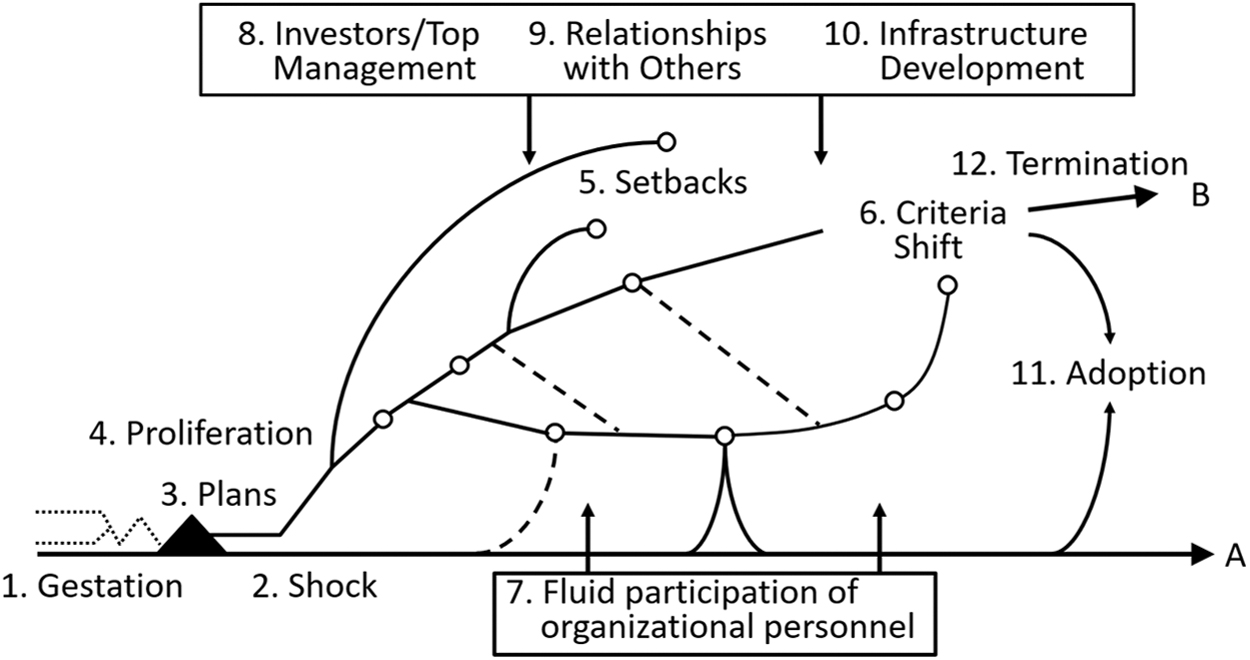
The innovation process model. Reprinted from Van de Ven et al.5(p. 25)
The U.S. government (i.e., the Air Force and the National Aeronautics and Space Administration [NASA]) conducted supporting research for the HSSFP in the 1950s through the 1970s. Between the years 1996 and 2004, the private Ansari X PRIZE competition stimulated many individuals and companies around the world to develop, and invest in, commercially viable vehicles to safely fly ordinary humans to the “edge” of space and back. New firms proposed many vehicle designs, some as traditional rockets, and others as winged vehicles. Some vehicle designs launch from the ground, some from sea, while others were designed to be dropped from an aircraft, or high-altitude balloon, in flight. The entire mission, from the time the rocket fires until the safe return to Earth, typically lasts less than 30 min. The X PRIZE purse was ultimately won by Scaled Composites in October 2004.
This current research focuses on vehicles designed to carry people to a minimum altitude of 100 km and return to the same location on Earth. The firms included in this study all reached, or surpassed, the milestone of initial fabrication of a full-scale vehicle as of December 2017. These include Scaled Composites (with their vehicle, SpaceShipOne), Virgin Galactic (with SpaceShipTwo), Blue Origin (with New Shepard [NS]), XCOR Aerospace (with Lynx Mark I), and Rocketplane Global (with XP). † This analysis does not include firms who designed and operated suborbital vehicles (including sounding rockets) to transport scientific payloads, but not humans. One firm that built initial hardware but not included in this study, Copenhagen Suborbitals, started in 2008 with the goal of flying a single human on a suborbital trajectory in a rocket-powered vehicle, but their long-term public plans do not include commercial operation. Finally, in October 2017, Elon Musk of SpaceX announced human suborbital transportation (flying to a different point on Earth) as a possible business spin-off from his orbital and deep space plans. 6 As of December 2019, 2 of the 5 HSSFP firms were in operation, but neither had begun revenue-generating flights. Because no paying customer has flown in an HSSFP vehicle to date, the industry is in a pre-production stage of emergence.
This report begins with a brief description of data collection and analysis, followed by a recounting of the HSSFP emergence story, grouping the relevant events into their respective phases of the innovation process model. The report ends with a brief conclusion section. The fully cited HSSFP event listing is provided in the report Supplementary Appendix for use by other researchers (with the presumption of appropriate attribution). To minimize repetition between the list of references in the main report and the Supplementary Appendix, statements of events given in this report, that would normally be cited, are not.
Data
This section describes the collection and analysis of data. This research collected individual HSSFP incidents (the units of analysis) and combined them into relevant events through a 2-stage categorization process. A chart showing the chronological sequence of HSSFP emergence events was created based on a framework of required industry emergence resources.
Data Collection
This research initially collected data from industry blogs, including individual incidents dated between April 1999 and December 2016. 7 From the ∼28,000 incident entries generated from many different types of data sources and outlets, a search using HSSFP keywords ‡ reduced the list to ∼8,400 HSSFP incidents. Industry blogs provide access to data. A secondary aggregator site was queried, and it identified similar industry incidents, providing links to the same, or similar, sources as the principle site. The benefit gained from the secondary site was marginal (i.e., very little new information was found). In addition to the aggregator sites, other sources of information included company web page archives, other web logs, and traditional media research databases. LexisNexis was used particularly for incidents and events before April 1999 and after December 2016. In total, these sites identified incidents from press releases, publicly available government documents, conference presentations, news media reports, editorials, and commentaries. Data collection for this research ended with events in late 2017.
This research also collected primary data through 40 semi-structured personal interviews with HTTSP members, representing private firms, trade organizations, U.S. government executive branch agencies (including the U.S. space transportation regulator [the Federal Aviation Administration, FAA], NASA, the Office of Management and Budget, and the Office of Science and Technology Policy), the U.S. legislative branch, industry consultants, conference organizers, and supply chain members.
Data Analysis
Next, individual incidents were grouped, identifying important contributing HSSFP events. Events were defined as “an incident when change occurred,” following a data collection methodology described by Van de Ven.8(p. 33) Changes were based on 5 major concepts of the innovation process definition (italics added for emphasis in the following quote):
“motivating and coordinating people to develop and implement new ideas by engaging in transactions (or relationships) with others and making the adaptations needed to achieve desired outcomes within changing institutional and organizational contexts.”3(p. 9)
Incidents were grouped into event categories of type and life cycle stage. Event categories included: (1) meetings, expositions, and conferences, (2) launches, (3) hardware testing, (4) raffles or other types of games of skill or chance, (5) individual speaking engagements or interviews, (6) organizations or government agencies, (7) government programs, and (8) bills, legislation, or laws (at federal, state, and local levels). Event life cycle stages included: (1) start, entry, or introduction, (2) a retrospective, profiles, plans, information, activities, partnerships, reactions, or forecasts, (3) milestones, (4) conclusion, exit, or passage, and (5) retrospective or future plans. Of the 8,400 HSSFP incidents, the categorization process identified ∼400 events.
The event data were then grouped within a framework of industry infrastructure elements (IIEs). 9 The IIE framework identifies resources required for successful industry emergence, including first-level categories of Institutional Arrangements, Resource Endowments, and Proprietary Functions. 10 Beneath these 3 top-level elements are second- and third-order subelements, as shown in Table 1.
Industry Infrastructure Element (IEE) Framework Taxonomy 17
The identification and use of multiple data sources maximized data robustness. Data triangulation, a coherent audit trail, a thorough description of industry emergence incidents and events, and collaborating interviews, maximized the reliability and overall validity of the data. A recognized data collection limitation was the reliance on secondary data, diminishing the data confirmability and credibility.
Data analysis involved creating an industry emergence chart (Fig. 2) by chronologically ordering each event within the framework of IIE and identifying interdependencies between them. 8 The chart spans 7 decades, starting with events dating back to the early 1950s, allowing an opportunity for in-depth description and analysis. The majority of HSSFP events fit comfortably into the IIE framework. The chart traces a storyline that describes how individual firms entered the industry, sought and acquired financing, interacted with regulatory agencies, conducted vehicle design, assembly, testing, and operations, and, in some cases, exited the industry. It also shows specific relationships and interactions between supporting facilities (such as spaceports) and firm activities, and activities that support the creation of knowledge and market resources.
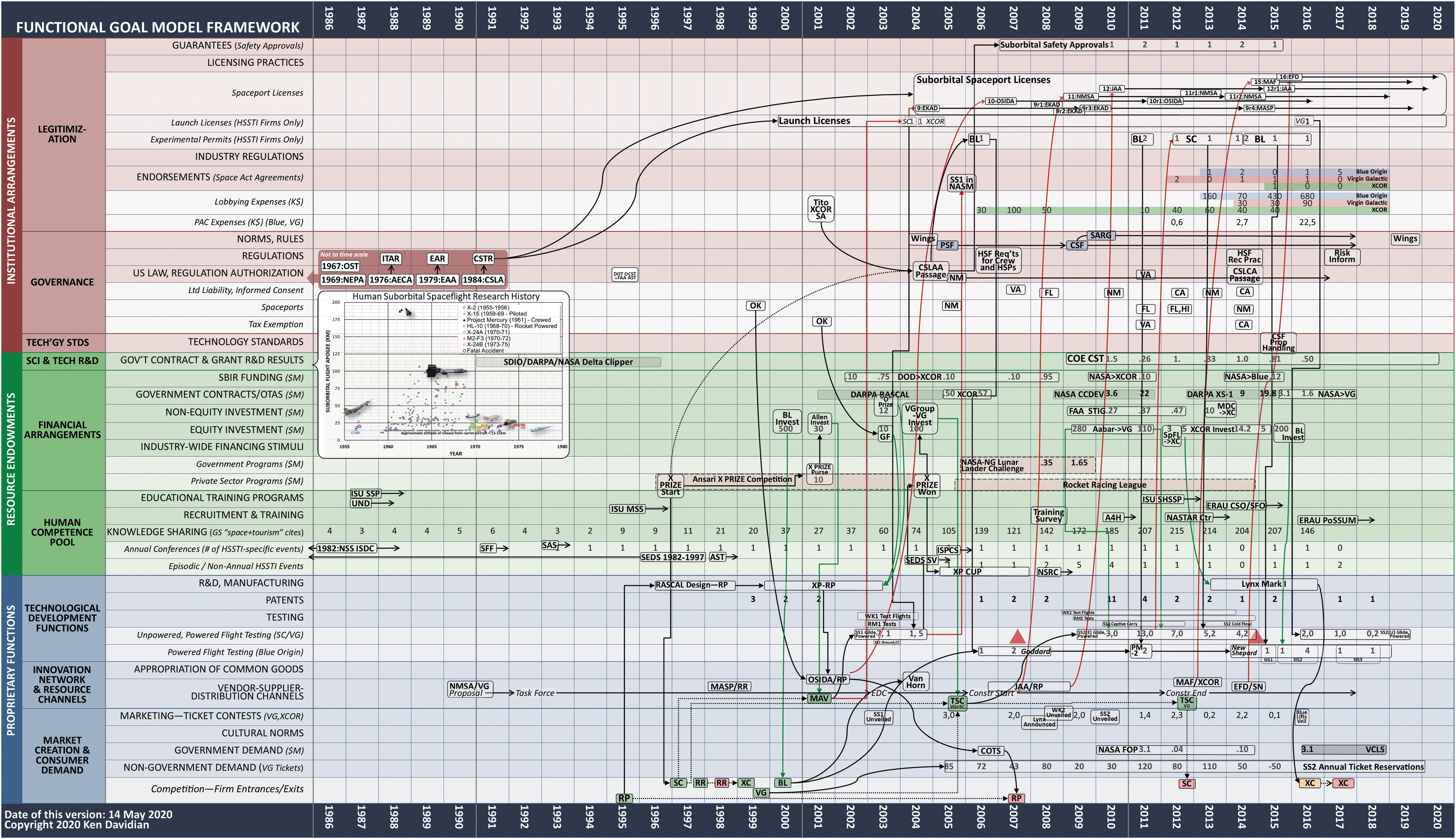
HSSFP emergence chart. HSSFP, Human Suborbital Spaceflight Population.
Space Tourism Industry Emergence
This section recounts the events corresponding to the 3 innovation process periods and 12 phases of the fireworks model (Fig. 1).
Initiation Period
The innovation process Initiation period includes phases of Extended Gestation, a Shock Trigger, and the Submission of Initial Plans. HSSFP events that occurred within these phases are described below. Gestation events include the creation of institutional resources, scientific knowledge, and human capital. Although the Ansari X PRIZE was a triggering event for space tourism as a whole, the creation, announcement, and activity of space tourism companies were primarily established before the winning of the competition.
Extended gestation phase
Institutional gestation events, including treaties and regulations, were enacted that support many space industry segments, including the HSSFP. For example, the Outer Space Treaty established national oversight responsibilities for any country's space activities, providing the legal basis for national-level regulation of all space activities, including the U.S. commercial space transportation regulations. Other U.S. laws led to regulations regarding technology transfer, export control, and environmental protection.
Gestation events that developed resources of scientific knowledge also occurred, including government research and development (R&D) results. Technology development programs supported later HSSFP emergence, listed in Table 2, including suborbital flights conducted by the military (the U.S. Air Force or the Defense Advanced Research Projects Agency [DARPA]) and/or NASA, as part of a government research program. § Experimental suborbital vehicles, dating back to the mid-1950s, were included if they met the current regulatory definition of “suborbital rocket” and “suborbital trajectory.” ** The best known vehicle in this category was the X-15. The Mercury capsule, atop an Atlas rocket, attained the highest altitude of all the government research vehicles carrying humans on a suborbital trajectory, on the first 2 flights of the overall program. †† Subsequent to the end of these research programs (which ended in the mid-1970s), DARPA conducted the Delta Clipper program to advance technologies important to the space tourism industry.
Government Research
Human capital resource events (Table 3) also prepared institutional and industry actors for the emergence of the HSSFP (and the space industry in general) during the Gestation phase. In addition to university-level aerospace engineering programs, ‡‡ new multidisciplinary programs were created (the International Space University Space Studies and Master of Space Studies programs, and the University of North Dakota Space Studies program), as were conferences emphasizing student involvement, the sharing of amateur rocketry experiences, and promotion of the commercial (nongovernmental) uses of space.
Educational Programs and Conferences
Shock trigger phase
The Shock Trigger phase is next in the Initiation period, during which an exogenous event, sometimes referred to as a “punctuation,”11–13 stimulates industry emergence events. For the HSSFP, the Ansari X PRIZE competition was that shock event. The Ansari X PRIZE offered a 10 million U.S. dollar purse to the first nongovernmental organization to fly a single vehicle, capable of carrying 3 adults, to an altitude of 100 km, twice in a 2-week period. The contest was announced in 1996 by the X PRIZE Foundation, and at its peak, there were 23 registered teams. Of the total field, approximately one-quarter built and/or tested hardware, and only 1 team ended up conducting competition flights. The purse was secured in 2001 (through the procurement of a “hole in one” insurance policy), encouraging the owner of Scaled, and the designer of SpaceShipOne, Burt Rutan, to begin pursuing the prize in earnest. SpaceShipOne won the competition in October 2004.
Figure 3 shows the number of industry emergence events increased significantly since 1996. The number of conference publications and journal articles also experienced a marked increase after the announcement, purse funding, and winning of the X PRIZE. A 2-sample t-test (assuming unequal variances), for the average number of events per year from 1955 to 1995 compared with from 1996 to 2016, §§ supports the hypothesis that the increase in the average number of annual HSSFP emergence events was statistically significant. As shown in Figure 4, the number of HSSFP-related publications also shows a statistically significant increase following the X PRIZE announcement in 1996. *** Therefore, these findings support the assertion that the X PRIZE competition, from initial announcement through the final award, was the shock trigger for the current set of observed HSSFP emergence events.
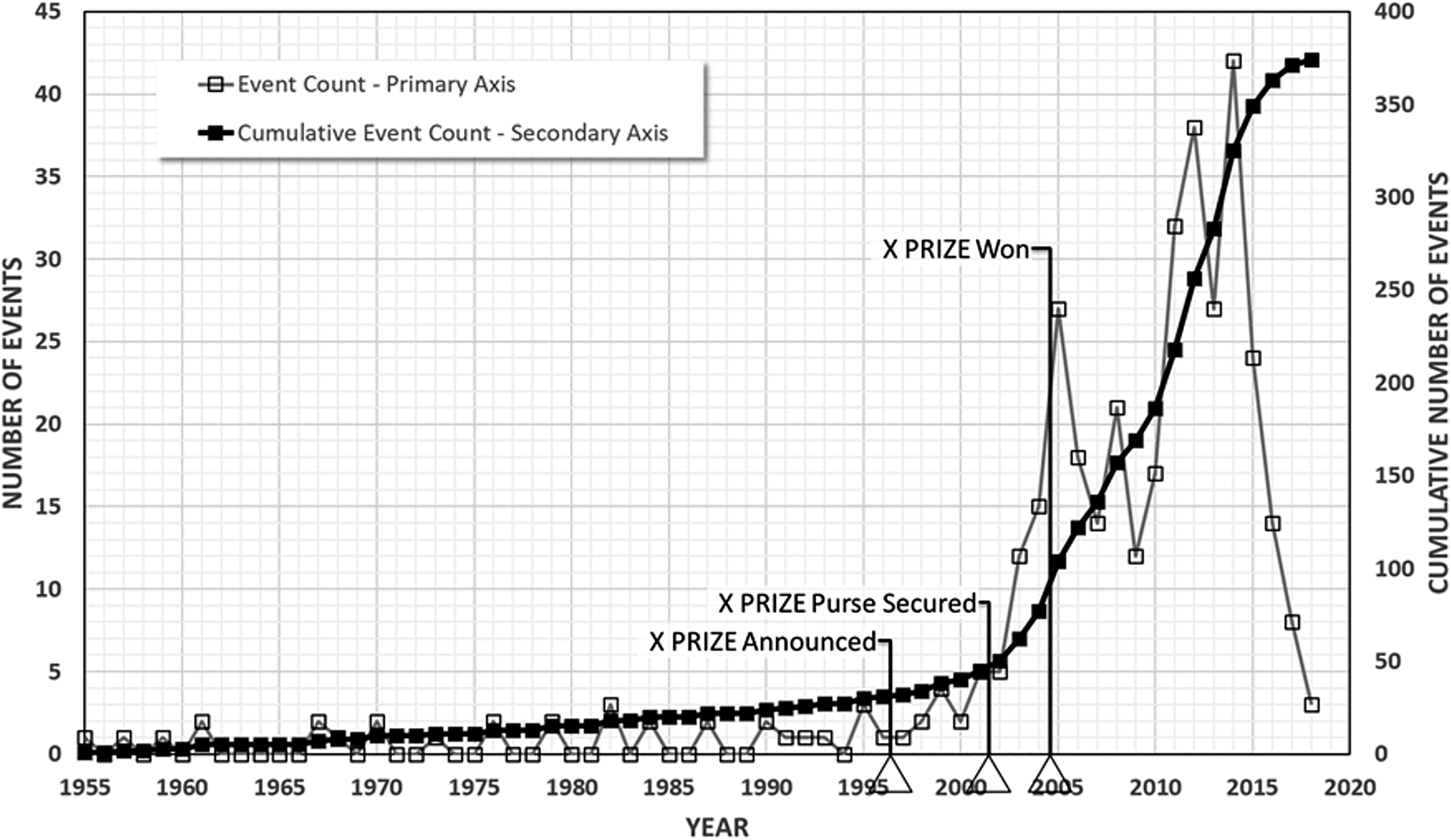
Chronology of HSSFP events.
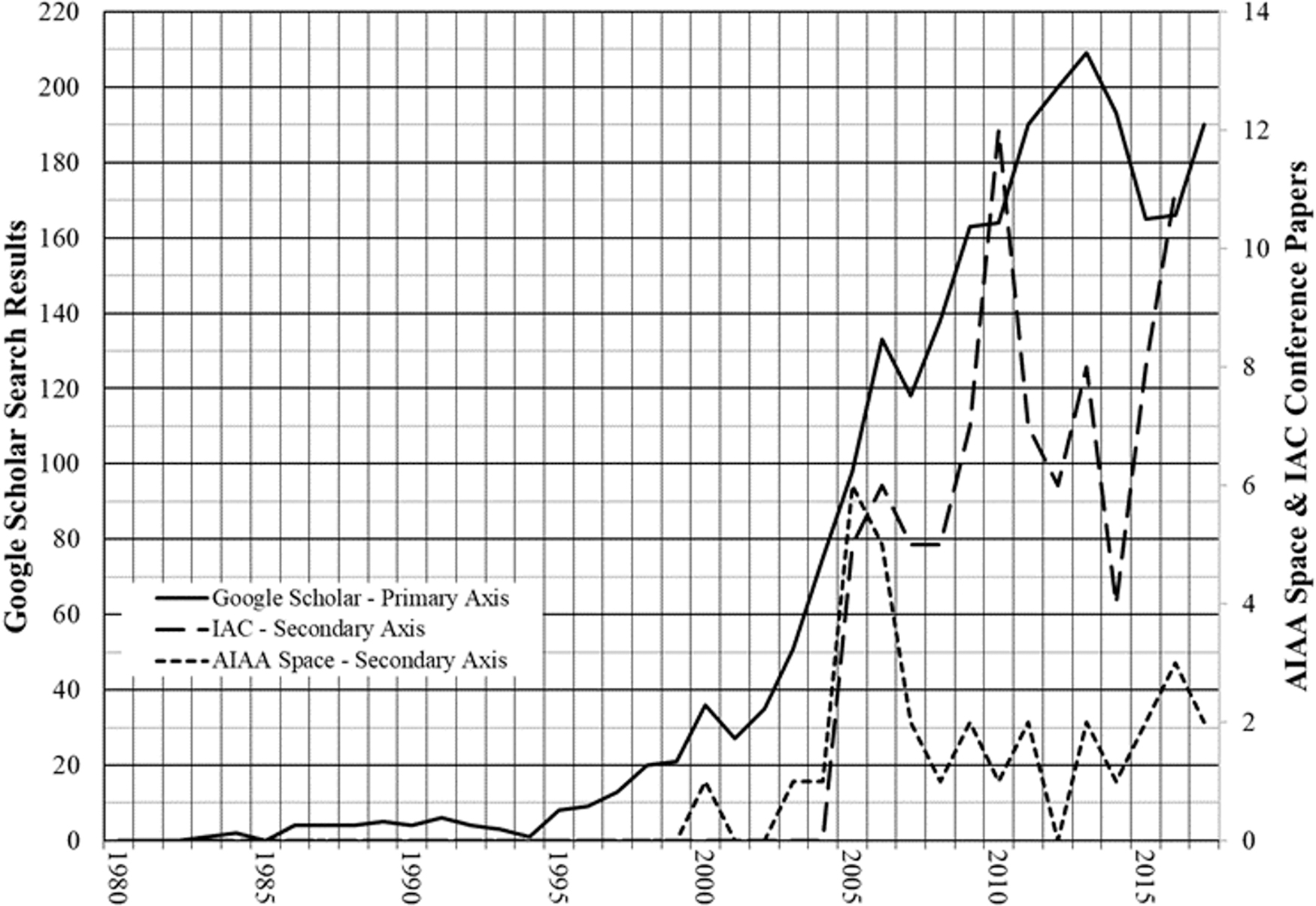
Bibliometric results of “space AND tourism” keyword search.
Submission of initial plans
Building upon the foundational institutional arrangements, government research, and development of human capital, firms began executing their space tourism plans in earnest subsequent to the Ansari X PRIZE announcement, signaling the end of the first period of the innovation process.
Initial planning and establishment of the first HSSFP firms began in the late 1990s and early 2000s. When Scaled won the X PRIZE in 2004, 4 companies had already been created and announced. Scaled was the first of these companies, originally founded as an aircraft design firm in 1982, and it “diversified” into suborbital spacecraft design in 2001. Founded in ∼1995, Rocketplane was also a registered X PRIZE team and began hardware manufacturing in the early 2000s. Although Richard Branson licensed the name “Virgin Galactic Airways” in 1999, it was not until 2004 that the brand was publicly announced at a ceremony immediately following the second X PRIZE flight of SpaceShipOne. XCOR and Blue began operations in 1999 and 2000 (respectively) and pursued vehicle development for the space tourism industry without participating in the X PRIZE competition.
The next period of the innovation process describes a complex series of activities that advance the suborbital transportation industry emergence narrative.
Developmental Period
During the Developmental period, industry actors identify and voluntarily pursue alternative applications for their innovations. Challenges and setbacks, or involuntary changes of company activities, also arise. These can have a ripple effect, leading to a reevaluation of company goals and success criteria, changes of technical staff and managers, new organizational partnerships, and multiple program reviews. During this period, industry actors decide whether, how, and with whom to partner, to accumulate industry infrastructure resources required for commercial success.
Proliferation into multiple ideas
As innovations develop, original objectives and applications may not materialize as planned, and new ones become evident, sometimes in very different industry segments. The 5 space tourism companies included in this study pursued vehicle development and operations to different degrees. Rocketplane and XCOR advanced to the stage of vehicle manufacture, but did not begin operational testing of the entire vehicle system. The remaining 3 companies all began flight test programs of their vehicle systems. Two companies (Scaled and Virgin) conducted flight tests with humans onboard.
All 5 companies encountered opportunities to pursue alternative activities in spaceflight. Rocketplane halted its suborbital vehicle development activities after its selection to participate in the NASA Commercial Orbital Transportation System (COTS) program. XCOR teamed with another company (Masten Space Systems) to compete for the DARPA XS-1 program ††† and later dedicated a portion of its workforce to develop a propulsion system for the U.S. Air Force. Like XCOR, Virgin participated in the XS-1 program (teaming with Northrop-Grumman) and also started an entirely new company (Virgin Orbit) to develop a launch vehicle system to deliver low-mass payloads to orbit, directly drawing upon their experience in the design of their HSSFP vehicle and propulsion systems. Finally, Blue pursued multiple parallel activities, participating in the NASA Commercial Crew Development program to develop a crewed orbital capsule, partnering with Boeing on the XS-1 program, and developing an orbital vehicle, called New Glenn. Although each of the space tourism companies took detours, or branched out, from the original human suborbital goals, they assumed these activities voluntarily. Therefore, these are not considered industry emergence setbacks.
Setbacks and mistakes
Setbacks and mistakes occurred during the proliferation phase of HSSFP firms' activities. Some setbacks caused companies to exit the industry, whereas others had less severe repercussions.
Blue experienced multiple setbacks during the flight test phase of their vehicle development activities. On 2 occasions, flight testing resulted in the entire loss of the vehicle. Neither case involved a fatality (no people were onboard). Both Scaled and Virgin experienced some minor technical setbacks during their flight test programs, but the companies also experienced significant setbacks resulting in 4 fatalities and a schedule delay of 22 months.
XCOR lacked the financial resources of Blue and Virgin, so firm survival required exploiting the company's core competency of liquid engine system development. XCOR divided its technical team between activities of retail sales and development of their vehicle and engines.
“I never wanted to be in the consumer sales business, and ultimately, getting in the consumer sales business probably is what ultimately killed the company. I didn't want to get into that business because I thought, ‘That's an incredibly different business.’”—HSSFP Executive
Rocketplane was of similar size as XCOR and also had limited resources. After 4 years of vehicle development activities, Rocketplane diverted all their resources to work on an orbital vehicle under the NASA COTS program. In 2007, when Rocketplane failed to meet a required financial milestone, NASA removed Rocketplane from the program. The effects were catastrophic and forced the company into “hibernation mode”:
“We were moving along, we would have been in flight test and probably in operation by 2008 or 2009 if it hadn't been for COTS, and we hadn't been distracted and ultimately bled out.”—HSSFP Executive
Shifting goals and criteria
Financial considerations caused the smaller space tourism firms to modify their business goals and technical criteria of success. Rocketplane's vehicle design evolved from a modified Lear Jet to a larger vehicle, doubling the vehicle cost, and putting a financial strain on the firm. It was at this time the COTS program opportunity emerged, so Rocketplane decided to pursue that new objective. XCOR moved their R&D activities from Mojave, CA (where they perceived the cost of doing business as too high), to Midland, TX, in search of “the best business conditions.”
Change of involved personnel
In addition to shifting goals and success criteria, personnel also came and went from the space tourism projects. The 4 firms that entered the market after the X PRIZE (i.e., all except Scaled) experienced changes of personnel working for the companies. The monotonically increasing number of Blue employees reflects the overall company growth, due to its diversification into the orbital sector, and cannot be attributed solely to their suborbital activity. For the smaller companies (Rocketplane and XCOR), the employment numbers rise and then fall to zero. Although the data are a bit sparse, Table 4 provides employment levels for all the space tourism industry firms.
Human Suborbital Spaceflight Population Firms' Employment Histories
The rows, for the years with no data (2009, 2010, and 2013), have been omitted from this table.
Insights into personnel changes at Blue, Scaled, and Virgin are limited to publicly available sources. Typically, changes at the highest organizational levels were deemed noteworthy by industry observers, although the impact of these changes within the company is estimated to be limited because no major strategic or operational changes were observed. The organizational structures of the 2 smaller firms, Rocketplane and XCOR, were much flatter, resulting in a greater impact of personnel changes within these companies. XCOR experienced a significant change of the company ownership, which may have led to the release, 6 months later, of the employees working on vehicle development.
Involvement of top managers and investors
All 5 space tourism firms benefited from the involvement of top managers and investors, but the benefits were especially significant for Blue and Virgin. Jeff Bezos committed to annually sell $1 billion of Amazon stock 14 to subsidize all Blue operations (suborbital and orbital). In 2004, Virgin was funded by their parent company (the Virgin Group) and then by sovereign investors (United Arab Emirates [UAE] then Aabar Investments, later Mubadala Investments), in 2009 and 2011, at funding levels in the hundreds of millions of dollars. Paul Allen provided ∼$30 million of funding for Burt Rutan to compete in the X PRIZE competition. XCOR had individual (angel) and other private investors from the United States and Denmark, providing on the order of tens of millions of dollars, that later changed the company's direction. George French invested $10 million into Rocketplane to enable passage of an Oklahoma tax credit law, resulting in a $12 million cash return.
Interorganizational relationships
All 5 companies had strong interorganizational relationships with state and federal government agencies, including many of the NASA research and spaceflight centers, and U.S. military organizations. Blue executed multiple space act agreements (SAA) with NASA centers. Rocketplane established a relationship with the Oklahoma state government, leading to the passage of a tax credit law which Rocketplane converted into $12M of liquid funds. Because it would have violated the rules of the X PRIZE competition, Scaled had minimal (if any) relationship with governmental agencies for the design and operation of SpaceShipOne. Once the X PRIZE purse was fully funded, Rutan received an investment of ∼$30 million from Paul Allen to design and build the vehicle that ultimately won the X PRIZE competition. They also established Mojave Aerospace Ventures (MAV) to license the vehicle technology. After the competition, however, Virgin licensed the vehicle design from MAV and entered into a business partnership with Scaled to create The Spaceship Company (TSC) for the manufacture of future SpaceShipTwo vehicles. Scaled sold its minority share in TSC in 2012 and effectively exited the space tourism industry at that time. Virgin also entered into multiple SAA with NASA centers. Finally, XCOR also had an SAA with NASA.
Infrastructure development
The last phase of the Developmental period, Infrastructure Development, is very significant because all actors, either individually or in cooperation with others, work to ensure the long-term viability of the industry, by building and accumulating IIE of Institutional Arrangements, Resource Endowments, and Proprietary Functions. Development and accumulation of some IIE began before the X PRIZE events, as discussed in the Gestation phase of the innovation process model. Resources accumulated after the Shock Event phase are discussed in this section.
Institutional arrangements
Subcategories of Institutional Arrangements IIE events include legitimation, governance, and technology standards. After the X PRIZE, the U.S. regulatory agency (FAA AST) issued safety approvals, experimental permits, spaceport licenses, and mission licenses related to the space tourism industry. These regulatory determinations increased the legitimacy of HSSFP activities, 15 such as training services. Other legitimation events included Congressional testimony regarding space tourism, Congressional recognition of the X PRIZE award, and the induction of SpaceShipOne into the Smithsonian National Air and Space Museum. Political activities of space tourism firms also influenced legitimacy through active lobbying, and contributions to political action committees. ‡‡‡
Space tourism industry governance events also fostered and reinforced norms and rules of the community, including recognition ceremonies (awarding of astronaut wings), creation of an space industry trade association (the Personal Spaceflight Federation, later renamed to the Commercial Spaceflight Federation), and creation of a space tourism industry interest group (the Suborbital Applications Research Group). The FAA released recommended practices, and other guidelines for human spaceflight crew and occupant safety. The U.S. Congress enacted 2 federal laws to amend the original Commercial Space Launch Act of 1985 after the X PRIZE was won. State governments (in Hawaii, Virginia, Florida, New Mexico, California, Oklahoma, Texas, and others) passed laws related to the space tourism industry, addressing topics of limited liability, informed consent, the establishment of space port and space port authorities, taxes, and tax exemptions for space-related expenses.
Resources to establish space tourism industry technology standards (including government mandate, de facto, or industry consensus-voluntary standards) have not yet been substantially accumulated. Contributing factors may include the high level of diversity of trade organization members, or the political nature of creating industry standards. Attempts by the trade organization at standards development has only resulted in an industry consensus for propellant handling. More recently, HSSFP members began working with a standards development organization, to make progress in this IIE. Based on the attitude of Congress toward the level of government involvement in space tourism industry emergence, no standards were mandated by government. There are no de facto (i.e., dominant design) standards because no firm has fully entered the market. This is a major gap in the development of Institutional Arrangement IIE.
Resource endowments
Resource Endowments IIE events include public-domain (i.e., government funded) scientific and technological research, financial arrangements, and the pool of human capital. Although government contract R&D generated very few results relevant to the space tourism industry since the X PRIZE, federal grants to universities (through the FAA Center of Excellence for Commercial Space Transportation) supported suborbital transportation research since 2010. Government financing provided to space tourism industry firms for reasons other than knowledge generation (such as market creation) are included in the subelement of financial arrangements. The U.S. Department of Defense, NASA, and other government agencies at the federal, state, and municipal levels also funded space tourism industry firms through the Small Business Innovation Research program, various acquisitions, and nonequity investments. The level of governmental, nonequity support is small (ranging from $100 thousand to $12 million) compared with private funding sources in exchange for equity. Equity investments (by private individuals, parent companies, angel investors, venture capitalists, and nondomestic governmental investment groups) were typically on the order of tens, or hundreds, of millions of dollars. Jeff Bezos started Blue with a personal investment of $500 million. Aabar investments (backed by the government of the UAE) provided 2 rounds of funding to Virgin, the smallest of which was $110 million. The largest private equity investments far exceeded the level of funding provided by any government sources.
Other programs, initiated by both government and nongovernment entities, included prize and contest competitions. These were categorized separately from other funding sources because they acted as catalysts for private investment, although the programs themselves provided a token amount of funding only upon successful completion of the project. Although the purse could be relatively small (e.g., $10 million in the case of the X PRIZE), it stimulated larger investments from additional sources, inside and outside the industry. The Lunar Lander Challenge was a $2 million prize competition funded by NASA, administered by the X PRIZE Foundation, and financially supported by Northrop Grumman. A similar activity, designed to stimulate industry-wide investment, was the short-lived Rocket Racing League. Although prizes are categorized within the funding resource IIE, prize competitions are also contributors to industry and individual legitimacy. 15
Events that develop the HSSFP human competence pool include the creation and execution of educational programs, recruitment and training events, and knowledge sharing efforts. A small number of new educational programs came into existence after the X PRIZE (including the International Space University Summer Hemisphere Space Studies Program, and the Embry-Riddle Commercial Spaceflight Operations program), complementing those already in existence. Training programs began to proliferate, 16 emphasizing the training of future nongovernment, citizen-scientist astronauts (e.g., Astronauts4Hire, the NASTAR Center, and Embry-Riddle Aeronautical University's “Polar Suborbital Science in the Upper Mesosphere” program), and providing training in the use of space suits, mission simulation, and functioning in simulated spaceflight conditions (e.g., hypoxia and high g-forces). Knowledge sharing events, such as annual and episodic conferences, proliferated. Some events focused specifically on the HSSFP (e.g., the X PRIZE Cup events, and the Next-Generation Suborbital Researcher's Conference). As mentioned previously, a bibliometric proxy for HSSFP knowledge sharing activity shows the significant increase of knowledge-sharing since the X PRIZE competition (Fig. 4).
Proprietary functions
The Proprietary Functions IIE events include technology development functions, the creation of innovation network and resource channels, market creation, and consumer demand. Technology development functions include proprietary R&D conducted by the firms, and manufacturing, assembly, and testing of their vehicles. Insights into privately funded R&D are limited because of the secretive nature of proprietary activities. Press releases provide general information, but details of specific projects are typically not publicly available. Proprietary research results, conducted by firms for their own purposes, differ from the publicly available R&D conducted in the Resource Endowments element. The in-house R&D activities of each firm contribute to their intellectual property, protected through the patenting process, or by the keeping of trade secrets. These protections are necessary to ensure that the firm benefits from their research, and “free riders” do not. Patent data exist for space tourism firms, but the numbers of patents for some firms are small or zero. The patent quality and applicability to the space tourism industry are also open to interpretation. Patents awarded to the space tourism firms are listed in the Supplementary Appendix.
Before 2005, Rocketplane participated in a government-sponsored design program, resulting in the partial construction of their vehicle. In 2004, XCOR received a mission license for the Xerus vehicle design that was never built. The company worked on rocket propelled aircraft that could participate in the newly formed Rocket Racing League, but when follow-on development contracts did not materialize, they announced the design of their Lynx Mark I and Mark II vehicles. The design of the Mark I was completed, and the vehicle was only partially assembled when the company ran out of funds.
Scaled, Virgin, and Blue all conducted flight testing of their vehicles. Since flight testing is difficult to conceal, industry observers easily documented HSSFP vehicle testing activities. Scaled provided detailed flight test summary reports on their website. Flight testing began in 2003 and culminated in the prize-winning flights in September and October 2004. The flight test program for Scaled is summarized in Table 5.
Scaled Composite SS1 Program Testing Summary
At the second competition flight of SpaceShipOne, Sir Richard Branson announced the creation of Virgin. Virgin worked closely with Scaled from 2004 to design, manufacture, and assemble SpaceShipTwo, the new vehicle. Testing of operational procedures, specifically the transfer of nitrous oxide propellant, led to an accident that killed 3 Scaled employees. Although this was not considered a space industry accident (the accident investigation fell under the purview of the California Occupational Safety and Health Administration), the timeline of SpaceShipTwo development and testing was negatively affected by the accident. Flight tests of the new vehicle began in 2010 and continued at an increasing pace until another fatal accident in October 2014 occurred on the fourth powered flight of SpaceShipTwo. Because the accident occurred during flight, this investigation was led by the National Transportation Safety Board, and testing operations stopped for ∼2 years. Flight tests resumed in 2016 and are still ongoing at the time of this writing. Virgin's flight test program is summarized in Table 6.
Virgin Galactic SS2 program Testing Summary
After its founding in 2000, Blue maintained a low profile, eschewing publicity and maintains a high level of secrecy of its operations and intentions. It was not until 2016 that Blue began publicizing their activities, inviting the press to tour their facilities, and providing web broadcasts of their test flights. After the firm creation, Blue established their private launch site near Van Horn, TX, and then tested their early vehicles (the Charon, Goddard, and Propulsion Module 2) between 2005 and 2011. After a hiatus of 4 years, the NS vehicle, their first reusable vehicle capable of carrying humans to 100 km altitude, began flight testing. The first NS1 flight test in April 2015 ended in loss of vehicle, but NS2 flights recommenced before the end of the year. NS2 went on to fly 5 times before being retired in October 2016. NS3 began its flight tests in December 2017 and is still the vehicle being tested at the time of this writing. Blue's flight test program is summarized in Table 7.
Blue Origin Program Testing Summary
Private research organizations also performed some testing of spaceflight systems (e.g., Southwest Research Institute tested pressure suits). Individual testing events for all HSSFP companies are listed in the Supplementary Appendix.
Successful industry emergence requires the creation of an innovation network, including the appropriation of common goods, and the development of a network (i.e., channels) of vendors, suppliers, and distributors. Common goods (government-funded scientific and technological results, education and training programs, knowledge sharing activities, and publicly available infrastructure facilities) were discussed above, except for spaceports. Spaceports used by suborbital vehicles do not include the orbital federal launch sites located on the east or west coasts of the continental United States (i.e., the Cape Canaveral and Vandenberg ranges). HSSFP spaceports available to any vehicle operator can be purpose-built, or repurposed from existing military or civilian facilities, and receive a license to operate from the FAA. Blue uses its own private facility, not available for use by other companies, near Van Horn, TX. Virgin is initially committed to the New Mexico spaceport but has explored options of operating out of other locations within the United States and around the world. Other HSSFP spaceport sites have been proposed. A list of the HSSFP spaceports is given in Table 8.
The Creation of Human Suborbital Spaceflight Population (HSSFP) Spaceports
Development of vendor, supplier, and distributor networks are evident in the HSSFP. An example is the Virgin partnership with Scaled to create TSC, the manufacturing firm for SpaceShipTwo. Virgin eventually bought Scaled's share of the joint venture in 2012, signaling Scaled's exit from the HSSFP, and Virgin's vertical (backward) integration into vehicle manufacturing. Other network creation events included XCOR's partnership with, or acquisition of, other companies (such as Xtraordinary Adventures, Rocketship Tours, or Space Expedition Corp.) to market and sell tickets on their vehicle. Virgin included ticket sales within the boundaries of their company operations. Rocketplane never actively sold tickets, although angel investors were promised rides on the vehicle once it was in operation. Blue started offering tickets for sale in 2017, and the activity was primarily performed in-house.
HSSFP firms performed market creation and consumer demand activities in many ways, including the unveiling (i.e., dramatic revealing) of a new vehicle, facility ground breaking, “grand opening,” or dedication events (e.g., of spaceport runways), the creation of new programs, the announcement of new industry publications, contests, and raffles for winning prizes of suborbital flights, or the predictions of first test flights or first commercial flights. For example, there were unveiling events for WhiteKnightTwo and SpaceShipTwo at the Mojave Air and Space Port. XCOR announced their Lynx vehicle designs at a press conference, with the intention of increasing visibility of their company and project. Contests, including competitions, prizes, awards, raffles, and sweepstakes, were used extensively to promote HSSFP firms (primarily for Virgin and XCOR) and provided some funding, marketing, and motivation to the companies:
“when you're at a company that is funded the way we were funded, those sorts of activities can really help with moral of the employees. And they see validation in what they're doing. So it was always helpful just to have those things going on and people coming through and … them giving a summary of their work. It's amazing when you have an intern or a first-year engineer who's asked to well, show this person what you're working on. And then they find out later that that's the number 2 producer at The Big Bang Theory, their favorite TV show … It's like, ‘Oh my God!’, you know?”—Former HSSFP Executive
Actual demonstrations of demand, through the advanced purchase of tickets for future flights, are discussed in the Innovation Adoption section.
Industry emergence is a result of surviving all the challenges encountered in the Developmental period of the innovation process. Setbacks, mistakes, personnel changes, partnerships, management and investor involvement, shifting of goals, and the complex process of building and accumulating all the industry infrastructure resources are constant barriers that new industry firms must overcome. If they survive the first 2 periods, firms may independently progress into the ultimate stage of the innovation process, the Implementation period.
Implementation Period
The Implementation period includes phases of Adoption, when the innovation finds some degree of market acceptance, and Termination, in the cases where insufficient adoption forces the innovation process to end, or the firm to cease operations. As of the time of this writing, 2 HSSFP firms (Blue and Virgin) are still in a state of pre-production, awaiting strong evidence of market acceptance. §§§ Although customers have purchased, or placed deposits toward, future spaceflights, no company has yet delivered a successful suborbital spaceflight to a paying customer. The Termination phase has already been experienced, voluntarily by Scaled, and involuntarily by Rocketplane and XCOR.
Innovation adoption
As of early 2020, Blue and Virgin are working to enter the HSSFP market. A proxy for HSSFP innovation adoption exists, however, in the number of flight reservations recorded. Based on statements made by Virgin officials, the number of reservations has shown a steady growth, from 0 in 2005 to the first 100 reservations by 2006, and reaching ∼700 at the time of the SpaceShipTwo accident in October 2014 (Fig. 5). **** Since that time, the number of reservations has held steady, primary because Virgin halted sales. These reservations were made through deposits, between 10% and 100% of the full ticket price (initially $200,000 and raised to $250,000 in mid-2013). Reportedly, XCOR also sold on the order of 200–300 advanced tickets, but the degree of documentation on these numbers is less rigorous than those for Virgin. At the same time that reservations for future flights were being sold, NASA began the Flight Opportunities Program, intended to stimulate demand for the HSSFP flights. The program issued contracts to developers of experiments and payloads that could eventually fly on the suborbital vehicles, or they purchased future flights on pre-production vehicles.
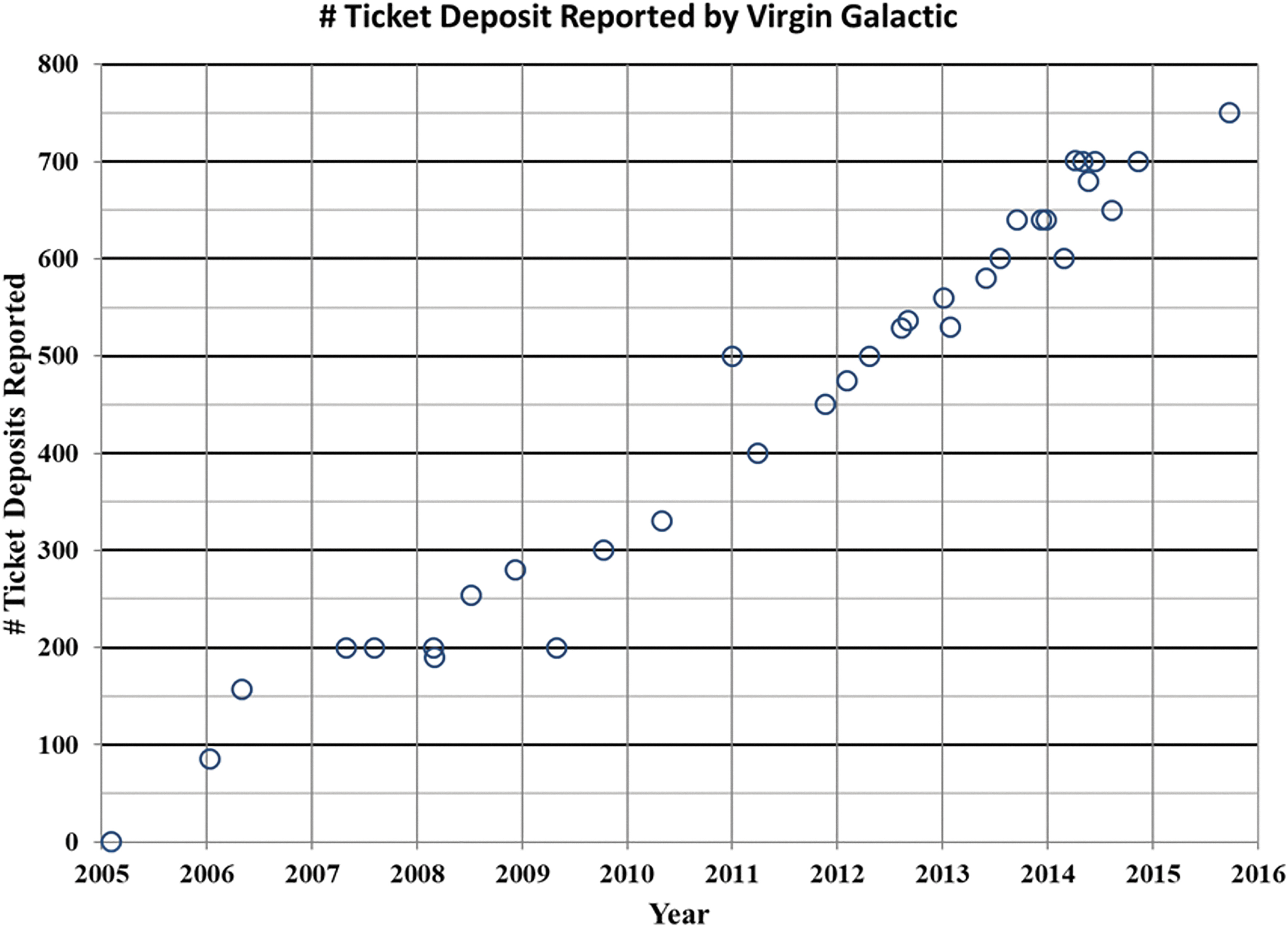
Number of reported flight reservations on the Virgin Galactic SpaceShipTwo vehicle.
Termination
Whereas innovation adoption is a positive sign for industry emergence, firm exits are negative indicators. Scaled voluntarily phased out of suborbital flight operations after winning the X PRIZE competition, at which time, it licensed the design of SpaceShipTwo to Virgin. The 2 companies then partnered to create TSC. Scaled eventually sold its share of TSC to Virgin in 2012, effectively exiting the HSSFP altogether. In 2006, Rocketplane diverted all their resources to work on an orbital vehicle under the NASA COTS program. In 2007, when Rocketplane failed to meet a required financial milestone, NASA removed Rocketplane from the program. This forced the company into “hibernation mode.” Ultimately, the company filed for bankruptcy and was eventually sold at auction for $25,000. Over time, the XCOR vehicle development activities ran out of funding and that team was released in June 2016. By June 2017, the engine development contract was terminated, forcing the entire company to file for bankruptcy.
Summary
This research identified HSSFP events that fit within the innovation process “fireworks” model and provide the industry emergence story. All 3 periods and 12 phases of the model are represented by the observed events, demonstrating that the industry is past the initial emergence stages, into an intermediate pre-production phase, that is seemingly close to actual commercial operation. This will be signaled once any firm flies a customer in exchange for a ticket sold. To date, many tickets have been sold, but no customers have flown. Scaled, the 1 firm that diversified into the suborbital transportation market, has voluntarily redirected their focus back to innovative aircraft design. Another 2 firms exited the HSSFP due to financial constraints. The remaining 2 firms, Blue and Virgin, persist in their efforts to enter the market of offering suborbital space transportation flights to paying customers.
Conclusion
The purpose of this article is to describe the emergence of the HSSFP within models of the innovation process and required industry resources. The HSSFP emergence description (given here) and the cited event data (provided in the Supplementary Appendix) are offered for use by researchers employing a similar data collection methodology in support of their innovation process research. This research collected individual HSSFP incidents, and combined them, through a 2-stage categorization process, into relevant events. A chart of HSSFP emergence was created by framing the events chronologically within the IIE framework. The history of HSSFP emergence was described within the 3 periods and 12 phases of the innovation process “fireworks” model.
Initiation period events laid the foundation of knowledge and technologies supporting HSSFP emergence based on government test programs starting in the 1950s. The space tourism industry also benefited from institutional treaties, laws, and regulations, affecting space activities in general, from the mid-1960s until the mid-1980s. The Ansari X PRIZE, starting with the initial announcement in 1996, and ending with the $10 million purse award in 2004, provided the major shock trigger that acted as a catalyst for the formation of new space tourism firms, signaling the end of the first period of the innovation process. Next, the Developmental period describes a complex series of activities that facilitate the development and maturation of suborbital transportation innovations. Surviving these challenges is difficult and include setbacks, mistakes, personnel changes, partnerships, management and investor involvement, and shifting goals. HSSFP actors actively accumulated and are still accumulating, most of the IIE resources required for successful space tourism industry emergence. Space tourism firms that eventually exited the industry received financial resources on the order of tens of millions of dollars. The 2 remaining space tourism firms still in existence, however, received funding on the order of hundreds of millions of dollars. Subsequently, firms progressed to the last stage of the innovation process, the Implementation period. Although a number of pre-flight ticket reservations have been received by one of the 2 remaining space tourism firms, no customer has yet flown in a suborbital space transportation vehicle, evidence that this industry segment has yet to demonstrate full emergence. Finally, 1 resource, technology standards, is still underdeveloped. While this is characteristic of industry evolution before the clear identification of market demand and emergence of a dominant design, the continued absence of standards could increase interorganizational conflict and reduce HSSFP legitimacy, both of which would reduce the chances of successful emergence.
The data supporting this research are made available in the attached Supplementary Appendix, fully cited, for use by other researchers (with the presumption that appropriate attribution will be given) following a compatible data collection methodology. It is hoped that a practice of collectivist data collection can be established, allowing other organizational change and innovation researchers to benefit from, and contribute to, a data pool encompassing multiple dimensions, including industry contexts, time periods, and geographic coverage.
Footnotes
Acknowledgments
This work was conducted as part of a doctoral thesis, under the academic supervision of Dr. Richard Chivaka at the University of Cape Town Graduate School of Business. At the time of this submission, the author was an employee of the FAA, which neither endorses nor rejects the findings of this research.
Author Disclosure Statement
No competing financial interests exist.
Funding Information
This research was personally funded and did not receive support from any other organization.

References
Supplementary Material
Please find the following supplemental material available below.
For Open Access articles published under a Creative Commons License, all supplemental material carries the same license as the article it is associated with.
For non-Open Access articles published, all supplemental material carries a non-exclusive license, and permission requests for re-use of supplemental material or any part of supplemental material shall be sent directly to the copyright owner as specified in the copyright notice associated with the article.
