






Abstract
Abstract
For nearly 70 years, sending humans to Mars has been the long term goal of many national space programs. Today, the consensus for sending humans to Mars appears stronger than ever before. With the amazing knowledge gained during the space shuttle and International Space Station programs, and with the Orion spacecraft and Space Launch System (SLS) launch vehicle completing development, NASA and its international and commercial partners are in a great position to lay out a plan for human Mars exploration and execute that plan. In May 2016, Lockheed Martin debuted the Mars Base Camp concept; a bold plan to transport scientist/astronauts from Earth to Mars within about a decade to answer fundamental science questions and prepare for a human landing. The key to achieving this vision is to capitalize on the major architecture elements already being developed by NASA, Orion and SLS, in an innovative architecture that focuses on crew safety and world-class science and exploration. Of course, Lockheed Martin is not the first to advocate for an orbital mission, but we believe that there are enormous advantages in an initial orbital mission, followed by landed missions in the subsequent opportunities.
After the United States successfully landed humans on the Moon, there were discussions at NASA that advocated sending humans to Mars by the mid-1980s. Given the impressive speed at which the Moon landings were achieved, this goal didn't seem all that outlandish. In the decades that followed, several Mars architectures have been developed but none have fully materialized. On March 21, 2017, Congress passed the NASA Transition Authorization Act of 2017 which sets the long-term goal of human missions to be near or on the surface of Mars in the 2030s. The bill also calls for a study on the feasibility of the launch of a human space flight mission to Mars in 2033. This bill contains the most comprehensive language supporting human missions to Mars to ever appear in legislation. Lockheed Martin's Mars Base Camp concept builds on existing deep-space technologies in development today and provides a possible blueprint for NASA and the international community's crewed Mars exploration plans.
Using two Orion crew modules as the cornerstone, the initial Mars Base Camp mission crew of six would explore the moons of Mars and tele-robotically operate assets on the surface of Mars, including the return of Mars samples to the orbiting base camp. Follow-on missions would include a re-usable, single stage, crewed, descent and ascent vehicle to perform sortie missions to the Mars surface. Follow-on missions would also transition to using water either delivered from Earth or obtained in space to produce propellant. Before going to Mars, the base camp elements would be assembled and tested in cislunar space. These element designs would themselves be evolved from the designs for NASA's Deep Space Gateway.
Uniting NASA, international, and commercial partners, Mars Base Camp projects a vision of achievable high adventure, exploration of the unknown, and acceleration of science discovery. As exemplified by collaboration on the International Space Station, the contribution of additional resources, technology, expertise and investments will enhance the value and number of scientific investigations performed at Mars.
The Mars Base Camp concept was deliberately designed to be executable without any substantial increase in the NASA human exploration budget. This architecture prioritizes astronaut safety, significant scientific discovery, and evolution of specific mission objectives (Fig. 1).
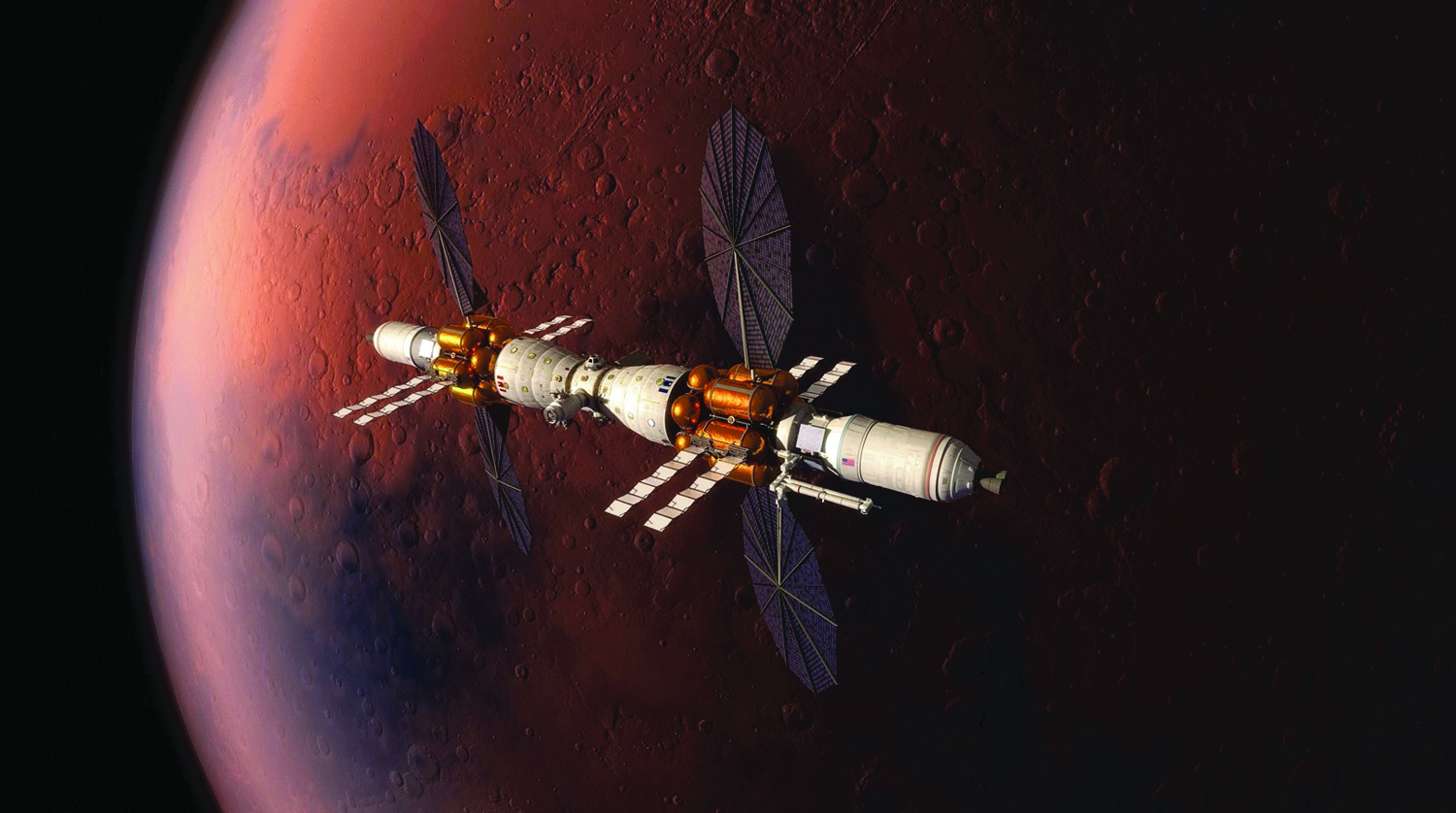
Mars Base Camp.
Mars Base Camp Vision
From 2010 to 2015, Lockheed Martin described a series of increasingly challenging Stepping Stone exploration missions to incrementally push farther into space and explore for longer durations.1–3 The Stepping Stones plan took full advantage of Orion's capability beyond low earth orbit and provided opportunities to perform and perfect telerobotic surface operations from orbit, space maneuvers near small bodies, and sample return. Lockheed Martin is currently working on Exploration Missions 1 and 2, on the production strategy for the EM-3 and later vehicles, as well as defining the NextSTEP habitat, in partnership with NASA. 4 The Jet Propulsion Laboratory's recent Minimal Mars Architecture laid out an affordable plan for human Mars exploration, based on today's available technologies. 5
Mars Base Camp was developed to explore the feasibility of a humans-to-Mars mission within about a decade.
6
A crewed orbital mission seems a prudent and necessary precursor for a human Mars landing. A key distinction of Mars Base Camp is to bring scientists in close proximity to the planet and its moons, armed with new classes of probes, rovers, sample acquisition systems, and remote explorers under low latency control, combined with a substantial laboratory for sample analysis. The thesis is that these scientists can greatly accelerate discovery, making decisions in near real time, and adjusting and replanning the science investigation based on discovery. They would not do this in isolation though; high bandwidth communication with their colleagues on Earth would be part of the concept of science operations. The science investigations carried out in this mission would be primarily derived not only by the three origins questions: “Where did we come from?,” “Where are we going?,” and “Are we alone?,” but also by key planetary geological and atmospheric science objectives. To address these questions, the science goals of Mars Base Camp are:
• Perform remote sensing and teleoperation of science ground assets on the surface of Mars • Perform in situ investigation and sample return from Phobos • Perform in situ investigation and sample return from Deimos • Perform rendezvous and capture of Mars surface sample canisters in Mars orbit
The Mars Base Camp architecture elements are built on a foundation of technologies that exist today or are in development and include the following mature and rapidly maturing programs and systems:
• Orion: NASA's first deep-space crew spacecraft, built for long-duration deep spaceflight, with a multi-layered strategy for supplementing high reliability with deliberate levels of full fault tolerance, graceful degradation in the presence of multiple faults, and emergency systems focused on crew survival. • Space Launch System: Super heavy lift system designed to send crew, critical labs, habitats, and supplies to Mars. • Habitats: Building on NASA's NextSTEP Deep Space Gateway research, deep space habitats will give astronauts a safe place to live and work on the long voyage into Mars orbit and their subsequent return. • Solar Electric Propulsion (SEP): Based on technology demonstrated in Earth orbit and in deep space, the advanced propulsion concepts embodied in the Asteroid Redirect Mission, the 12.5 kW Glenn-developed Hall-effect thrusters combined with 50–100 kW solar power systems, will pre-position modules in Mars orbit and haul items to Cislunar space. SEP technology has already been demonstrated on many satellites, such as the Advanced Extremely High-Frequency satellites first launched in 2010.
A few key tenets were selected to help drive the architectural solutions. This includes minimizing the number of system developments and maximizing the use of the already developed systems. To drive affordability, which drives realism, there is no need to create new complex development programs if solutions already exist. For example, Orion is the core of the Mars Base Camp vehicle. Orion is architected with capabilities that include long duration, highly autonomous operation in deep space with layers of redundancy for mission robustness, and crew safety. Orion can perform high-speed, precision Earth re-entry from any lunar return trajectory and all Mars Base Camp-designed Mars return trajectories.
Orion benefits Mars Base Camp by providing a foundation of safety, performance, and affordability to the architecture. Orion is a safe haven that can provide redundant life support and consumables for 3 weeks or more in emergency scenarios. In case of a major emergency, this provides the crew with the extra time they need to plan recovery and repairs. Orion also can serve as a contingency airlock or a mobile safe haven. During sortie missions to the Mars moons, having dual Orions provides the ability of the away crew to survive and the Mars Base Camp crew to mount a rescue in the event of a cryogenic propulsion stage failure. For deep-space missions of 1,000 days, the ability to perform self-rescue is essential, since no rescue from Earth is feasible. The re-entry capability of Orion provides for direct entry to Earth on the return journey in case there is a performance shortfall or an issue with the final maneuvers to place Mars Base Camp back into Cislunar space.
From a performance perspective, it is efficient to use Orion as a Cislunar transportation vehicle and as part of the Mars vehicle. Orion is the habitat and life support function for the 2-week sorties to the Mars moons. This combination of functions allows for a minimal number of SLS launches. The Orion heat shield, parachutes, and associated re-entry systems and structure only increase the total system mass, including propellant, by 5%–7% and allow for emergency direct entry crew returns. This avoids the risk and extra mission operations required to rendezvous in Cislunar space and transfer of the crew to an empty Orion vehicle. From a contingency viewpoint, or the perspective of a pilot, it is far preferable to bring your parachute with you compared with rendezvousing with it in flight.
For this first human interplanetary mission, system redundancy and self-rescue capability is of paramount importance. Aborts from low earth orbit take as little as 90 min to be safely back on Earth's surface. Aborts from Cislunar space take on the order of 5 to 10 days depending on the orbit type. Aborts during a Mars mission are much less feasible, and they would take months if executable. The crew of Mars Base Camp will need to be able to move to redundant elements if there are system failures to plan out and perform repair operations. They will also need to be able to perform rescue operations for any sortie missions. For the Mars Base Camp architecture, there are no required rendezvous and docking operations of pre-staged elements at Mars or on return to Earth that, if failed, would lead to loss of the crew. Examples of pre-staged elements include scientific modules, equipment, and consumable supplies that are not required to sustain the crew. For this reason, the Earth re-entry vehicle remains with the crew. This is to minimize single events that lead to loss of the crew.
Beyond safety, Orion also increases affordability by leveraging already developed systems across the architecture. Given the relative stability of funding over the past 20 years, NASA's budget can be described as a fixed price agreement with the United States to explore space. The idea of humans at Mars within about a decade is achievable only if the development budget is focused on systems that do not exist today. Given limited budgets, development money should not be spent changing or improving existing systems unless it is absolutely necessary to perform the mission.
The Mars Base Camp architecture is designed to include participation of commercial and international partnerships. From flight-proven hardware, such as robotic arms and laboratory modules on the International Space Station (ISS), to innovative concepts surrounding in-space propulsion and deep-space habitats, utilization of technologies through government and industry partners is not just an ideal scenario to consider but one that is essential to turning Mars Base Camp from concept to reality. Over the past several decades, commercial and international collaborations have become an essential building block in the design and maturation of space technologies and science missions, particularly in the context of larger and more complex missions. Access to space involves a group of private industry and global entities, many of which can provide a variety of options for supporting Mars Base Camp. Some possibilities for international collaboration include providing modules such as the science laboratory or the center node, and providing major elements such as a cupula, robotics arm, or solar arrays. Robotic science elements, such as rovers, that are pre-staged on Mars are another contribution possibility. Logistics flights will also be required both during the Cislunar proving ground phase and during the build-up of the Mars-bound vehicle, which could be provided by international and commercial entities (Fig. 2).
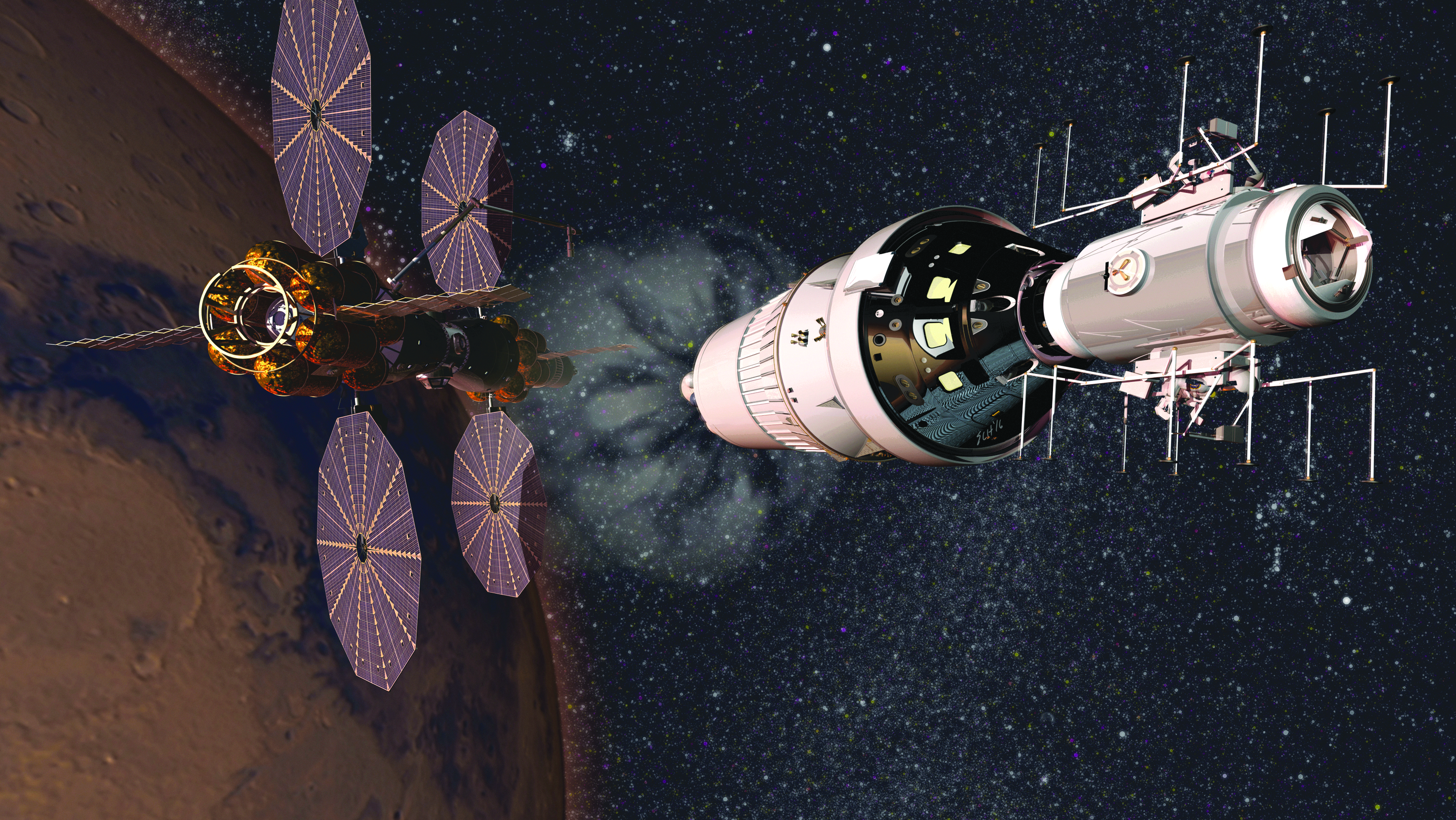
Mars Base Camp sortie system leaving for Deimos.
Science Objectives
Today, the human exploration of Mars is performed through the robotic assets in orbit and on the surface. Mars Base Camp accelerates scientific discovery of origins and the search for life by using scientists/astronauts and advanced robotics to conduct unprecedented field science and in situ sample analysis in the Martian system, pinpointing the right human landing zones and bringing back the right samples, as shown in Figure 3. Mars Base Camp allocates 7 metric tons of science equipment for its laboratory module, along with 40 kW of dedicated electrical power. These allocations, along with the ability to access and download larger quantities of raw data than compared with current Mars-transmitted downlinks to Earth, are intended to be a starting point for the discussions of science objectives, measurement types, instruments and support equipment, sample curation, external robotic elements, interfaces, operational concepts, and the identification of driving functional and performance requirements. Further in-depth analysis will be conducted with the science community in examining the Mars Base Camp mission concept, focusing on the most effective roles and use of robotic/automated and human/manual capabilities and systems for the advancement of key science objectives. Of particular interest is the definition of the robotic systems, elements, and missions, outside of the Mars Base Camp vehicle, that best complement the capabilities and limitations of the crew and science systems aboard the Mars Base Camp vehicle. The current and future plans of NASA, objectives of international partners, and perhaps commercial interests in resource prospecting will all be factored into the Mars Base Camp mission concept.
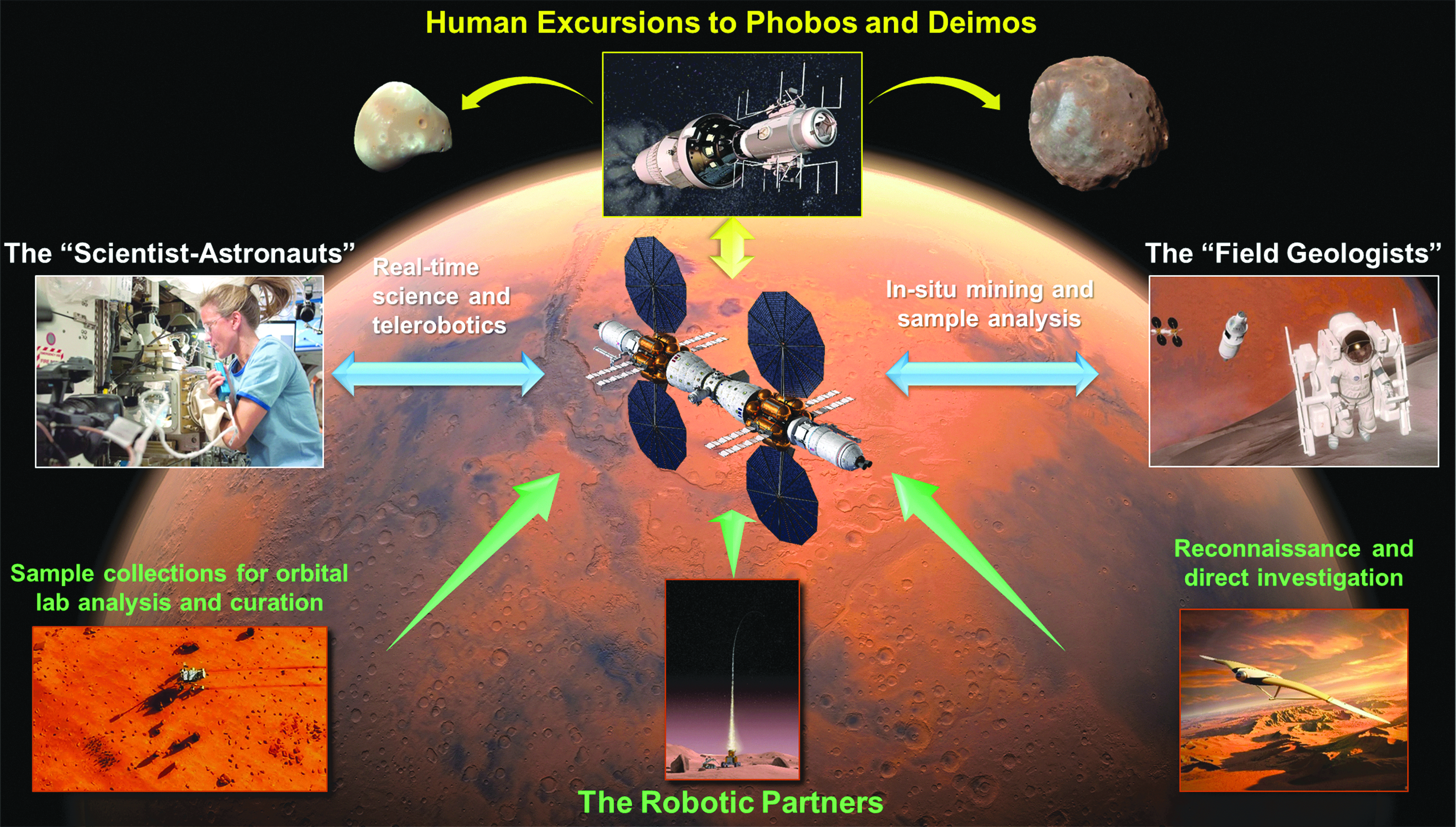
Mars Base Camp mission science elements.
Care must be taken in planning out the types of sample analysis to be performed in the Mars Base Camp lab. Planetary protection and crew safety concerns may limit how certain samples are handled, if at all. Samples from the Mars moons will present less of a concern than Mars surface samples. Unless analysis of materials from previous sample return missions has eliminated the concern for possible introduction of a hazardous biological agent into the Earth's biosphere, the Martian samples must be kept isolated from direct contact with the astronauts. A current paradigm in the planetary protection community is “breaking the chain of contact.” The favored implementation concept has been that once samples are sent into Mars orbit, the capture of the sample cache by an orbital asset must be done in such a way that there cannot be any uncontrolled transfer of material, for example, transfer of dust on the outside of the cache over to the orbiter. Astronaut retrieval of the cache is an ideal method because of the demonstrated proficiency of highly trained astronauts in rendezvous and capture of in-space hardware. The astronauts may subsequently be allowed to perform analyses working on samples inside biobarriers, or by sterilizing a subset of samples so that they can be handled in their shirt-sleeve laboratory environment.
Mars Base Camp is intended to address the very fundamental questions of origins and evolution of our solar system as well as the fundamental question of life on Mars. The architecture provides the ability to send robotic elements to locations on Mars, to return samples for analysis to a laboratory in Mars orbit, and to return those samples to Earth for in-depth analysis. The robotic elements may be launched to Mars as separate missions or may be deployed from Mars Base Camp. These robotic elements may be landers, rovers, or perhaps even aerial vehicles. The crew in Mars orbit will be able to operate these robotic assets with low latency communications, in addition to traditional operation from Earth and increased asset autonomy. Scientists/astronauts in the Mars system will have unique talents and capabilities, but they will augment and not replace the extensive ground team planning science operations and operating robotic assets when the unique capabilities of the crew in orbit are not needed. To maximize the science return, the robotic elements will likely be a new class of smaller, affordable vehicles with fewer power constraints, designed to operate three ways: autonomously, by ground control, or by teleoperations from orbit. These elements can also take great advantage of the increased communication capability provided by a human-tended system in orbit. A key objective of the Mars surface robotic operation will be to place a sample into Martian orbit near the orbit of Phobos for a sortie mission to retrieve. This sample may be some of the samples selected and cached on the surface by the Mars 2020 rover, a set of samples selected by a later robotic mission, or samples selected during the Mars Base Camp telerobotic operations.
The crewed sorties to Phobos and Deimos will attempt to answer questions including the moons' origins and availability of useful resources. A three-person crew will conduct missions at these locations for about 2 weeks in length, utilizing the excursion vehicle elements to perform sortie rendezvous and Mars Base Camp crew “landings.” Given the vehicle architecture and the sortie capabilities of Orion, these missions are not a major cost driver to the architecture, and they will demonstrate low-gravity operations that can be applied to future missions to asteroids. Before landing, the crew will map out the surface in more detail and select landing spots from the orbiting excursion vehicle. Astronauts will venture via a Spider Flyer/Walker to the surface, perhaps to multiple sites. While in the Spider Walker configuration, which provides the crew the ability to conduct scientific operations with minimal geologic disturbance in the milligravity of these “alien” worlds, astronauts will collect various samples to be delivered back to the Mars Base Camp laboratory for study and analysis. The progression of Stepping Stones missions in Cislunar space also provides opportunities to develop and validate sample return and low-gravity body mission elements, systems, and protocols before their use at Mars. In particular, the return of Lunar samples from the South Pole Aitken Basin meshes the accomplishment of a key Decadal Survey science objective with the complementary development of Cislunar and Mars crewed and robotic system capabilities (Fig. 3).
Mission Campaign
A series of missions will be required to meet NASA's required objectives 7 in Cislunar space and at Mars, and to build up the Mars Base Camp system. Table 1 is a summary of a proposed mission campaign. The 2018 InSight Mars lander will investigate the interior structure and processes of Mars, including the dynamics of Martian tectonic activity and meteorite impacts. EM-1 in 2019 includes a full system test of Orion and SLS transportation during a Cislunar multiple-week exploratory mission, demonstrating the system for human deep-space exploration. The mission will demonstrate autonomous operations and on-board automation balanced with the ground mission operations. An ascent abort test to be performed in 2019 will demonstrate Orion's Launch Abort System by performing an ascent abort off a test booster launched from Cape Canaveral, FL. Mars 2020 rover is critical for understanding the Mars surface and preparing for Mars Base Camp robotic science missions and the subsequent human landing. The mission includes Mars surface exploration and sample caching.
Proposed Mission Campaign
SLS, space launch system.
EM-2 will be the first crewed mission for SLS and Orion, and the first flight of SLS's Exploration Upper Stage. EM-2 will also be the start of the Deep Space Gateway missions in Cislunar space to begin addressing objectives. The initial outpost will also provide opportunities for scientific experiments, both during crew-tended periods and during the untended periods between missions. The Next Mars Orbiter is planned to provide enhanced remote sensing capabilities, high-rate communications, and possible sample storage or transportation. EM-3 will continue the outpost's assembly in Cislunar space. As the Deep Space Gateway missions proceed and mission durations increase, supplies and consumables will be delivered by commercial or international partnership launches. During EM-4, the crew will check out systems, perform science experiments, demonstrate tele-operations and sample retrieval capabilities, and make progress in verifying performance against Mars Base Camp mission objectives.
Co-manifestation with EM-5 will be the first element of the Mars-bound vehicle to be assembled at the Deep Space Gateway, the large living space. Along with the prototype modules already assembled, EM-5 will be a year-long duration shakedown cruise to test out systems. In 2026, during the timeframe of the shakedown cruise, science assets such as the excursion system/assembly platform, laboratory, and robotic assets will be pre-deployed to Mars with SEP stages. From 2026 to 2028, the Mars Base Camp habitat/propellant tanks, propulsion stages, and consumables will be launched. EM-6 and EM-7 will be dedicated to assembly and full system tests. By the end of EM-7, all of the Cislunar objectives will be completed. Those objectives are:
• Transportation ○ Crew Transportation ○ Heavy Launch Capability ○ In-Space Propulsion ○ Deep Space Navigation and Communication • Working in Space ○ Science ○ Deep Space Operations ○ In situ Resource Utilization • Staying Healthy ○ Deep Space Habitation ○ Crew Health
This progression of missions to a Mars Base Camp is not focused on minimalism, and it could arguably be reduced in scope or bypass certain Cislunar steps to reduce cost. However, the mission sequence is intended to ensure astronaut safety and mission success, yet it can be executed without any substantial increase in the current inflation-adjusted NASA human exploration budget, given a phased retirement of the International Space Station beginning in 2024. The key to a cost-effective near-term human exploration program for Mars, which begins with an orbital Mars Base Camp, is the choice of mature and nascent technologies throughout the architecture. The key emerging technologies on which the Mars Base Camp is dependent do not require any fundamental breakthroughs. The emerging technologies include cryogenic propellant storage and transfer, near-closed loop life support systems, and telerobotic systems. Recently, NASA's human exploration yearly budget has been about 8 to 9 billion dollars a year. Assuming this budget continues, and with an initial Mars orbit mission in 2028, the amount of available funding over this period is significant. Relying on existing systems as much as possible, spreading the development of the emerging technologies across this period, and minimizing the costs of operational systems are key to the efficient use of NASA's human exploration budget to achieve humans to Mars (Fig. 4).
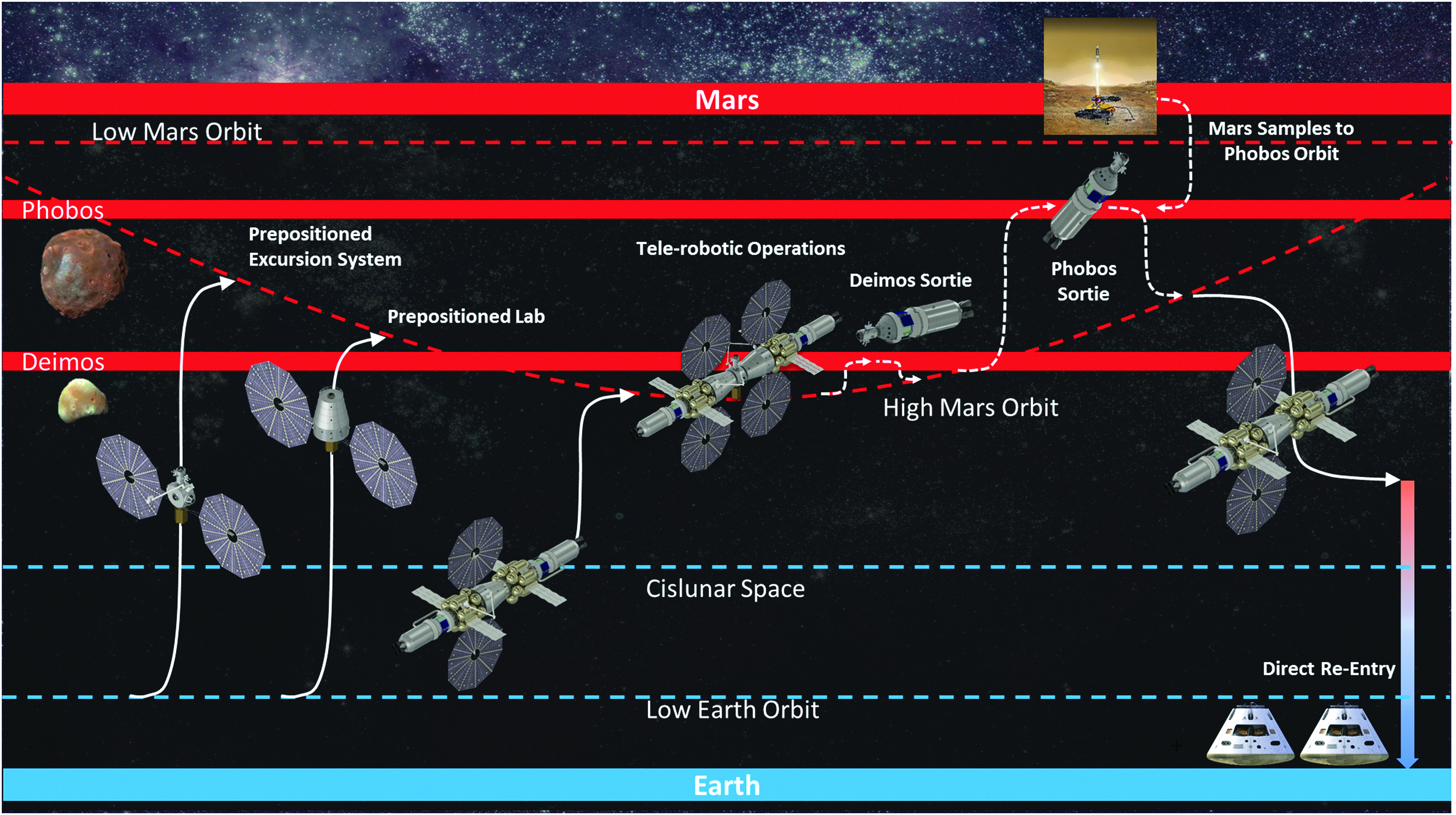
Mars Base Camp mission overview.
Mission Description and Concept of Operations
The expedition begins with the prepositioning of mission elements that are important for mission success but are not essential for the survival of the crew. This includes the preplacement, via 200 kW class SEP, of the Phobos/Deimos excursion system, the laboratory and science equipment, the center node, and certain consumables that are not required for survival. While these pre-placed system elements are in transit to the one-sol Mars Base Camp orbit, the final assembly of the Base Camp transit configuration is completed at the Deep Space Gateway. Figure 5 shows the launch manifest for Mars Base Camp elements after the Deep Space Gateway phase. The nomenclature used to describe individual launches and missions is as follows:
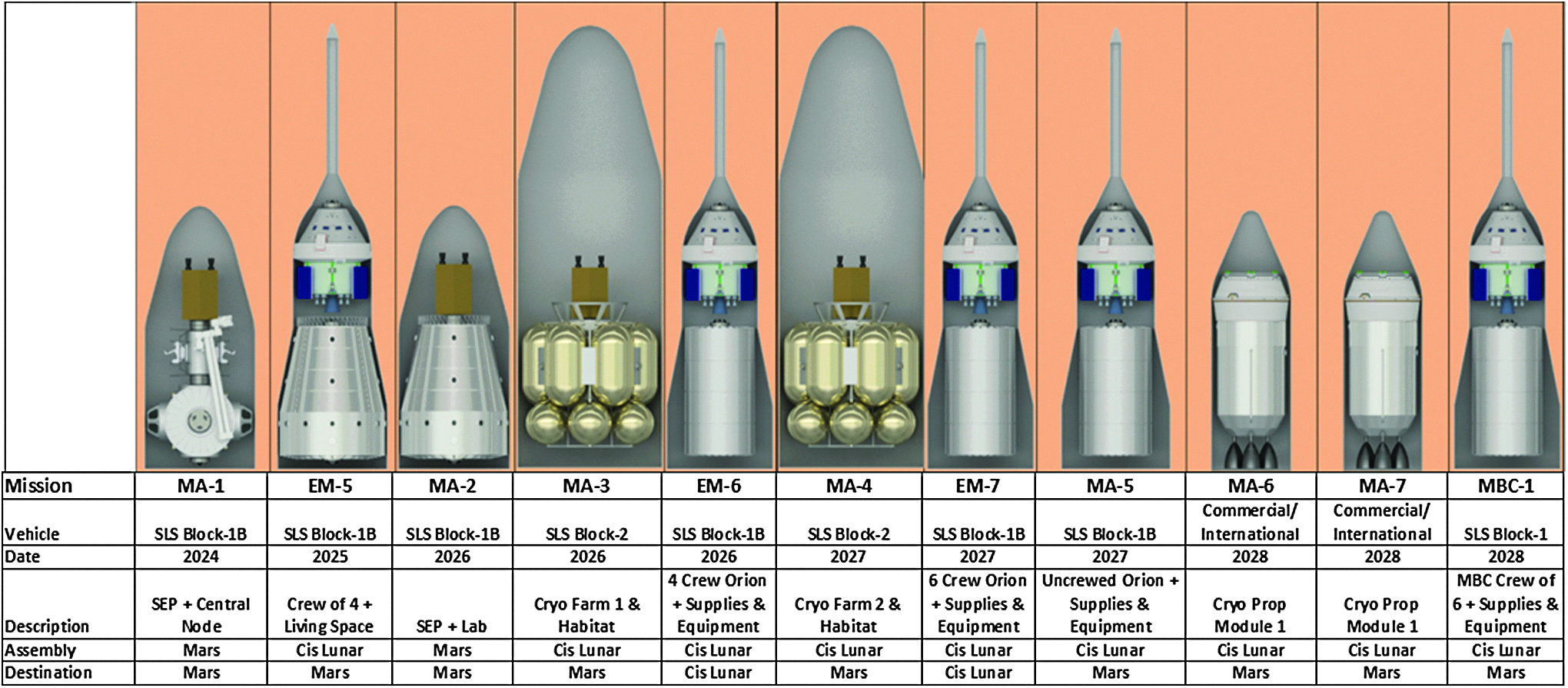
Mars Base Camp mission-specific launch sequence.
• EM-N: Exploration Mission N, Orion, and a co-manifested payload on an SLS Block 1B
• MA-N: Mars Base Camp Assembly mission N, Mars Base Camp elements that will be assembled into the Mars Base Camp system, destined for Mars Orbit, via either SEP pre-placement direct to Mars or SLS Block 1B, Block 2, or commercial/international launch for assembly in High Earth Orbit
• MBC-1: The final launch of the Mars Base Camp crew and supplies for departure to Mars
The transit configuration is essentially identical for both trans-Mars and trans-Earth transportation of the crew and consists of two copies of all modules that are necessary for safe crew return in the event of a major element-level malfunction. The transit configuration and the contingency configurations of Mars Base Camp are shown in Figure 6. Once the transit configuration arrives in the one-sol science orbit, it is mated with the elements pre-placed via SEP to form a unique expedition-class planetary science vehicle that is capable of supporting human exploration sorties to both Phobos and Deimos as well as robotic telepresence exploration and sample return from the surface of Mars.
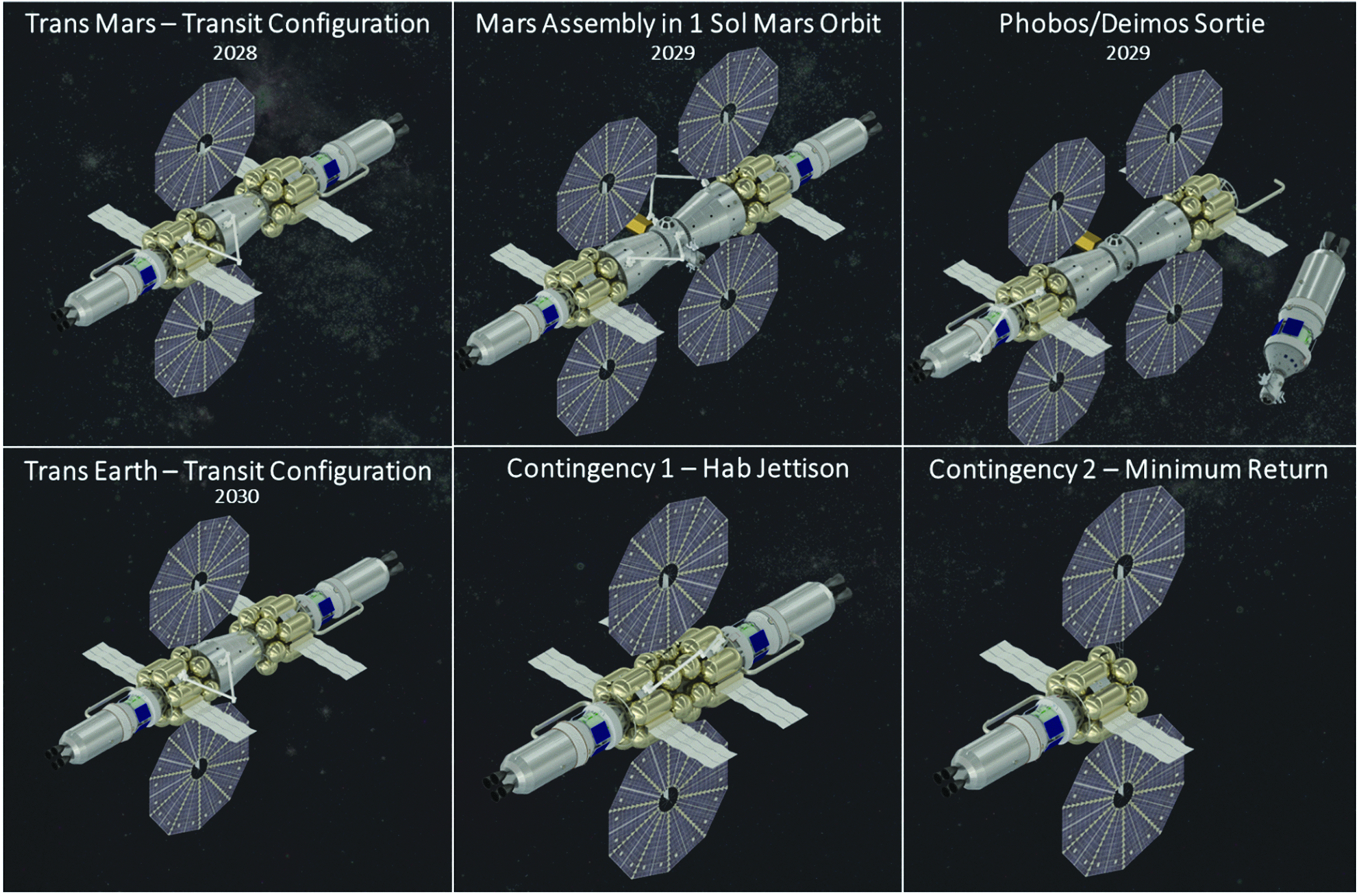
Mars Base Camp primary and contingency configurations.
The laboratory module and science equipment arrives in Mars orbit before the crew and remains in Mars orbit when the crew departs for Earth in the transit configuration. The only element of the transit configuration that is not mirrored for system-level redundancy is the large living space that is designed to provide habitable volume but could actually be jettisoned in the event of an emergency. The living space could be discarded in a crisis situation because the closed loop environmental life support system hardware is contained in the smaller habitat modules that are surrounded by the cryogenic hydrogen and oxygen tanks (tank farms). The tank farms surrounding the habitats provide an excellent storm shelter for solar particle events, and a partial but significant attenuation of the galactic cosmic ray environment during sleep and rest periods. Orion is already designed to meet strict deep-space requirements, including the ability to withstand radiation events, such as a solar flare. Orion is equipped with a radiation-sensing instrument to provide early warning if astronauts need to take shelter. In such an event, the crew would use mass already on board to create a shelter in the aft bay of the spacecraft, closest to the heat shield.
The living space includes work, recreation, dining, and exercise areas that are comparable in volume to the Skylab module. Without the living space, crew well-being is compromised. However, even with the loss of a propulsion stage, a habitat, or an Orion vehicle, the entire crew can be still be returned safely to Earth and accommodate all six crew members. The Mars Base Camp architecture provides the crew with the resources that are necessary to support self-rescue throughout the mission if no other option exists. In this respect, the Mars Base Camp architecture is unique compared with most other Mars human exploration architectures. It could be argued that the Mars Base Camp mission could be done with a single Orion and a single habitat, and that the propulsion stages could be more efficiently combined into a single stage that still supported two sortie missions. However, the self-rescue capability provided by element-level redundancy is a critical capability for crew safety on a long-duration, interplanetary mission.
The Mars Base Camp mission places humans on the two alien worlds Phobos and Deimos, whose origins, histories, and compositions are largely unknown. One Orion, a propulsion stage, and the excursion module can operate together as an excursion vehicle. Three crew in the excursion vehicle separate from the main vehicle and travel to each moon in separate sorties. In the low-gravity environment of Phobos and Deimos, care must be taken to avoid kicking or pluming the surface with thrusters as this will propel loose surface material into orbit or escape velocities.
For free roaming exploration in this environment, the excursion system allows suited crew to perform extra-vehicular activities (EVAs) with a Spider Flyer/Walker. This system is devised to allow scientist/astronaut crew to interact directly with the surface and to move freely about the surface by using jumps to avoid thruster plumes disturbing the surface. The system has a blended reaction control system that maintains contact with the surface, pushing toward the surface as necessary, to keep in contact while in walking mode. During the EVAs, one crew member would remain in Orion. Multiple EVAs would be possible during the roughly 2-week sortie mission. Figure 7 illustrates the intended interaction of the excursion system in route and on the surface of the Martian moons.
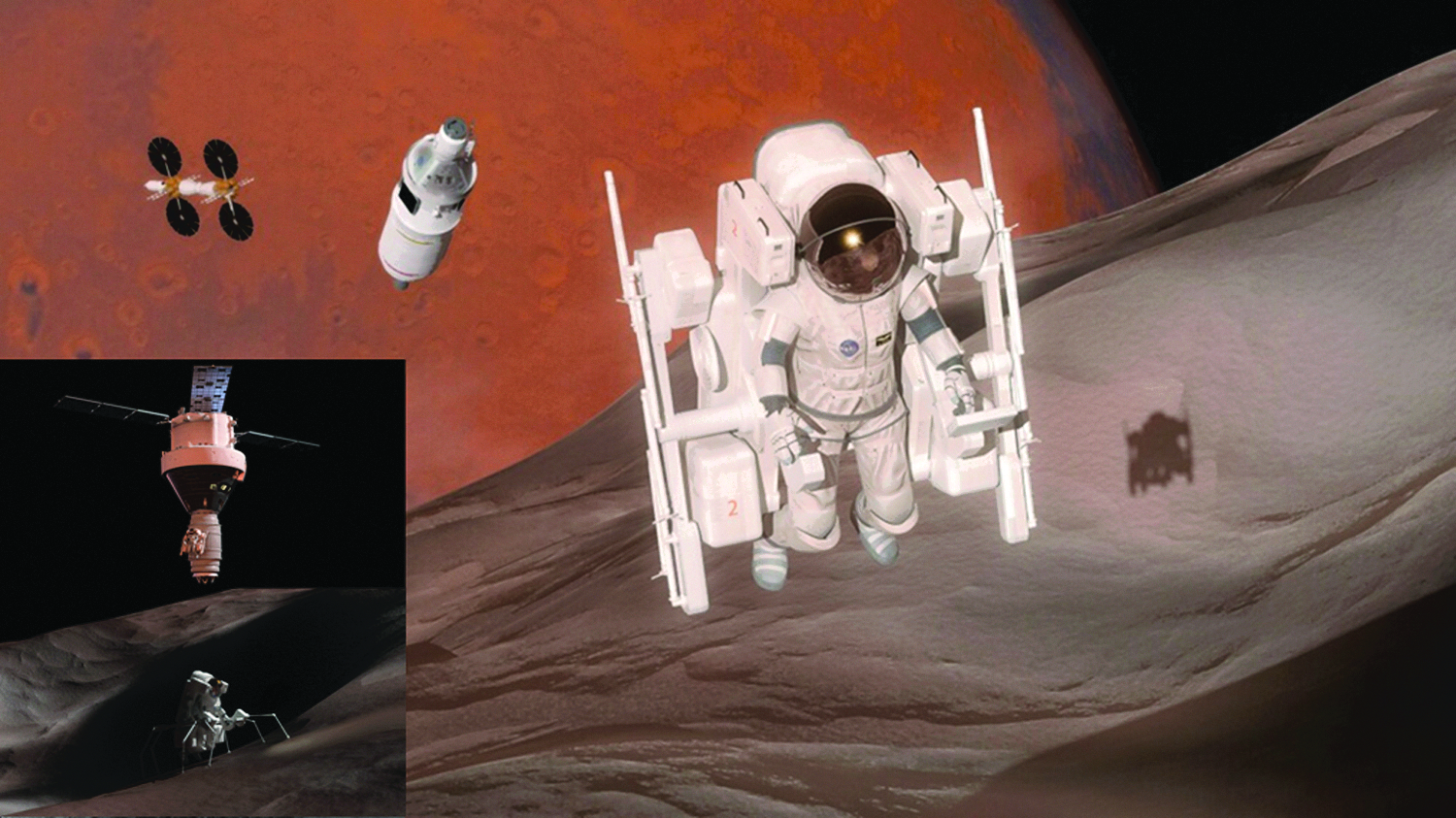
Spider Flyer/Walker operation at a Mars moon.
The crew of the Phobos excursion vehicle will also collect samples from Mars that have been placed in orbit near Phobos by robotic systems that are under the direction of the Mars Base Camp crew. Teleoperations and telepresence are used to interact with rocket-propelled airplanes that target the source methane emissions on Mars, rovers on the surface, and the robotic Mars ascent vehicles that bring samples up to Phobos orbit altitude. The crew will stay in Mars orbit for about 11 months before departing for the journey home to Earth.
The one-sol science orbit at Mars is chosen to allow surface synchronized telerobotic operations while optimizing the propulsion needs between the large transit configuration, the smaller Phobos and Deimos sortie systems, and the robotic Mars ascent vehicle that delivers samples to Mars orbit for recovery by the Phobos sortie crew in the vicinity of Phobos. To further validate requirements for maneuvers and mission duration, as well as support more detailed mission design work, a reference trajectory for the MBC-1 has been developed. This initial reference mission is a conjunction class mission that departs Earth in 2028. There are a number of key assumptions made and constraints considered as part of this mission design. The Mars mission orbit is equatorial, has a one-sol period, and is oriented in a manner to support telerobotic operations to a wide variety of sites. The equatorial constraint is driven by the desire to minimize ΔV costs for the transits to Phobos and Deimos. To minimize the fuel required and provide long dwell times at apogee for science operations, the orbit should be elliptical with a periapsis no lower than 250 km. To support telerobotics, the orbit should be aligned to provide line-of-site to a wide range of possible sites while they are sunlit. This requires the orbit to be in a particular phasing with respect to the Sun. Also, to support contingency direct entry, the final Earth entry interface will have an atmospheric entry velocity less than 11.5 km/s targeting a flight path angle appropriate for that velocity, consistent with the capabilities of the general Orion thermal protection system design with minor upgrades over the current lunar-sized design. The overall mission is optimized to minimize an equally weighted sum of all maneuvers (Table 2).
Reference Mission Performance Summary
The crew returns to Earth in the same transit configuration as was used to reach Mars. The laboratory, central node, and excursion system remain in Mars orbit for the next mission. The living space and multiple habitats and Orion provide sufficient partition-able habitable volume to support crew well-being and safety for the voyage home. For the nominal case, the vehicle performs maneuvers at Earth to go back to the Deep Space Gateway in Cislunar space to be outfitted for the next mission. After a thorough checkout, the crew is divided into two groups of three along with containers of samples from Mars, Phobos, and Deimos on both Orion vehicles and returns to Earth. As a contingency, a new Orion could be launched from Earth to bring the crew home.
The mission is designed to limit the return velocity relative to Earth's atmosphere to be consistent with Orion's capabilities. In case there are any issues with the ability of the Mars Base Camp vehicle to perform the maneuvers at Earth, or any issues at the Deep Space Gateway, the crew can perform a direct entry in the Orions. Each Orion is a free flying vehicle that separates from the Mars Base Camp system and positions itself for entry, descent, and landing. The crew module and service module separate as in any Orion return, and the crew module descends on parachutes for a mid-ocean recovery. In the event of an anomaly or system-level malfunction, the entire crew of six can return in a single Orion.
Element Descriptions
Orion provides command and control capability throughout the mission. Orion is inherently a long-duration deep-space vehicle due to its high reliability, fault tolerant design, and proven long-life systems and components. In a sortie configuration, endurance is only limited by consumables. In a mated configuration, where consumables are not used or are resupplied from Mars Base Camp, the spacecraft has an operational lifetime of at least 1,000 days. Similar designs and processes are used for Lockheed Martin's deep-space robotic exploration vehicles, which often have a design life of 6 years and typically operate for more than 10 years. The Orion service module provides six degrees of freedom attitude control, propulsion, power generation, thermal control, and consumables that are sufficient to support a crew of three for a month.
The habitat with more than 40 m3 of pressurized volume is nestelled inside the tank farm. It contains all essential Mars Base Camp closed-loop life support system hardware as well as individual sleeping quarters and storage space for consumables. Using the methodology and consumption factors developed by NASA, 8 the Mars Base Camp is sized to accommodate 21 metric tons of consumables, and it includes an additional 1 metric ton of pressurized atmosphere in its fully assembled configuration. Consumables are distributed across the Mars Base Camp elements, including the habitat, avoiding single-fault vulnerabilities. The habitat also includes hygiene and waste management facilities. The crew can sleep, relax, and work in their quarters while taking advantage of the solar particle event safe haven and partial galactic cosmic ray radiation shielding afforded by the cryogenic hydrogen tanks. The living space module provides for additional habitable volume and equipment, but the habitat provides everything that is necessary for survival in the event of emergency. For each element, a short description and some specifications are also provided in Table 3.
Mars Base Camp Element Descriptions
LOX, liquid oxygen; LH2, liquid hydrogen; MT, metric ton.
The tank farm is an integral part of the habitat that is launched as a pre-integrated system. The tank system for cryogenic hydrogen and oxygen is designed for zero boiloff via active cooling in flight by using power from the large solar arrays. By minimizing conductive penetrations into the multi-walled vacuum shroud, these storage tanks minimize energy gain and are much better insulated compared with the Cryo Stage, which includes structural load paths, secondary structure, turbomachinery, and equipment accommodations.
The large living space module provides 300 m3 of pressurized volume designed to enhance crew welfare and productivity. It contains exercise, work, observation, recreation, entertainment, medical, communication, and meeting facilities as well as a full galley. Similar to each of the modules on the Mars Base Camp backbone, the living space has redundant interfaces on each end for thermal control fluid, potable water, grey water, oxygen, nitrogen, 120 V power, and fiber optic command and data lines.
The laboratory module is an identical twin to the living space module except that it contains an allocation of 7 metric tons of science equipment and is provided 40 kW of dedicated power while in Mars orbit. Although some preliminary items and operations concepts have been suggested, these allocations are intended to support a self-contained, multi-disciplined, and well-equipped remote field laboratory. The shirt sleeve environment of the laboratory allows for the latest handheld scientific equipment to accompany the scientists/astronauts on the Mars Base Camp journey. High bandwidth links ensure that teams on Earth can augment and support the exploration crew in the most effective practical way.
The 20-m diameter solar arrays and power storage, distribution, and control modules are designed to be interchangeable between the SEP modules that pre-emplace Mars Base Camp mission elements at Mars and the Mars Base Camp tank farms. A robotic arm is used to perform this repositioning operation, relocating the power system module without the need for an EVA. With a pair of solar arrays and lithium ion batteries, the power module provides 150 kW of power at Mars and 30 kWh of energy storage. Additional electrical energy storage exists on the living space, laboratory, Orion, and tank farm modules.
The center node, which is pre-placed by SEP tugs along with the Phobos/Deimos excursion module, includes two opposed cupolas that provide the crew with full observation capabilities while in Mars orbit. This observatory can be equipped with telescopes, cameras, and sensor systems designed to be operated manually and via automation from the laboratory module. The center node also has two docking ports and a robotic arm to facilitate reconfiguration of Mars Base Camp elements and berthing. One of the docking ports is dedicated to the Phobos/Deimos excursion vehicle; the other is unallocated but can accommodate an Orion or similarly equipped spacecraft or future element.
The Phobos/Deimos excursion vehicle consists of an airlock with docking systems on each end. With the aid of the center node robotic arm, an Orion/cryo stage can be mated to the excursion vehicle in preparation for a sortie mission to one of the moons of Mars. Two of the crew will don and doff suits in the excursion vehicle airlock while the third crew member remains in the Orion command deck in a slow orbit or standoff position at Phobos or Deimos. Once suited, the crew performs an EVA to strap into the Spider Flyers. The excursion vehicle airlock provides service and mating interfaces for the Spider Flyers that use their robotic legs to facilitate embarking and disembarking.
The Spider Flyers are designed as free flying six degree of freedom crew maneuvering vehicles equipped with tool and storage caddies intended to support field science. The Spider Flyer can autonomously fly a preplanned flight plan or can be manually flown or directed over the surface. In flying mode, the system automatically avoids directing thrusters at the surface within prescribed altitude and plume angles. The spider legs provide stability on the surface in conjunction with the monopropellant maneuvering system that helps provide downward force to prevent unintended hops. The legs allow the Spider Flyer to drop from initial altitudes of 100 m or more and arrest the relatively small (∼1 m/s) touchdown velocity. Likewise, the use of the legs to impart a 1 m/s vertical leap will result in an apex of about 100 m in 180 s, at which time the propulsion system can transition to a traditional six degree of freedom control scheme. The Spider Flyer transitions to a Spider Walker on the surface with an articulating chassis that allows the scientist/astronaut to manipulate tools and interact with the surface from a stable platform. By modulating leg motion with thrusters directed away from or tangent to the surface, the Spider Walker can achieve slow but reasonable surface mobility. To make faster transitions, the Spider Walker makes a hop to altitude and flies to a new dropdown location.
Mars Surface Access
Humans landing on Mars is the fundamental goal of Mars Base Camp. To accomplish this, Lockheed Martin developed the concept of a Mars Ascent/Descent Vehicle (Fig. 8) designed to fit the following requirements:
(1) Reusable vehicle supporting sortie missions from orbit to the surface and back to orbit
(2) Lander departs from and returns to a one-sol orbit with a 400-km periapsis
(3) Lander accommodates four crew
(4) Lander supports at least a 2-week surface stay
(5) Lander has a maximum 100 metric ton gross (wet) mass
(6) Liquid oxygen (LOX) and liquid hydrogen (LH2) are the primary consumables, refueled in Mars orbit.
(7) Lander provides near global access to Mars surface landing sites
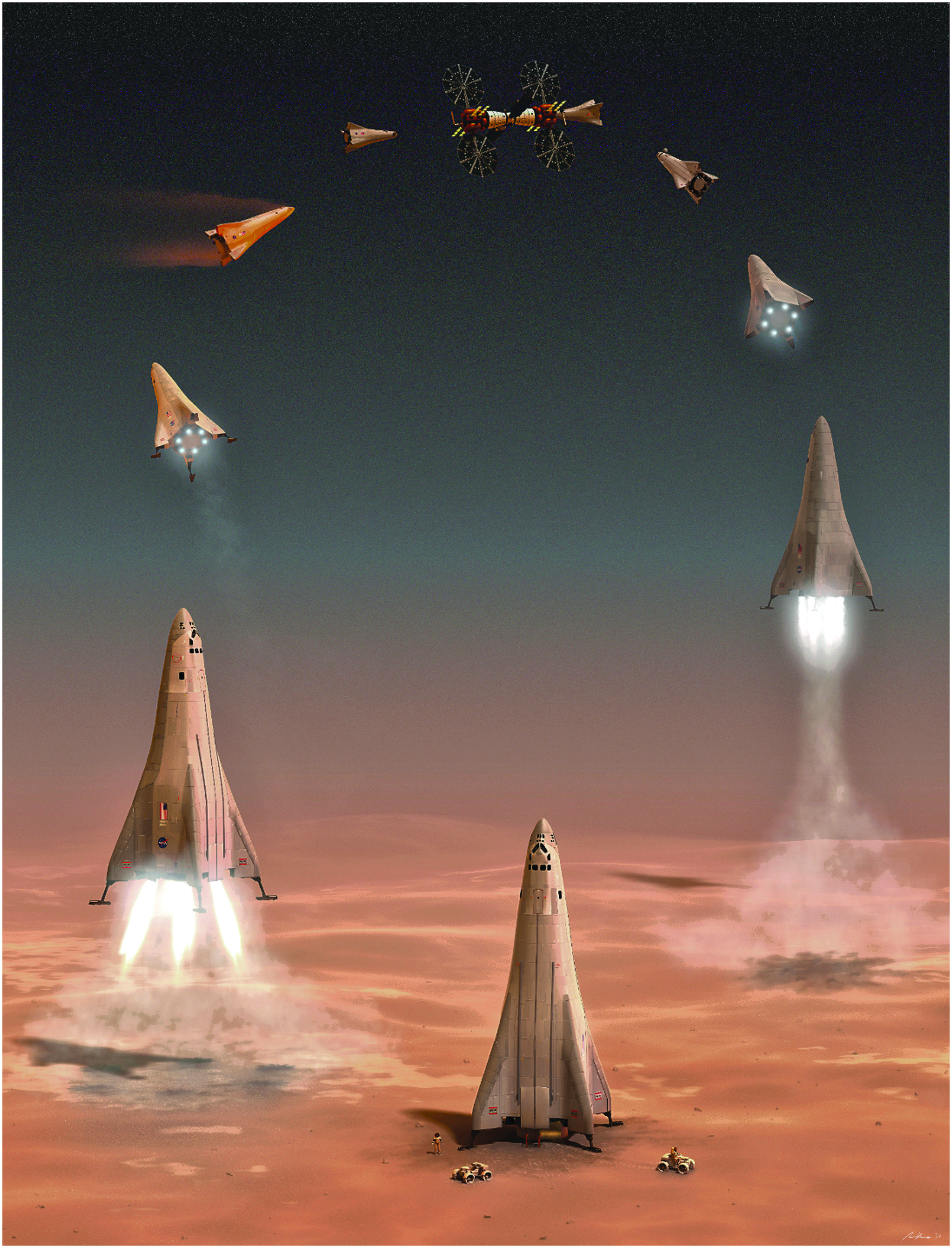
Mars ascent/descent vehicle.
To reduce cost and ensure Mars surface exploration with humans is achievable with NASA's current budget, new development should be minimized. The ascent/descent vehicle shares much in common with the cryogenic propulsive stage, including LOX/LH2 propellant, and would include six RL-10 equivalent engines with deep throttling capability. The crew pressure vessel contains much of the same internal components as Orion, including avionics, controls and displays, life support systems, and other crew systems. With lower re-entry speeds from orbit, a mostly metal alloy skin provides durable, zero maintenance protection for multiple re-entries and ascents through the Martian atmosphere. This vehicle has the potential to perform 6.5 km/s of velocity change, providing the capability to operate out of a high Mars orbit. The vehicle would also provide anytime abort capability, even during descent and landing. The vehicle is launched empty on an SLS Block 1B, with an attached SEP stage providing services including rendezvous and docking to Mars Base Camp. The SLS provides injection to Mars, and the SEP stage then controls attitude and trajectory as it captures at Mars and spirals into the chosen orbit. The vehicle is then fueled at Mars Base Camp before each sortie. Table 4 shows the major specifications for the lander and Figure 9 shows the overall layout.
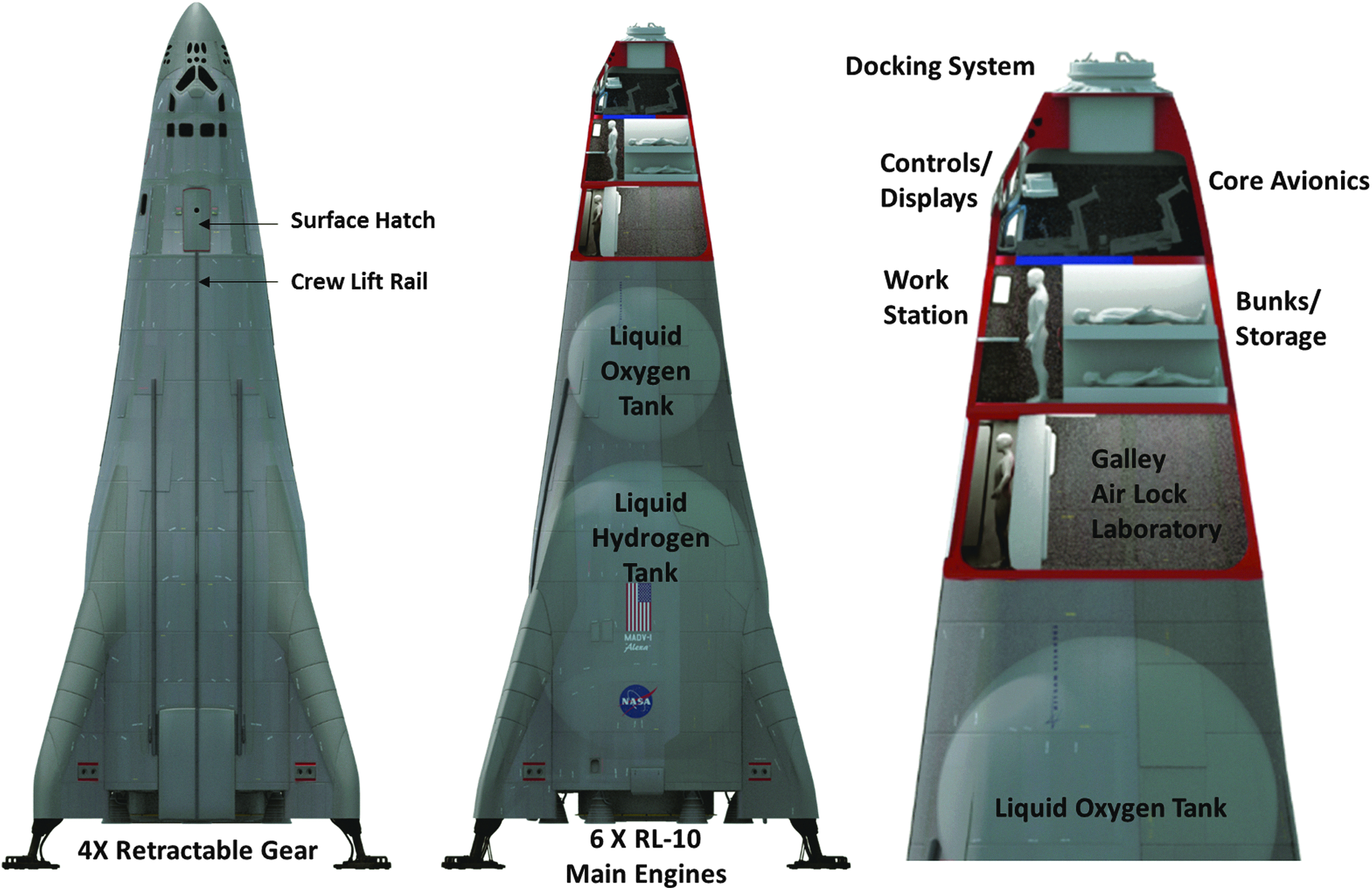
Ascent/descent vehicle layout.
Ascent/Descent Vehicle Parameters
By providing global access, and multiple landings, scientists/astronauts would be able to further our understanding of the history of Mars. With the addition of the ascent/descent vehicle to the architecture, Mars Base Camp provides a method to explore both low-gravity objects such as Phobos and Deimos and the entire planet Mars. The orbit-only mission in 2028 will provide invaluable data for future human landings on the surface during following missions. NASA and other international partners will use this data to confirm the most promising landing sites to search for life, and direct scientist/astronaut in the best ways to advance science and exploration objectives. Mars has a varied geology, and about the same surface area as the land mass on Earth. Before a permanent presence on the surface, operations from an orbital base camp provide crewed access to multiple locations on the surface, greatly increasing the science return. When the permanent presence is established, this vehicle can provide crew transportation to and from orbit, with cargo transportation handled by simpler one-way landers. This concept of operations is enabled by the high performance of hydrogen as a propellant, full vehicle reusability, and refueling in orbit above Mars.
Water As a Propellant Feedstock
For the first Mars Base Camp mission in 2028, hydrogen and oxygen propellant will be launched from Earth. As follow-on missions proceed, using water as a propellant feedstock will become part of the mission architecture. Given the power requirements at Mars, the solar arrays are oversized for operations in the Earth-Moon system. This extra power can be used to produce hydrogen and oxygen with the electrolysis of water. Water is ubiquitous on Earth, and can be found in shadowed lunar craters, on asteroids, buried beneath the surface of Mars, and maybe even on the Mars moons. Setting up an in-space water economy would drive a competitive commercial market with multiple sources, whether launched from Earth in low-cost simple launch vehicles, or acquired from sources in deep space.
The propellant for Mars missions could be made before departing for Mars, which would take about 2 years, or could be made along the way. Water could be delivered to Mars orbit from multiple sources to be made into propellant for the surface sorties and the return trip to Earth. Figure 10 shows a refueling vehicle transferring propellant to Mars Base Camp.
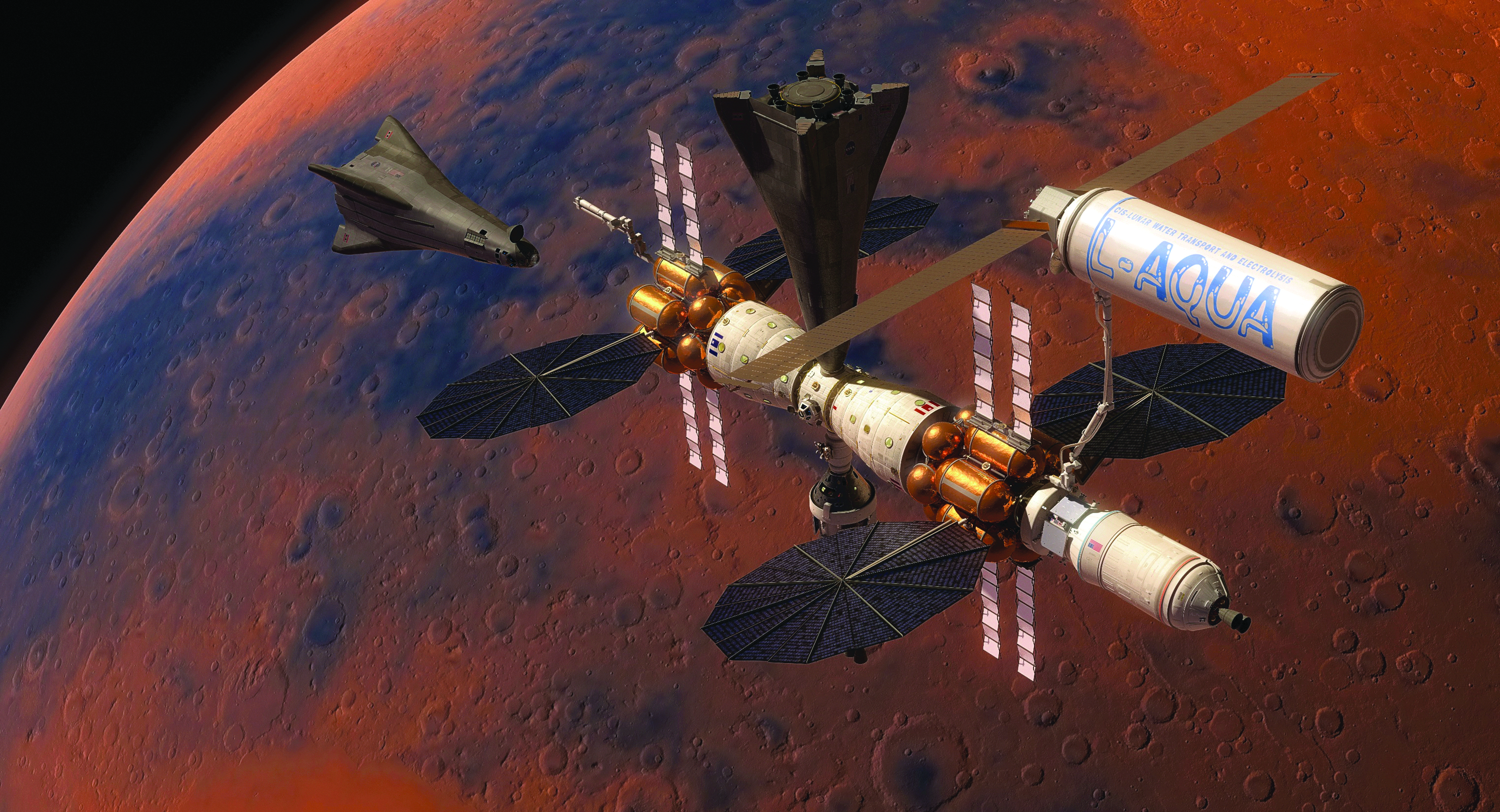
Propellant delivery in Mars orbit for later missions.
Conclusion
Since well before the first Viking lander touched down on Mars on July 20, 1976, humanity has been fascinated with the Red Planet. Lockheed Martin built NASA's first Mars lander and has been a part of every NASA Mars mission ever since. The Mars Base Camp concept builds on existing deep-space technologies in development today and provides a possible blueprint for NASA and the international community's crewed Mars exploration plans. This plan ensures the safety of our astronauts, provides the opportunity for significant scientific discovery, and can be evolved to accommodate specific mission objectives. Carrying out this kind of orbital mission in the next decade will instill confidence that NASA and its partners, domestic and international, can cooperate and innovate with efficient use of the fiscal and human resources that they possess. This mission would be the most extraordinary undertaking that human kind has ever attempted, a 1,000-day mission to an interplanetary destination that has no precedence in human history (Fig. 11).
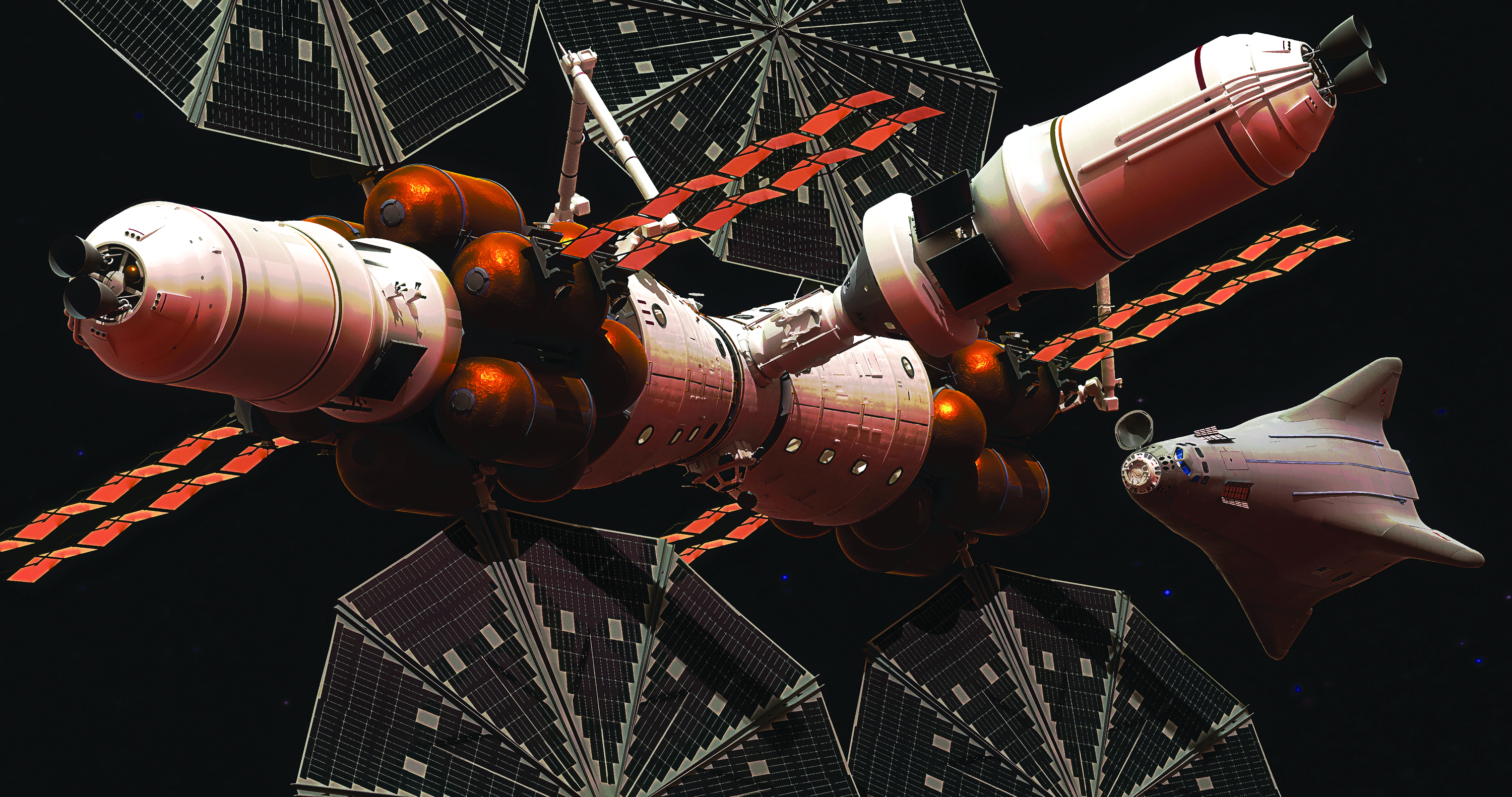
Operations from Mars Base Camp.
Footnotes
Author Disclosure Statement
No competing financial interests exist.