






Abstract
Robotics is entering our daily lives. The discipline is increasingly crucial in fields such as agriculture, medicine, and rescue operations, impacting our food, health, and planet. At the same time, it is becoming evident that robotic research must embrace and reflect the diversity of human society to address these broad challenges effectively. In recent years, gender inclusivity has received increasing attention, but it still remains a distant goal. In addition, awareness is rising around other dimensions of diversity, including nationality, religion, and politics. Unfortunately, despite the efforts, empirical evidence shows that the field has still a long way to go before achieving a sufficient level of equality, diversity, and inclusion across these spectra. This study focuses on the soft robotics community—a growing and relatively recent subfield—and it outlines the present state of equality and diversity panorama in this discipline. The article argues that its high interdisciplinary and accessibility make it a particularly welcoming branch of robotics. We discuss the elements that make this subdiscipline an example for the broader robotic field. At the same time, we recognize that the field should still improve in several ways and become more inclusive and diverse. We propose concrete actions that we believe will contribute to achieving this goal, and provide metrics to monitor its evolution.
Introduction
Diversity in science is a resource that is yet to be harnessed. 1 Studies ranging from medicine to engineering, from law to Earth sciences summarize the obstacles of equality in academia, or more broadly in societal development. 2 Equal opportunities among all members of society is a human right and cultivating it is vital, especially in the face of the social instabilities introduced, for instance, by pandemics, 3 a hazard in the era of the climate crisis,4,5 or increasing political turmoil. Ethnographic differences and economic and cultural disparities are key points to understand social expectations,6,7 particularly in leadership positions. 7 In fact, intersectionality 8 needs careful considerations when designing inclusivity initiatives and politics.
In scientific communities, diversity is essential for tackling our most relevant and challenging problems, yet it is severely overlooked. Traditional culture, seen as male-centered, shapes how scientific research is performed and organized. For this reason, a research system should not be considered gender neutral because it contributes to the reproduction of the traditional job-role division. 9 Throughout scientific and engineering disciplines, academia systematically presents a lack of equality and diverse societal representation. 2 Robotics is a research field where diversity, and in particular gender representation, is specially poor. Although it improved over time, the representation of women in leadership roles at the major robotic and engineering conferences remains low, only 11% hold positions as general chairs, 8% as program chairs, and 8% as plenary speakers. 10 Nevertheless, robotics is a field that will have a significant impact on our society, economy, and culture. Teams’ diversity has shown to generate several benefits in terms of greater creativity and productivity. Literature about teams’ inclusivity dedicates a significant space to the gender dimension. In this respect, studies advocate that greater diversity fosters radically innovative research outcomes and ultimately lead to better scientific results.11,12
Soft robotics is an interdisciplinary field, straddling control theory, materials science, machine learning, design, and more. 13 The applications of soft robots are highly relevant in fields such as social care, agriculture, medicine, rapid manufacturing, sustainability, 14 and exploration, to name a few. The soft robotics community is tackling the equality challenge on several fronts. Concepts related to artificial intelligence, such as embodied intelligence and morphological computation, 15 bring to light the relevance of soft robotics in creating an inclusive community. Maps of research collaborations, based on scientific publications, reveal that soft robotics is highly interconnected and diverse, 15 while also permeating several categories, for example, sensing, control, and manipulation. On the contrary, the ongoing development of fields such as artificial intelligence and human–robot interaction is called to avoid creating new stereotypes or reinforcing the existing ones.16,17 In addition to its interdisciplinarity, soft robotics research does not require expensive facilities, as it is characterized by affordability of materials and nontraditional techniques, combined with low-technology readiness level applications. It is therefore an optimum study pool to learn and develop inclusivity in pupils in the pre-enrollment age and, later on, in academia. It is, in fact, widely acknowledged that the gender gap in robotics appears early in students, with Jackson et al. 18 identifying that pupils develop an interest, or lack thereof, in robotics before college enrollment. Consequently, dissemination and outreach activities in schools are important to establish pupils’ interest in robotics. 19 Soft robotics is at the forefront of robotic technology development and inherently a diverse research area; it is therefore fitting to consider it a flagship for equality in robotics. The need to improve diversity in soft robotics is a challenging and multifaceted problem. Grzelec 20 gives a novel insight about gender equality, by identifying two undermining common practices: embracing data-driven decisions and simple solutions, when both are undertaken without considering their nexus in relationship to the particular work/study environment. Grzelec 20 warns the community about the need to rethink also the way we gather gender distribution data, focusing more on the community dynamics and behaviors rather than on personal experiences. Furthermore, the lack of a supportive social network and of leadership promoting equality initiatives are among the elements that hinder inclusivity 21 ; this is confirmed to be the case for soft robotics by the survey results and analysis presented in this article. Affinity groups can aid to create an inclusive environment in academia and so also can empathetic event logistics. 22 When examining the reasons behind the gender disparity in leadership and recognition in academia, it is important to pay attention to the cultural background and social expectations, which may or may not be part of the work environment itself, but still hamper inclusive actions. 23
In 2023, the 6th IEEE-RAS International Conference on Soft Robotics (RoboSoft 2023, Singapore) hosted the forum: Women in Soft Robotics. The panel highlighted the need for greater awareness of inclusivity in soft robotics. The diverse audience discussed challenges and opportunities specific to this research community. To build upon this momentum, we have followed with more quantitative analysis by surveying the soft robotics community to further identify the present status and needs of the community. This article outlines the present gender inclusivity panorama in soft robotics, examining the successful strategies and suggesting new approaches to strengthen equality. Ultimately, we are aware of the multidimensionality of inclusivity, 8 and hence, we offer an outlook on scalable solutions 24 directed to the underrepresented communities in academia.
Present State of Diversity and Inclusion in Soft Robotics
A key indicator for diversity and representation across the field of soft robotics is the diversity of attendance to the flagship Soft Robotics conference, IEEE-RAS International Conference on Soft Robotics (RoboSoft). For this, we can consider the participation of women, from 2018 to 2023. During this period, there has been an increase in women participating from 21% in 2018 to 26% in 2023. RoboSoft 2022 was held in a hybrid form (due to coronavirus disease), which allowed a wider participation, 548 people versus 233 participants in 2018 and 397 in 2023. Nevertheless, 22% of the participants were female, showing similar levels to 2018. However, looking at the geographical representation, in this hybrid format, 10% of participants were from South America, compared with the 1% and 0% present in 2018 and 2023, respectively.
A second key indicator that we consider here is the diversity of authors of soft robotics research articles. The geographical distribution of soft robotics authors retrieved from Scopus, 1 Figure 1(a), is reflected in the conference participation, with most authors from North America, Asia, and Europe. As far as gender distribution is concerned among the top 10 publishing authors in soft robotics, 20% are female, again consistent with the conference attendance data. Scopus data, Figure 1(b), show an increase in the number of publications, which include “Soft Robotics” among their keywords, with abrupt growth starting from 2013, showing how the field has been growing rapidly over the last 10 years.
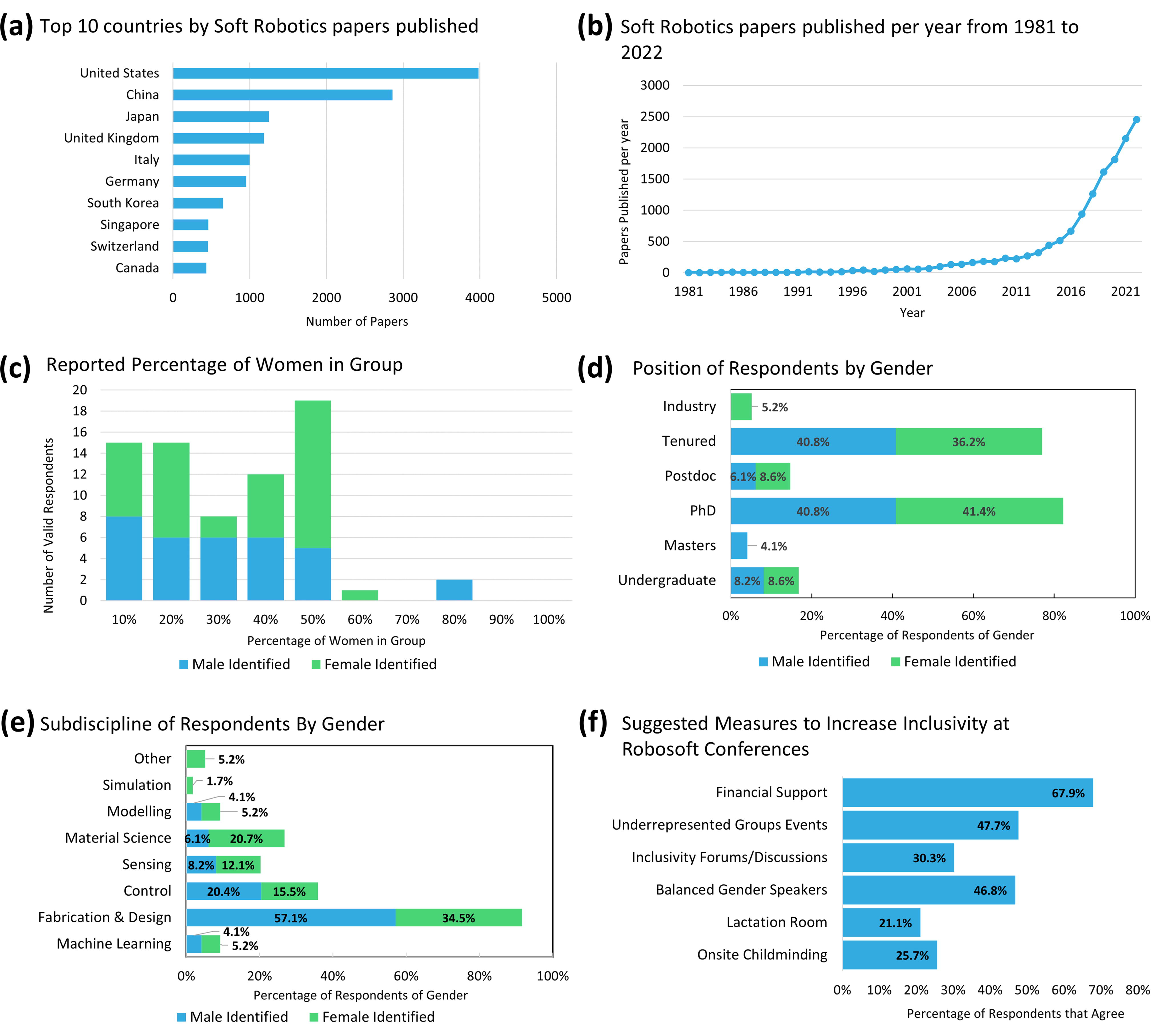
This figure shows data retrieved from Scopus describing the geographical distribution of soft robotics publications
Inclusivity survey
We have created a survey to outline the present gender inclusivity panorama in the academic realm of soft robotics and to encourage a bottom-up approach in support of future policies dedicated to diversity and inclusion. The questionnaire was distributed through soft robotics mailing lists,
2
109 people responded to it in May 2023. The survey is formed by nine questions as follows:
What gender do you identify with? Which region are you based in? What is the gender distribution of your group? What is your position in institution/company? What subdiscipline(s) of soft robotics best describes your work? Are there programs in your research/work environment to improve inclusivity? What concrete actions could help improve inclusivity in the soft robotics community? What actions could help enhance inclusivity at RoboSoft conferences in the future? Any other comments or suggestions?
The participants had a gender distribution of 58% women, 49% men, and 2% of respondents who opted not to disclose their gender.
The majority of respondents were based in Europe, comprising 45% of the participants, followed by North America with 27% of the respondents, whereas Asia accounted for 22%. A noteworthy 6% of participants hailed from other regions (South America, Central America, Oceania, the Caribbean, and the Middle East).
On average, the gender distribution of the respondents’ research groups reported 30% women to 70% men. Figure 1(c) reports variable distributions ranging from 10% to 80%. Half of the survey participants reported a percentage of female coworkers under 40%. The average female presence among laboratories is higher than in publications (20% of the top publishing authors) and conference attendance (26% in 2023).
Among female respondents, Figure 1(d), the majority of individuals were pursuing their PhD studies, constituting 41.4%. This closely parallels the distribution among men, where 40.8% were also PhD students. Moreover, a substantial percentage of women, 36.2%, held tenured positions, while a similar percentage of men, 40.8%, occupied these positions. Under the tenured definition, we included the following: permanent researchers, professors, and assistant professors. The remaining correspondents were distributed across other academic and professional positions, with 8.6% engaged in undergraduate studies, similar to the 8.2% of men. The distribution of women (8.6%) and men (6.1%) in postdoctoral roles was relatively close. A noteworthy observation was the presence of women in industry (5.2%), with no men reporting industrial positions. No female respondents identified themselves as master’s students, in contrast to 4.1% of male respondents who occupied this category.
Analyzing the different subdisciplines of the respondents, from Figure 1(e) it appears that the subdisciplines of “fabrication and design” and “control” have a higher representation of men, while “material scienc” and “sensing” have a relatively higher representation of women. The fields of “ML,” “modeling,” and “simulation” have low representation of both women and men.
Regarding the presence of programs aimed at enhancing inclusivity in research/work, a majority of the respondents (∼44%) reported that such programs do exist. A substantial number of respondents (∼29%) indicated uncertainty. Approximately 26% stated that there are no inclusivity programs.
To enhance inclusivity and diversity in the community, participants were presented with a specific set of actions and asked to indicate their level of acceptance for each one. The highest acceptance rate was recorded for the sharing of outreach events and resources, with approximately 58.95% of participants supporting this initiative to enhance inclusivity and diversity. Participants expressed an interest in mailing lists highlighting new career opportunities and events (51%); a best practice guide (49%); online communities’, for example, slack and discord (48%); and online seminars (45%).
Among the actions suggested to enhance inclusivity within conferences, Figure 1(f), the most significant level of acceptance was observed for the proposal to provide financial support to minorities, individuals from developing countries, and single parents, with an impressive 67.9% of participants expressing their support for this action. In addition, the concept of organizing get-togethers and events tailored for underrepresented groups received substantial support (47.7%). A majority of participants (∼46.8%) indicated their endorsement of ensuring a balanced gender distribution among conference speakers. In contrast, other proposed actions, such as the provision of play areas at conferences or on-site childminding, the establishment of lactation rooms, and dedicated forums and discussions on inclusivity, did not exceed a 35% acceptance rate among participants.
Lastly participants provided valuable suggestions for enhancing inclusivity and diversity within the community, including the following:
Enhancing the quality of forums and events offered during conferences. Raising awareness of soft robotics among undergraduates. Amending future questionnaires to include consideration of backgrounds and ethnicity. Amplifying the voices and representation of minority groups.
Survey discussion
The survey recorded a global participation. Although it aimed to cast a wide net and reach participants from various regions, it is possible that the distribution of respondents was affected by the reach of our network.
The results suggest a remarkable gender balance in terms of academic and research roles within the soft robotics community. All participants working in industry identified as women, potentially reflecting the diverse career paths and opportunities pursued by women in the field. There were no master’s students among women respondents, and this may warrant further investigation to understand the opportunities that undergraduate students are offered and that may directly influence career choices and academic pursuits within the soft robotics community. The lack of female master’s students in soft robotics might also be intrinsic to the variety of disciplines that flow into soft robotics during later career stages, such as biology, earth sciences, neuroscience, and botany. This result may also be related to the position of students who may not identify themselves as part of a scientific community yet.
Framework for Improving Diversity and Inclusion in Soft Robotics
While fundamental change is required at a societal, educational, and cultural level, we can leverage soft robotics as a tool for inclusivity, while also improving the state of inclusion within the very same community.
Based upon the results and analysis in this study, we propose a framework that can be used by the soft robotics community to move to a more diverse group. This includes actions that seek to repair the present “leaky-pipe,” Figure 2. The second key component we propose are metrics to evaluate any change and improvement, to ensure that we quantitatively understand the extent of the challenge while also measuring the progress being made.

The scientific career of a soft robotics scientist represented along a “leaky pipe,” where the “leaks” represent the elements along a career that are likely to hinder the academic progression of a scientist belonging to an underrepresented group.
Soft robotics as a tool for inclusion and diversity
The specifics of soft robotics can serve to make this field an effective tool for engaging the next generation, and normalizing diversity and inclusion within robotics.
Raising visibility and awareness
Outreach, in particular in the younger years at school, is known to have a significant impact on setting expectations and norms regarding careers. Soft robotics has a number of properties that make it uniquely well positioned to be an effective tool for aiding inclusion and diversity. This includes the use of low-cost and novel materials, a focus on both hardware and software, and bioinspiration. We should build upon this to create soft robotic tool kits for outreach. 25 This could make robotics appeal to a wider demographic, and standardize outreach.
Strengthening inclusion
While there is significant room for improvement within soft robotics, its diversity panorama is more inclusive than that of the wider robotic domain. The lack of heavy machinery and its role in social care (e.g., human–robot interaction, prosthetic) are cornerstones, which call for interdisciplinary scientific collaborations, hence magnifying the diversity in soft robotics. To nourish such diversity, it is important to support diversified role models26,27 from the student level upward.
The soft robotics field is well placed to become a leader in how to create inclusive communities. To strengthen equality and diversity in soft robotics as well as the broader robotic community and, ultimately, across science, technology, engineering, and mathematics (STEM), we extracted the following scalable lessons:
Encourage interdisciplinarity. For example, through multifaceted research, which embeds materials science, biology, computer science, fluid dynamics, etc. Identify application areas with a significant societal, economic, or environmental impact. Strengthen “gender-awareness,” for instance, in soft robotics wearable design,
28
AI, and human–robot interaction.16,17
Breaking down barriers at conferences and events
As identified in the survey, conferences and events are hubs where practical measures can be taken to make them more inclusive and break down barriers, for instance, for young families. These specific practical measures include the following:
Demonstrating diversity in speakers at all levels, including keynotes, student talks, and post presentations. Creating inclusive spaces, for example, childcare facilities on-site, and nursing facilities, to facilitate young parents. Set specific grants and funding to support students and researchers from different backgrounds. Include discussions around diversity and inclusion.
Metrics for monitoring and evaluating progress
Measuring and monitoring progress are key to evaluate the impact of actions, and to truly understand the remaining challenges. Therefore, moving forward it is fundamental to do the following:
Record conference attendance and participation data regarding gender, age, career stage, and geographical distribution at different events, for example, RoboSoft. Record the gender ratio of speakers at events and workshops, including their role (panelist, moderators, keynote speakers) in the records. Track the demographics of the soft robotics community through periodical and standardized surveys. Record soft robotics outreach programs and events. Monitor the number of institutions offering and supporting Diversity and Inclusion (D&I) measures.
In summary, we propose to formalize a yearly survey of the soft robotics community, and analysis of key conferences in this area, to track the changing demographics of the community. It is important that these activities and goals are acknowledged by the entire community and enabled by all, not purely those in the minority groups.
Technology-Driven Future
Technology is increasingly impacting our lives. It is ethically sound to embed the input of us all into its development and to pave the way to a sustainable future, where technology works in sync with nature. We envision future robotics to mirror people’s diversity and their needs. In Figure 3, layer 1 schematizes the present society-fragmented, and present technology-segmented. Existing commercial robots are typically rigid designed for isolated spaces where they execute specifically designed tasks. The soft robotics scientific community recognizes the need for cross-disciplinary research thanks to the large scope and crucial role of its applications, Figure 3 layer 2. Soft robotics has the potential, Figure 3 layer 3, to introduce robots into our daily lives as well as in prime areas affecting our economical development and the understanding of the world we inhabit. Future robotics should ideally improve human lives while interconnecting with nature, Figure 3 layer 4. Soft robotics plays a key role in the uptake of technology. By providing the meeting point of diverse disciplines, it leads to the design of a future inclusive society.

Future vision of an inclusive robotic community.
Concluding Remarks
The general field of robotics can learn a lot from the soft robotics community. The field has shown an increasing balance in gender representation across both publications and conference attendance over the past five years. The affordability of materials and reduced requirement for specialized machinery in soft robotics can serve as an inspiration for cost-effective technologies that lower the monetary barriers classically associated with robotics and improve accessibility for all. It can also be considered a safe and affordable way for younger generations to learn about robotic topics such as actuation, sensing, and control. Soft robotics appeals to a broad group of diverse scientists thanks to its interdisciplinary nature, and it creates a space where various expertise and academic backgrounds can coexist and thrive by developing different gears of the same system. From the results of our study, we show that from year to year, the field of soft robotics has evolved to be more inclusive, more diverse, and more equal. However, the changes that have been made have been incremental and the field is still far from achieving equality. By implementing the changes presented above and by staying mindful of the challenge, we hope that the next few years can see significant leaps toward a community that is fair, equal, and welcoming for all.
Footnotes
Author Disclosure Statement
All the authors declare no competing financial interest.