






Abstract
Sound is a rich information medium that transmits through air; people communicate through speech and can even discern material through tapping and listening. To capture frequencies in the human hearing range, commercial microphones typically have a sampling rate of over 40 kHz. These accessible acoustic technologies are not yet widely adopted for the explicit purpose of giving robots a sense of touch. Some researchers have used sound to sense tactile information, both monitoring ambient soundscape and with embedded speakers and microphones to measure sounds within structures. However, these options commonly do not provide a direct measure of steady state force or require electronics integrated somewhere near the contact location. In this work, we present AcousTac, an acoustic tactile sensor for electronics-free, force-sensitive soft skin. Compliant silicone caps and plastic tubes compose the resonant chambers that emit pneumatic-driven sound measurable with a conventional off-board microphone. The resulting frequency changes depend on the external loads on the compliant endcaps. The compliant cap vibrates with the resonant pressure waves and is a nonidealized boundary condition, initially producing a nonmonotonic force response. We characterize two solutions–adding a distal hole and mass to the cap–resulting in monotonic and nonhysteretic force readings with this technology. We can tune each AcousTac taxel to specific force and frequency ranges, based on geometric parameters including tube length, and thus uniquely sense each taxel simultaneously in an array. We demonstrate AcousTac’s functionality on two robotic systems: a 4-taxel array and a 3-taxel astrictive gripper. Simple to implement with off-the-shelf parts, AcousTac is a promising concept for force sensing on soft robotic surfaces, especially in situations where electronics near the contact are not suitable. Equipping robots with tactile sensing and soft skin provides them with a sense of touch and the ability to safely interact with their surroundings.
Introduction
Soft robotic surfaces and skins provide inherent safety that is useful in human–robot physical interaction and interaction with fragile objects. 1 Soft systems and mechanisms physically embody the ability to adapt to dynamic and unexpected loads through passive compliance.2,3 As a result, soft robots also exhibit durability in harsh environments. 4 This motivates the development of soft, compliant coverings for otherwise rigid robots, for both robot and environmental safety. For example, the CoboSkin includes variable stiffness inflatable units to tune impact dynamics. 5 A recent review by Niiyama points out how soft skin is essential for humanoid robot application. 6 Yet, these hardware solutions are slow to translate to industrial settings, as compared with sensing and software-based collision avoidance. 7 The design of soft skins for various robotic applications therefore remains a relevant area for ongoing development.
Artificial skin can also provide robots with a sense of touch that enables adaptive control for dexterous manipulation tasks. 8 Composition of sensitive skins relies on a wide variety of materials, including those with resistive, piezoelectric, and magnetic properties; the history and breadth of tactile sensor design are reviewed in chapters, reports, and books.9–13 Skin with channels filled with liquid-phase gallium–indium alloy is one method for generating sensitive skin, in which overlaid channel patterns are individually sensitive to unidirectional strain and contact pressure. 14 Numerous other works utilize bulk resistivity and embed cavities of conductive material in soft structures, where contact forces change the shape and therefore resistance.15–17 All of these works describe a direct electronics-based measurement of the contact point. Challenges arise for skin made of multiple materials regarding the durability of traditional electronics, integration of soft and hard conductive materials without failure from stress concentrations or fatigue at connectors, and long-term life and reliability of experimental new materials at the contact point.12,18 Early development of self-healing soft tactile skin combats some of these durability issues. 19
Removing electronics and delicate materials from the contact point altogether represents another approach to generating mechanically resilient touch sensation. Various options place an intermediary material between physical stimuli and electric transducers to achieve such isolation. In Table 1, we present an overview of soft tactile sensors grouped by the approximate distance (order of magnitude) between contact location and transducer. For example, a recent work generated a camera-based structure as a successor technology to GelSight, 20 which shifts the camera to the base of the finger; it provides a measure of force through images while improving the mechanical durability of the appendage. 21 Pneumatics and hydraulics are another avenue for transmitting data throughout soft structures for remote sensing. Monitoring the pressure in a closed fluidic system provides rich tactile sensing information.22,23 In open fluidic tactile sensors, flow rate monitoring discerns object presence and surface characteristics for underwater 24 and in air25,26 applications. In these examples, transducers are physically in line with flow or pressure differential tubes routed away from the contact location. Vibrations transmitted through structures provide yet another method specialized for dynamic tactile sensing. 27 Resonant frequency-based contact detection informs robotic reaching and grasping, such as work by Backus et al. that used accelerometers in compliant fingers. 28 Such vibration measurements require the vibrations to transmit effectively through the robotic structure itself. We call such physical interfaces–for example, wires, tubes, cavities, and members–contact transduction.
Sensors That Provide Tactile Information, Grouped by Distance Between Transducer and Contact as an Order of Magnitude
Noncontact transduction is whether or not the transducer and contact location are physically linked through solid materials, for example, wires, tubing, or cavities. Direct force sensing is a metric of whether tactile information is inferred or determined directly. OoM, order of magnitude.
Researchers also use other modalities with noncontact transduction, such as vision, to infer tactile information. 29 Beyond the use of sight, pressure, or structural vibrations to measure contact from a distance, sound is another medium through which to measure touch. Sound, generated through either the active or passive emission, can be measured with a microphone without being physically linked to the contact location. Two surfaces sliding across each other emit information about their relative movements and the material types, shown for rigid–rigid contact in Dornfeld and Handy. 30 Coincidental noise during manipulation can even be used to provide force feedback during teleoperation.31,32 These signals change with material properties and do not provide a direct measure of either static or dynamic contact forces. Rather, the measurands indirectly sense and infer these physical quantities. In an active sensing application, a receiver monitors the ultrasound signal transmitted through an air cavity that changes with stress in the surrounding compliant material. 33 Researchers embed a microphone in a soft pneumatic finger and later add an embedded speaker that outputs a frequency sweep to detect contact with high spatial resolution.34,35 Acoustic vibrations between robots also assist in shared communication and coordination. 36 These active acoustic examples achieve more specific measurands than in passive sound generation, which we call direct force sensing. However, the emitter/receiver pairs are embedded or located in close proximity to the contact, usually on the order of a millimeter or centimeter away, and may require contact transduction.
In the present work, we present AcousTac, an active, pneumatically driven, acoustic tactile sensing method suitable for force measurements using a generic microphone located outside the skin. The idea is that robots, with a regulated air supply and a built-in microphone on the body, can include this sensing modality without the addition of new electronics. With AcousTac, we achieve noncontact transduction capable of direct force sensing across distances on the order of meters or more. Instead of using an electronic sound emitter, we take inspiration from wind instruments and pneumatically produce resonant sound at the skin. Air-driven resonance is an ancient concept, with musical instruments emerging thousands of years ago. 37 1 In recent years, researchers have used simulations to model and design musical instruments.38,39 We design a tactile array using air-driven resonance based on a simple theoretical model and uncomplicated to fabricate. This design has no electronic components at the contact area, removing the need to robustly integrate fragile components and route wires in soft skin. In our prior work, we generated such resonance in tubes along the length of a soft finger in order to detect the pose and fingertip contact and estimate force with a fully rigid probe. 40 The present work represents the first study looking at this modality for force-sensitive soft skin and includes new observations about how resonant modes and sound of a soft structure change when interacting with an object.
Overview
In the “Taxel Design” section, we describe the theoretical basis for AcousTac design, which includes models of taxel length and resonant frequency and relationships of taxel deformation with force. We then introduce and propose alterations to the boundary condition at the compliant cap. The taxel implementation is presented in the “Methods” section, along with a description of the experimental and signal processing methods used to characterize the sensor. Results from experimental characterizations of different single taxels in the “Results: Taxel characterization” section reveal the effect of tube length and endcap modifications on the range and sensitivity of AcousTac. We demonstrate a system of AcousTac sensors in a 4-taxel array and a 3-taxel astrictive gripper in the “AcousTac Demonstrations” section. Design guidelines, additional observations, limitations, and future work are described in the “Discussion” section. The “Conclusion” section summarizes the impact of this work in the broader context.
Taxel Design
In the following sections, we describe the theory behind the design parameters examined in this work. We present trade-offs in generating acoustic resonance in structures that respond to variable force ranges and with different compliant boundary conditions. A photo of one fabricated taxel is shown in Figure 1A with variables further defined in Figure 1B. Figure 1C and D describe the resonant frequency modes within the tube for a given length and boundary condition. Figure 1B and E give schematics of how tube length decreases as normal force is applied to the compliant cap. Figure 1F and G present two modifications to the compliant cap; adding a hole and adding a mass on the end of the cap have different use cases and are further described below.

Taxel schematics related to theory.
Resonant frequency and tube length
Each taxel has an inner diameter D and unloaded length L0 and emits sound with wavelength
For a tube that is open on both ends (Fig. 1B), the resonant wavelength is twice the tube length, such that the resulting frequency,
For both the open–open and open–closed boundary condition, frequency is inversely proportional to length.
41
From Eqs. 1 and 2, frequency is higher for shorter-length tubes, that is, smaller sensors. In the case of a tube with a soft endcap at one end, the soft material partially damps and reflects vibrations, and this boundary condition appears to lie between the open (
When external forces deform the soft endcap (Fig. 1B), the length of the tube changes; the frequency also changes. Derived in the Supplementary Data S1, rearranging Eq. 1 relates the change in frequency
For a change in length that is small relative to the total tube length,2
Here, we can observe an approximately linear relationship between length and frequency change. If the change in length is not small relative to the total length, the change in frequency would be more accurately calculated with Eq. 4. While simpler to deduce from Eq. 5, both Eqs. 4 and 5 show that the shorter the tube length, the greater the frequency change for a change in length. As such, shorter tubes are more sensitive to endcap deformations.
The above theory is 1D and assumes a thin tube,
Force on compliant hemispherical shell
Deformations of the endcap alter tube length and result from externally applied normal compressive forces. Frequency is therefore a measure of force. Designers can tune force sensing range and resolution by varying endcap stiffness. Both material selection and geometry alter the force-deformation response. Generally, the stiffer the cap, the greater the force range and the lower the resolution and sensitivity. Hertzian contact theory assumes small deformations of a compliant rubber hemisphere and models the relationship between force F and displacement
In this work, the endcap is a hemispherical shell with a wall thickness t and inner diameter D that experiences large deformations (Fig. 1D). We therefore propose an empirical fit to the form of Eq. 6 with a constant offset for each cap design
Altering endcap boundary conditions
Due to the physical properties of the soft compliant endcap, the unloaded cap exhibits resonant characteristics that are in between an open and closed boundary condition, and we refer to this as damped. In this damped boundary condition, the cap is a flexible, oscillating surface, resulting in a frequency that is higher than in the closed condition and lower than in the open condition. When a rigid object contacts the cap, the boundary condition undergoes a transition from damped to closed, lowering the resonant frequency. This will occur even without gross deformations,
In this work, we propose and investigate two design features to mitigate or remove this resonance property and produce monotonic measures of force. Specifically, we explore the introduction of a hole or mass at the tip of the endcap. We characterize both options as the hole and mass have different advantages and disadvantages. Sensors with a hole in the cap are expected to have lower audio amplitude when not in contact, which is preferred for operation around live subjects that then would mainly hear the sensor only when contact occurs. However, unwanted debris or liquid could pass through the hole and become lodged in the taxel resonant cavity, throwing off all subsequent measurements. Caps with a distal mass, without the addition of a hole, do not suffer from these issues.
Hole
As in Figure 1F, we add a hole of diameter h to the center of the compliant cap. The hole makes the cap behave more similarly to an open boundary condition (Eq. 2) when not in contact. When an object occludes the hole and loads the cap, the end then transitions to the closed boundary condition (Eq. 1). For a given tube length, the resonant frequency of the open–open boundary condition is twice the frequency of the open–closed boundary condition. We generally expect an increasing flow rate to excite higher frequencies and resonant modes. Therefore, selecting a flow rate that actuates closed tube resonance but not open tube resonance creates a change in amplitude at the transition between no contact and contact. By coupling both amplitude and frequency measurements, contact force is uniquely determined, overcoming the nonmonotonic force–frequency relationship in the transition region. In addition to flow rate, some geometries, including the edge-orifice shape and inner tube diameter, are more conducive to certain resonance modes than others.
Mass
As in Figure 1G, we add mass m to the cap to draw the cap boundary condition toward closed, even without contact. The mass increases the inertia of the compliant surface and further dampens the pressure oscillations when unloaded. Sufficient mass removes the nonmonotonic behavior of the frequency, such that the boundary condition does not change upon contact. By adding mass, we aim to attain a monotonic force–frequency calibration for a usable sensor without needing to also consider signal amplitude.
Methods
Taxel implementation and test parameters
A rigid tube and compliant endcap compose each taxel. We individually fabricate these components and assemble them together into a single taxel, which is then rigidly mounted to an acrylic plate for testing. The rigid tube is a specified length3 L (Fig. 2A), additive manufactured with PLA (Makergear M3-1D 3D Printer, nozzle diameter 0.35 mm). The length of the resonant tube varies between 41 and 65 mm, in increments of 6 mm. These 6 mm intervals ensure the resonant frequencies of the different taxels do not overlap. The inner diameter is 6 mm. The smallest cross section is 1.4 mm, located immediately before the edge orifice, the angled cutout of the tube wall. The inlet and edge-orifice geometry are consistent across all taxels.

The endcap is the soft element in the taxel. We fabricate and test a range of cap thicknesses t, hole diameters h, and added mass m (Fig. 2B) to assess the effect of these parameters. We cast silicone (Smooth-On Dragon Skin 30) in a two-part mold to make the caps. All caps have the same 7 mm inner diameter hemisphere, regardless of thickness, and a 5 mm long cylindrical cavity, also 7 mm in diameter, that stretches over the open end of the rigid tube.
To assess taxel stiffness and force range, the wall thickness t of the caps ranges from 1 to 5 mm (t1 through t5), at 1 mm increments. To test the effect of hole size, we compare caps with 3 mm wall thickness, across 0, 1, 3, and 5 mm hole sizes. A complete set of thicknesses (t1 through t5) are tested for both without (h0) and with a 3 mm hole (h3) to test coupling between these parameters. The caps with holes are cast with dowel pins of a specified diameter in the negative mold. We add cylindrical magnets to the compliant caps to assess the addition of mass. Each magnet has a mass of 50 mg, a diameter of 2 mm, and a height of just less than 1 mm. We test caps of 1, 3, and 5 mm wall thickness, and vary the number of magnets between 1 and 4 (m1 through m4). This results in an added mass of up to 200 mg. For the 1 mm thickness cap, we adhere one magnet to the outer surface with glue. For 3 and 5 mm thickness, the first magnet is embedded into the cap during the casting process. We increase mass by adding more magnets to the inner surface of the cap, which utilizes their magnetic attraction to attach them. Masses of other materials could likely be used. These experiments utilized copper-based magnets because it was relatively straightforward to quickly and discretely adjust the mass as desired during experiments. Dense materials are recommended to reduce excess volume inside the cap. We do not expect the magnetism to have a substantial effect on sensor performance.
In this study, we characterize all the different endcap designs using one resonant tube length
Taxel characterization test setup
We characterize each taxel individually using the experimental setup shown in Figure 2C. The taxel is fixed to the tabletop. Wall compressed air flows through flexible 8.3 mm (3/8″) tubing and a flow meter (analog 1–10 l/min) before entering the resonant tube, which is kept between 4 and 5 L/min. A robot arm (UR-10, Universal Robots) and 6DOF wrist force/torque sensor (Axia80, ATI) cyclically palpate the taxel, moving at 0.5 mm/s until at least 5 N of normal force. We increase the tested force range with cap thickness. Robot Operating System software records force and position at 2.0 and 3.3 kHz, respectively. A smartphone (iPhone 11) located ∼0.5 m away records sound at a sampling rate of 44.1 kHz. Ambient lab noise is ∼65 dB, less than the ∼90 dB sound level when a taxel is active.
Audio processing
Figure 2D shows an example of the audio signal and processing outcome for four palpations of the t3h0 endcap. We perform data processing using the pipeline detailed in Li et al. 40 We extract the resonant frequency from the raw amplitude data at 25 Hz using the built-in MATLAB functions spectrogram() and tfridge() and binning frequency in 2.5 Hz intervals. For caps with holes, we are also interested in the amplitude of the audio signal. We generate an envelope of the raw audio by finding the max absolute amplitude value for every 22.7 ms (1000 data points) and then taking a smooth average for every 113 ms (5000 data points). The amplitude is then downsampled to 25 Hz to match the sampling rate of extracted frequency.
Characterization tests without a hole h0t1–h0t5 or with a mass m1–m4 all consist of at least three palpation cycles performed within 80 seconds each. In the amplitude thresholding tests when a hole is present, h3t1–h3t5 and h1t3–h5t3, we only report points above the set threshold, which is ∼12 s of data over at least two palpation cycles. The specific amplitude thresholds in each hole case are individually selected as the minimum value to avoid a nonmonotonic relationship between force and frequency in that design’s dataset. We use the amplitude threshold to determine the lower bound of the force range
In later demonstrations with systems of 3 and 4 taxels emitting sound simultaneously, we assume that the achievable frequency range of each taxel does not overlap with any other. This is achieved by assigning a unique tube length to each taxel. We process data within the expected frequency range for each taxel separately.
Results: Taxel Characterization
We present an experimental characterization of the taxel design parameters and compare these results to the models presented in “Taxel Design” section. The parameters tested include frequency dependence on taxel tube length and the force response of varying cap thickness. We then report results regarding sensor performance in the presence of a hole and mass on the compliant cap. Where the boundary condition transition does not inhibit curve fitting, we present tabulated values characterizing the different parameters that fit empirically.
Tube length, L
In Figure 3A, we plot the measured frequencies for the four rigid tube lengths from two normal force loads: 5 and 10 N. We also show the empirically fitted curve from Eq. 3 and the 1D theory for an open–closed cavity from Eq. 1. Consistent with theory, longer tubes exhibit lower resonant frequencies. Table 2 presents fitting constants from Eq. 3, and we note that the NRMSE is below 7%. The endcap geometry is a constant length offset that is not included in our calculations and is thus captured in the fitting constants.

Calibration curves for taxels with varying tube length L with cap t3h0.
Relationship Between Tube Length and Frequency
Figure 3B shows the full characterization curves for frequency as a function of force, with loads ranging from 0 to >10 N. Using Eq. 1 to select tube lengths, the frequency ranges do not overlap each other to streamline later signal processing when multiple taxels emit sound at the same time. In Figure 3C, we plot the same data but now as the net change in frequency; measured frequency f is subtracted by unloaded frequency
Cap wall thickness, t
We plot cap deformation versus force in Figure 4A for caps with no hole (t1h0–t5h0). For the tested displacement range, thicker caps provide a more linear force–displacement curve, which is steeper than thinner caps at lower displacements. The softer, thinner caps have a linear region only at low forces. Table 3 shows the fitting constants for these caps using Eq. 7, which relate the force exerted on the cap and its deformation. The minimum force is zero, and the force exerted on the cap prior to the signal deviating from linear is the maximum force in the taxels’ approximately linear range,

Characterization of cap wall thickness t and hole diameter h. A color-coded schematic is used as a legend of tested cap parameters. For
Force F and Resultant Deformation
Relating the force and resultant deformation to sound, Figure 4B shows how the amplitude of sound produced by the taxel changes with deformation. A negative value of
Cap design feature: Hole, h
We present a characterization for caps with constant hole diameter and varied cap thickness, as well as constant thickness and varied hole size. Figure 4D shows the audio amplitude with varying cap wall thickness in designs with a 3 mm diameter hole (t1h3–t5h3). As compared with the cases without a hole, all taxels have a lower amplitude when there is no contact. Upon contact, the amplitude fluctuates and then increases substantially. Importantly, all signals increase and remain above the unloaded amplitude with enough deformation. This amplitude crossover threshold occurs for the smallest deformation for the thinnest cap, which also has the lowest amplitude prior to initial contact. In Figure 4E, the force–frequency relationship is plotted while employing the amplitude crossover threshold to produce monotonic results. The shape of the force sensing curves is similar to those found in Figure 4C, except for the omission of data at the lowest force levels. Table 4 reports each taxel’s resulting approximate force ranges and sensitivities. The lower bound of the force range is from the minimum detectable force after amplitude thresholding. Visual inspection dictates the upper bound as to where the signal begins to deviate from the linear approximation.
Sensor Characterization of Caps with a Hole Across Thickness t
Values shown for amplitude threshold value in arbitrary units, lower and upper bound of force range
In Figure 4F, the amplitude is plotted across caps with the same thickness, 3 mm, but with varying hole sizes (t3h0–t3h5). Larger-holed caps exhibit lower sound amplitude prior to contact, which is expected as they are more physically similar to an open tube. As a result, the larger hole allows for a lower amplitude threshold. As seen in the monotonic force–frequency curves in Figure 4G and tabulated values in Table 5, caps with larger holes capture smaller forces in their sensing range when using amplitude thresholds. As this experiment was focused on the hole diameter effect on boundary condition transition, we only tested up to approximately 5 N of force. We expect the maximum force range to be greater than the tested 5 N range.
Frequency Dependence on the Cap Hole Diameter
Tabulated values of amplitude threshold value, force range, and sensitivity for caps with 3 mm wall thickness are plotted in Figure 4G The maximum of the force range Fmax is greater than 5 N, the largest load tested.
Cap design feature: Mass, m
Overall, increasing mass of the cap mitigates the frequency fluctuations from the boundary condition transition, such that the endcap behaves more similarly to the closed boundary condition in Eq. 1. Figure 5 depicts how magnets attached to the tip of the cap alter force–frequency relationships in the transition region, where A, B, and C show the results for the 1, 3, and 5 mm cap thicknesses, respectively. The added mass varies from 50 g (m1) to 200 g (m4), with darker lines indicating higher mass. We also present the caps with no added mass in the same plots. We observe nonmonotonic behavior in the tested force range with 50 mg added mass in all three cap thicknesses. This boundary condition effect resolves with 200 mg for 1 and 3 mm thicknesses and 100 mg for 5 mm thickness caps. As expected, the thinner caps require more mass to remove the boundary condition transition. For both the 1 and 3 mm thicknesses, intermediate levels of mass shift the minimum frequency locations to higher force levels. The mechanism that causes the t3m3 force–frequency curve to have this upward and then downward sloping shape is unclear; the decrease is out of the typical force range for a boundary condition transition and perhaps due to the mechanics of the added mass on the cap. The magnets have nonzero volume and are rigid, which may account for the hysteretic effect observed within some transition regions, for example, in t1m3. Table 6 presents the sensitivity from linear fitting and RMSE values for the 5 mm thickness cap from Figure 5C, assuming the sensing range from 0 to 10 N. While the effects of added mass on the cap are not modeled, we can capture the whole system with the empirical calibration. Adding mass decreases the nonmonotonic undulation at low forces and subsequently lowers the RMSE.

Characterization of added mass m on the relationship between force and frequency. The schematic legend shows how stacked magnets were used to modulate the added mass on the cap. Frequency f versus force F are plotted for wall thickness for
Frequency Dependence on Added Mass, with Each Magnet Weighing 50 g
We report sensitivity and RMSE for caps with 5 mm wall thickness, plotted in Figure 5C. We use the measurable force ranges from 0 to 10 N, the highest load tested.
AcousTac Demonstrations
Test systems
Two multitaxel systems are shown in Figure 6: (A) a tactile array and (B) an astrictive gripper.
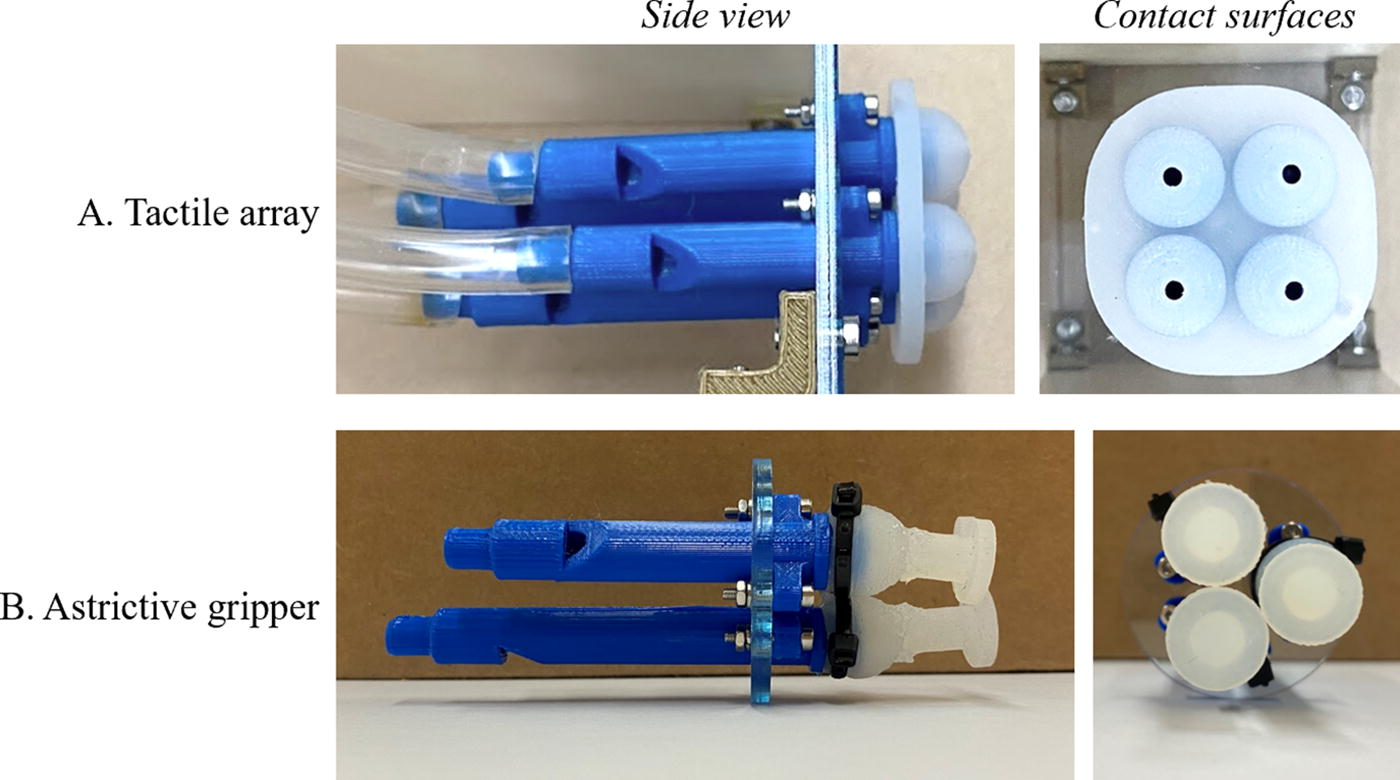
First, we combine four taxels of different lengths for an indicied, force, and contact-sensitive 2 × 2 array. The tube lengths are consistent with those in “Tube Length, L” section: 41, 47, 59, and 65 mm. We position the four taxels in a grid pattern, spaced 15 mm apart center-to-center. The endcaps have a 3 mm wall thickness and 3 mm hole (t3h3). For the processing of the signal from the L59 taxel, we use the sensitivity value from Table 4 to translate frequency to force. For the three other taxel lengths, we scale the force by a ratio of
Next, we integrate three taxels into a force-sensitive astrictive gripper. Inspired by prior work,25,42 we implement passive suction cups to grip onto objects. The taxels are evenly spaced 15.9 mm apart, with rigid tube lengths of 41, 47, and 59 mm. The caps have 2.5 mm wall thickness, and we adhere a suction cup to each cap using an air-cured silicone glue (Smooth-On Sil-Poxy). The suction cups are similarly cast from silicone (Smooth-On Dragon Skin 30) and are 13 mm in diameter and 2.5 mm thick. The suction cups sit on posts 7 mm in diameter and 11 mm tall. We affix the caps to the rigid tube and wet the suction surface with tap water to increase suction force. Because the introduction of suction cup structures to the caps alters the frequency response of this system, we report frequency and not force.
Tactile array interaction
As shown in Figure 7A and in Supplementary Video SV2, we contact and palpate the caps individually with one finger and together with a piece of acrylic over four different sequences. First (i), we make light contact with each taxel individually, starting from L65 and ending with L41. In the same order, we push down on each taxel individually with greater force (ii). In the third sequence (iii), an acrylic plate is pushed down on all the taxels simultaneously. In the last sequence (iv), the same acrylic piece applies a rolling forceful contact across the array in two orientations rotated by 90°, side to side and front to back. Figure 7B shows the audiospectrogram in the relevant frequency range. We extract the peak frequencies from the spectrogram (Fig. 7C) and translate them to force (Fig. 7D). Signals are as expected. With rolling contact, we observe two taxels loaded prior to the other two, showing the difference between the two rolling orientations. We use a linear mapping enabled by the addition of a hole and therefore monotonic force–frequency relationship. This tactile array demonstrates the practicality of holes in the caps, exhibiting low amplitude of sound when not in contact and louder resonance when loaded.
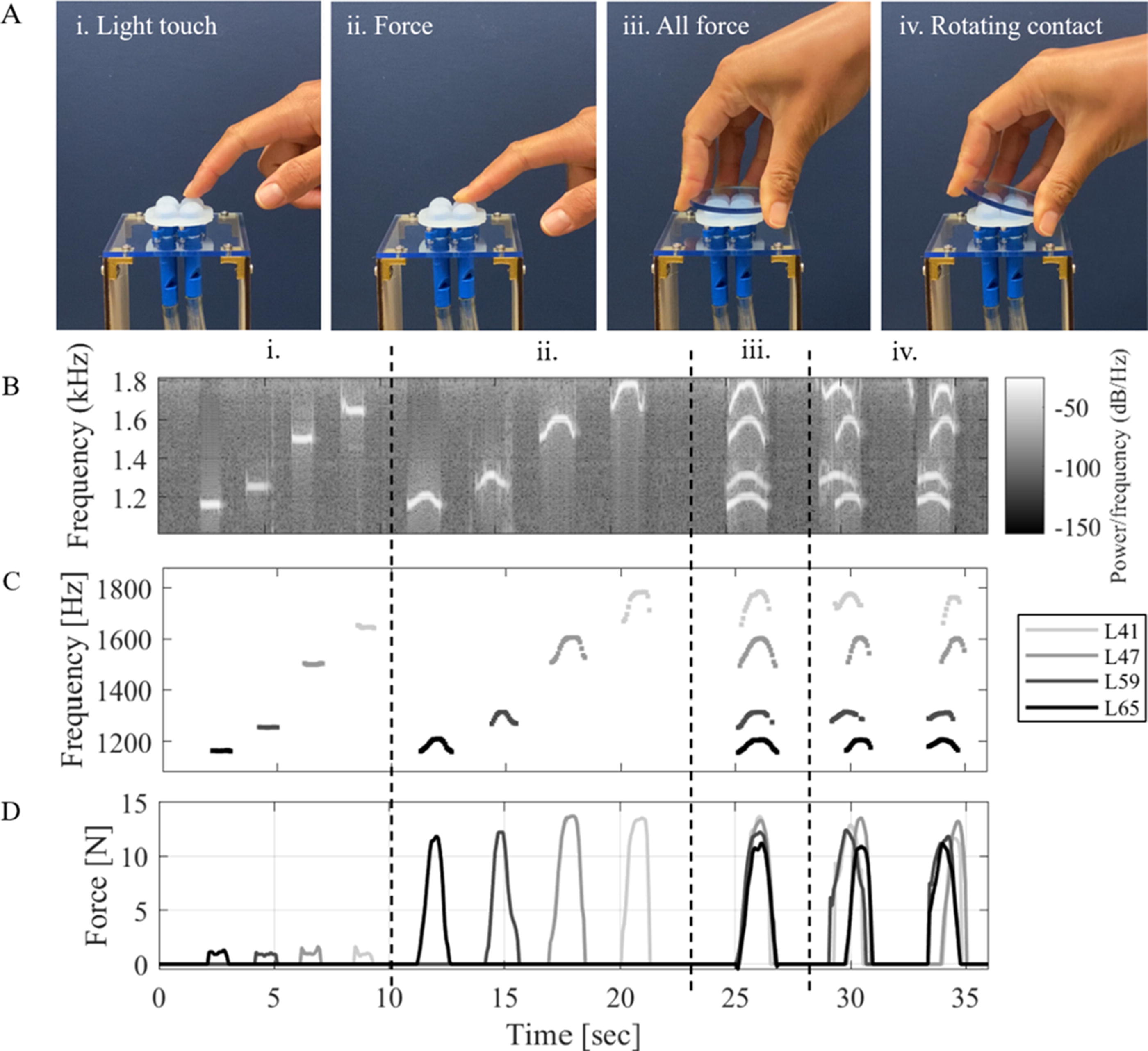
Robotic demonstration of tactile array with caps t3h3. We palpate taxels individually, with a light touch (i) and then with a forceful touch (ii). We then use an acrylic round to press all the taxels down simultaneously (iii). Then we use the same round and roll/rotate across the taxels, across both directions (iv).
Astrictive gripping
As shown in Figure 8A, we manipulate a 500 g weight, imparting tension and compression via suction cup gripping. Figure 8B shows the net frequency of the three suction cup taxels. In the demonstration, the suction cups adhere to the smooth, flat surface of the weight (i). The gripper lifts the weight and hefts repeatedly with weight still attached (ii), varying the tension loading. In part (iii), we compress the suction cups against the weight. The resonant frequency signals show expected trends, in which the sensor captures the oscillating tension forces at ∼4 Hz in (ii) and the larger compression force at about 1 Hz in (iii).
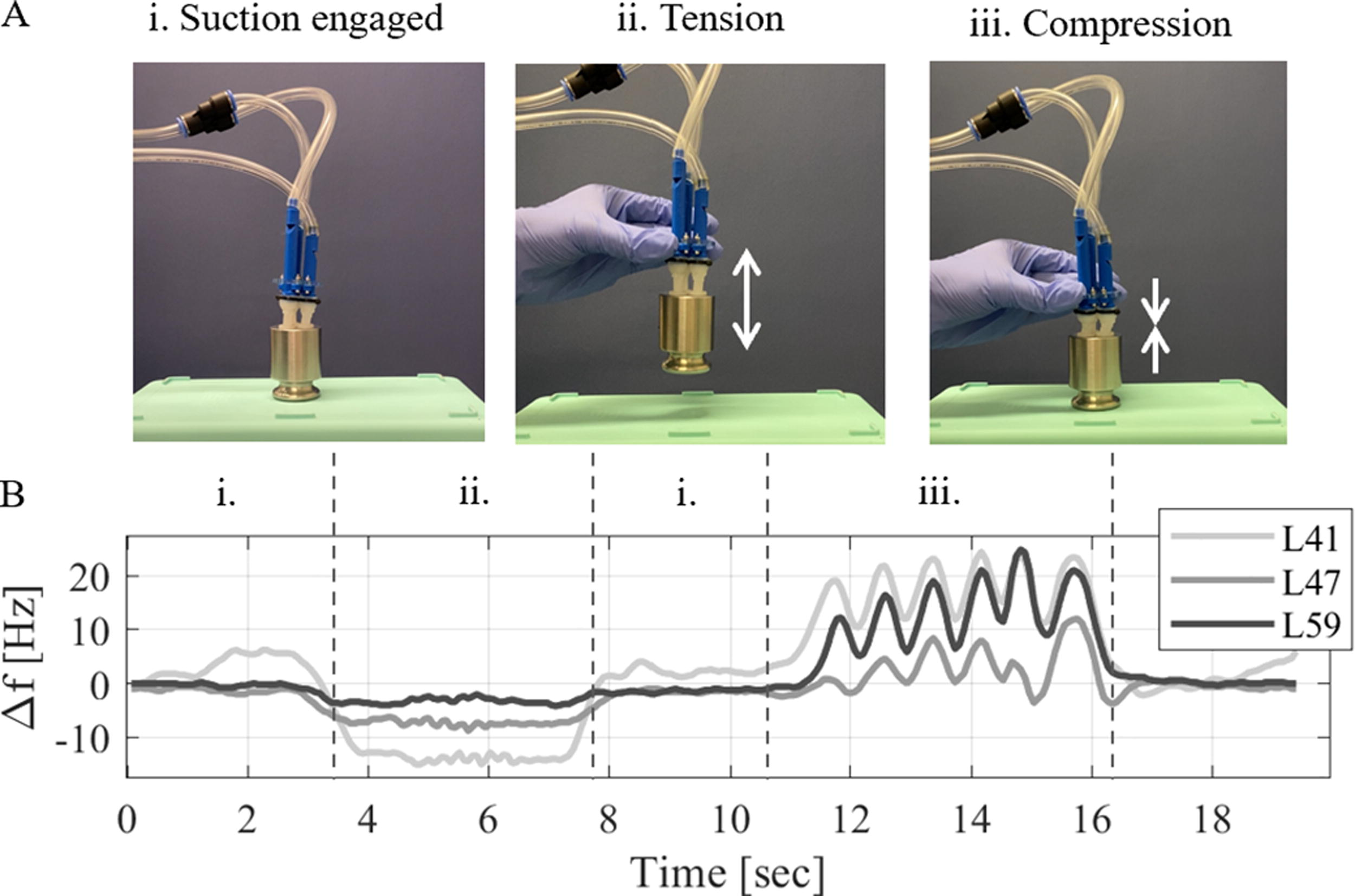
Demonstration of suction cup gripper with three AcousTac taxels tested on a 500 g weight. All three suction cups are engaged (i) and exhibiting some load due to air hose routing. Gripper is lifted along with the weight and then hefted so the weight bounces up and down (ii). Weight is set back on the surface, and compression forces are applied (iii).
Discussion
The experimental results show the substantial effects of tube and cap geometry on the sound signals generated by AcousTac. Parameters including tube length and cap wall thickness affect frequency and force measurements as described by simple first-principle design models. For example, as the tube length decreases, a given deformation results in a higher frequency output range. So, shorter tubes have higher sensitivities and also higher total frequencies. We leverage this length–frequency relationship in order to read multiple force signals simultaneously by assigning different tube lengths to different taxels in system demonstrations. Designers can further tune the cap wall thickness or material stiffness for a desired force-sensing range. We empirically fit the AcousTac taxel calibrations to capture factors that are unaccounted in our model equations (e.g., signal saturation due to physical limits). The fabrication of these taxels is relatively accessible, requiring only a 3D printer and silicone casting equipment. In part, the simplicity of this system is because there is no need for the integration of precise or sensitive electronics into the skin.
We observe a change in boundary conditions when contact occurs with the soft taxel cap. The compliant material produces a boundary condition that lies in between the open and closed cases. We posit that this damping results in the nonmonotonic force–frequency relationship that occurs upon initial touch during experiments. In order to tackle this issue, the addition of a hole or mass at the tip of the cap enables monotonic force readings, not otherwise achieved. When using holes, rather than mass, the sensor is generally quieter when no contact is being made, which is advantageous if operating near people. The larger the hole, the quieter the sensor when not in contact. The presence of the hole also enables pretouch and close proximity sensing; prior to contact, at distances of ∼1 mm, a unique set of amplitude and resonant frequency signals are generated. At the same time, adding mass is a useful solution if a hole is not an appropriate option, for example, when handling objects in wet or dirty environments where matter would enter the hole. In addition, the taxels with holes only produce reliable sounds when the hole becomes sealed by contact, which may not always occur.
For further insight into cap design considerations, Figure 9 presents plots of sensitivity versus cap thickness, hole size, and added mass from Tables 4, 5, and 6. The sensitivity reduces as cap thickness increases, as the cap is stiffer and deforms less for the same amount of force. This is the main factor in the force sensitivity design that we tested. Increasing hole diameter has a secondary effect, with sensitivity increasing as hole size increases even though the cap thickness is kept constant. This may be because, with larger holes, the cap becomes easier to deform. Adding magnets does not appear to have a clear or substantial effect on sensitivity, which is expected as they should only change the vibrational dynamics of the boundary condition.

Sensitivity S plotted with
Throughout this work, we use a common smartphone microphone to measure signals, demonstrating the accessibility and nonspecialized requirements to implement AcousTac. In the current implementation, we use audio processing parameters that dictate the temporal and force resolution. While this is not a physical limitation of the taxel sound emission, sound collection hardware and processing speeds will influence overall system performance and the ability to detect fast transient loads. We operated experimental trials in a normal laboratory environment. In environments with loud or complex ambient noise, more sophisticated processing methods may be needed.
Limitations and future work
Taxel size and spatial resolution are not the focus of this current work and could be improved in future work. In theory, taxel size has no lower bound. However, we were limited by the practicality of fabrication (e.g., 3D printing resolution). A model and experiments testing taxel size and inner diameter are detailed in Supplementary Data S1. The form factor of the current design dictates that the taxel in relation to skin is much bulkier and thicker than the contact area dimension. To make the AcousTac array form factor thinner and more skin-like, one could either shrink the taxels or redesign for shorter or thinner resonant cavities.
In the current design, taxels must be spaced far enough apart such that a deformed cap does not interfere with the neighboring taxel caps. Therefore, as taxel diameters get smaller, they can be packed more closely. As taxels reduce in size, output frequency, air supply, fabrication precision, and microphone requirements may need to change. Another issue could arise where the surrounding taxels interfere with the airflow near the edge orifice. If the edge-orifice area of the tube is obstructed, resonance is inhibited, though we do not observe any issues for taxels spaced 15 mm apart. For sensors at substantially different length scales, a resonance-generating geometry other than the current edge orifice may be more appropriate from a resonance, packing, and physical implementation standpoint. With the addition of more taxels, future work should also investigate the limit on how many simultaneous frequencies can be produced within unique frequency ranges.
Throughout this work, we assume superposition holds for sound signals from systems of multiple taxels. This is true for the current design, where each taxel operates the same independently of the other taxels. However, with closely overlapping frequency bands, heterodyning and difficulty processing the signals result. We also observe a dependence on microphone location due to constructive and destructive signal interference. Each taxel is separated by rigid materials in this study. When resonating soft structures are physically coupled together, their resonant frequencies can interact in complex and nonlinear ways, 43 a topic to further investigate in fully soft sensitive resonating structures.
We characterized AcousTac under normal loading conditions, yet oblique loading occurs in real robot manipulation. We tested taxels with a hole, a magnet, and no cap modification under such alternative loading conditions, detailed in Supplementary Data S1, Supplementary Video SV3. As a preliminary test, we also sheared caps with and without a hole under 5 N normal force, with up to 2 N lateral force. We did not find the sliding motions and shear forces to affect the normal force measurements. By modifying the cap geometry, AcousTac structures could potentially be specialized for other particular types of loading and deformation measurements in future work.
AcousTac uses the ambient atmosphere to transmit information. The atmosphere must be gaseous, as this resonance generation utilizes the compressible nature of the ambient air. The atmosphere also must be dense enough such that the sound propagates, that is, not the vacuum of space. Extreme changes in temperature, density, and humidity would require additional calibration steps as they alter resonance and sound propagation. 44 As an open fluid system, the robot also needs to be able to provide a continuous flow of air when activating the sensors. Pneumatic systems for locomotion in untethered robots 45 and robots in extreme environments 46 could potentially power AcousTac for sensing on mobile robots. One relatively untapped benefit of active acoustic tactile sensing is that sound can be measured across large distances, even without physical contact with the resonating system. Thus, if loud enough, information about the robot contact state is detected by any microphone within audible range.
Conclusion
In this work, we present AcousTac, a pneumatic-driven electronic-free tactile sensor that emits deformation and force information through active acoustic resonance. AcousTac is capable of producing monotonic force measurements without hysteresis, captured by a remote microphone. Because there are no electronics located at the skin, the taxels are simple and cheap to fabricate and resilient to loading that might otherwise fatigue or break electrical wires or connectors. By characterizing a range of sensor parameters and comparing them to theory, this work serves to guide future implementations of AcousTac across a range of force scales and applications. For example, it is an attractive option for operation where electronics cannot, for example, in a magnetic resonance imaging machine or in harsh environmental conditions, for example, when handling volatiles. AcousTac could also potentially be utilized for wireless communication between different agents, where any agent with a microphone can sense the state of another. Ultimately, sound holds great potential to enable soft robots to communicate information across distances without wires; with soft structures generating resonant sound, emitted frequencies sensitive to the robot state can be harnessed with audio transducers that are already integrated into robotic systems.
Footnotes
Acknowledgments
The authors acknowledge the assistance of Jadesola Aderibigbe who made the suction cups used in the demonstration, Jungpyo Lee and Sebastian Lee who assisted with robot arm control and Christopher Yahnker and Tae Myung Huh who met with the authors to give their perspective. The authors thank the Yale Laboratory (PI Rebecca Kramer-Bottiglio) for prototyping facilities for experiments in the revision process.
Authors’ Contributions
M.L. and H.S. conceived the presented idea. M.L. performed the experiments, derived the models, and analyzed the data. M.L. and H.S. designed the experiments, discussed the results, and wrote the manuscript.
Author Disclosure Statement
No competing financial interests exist.
Funding Information
The work of M. Li is supported by the National Aeronautics and Space Administration grant no. 80NSSC20K1166 through a Space Technology Research Fellowship.

References
Supplementary Material
Please find the following supplemental material available below.
For Open Access articles published under a Creative Commons License, all supplemental material carries the same license as the article it is associated with.
For non-Open Access articles published, all supplemental material carries a non-exclusive license, and permission requests for re-use of supplemental material or any part of supplemental material shall be sent directly to the copyright owner as specified in the copyright notice associated with the article.
