






Abstract
Haptic displays act on the user's body to stimulate the sense of touch and enrich applications from gaming and computer-aided design to rehabilitation and remote surgery. However, when crafted from typical rigid robotic components, they tend to be heavy, bulky, and expensive, while sleeker designs often struggle to create clear haptic cues. This article introduces a lightweight wearable silicone finger sheath that can deliver salient and rich vibrotactile cues using electromagnetic actuation. We fabricate the sheath on a ferromagnetic mandrel with a process based on dip molding, a robust fabrication method that is rarely used in soft robotics but is suitable for commercial production. A miniature rare-earth magnet embedded within the silicone layers at the center of the finger pad is driven to vibrate by the application of alternating current to a nearby air-coil. Experiments are conducted to determine the amplitude of the magnetic force and the frequency response function for the displacement amplitude of the magnet perpendicular to the skin. In addition, high-fidelity finite element analyses of the finger wearing the device are performed to investigate the trends observed in the measurements. The experimental and simulated results show consistent dynamic behavior from 10 to 1000 Hz, with the displacement decreasing after about 300 Hz. These results match the detection threshold profile obtained in a psychophysical study performed by 17 users, where more current was needed only at the highest frequency. A cue identification experiment and a demonstration in virtual reality validate the feasibility of this approach to fingertip haptics.
Introduction
Haptic displays can greatly enhance user experience and improve interaction performance.1,2 Compared to the forces and torques of kinesthetic feedback, tactile feedback is felt only in the skin and is prevalently used in mobile devices, gaming systems, virtual reality (VR), and assistive devices. 3 Delivering information by touch is attractive because tactile cues are salient, local, and private, and they can be especially effective when visual and/or auditory modalities are occupied by other stimuli. 4 Vibrotactile cues not only provide objective information such as the timing and intensity of a contact event 5 but also can stimulate an emotional response through customization of the signal's frequency, waveform, rhythm, and amplitude. 6 Applying vibrotactile stimuli to different hand regions or body parts affects perception of the signal because the distribution of mechanoreceptors spatially varies. 7 Due to its high density of low-threshold receptors 8 and frequent involvement in manipulation, we focus on the fingertip region, although our fabrication and actuation techniques could be adapted to other locations.
One popular application that can benefit from soft haptic interfaces is VR, as well as the related domains of augmented reality and mixed reality. After its rise and decline in the 1990s, researchers and engineers are once again advancing VR technology. Still, commercially available hand controllers and gloves for VR are expensive and bulky 9 ; ideally, such devices should deliver salient and expressive haptic cues while being small, lightweight, comfortable, adaptable across users, and motion friendly. 10 Major challenges include avoiding finger shape changes that interfere with motion tracking and attaching actuators to the user's skin with minimum discomfort and maximum adaptability. 1 Commonly used methods cannot fulfill both of these requirements.11–14
Most fingertip and hand-wearable devices create vibrotactile sensations by mounting eccentric rotating mass motors to a glove; their vibration frequency and amplitude are physically coupled. Less-common actuators include shape-memory alloys, pneumatic solenoids, dielectric elastomers, and ultrasonic actuation. 10 Wearable haptic devices constructed from rigid or bendable components are generally motion-restricting, heavy, and inconvenient to wear (e.g., Young and Kuchenbecker 15 and Khurshid et al. 16 ). Moreover, the sensations these devices provide are frequently inconsistent due to imperfect fit for different users; localization is also poor because vibrations travel through the device components. These challenges can be overcome using soft systems that directly manipulate the surface of the skin.
One recent example of a soft haptic display is a skin-stretch device made from polymer actuators twisted in a 1-mm-thick poured silicone layer; this approach achieves good accuracy but relatively slow human reaction times compared to vibrotactile feedback. 17 Another example is a pneumatic skin actuated by a pump; it can display vibrations up to only 100 Hz. 18 Finally, a recent untethered device used a thin dielectric elastomer to provide a comfortable lightweight alternative, but it showed a rapid decline in skin displacement and a moderate decrease in skin stretch before reaching 100 Hz. 19 Increasing the frequency range that haptic hardware can output is essential for generating complex signals similar to those that occur in natural interactions.20,21
The elastomeric haptic devices reported in the literature are mostly fabricated for research purposes using materials and methods that are difficult to scale up for mass production at competitive cost22,23 and do not meet the regulatory requirements for biocompatibility or safety.22,24 Considering this aspect at the early design stage is important, especially if the device is targeted for hygienic disposable consumer products.
Several ways of creating haptic feedback using electromagnetic actuation and permanent magnets have been reported. FingerFlux is a near-surface haptic device that involves a matrix of electromagnets and a permanent magnet adhered to the finger pad. 25 MagTics has two arrays of coils encasing a flexible single array of pins that move back and forth to create haptic patterns. 26 Another recent soft tactile device by Tan et al. consists of a flat sheet wrapped around the fingertip; it contains an array of 16 ferromagnetic pucks that apply lateral (not normal) forces on the fingertip when hovering above a permanent magnet. 27 These devices are finger-position- and orientation-dependent, stiff, and/or non-customizable. An invasive alternative involves surgically implanting a magnet into the fatty tissue of the user's wrist to explore the differences between external and implanted vibrations. 28
This article introduces a wearable soft finger sheath (Fig. 1) that serves as a vibrotactile display, generating cutaneous stimuli normal to the fingertip using electromagnetic actuation with independently controlled frequency and amplitude. The well-fitting silicone allows the user to take breaks and do other tasks such as writing, typing, and activating a touch screen while wearing the device. We show that our combination of a soft elastic sheath with a miniature rigid magnet transmits localized expressive signals exceptionally well. We use an original fabrication method to create the thin three-dimensional (3D)-shaped silicone shell with embedded elements, achieving a resilient structure in a single industry-oriented manufacturing process.

We characterize the system's mechanical dynamics using both high-fidelity finite element simulations and experimental measurements. Furthermore, we conduct a human-perception study to determine the oscillating force needed for the user to detect the feedback as a function of frequency and to demonstrate the clear delivery of diverse vibrotactile cues. The characterization results not only facilitate improvements to the system design but also explain the measured detection threshold profile. We complete the proof of concept for the suggested device by integrating it into two existing applications in VR.
Methods
Design considerations and fabrication
The device presented in this article was made from a thin silicone sheath that contains a permanent magnet driven by an alternating current (AC) applied to a nearby coil (Fig. 2). Since the magnetic force FB between the coil and the magnet directly depends on the current applied to the coil, one can control the vibration amplitude, frequency, and waveform using the current. While voltage drive is more common, here we chose current drive to obtain fixed current (and thus force) regardless of the temperature-dependent coil resistance. 29 To avoid hysteresis and eddy current losses derived from the cyclic reversal magnetization, especially in the higher frequencies, we selected a neodymium magnet rather than ferromagnetic material as the vibrating element. This choice allows bidirectional actuation, which produces stronger sensations since the skin is both pushed and pulled. Supplementary Movie S1 shows this bidirectional motion of the finger-pad skin at a sinusoidal frequency of 300 Hz, as captured by a high-speed camera.

System schematic: the input voltage Vin generated by a cDAQ device is transformed into a current through the air-coil by a linear current amplifier. The resulting current Iout applies a magnetic force on the permanent magnet located on the user's fingertip. cDAQ, compact Data Acquisition.
The magnetic force is influenced by not only the magnetic field generated by the coil but also the permanent magnet's magnetic moment, which is determined by its magnetic remanence and volume. Thus, several small magnets can generate a force similar to that of a single larger one. For simplicity, we used one cylindrically shaped magnet with a diameter of 2 mm and a thickness of 1 mm. We also produced prototypes with three smaller magnets (Fig. 3d) that provided similar haptic sensations but are beyond the scope of this study. Note that a very small magnet might hinder the perception of certain frequencies as the sensitivity of neural channels differs with the contactor size. 30 We placed the magnet at the central part of the fingertip where the vibrotactile sensitivity was reported to be the highest. 31
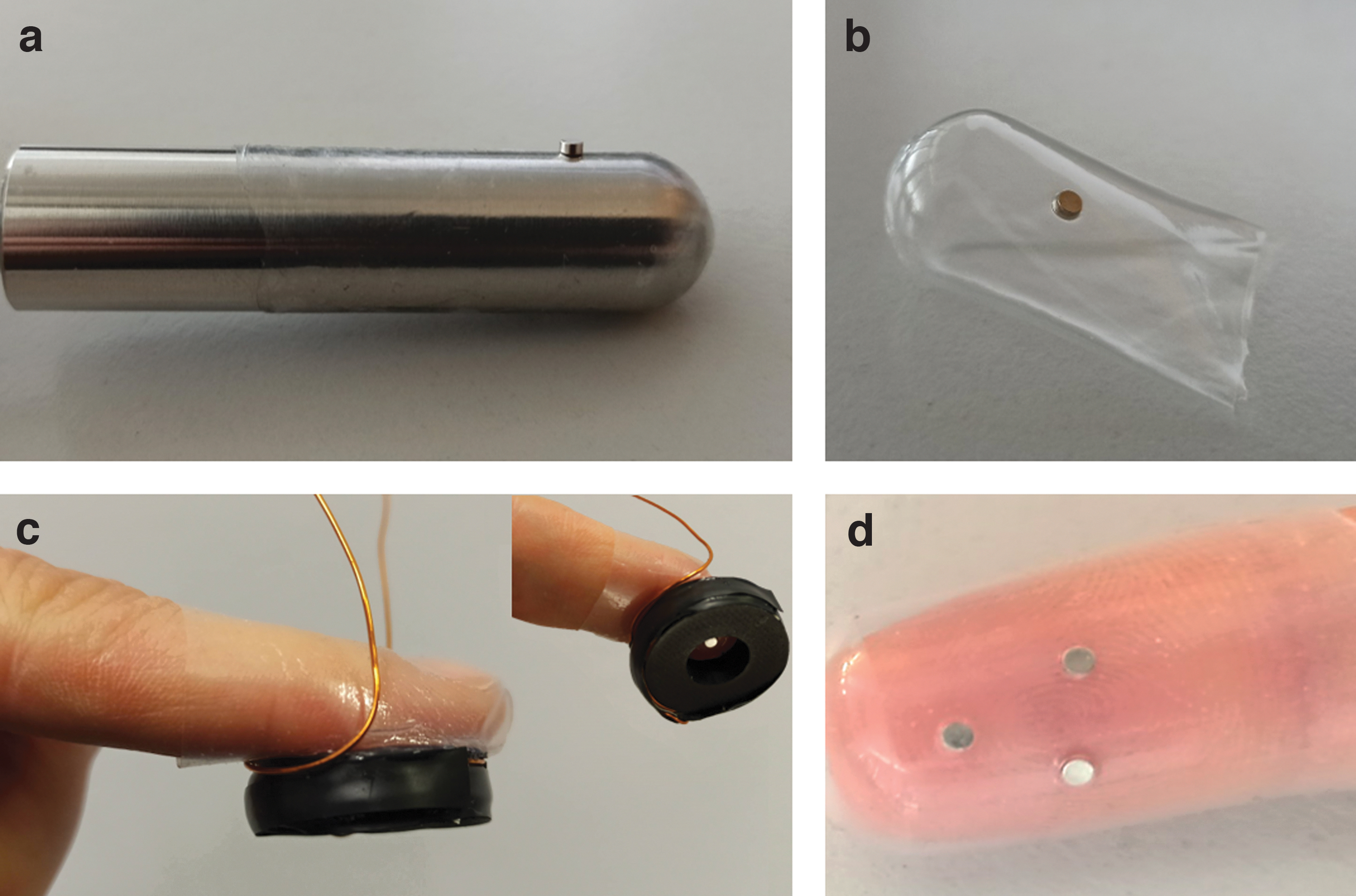
Magnetic sheath fabrication method.
The sheath was made from silicone rubber (Dow Silicones Corporation, USA) for its large elongation at break, which enables tear-free stretch while putting on and removing the device. This biocompatible and optically clear elastomer has characteristic adhesiveness that makes it a popular substrate for wearable electronics (e.g., Kim et al. 32 ). In this study, it couples the sheath and the skin without creating the strong sensation of wearing a device. The thin rubber and the skin of the finger pad remain in contact throughout use thanks to the sheath's continuous surrounding structure and the lack of an air gap between the two.
The fabrication was based on dip molding; a ferromagnetic mandrel was immersed into the silicone to produce the internal layer and then left to dry for 24 h. We used symmetrical rounded cylindrical mandrels in several diameters to fit many users; they could easily be modified to have a more realistic fingertip shape. A cylindrical permanent neodymium magnet (grade N48) was placed on the silicone layer ∼15 mm from the curved end of the mandrel (Fig. 3a), followed by another coating process to create an external layer on top of the magnet. Once removed from the liquid, the mandrel was held vertically and rotated by 180° every other layer to ensure homogeneity of the layered film. The mandrel's ferromagnetism allows fast, accurate, and secure attachment of the magnet unaffected by orientation, gravity, or polymer flow. The silicone sheath was cured at 75°C for 7 h to avoid demagnetization of the permanent magnet due to high temperature. The sheath was carefully removed from the cooled mandrel and cut to the desired length (Fig. 3b).
Encasing the entire fingertip provides robustness against tearing and causes no undesirable local sensations. The overall sheath thickness is 170 ± 5 μm. Although fabricable, a thinner silicone layer was not desired since it would be more sensitive to manufacturing defects and mechanical stress along the edges of the magnet due to the relatively low tear resistance of silicone. The same applies to natural or synthetic latex, which can replace the silicone rubber to reduce production costs at the expense of optical transparency. Increasing the thickness generally improves the sheath's durability for multiple uses; however, a thick (>250 μm) layer can exert stronger pressure on the fingertip through stretching and might reduce the user's sensitivity to haptic cues. The advantages of the method described here are its accuracy and compatibility with mass production.
The electromagnet was made from 0.5 mm copper wire wound around a 3D-printed housing (
The coil needs to be close to and well aligned with the magnet to produce strong haptic sensations. In addition to mechanically attaching it around the magnet (Fig. 3c), electromagnetic fields could be created at the user's fingertip through other configurations. For instance, the coil could be moved by a planar wire robot behind a screen to track the user's fingertip and deliver touchless haptic feedback from a graphical user interface or the sheath could be worn in a volume surrounded by large coils to feel and manipulate virtual 3D objects. For this proof-of-concept study, we chose to have the user hover their fingertip above an unattached coil.
Displacement and force measurement
To understand the system's dynamics, we measured the magnet's displacement as a function of frequency using a laser Doppler vibrometer (OVF-534; Polytec GmbH, Germany). The measurement was performed on a human fingertip wearing a 170-μm-thick silicone sheath made on a 14-mm-diameter mandrel. For consistent relative positioning, the air-coil was attached to the fingertip surrounding the magnet using insulating tape connected to the back of the finger, such that no pressure was applied on the finger pad. A reflective surface was attached to the sheath on the magnet to obtain a strong and stable signal. The input was a preprogrammed chirp with 1 V amplitude; it swept linearly from 10 to 1000 Hz over 3 s. The sinusoid was generated at a sampling rate of 10 kHz for three consecutive repetitions using a data acquisition device (cDAQ-9171 and NI-9264; National Instruments Corp., USA) and was amplified by a linear current amplifier to 2 A. The recorded displacement was high-pass filtered at 15 Hz to remove natural human trembling and environmental noise.
Separately, the magnetic force magnitude was measured by attaching the magnet to a precision scale (ABT 100-5M; Kern & Sohn GmbH, Germany) and applying a constant current of 2 A through the air-coil while it was held aligned with the magnet's top surface.
Dynamic modeling
We then predicted the dynamic response of the fingertip using computational simulations. High-fidelity finite element analyses were utilized to accurately represent the intricate geometry and nonuniform material properties of the fingertip with the attached haptic device. Specifically, we adapted DigiTip, an elaborate fingertip model that includes biologically inspired tissue layers and the bone profile. 34 We modified this model by adding a silicone layer covering the fingertip exterior and a rigid magnet embedded in the silicone at the center of the finger pad. The geometric parameters were set to match the dimensions of the index finger from which the experimental vibration measurements were obtained. The values of the geometric variables and isotropic material properties used in the model are provided in Supplementary Tables S1 and S2, respectively. The overall energy dissipation (damping) is incorporated into the system using a loss factor, which makes the global stiffness matrix complex. The appropriate damping level was explored by setting the loss factor to a range of values. Figure 4 shows the details of the resulting finite element model.

Finite element model of the fingertip covered by a silicone sheath with an embedded magnet.
The magnet undergoes magnetic forces in the direction normal to the skin (Fig. 2). We simulate this excitation by applying perpendicular harmonic forces on the magnet in the finite element analyses, equally distributing the forces on the 12 nodes of the magnet elements. The frequency of the force applied to the magnet was swept from 5 to 1000 Hz in 5 Hz increments.
User study
To characterize our device's ability to deliver vibrotactile cues, we conducted a human-perception experiment with two parts: detection threshold and cue identification. This study was approved by the Max Planck Society's Ethics Council under the framework agreement of the Haptic Intelligence Department with protocol number F018A. The goal of the detection threshold experiment was to determine the lowest signal amplitude that can be perceived by the user over the relevant frequency range. The cue identification experiment aimed to investigate the clarity and interpretability of the stimuli generated by the developed device.
Participants
Seventeen people (8 female and 9 male) whose age ranged from 25 to 59 years (mean [M] = 35, standard deviation [SD] = 8) were recruited for the experiment; they had varying levels of familiarity with haptic devices. All participants provided informed consent, and those not employed by the Max Planck Society were compensated 10 euros for their participation time of 75 min.
Experimental setup
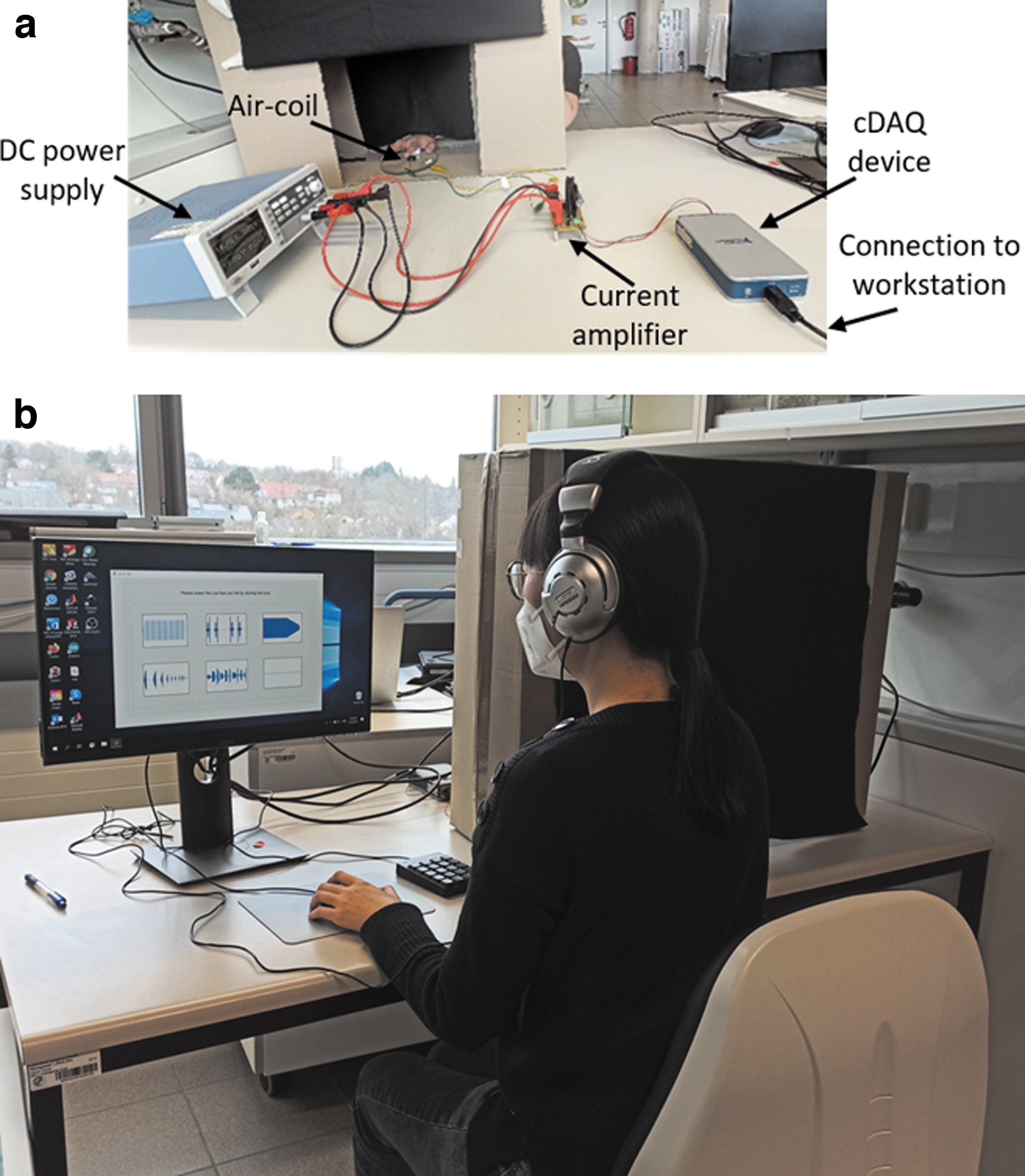
The study was conducted in a laboratory setting. As mentioned above, the actuation system includes a cDAQ device, current amplifier, direct current power supply, and air-coil (Fig. 5a), as well as a sheath chosen to fit the user's index finger. The system was placed behind an opaque curtain to hide visual clues about the actuation (Fig. 5b). The setup additionally included a computer, screen, mouse, keyboard, and over-ear headphones with white noise played at a comfortable level to mask environmental sounds.
Procedure
Detection threshold experiment
The participant placed their finger ∼1 mm above the center of the coil, aligning the magnet with the coil's top surface, and they were instructed to hit the “Enter” key each time they felt a vibration at their fingertip. The signals included in the experiment were 200-ms-long pure sinusoids at seven frequencies that were exponentially sampled to cover human vibrotactile sensitivity: 15, 30, 60, 120, 240, 480, and 960 Hz. This duration is long enough to exceed the neural threshold and sufficiently brief to prevent duration-related threshold reduction derived from temporal summation at certain frequencies. 35 The command amplitude could range from 0.005 to 0.1 V with 0.005 V increments.
Vibrations are perceived as similar to the corresponding audio representation 4 ; therefore, our chosen methodology for this experiment was inspired by audiometry tests. We adapted the American Speech-Hearing-Language Association Guidelines for Manual Pure-Tone Threshold Audiometry. 36 The sinusoid frequency was initially set to the central frequency of 120 Hz and then proceeded through 240, 480, 960, 120, 15, 30, and 60 Hz. For each frequency, the signal started with an amplitude of 0.01 V. If a participant detected the vibration within 1 s, the frequency, detected amplitude, and response time were saved in a log file, and the amplitude was reduced by 0.005 V for the final stimulus at that frequency. Otherwise, the voltage was increased by 0.01 V. The delay between successive vibrations changed randomly between 1 and 4 s to prevent users from predicting the next excitation. The participants' responses were constantly monitored to verify synchronization with the actuation and identify any false positive reactions. Participants repeated the complete test thrice. We discarded the data for the first presentation of the 120 Hz sinusoid in each test.
Cue identification experiment
For this task, we chose five practical tactile cues from the online vibration library VibViz, 37 a tool for haptic designers. The selected signals were similar in length (2.55 ± 0.15 s) but differed in their roughness, arousal, and valence levels; they were all scaled to a maximal amplitude of 0.57 V. A sixth cue of constant zero voltage (no vibration) was added as a control.
The experiment included three parts. First, the participant had a free practice session of up to 3 min to learn the cues: when they clicked the visual icon for a cue, that cue would play. The second part was a short practice test where each cue was generated once; the participant tried to select the icon of the delivered vibration and immediately saw if they were correct. This practice test could be repeated once upon request to avoid systematic errors. In the third part, the six cues were repeated randomly 10 times each, resulting in 60 total trials that were divided into 4 sets of 15. The participant took a short break after each set. The final survey asked for descriptions of the six cues, matching pairs of similar cues, NASA Task Load Index (NASA-TLX) questionnaires 38 to estimate the workload for both tasks, and additional questions regarding user experience.
Integration in VR
To demonstrate one possible application of our device, we attached the air-coil to the sheath at three points using a silicone adhesive (ELASTOSIL®; Wacker Chemie AG, Germany), as shown in Figure 3c. We used a commercially available VR headset (Oculus Quest 1; Meta Platforms, Inc., USA) and two open-source VR applications39,40 that generate realistic sounds during hand-object contact. Casting the Oculus visual and audio output to a computer, we directly utilized the sound signal as the input voltage for our haptic device using a standard audio cable so the user can feel realistic vibrations at their fingertip during virtual interactions; the audio signal was also visualized on an oscilloscope.
Results
Displacement frequency response functions
First, we measured the magnet displacement in response to a sinusoidal sweep from 10 to 1000 Hz (Fig. 6a). The displacement signal is sinusoidal since the elastic sheath maintains contact between the magnet and the skin and prevents formation of any air gap. For an input current of 2.0 A, the average force acting on the magnet was measured as 0.0033 N. We compared the experimentally measured amplitude envelope with the displacement frequency response function (FRF) curves computed from our finite element model driven with this measured force value across the same frequency range for four loss factor values (

Results of magnet displacement obtained through LDV measurements and simulations:
The experimentally measured displacement amplitude peaks around 300 Hz and then it drops and slowly levels off. The amplitude of the model's FRF curves also varies significantly with the excitation frequency. The lightly damped finite element model (
We also analyze the deformation profile of the fingertip at the peak response frequency of 300 Hz (Fig. 6c). Since the device provides bidirectional actuation, we visualize instances when the magnet is both pushed into the skin and pulled outward. The contours show that maximum displacements occur around the excitation region at this particular frequency, while there is also some movement at the sides of the fingertip.
Human perception
Detection threshold
Two participants were not able to feel the threshold-level vibrations due to a finger injury and large fingertip dimensions that exceeded our maximum sheath size. Thus, only 15 complete data sets were obtained for this task. Nevertheless, these two individuals completed the second experiment successfully.
We calculated each subject's mean detection threshold for each of the seven presented frequencies (Fig. 7a). They had more difficulty detecting vibrations at the highest tested frequencies, creating a U trend that resembles the sensitivity of the Pacinian corpuscles (P channel).35,41 The average detection threshold across participants ranged from 33.3 mA at 240 Hz to 56.0 mA at 960 Hz (across-participant medians between 30 and 40 mA). We analyzed the results using one-way analysis of variance with
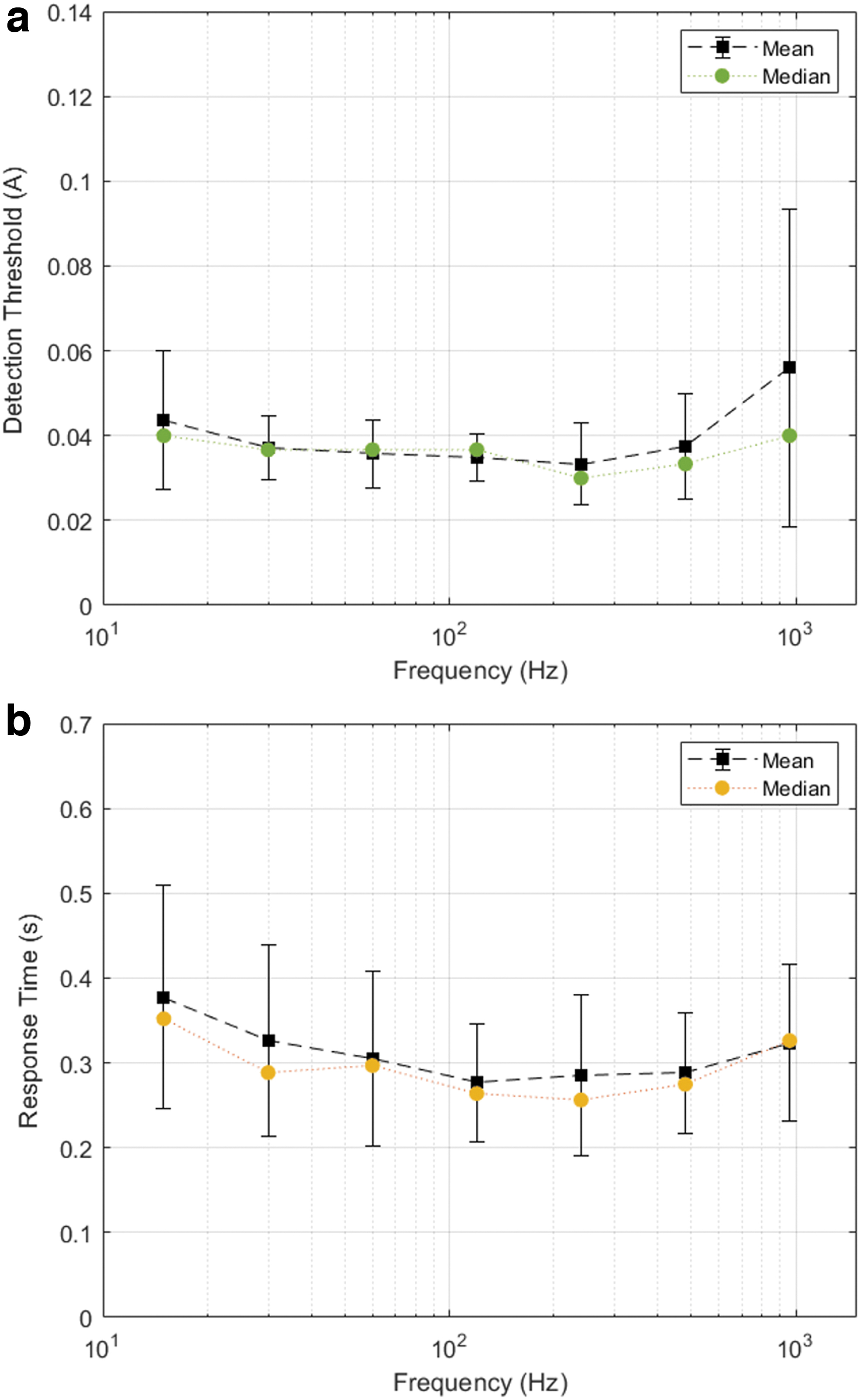
Results of the detection threshold experiment:
We also recorded response times up to a maximum of 1 s and calculated subject-specific means for each frequency (Fig. 7b). The average response time ranged from 278 ms at 120 Hz to 377.7 ms at 15 Hz (medians between 256.3 and 352 ms), which is comparable to the reaction time to vibrotactile stimuli reported by Forster et al. 42
Cue identification
The trials completed by 16 out of 17 participants were evaluated; 1 participant did not meet the English competence criterion and thus could not complete this task. Three participants accidently resumed the trials before positioning their fingers above the coil, so 3 out of the total 960 repetitions were discarded.
Figure 8 presents the resulting confusion matrix, displaying an overall accuracy of 97.6%. The silent control had a success rate of 100%. Participants mostly confused cues 4 and 5 (3.8% and 5.6%, respectively) and a few mixed up cues 1 and 3 (0.6% and 1.2%, respectively). These results match up well with the pairs marked by participants as difficult to distinguish. Of the participants, 82.25% marked cues 4 and 5 as difficult, followed by cues 1 and 3 (37.5%), cues 2 and 5 (18.75%), cues 2 and 4 (12.5%), cues 3 and 4 (12.5%), and none of the cues (12.5%).

The confusion matrix calculated from the average results of the cue identification experiment performed by the 16 participants.
Supplementary Table S3 summarizes the cue descriptions provided by the participants in comparison to those provided by the VibViz library. 37 One can note that there is a qualitative overlap between all parameters even though the study methodologies differed somewhat (free wording in this study vs. predefined taxonomic descriptions in the VibViz study).
The NASA-TLX results are shown in Figure 9; we compared the subscale scores between tasks using paired t-tests. Participants reported achieving significantly better performance (lower workload rating) for the cue identification task (M = 14.69, standard error [SE] = 4.04) than the detection threshold task [M = 32.00, SE = 5.58; t(14) = 3.09, p = 0.0081]. Temporal demand was also significantly lower for cue identification (M = 23.44, SE = 3.78) than for detection threshold [M = 39.67, SE = 5.70; t(14) = 2.45, p = 0.0281]. The other four categories did not show statistically significant differences between tasks.

The participants' rating for each subscale of the NASA-TLX during the detection threshold and cue identification tasks. The error bars represent the standard error of the mean, and the two lines with stars mark statistically significant differences between tasks. E, effort; F, frustration; MD, mental demand; NASA-TLX, NASA Task Load Index; P, performance; PD, physical demand; TD, temporal demand.
The participants also graded the device on a scale of 1 to 5, where 1 represents “strongly disagree” and 5 represents “strongly agree,” in terms of comfort to wear (M = 3.81, SD = 1.22), difficulty of use (M = 1.81, SD = 0.83), and confidence of use (M = 4.00, SD = 0.96).
Application in VR
As described in Integration in VR section, we connected the audio signal produced by the Oculus Quest 1 headset to replace the cDAQ output for our haptic device. As a result, a vibrotactile stimulus was generated on the user's fingertip in real time together with visual and audio feedback during contacts with virtual objects (Fig. 10). Supplementary Movie S2 shows a person using this system to touch several virtual surfaces, press piano keys, and manipulate a slider; the inset videos display the headset graphics and the haptic signals on the oscilloscope. The user could easily feel the low-frequency components (<1000 Hz) of the audible sounds at their fingertip.

Discussion
This article introduced a new wearable haptic device designed to clearly deliver complex vibrotactile cues in a sleek form factor. We showed that a lightweight silicone sheath containing an embedded permanent magnet can generate perceptible displacements across a wide frequency range through electromagnetic actuation. The design benefits from a robust fabrication method that is compatible with commercial requirements and allows simple control of the generated signal parameters.
The displacement FRF curves obtained by simulations and experiments agree well: their amplitudes peak around 300 Hz and decrease with higher excitation frequencies (Fig. 6b). Such a frequency-dependent response was previously reported
43
and can be explained by analyzing the simulation results for light damping. For small loss factor values (
The detection threshold results showed the best performance at the central frequencies, which are known to be easier for humans to perceive. However, detection performance at lower and higher frequencies was better than might have been expected; it is possible that the start and end of each pure sinusoid stimulus activated the P channel, which responds most strongly to stimuli in the range of 40–300 Hz. 31 In addition, the device's displacement FRF curves help explain these findings; the threshold was highest at 960 Hz, where the magnet displacement amplitude was approximately half of its value at the central frequencies. This frequency-dependent amplitude stems from the dynamic properties of the rubber-covered skin. The low average response time of about 0.3 s reinforces the quality of the presented stimuli.
These findings agree well with similar studies, 44 although extrapolation of our measured and simulated displacements indicates that detection occurred at smaller displacements than have previously been reported; additional experiments are required to validate this comparison. Although we do not explore this hypothesis here, we believe that the modal dynamics of the finger influence individual perceptual capabilities.
Both the quantitative and qualitative results obtained from the cue identification experiment demonstrate a clear signal delivery through our hardware to the user. The achieved identification accuracy is higher than those in other studies that used simpler patterns, for example, Ji et al. 19 and Hulin et al. 45 Such performance was probably attained due to the advantage of bidirectional normal force application (Fig. 6c) with minimal encumbrance of the neighboring skin. Moreover, even though almost all participants found certain cues hard to distinguish, they succeeded well at the task due to the good signal quality. We believe that performance at this task is limited by cognitive factors such as attention and memory rather than the rendering performance of the device.
The pure tone vibrations generated by our device were already detected by some participants at voltage amplitudes as low as 0.01 V (coil current of 0.02 A). Indeed, the P channel is known as the most sensitive channel. We attribute these surprisingly low thresholds mainly to the bidirectional coupling between the magnet and the skin and the enlarged stimulation area created by the rubber sheath. Furthermore, the good results indicate that variations in finger positioning relative to the coil did not interfere significantly with cue identification.
We demonstrated simple integration with existing VR applications by taking advantage of the similarity between audio signals and haptic vibrations. Nonetheless, the presented prototype needs further development to be suitable for our envisioned application scenarios and eventual commercial use. The coil and the magnet parameters should be optimized to minimize both the coil's dimensions and its power consumption; however, the current required to produce an adequate magnetic field will still be relatively high because our air-coil design does not include any core material. Furthermore, increasing the number of windings to reduce the current would create a coil that is too bulky to be worn on the finger. In wearable configurations, the coil's temperature needs to stay below 42°C to prevent damage to the user's skin. Since our coil has low resistance and low inductance, it stays below dangerous temperatures even when actuated for tens of seconds by AC waveforms at the amplitudes and frequencies relevant for haptic display.
To minimize these limitations, haptic devices that use an actuation principle similar to ours should be designed to facilitate coil cooling and should display only oscillating signals; coil temperature should be explicitly modeled and/or measured, and actuation should be limited to ensure user safety. Although we used current drive to ensure precise force generation during the reported perceptual experiments, voltage drive should be considered to reduce power consumption of both the coil and the overall system, particularly for portable configurations that use a compact battery. Power efficiency will become crucial for extended usage of more complex haptic feedback systems, for instance, a glove covering the whole hand with multiple magnets and coils that are activated simultaneously.
In addition, exploring the ideal method and location for the coil-sheath attachment can help improve the user experience and device robustness. The moderate mental and physical demand ratings in the NASA-TLX surveys for both tasks (Fig. 9) can be explained by the requirement to hold the fingertip in a fixed position during the trials, as some participants mentioned verbally and in their comments. Fixing or actively controlling the location of the coil relative to the fingertip would reduce user workload and enable interactive applications. The sheath design can also be improved to enhance its adjustability to different finger sizes and reduce the humidity that might accumulate during long use, possibly by adding slots along the rubber. Future studies can also include multiphysics magneto-mechanical finite element analyses, which can provide additional insights about the influence of other physical factors.
In summary, the proof-of-concept phase has been successfully completed for the presented haptic device. Thanks to the good quality of the vibrotactile feedback delivered by the miniature magnet, we expect that the system can haptically render more advanced signals than the cues explored here, such as virtual data-driven textures 20 and end-effector vibrations in teleoperation. 46 In the future, we intend to conduct additional experiments to demonstrate the device's performance in practical applications. Virtual and augmented reality, gaming, rehabilitation, medical simulators, and robotic surgery are among the fields and applications that could benefit from such a wearable haptic instrument.
Footnotes
Acknowledgments
The authors thank the International Max Planck Research School for Intelligent Systems (IMPRS-IS) for supporting Ifat Gertler and Dr. Lijuan Wang for helping with the experimental measurements.
Author Disclosure Statement
No competing financial interests exist.
Funding Information
No funding was received.

References
Supplementary Material
Please find the following supplemental material available below.
For Open Access articles published under a Creative Commons License, all supplemental material carries the same license as the article it is associated with.
For non-Open Access articles published, all supplemental material carries a non-exclusive license, and permission requests for re-use of supplemental material or any part of supplemental material shall be sent directly to the copyright owner as specified in the copyright notice associated with the article.
