




Abstract

Overview
This perspective shares a new model for sustainability, beginning with the description of the two Venn diagrams presently used to present a visual model for sustainability. The discussion then addresses the Wellness Model for Sustainability that has been used to represent sustainability at Bemidji State University (BSU) since 2008, providing justification, examples, and case studies of the model’s curricular, cocurricular, and institutional use at BSU and Augsburg University. While the examples included are from university settings, the model is assumed to be applicable anywhere people are working toward a better future together.
We will use the term Community of Life throughout this discussion. We use this to describe the interconnected, constantly changing web evolved over millions of years of being in relationship. We capitalize the term in a way that is consistent with proper nouns, similar to Mother Earth. From an Indigenous perspective, it is important to acknowledge such terms in this way. Everything is a member of the Community: the water coming out of the faucet, the air you breathe, the wren in the tree, the rhubarb in the garden, and the granite in the driveway. The Community of Life includes all the energy that flows between everything. Humans have responsibilities as a member of this Community.
Introduction to Sustainability Models
Introductions to and definitions of sustainability include two commonly used visual models of interconnected systems Figure 1 and Figure 2.

The Integrated Model
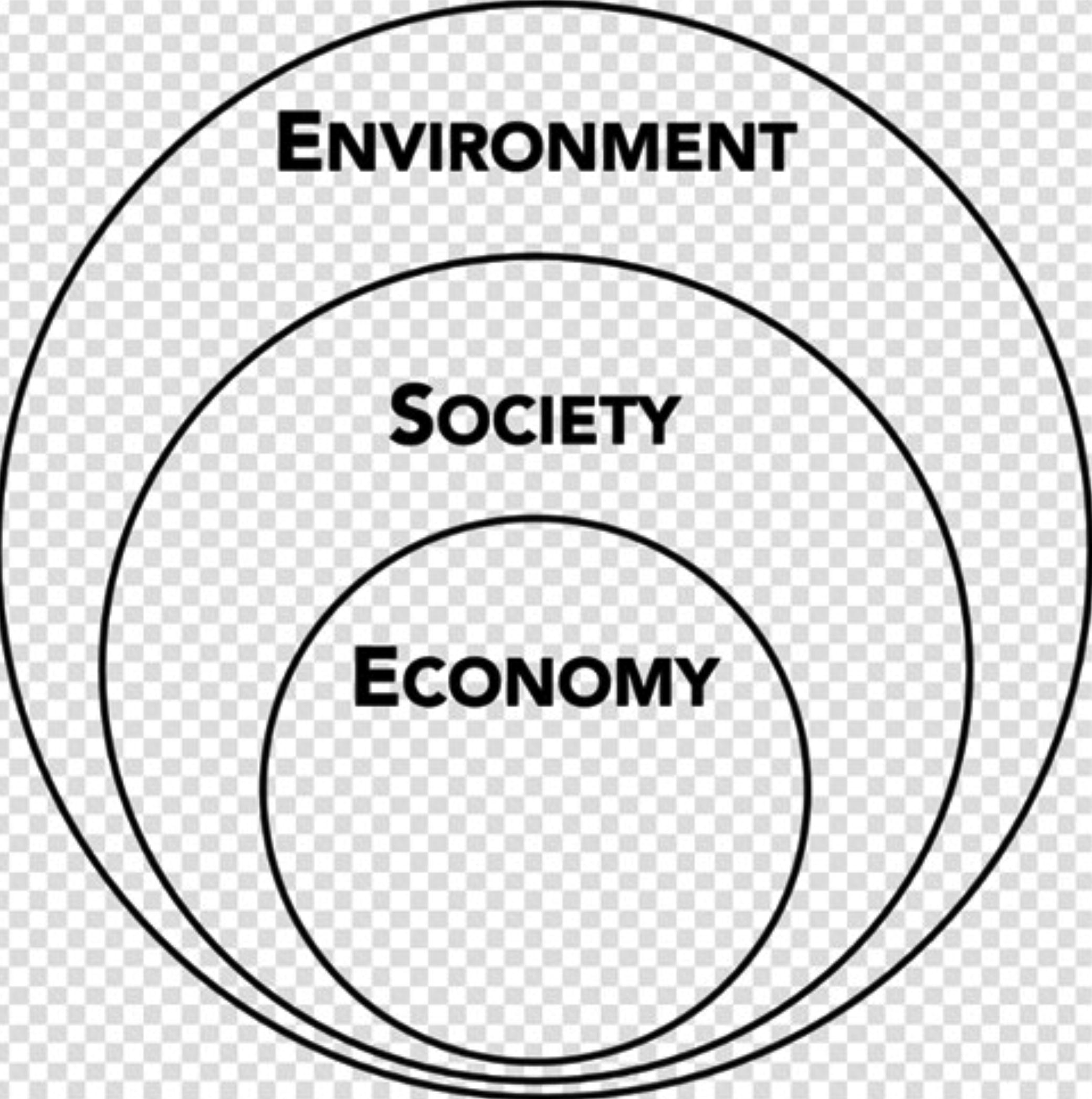
The Nested Model
Both models depict three systems: social, economic, and environment. The social sphere reflects the interactions and organized relationships among people, which includes social systems and institutions (i.e., family, education, cultures, nations, corporations, and industries). The economic system includes the production and distribution of goods for human consumption, as well as exchanges in these goods and services. The environment or ecological sphere reflects the natural environment and specifically the services its ecosystems provide for humans. These ecosystem services include energy and matter (i.e., raw materials) and the processing of waste, pollution, and emissions.
The Integrated and Nested Models (Figures 1 and 2, respectively) also illustrate the permanent tensions and intersections involved among these three systems. From a macroeconomic perspective, the economic sphere relies on consumers, markets, and institutions to respond to and address human needs and preferences; it therefore overlaps and is interconnected with the social sphere. In addition, the economic sphere relies on energy and matter from the environment to facilitate the exchange of goods and services, so it also overlaps and is interconnected with the environment sphere. Humans are largely interdependent upon one another, so they exchange goods that they have obtained or fashioned from the environment and/or perform services that are propelled by energy generated from the environment. In these ways, the social sphere is heavily dependent upon the environment and benefits from an economic sphere. Economist René Passet (1979) contends that the environment does not guarantee an unlimited supply of resources for humans. This scarcity can and has fueled technological advances that have made economic processes more efficient but has also contributed to social crises (Passet, 1979). Since the industrial revolution, and even before it, humans have had a profound impact on the environment in their pursuit of social and economic ends. During this current geologic age, the Anthropocene, human activities are now so pervasive and profound in their consequences that they affect the Earth at a global scale in complex, interactive, and accelerating ways; humans now have the capacity to alter the Earth System in ways that threaten the very processes and components, both biotic and abiotic, upon which humans depend (Steffen et al., 2004, p. 6).
The environment sphere, therefore, is greatly impacted by the social and economic spheres and also supports their existence, so it is an integral part of these models.
The Integrated Model (Figure 1) and the Nested Model (Figure 2), however, do share some distinct differences from each other. The Integrated Model depicts the social, economic, and environment systems as contributing equally to creating a sustainable world. These three spheres from the Integrated Model are typically associated with John Elkington’s (1998) concept of the triple bottom line (TBL) of social, environmental, and economic impacts. Elkington’s TBL concept, however, is mostly used as a framework to help for-profit companies increase their capital and profitability, so it presupposes the economic sphere as the ultimate priority. Therefore, the default goal of this sustainability model is to increase profitability and growth of the economic sphere. It does not consider the following: “How does money compensate an animal for its loss of habitat or a tree for acid rain?” (Giddings et al., 2002, p. 190). The sustainability in question is the ability for the company or organization to exist in the long term, not for human communities and the natural environment to exist in the long term. If it was, there may be harder questions to ask like should the organization or company exist in the first place?
On the right (Figure 2), the Sustainable Development Model, or Nested Model, more clearly demonstrates the codependence of society and the economy on the environment (Giddings et al., 2002). This model does not depict the three spheres as being coequal but presupposes that the social and economic spheres depend upon the environment sphere as follows: The economy is a subset of society and society a subset of the environment. A society cannot exist without an environment upon which to work, play, and grow food. Likewise, an economy cannot exist without human and natural capital. The downfall of the Nested Model is the visual similarity with a target and the economic sphere being the bull’s-eye or goal for society to achieve. Both assume humans as the main consumers or users of the environment and conceptualize these systems for and by humans; they do not include the broader Community of Life as part of these three systems.
A New Way: The Wellness Model Overview
As with all models, the Wellness Model for Sustainability presented here is not all-encompassing of reality. We recognize that in movements for a better world (including in the sustainability realm), vocabulary and focus change, and each of us in this movement brings unique knowledge and experiences. For example, you might be more familiar with or passionate about resiliency. Wonderful! It is all connected and needed as we move toward the world we want to live in. For us, sustainability is about all our relations—human and more-than-human, past, present, and future—and we acknowledge the limitations of representing this well in one introductory article. We recognize that the foundation of sustainability is change, and this model has been a guide that has supported us through many changes.
The new Wellness Model for Sustainability created at BSU in 2008 is shown in Figure 3. Like the Nested Model, the environment supports and surrounds everything else. The three integrated circles include the economy (our system of exchanging goods and services), society (humans interacting with each other), and wellness (individual mental, emotional, and physical health, among many other potential components). In this model, sustainability is the bull’s-eye, where financial, social, individual, and environmental components are optimized.

The Wellness Model
In implementing this model, wellness can be defined as the individual, group, or organization sees fit. There are many dimensions of wellness defined in the literature. BSU currently uses a wellness model for students called “Best You @ BSU” that includes, defines, and provides learning objectives around the following seven dimensions: academic and career, cultural, emotional, environmental, financial, physical, and social (Bemidji State University, n.d.). Similarly, the Wellness Institute defines six dimensions of wellness as follows: physical, intellectual, occupational, emotional, social, and spiritual (National Wellness Institute, 2023).
As in the Integrated Model, social and economic issues overlap, leading one to consider, for example, worker’s rights and other social justice issues. In this new model, individual wellness is a new, critical component, and the intersections can be described in many ways. Wellness and the economy overlap in discussions and efforts on affordable health care, active and accessible transportation, and farmers’ markets. Wellness and the society intersect to provide community education classes, community theater, and community gardens.
Over time, the Wellness Model for Sustainability has evolved to be less anthropocentric, especially as an Indigenous perspective was integrated. An economy is not just humans exchanging goods and services but the entire web of relationship and reciprocity upon which all life depends. Trees share nutrients with other trees. Wolves feast on beavers and thus contribute to managing wetlands. In a similar manner, the societal aspect of the traditional Venn diagram is not just referring to humans; it refers to interactions among the Community of Life. A turtle rests on a rock. A lightning bug does a special dance to attract a mate. Society is complex and beautiful, and we are a part of it all.
How We Got Here
BSU Sustainability Office was created in 2008, and students and staff immediately realized that the work they felt called to do required a different visual representation. The traditional Venn diagrams for sustainability (Figures 1 and 2) seemed limiting and did not engage the entire campus. For example, the BSU Sustainability Office staff were busy partnering to create events with the Track and Field program, the Theater Department, and the Council of Indian Students. These departments were ready and willing partners to design events that included sustainability and were often not considered in the typical facilities-heavy conversations. Countless higher education professionals from the humanities sensed the lack of inclusion of their field in the traditional sustainability models. Traditional sustainability can focus on recycling and light bulbs, which are valuable topics, but music, art, and theater, as well as yoga, volunteering, and gardening, may well be the hook needed to be better human relatives.
Two central themes emerged as BSU began to think deeply about their sustainability work. First, it made sense to have the environment as all-encompassing. The environment is not dependent on us; we are dependent upon it (and part of it). This belief is strongly emphasized by the Indigenous communities that are embedded in and surround the Bemidji region. BSU is located between the three largest Ojibwe nations in Minnesota. According to Ojibwe legend, as recounted by Basil Johnston in Ojibway Heritage (Johnston, 1976), the Great Spirit first created the physical world of sun, stars, moon, and earth and then the plant beings. After plants came the animal beings “conferring on each special powers and natures. There were two-leggeds, four-leggeds, wingeds and swimmers” (Johnston, 1976, p. 13). Last of all, the Great Spirit made man. Man was last in order of creation, least in the order of dependence, and weakest in bodily powers, yet man had the power to dream. The Great Spirit then made The Great Laws of Nature for the well-being and harmony of all things and all creatures. The Great Laws governed the place and movement of sun, moon, earth, and stars; governed the powers of wind, water, fire, and rock; and governed the rhythm and continuity of life, birth, growth, and decay. All things lived and worked by these laws. This way of thinking about humans’ roles and responsibilities as members of an interconnected Community of Life greatly shapes BSU’s sustainability work.
The second theme that emerged was the idea that we must not only take care of each other and the earth but also ourselves. Too many sustainability staff were getting burnt out. Colleagues were not sleeping well and were not getting enough physical activity. Anxiety levels were high. What impact would this lack of self-care have on our responsibility to be good role models and stewards? It felt important to include individual wellness in this new sustainability model. Not only was it important to ride a bike because it was less expensive and polluting, but it was also better for the individual’s physical and mental health than driving an automobile. The BSU Sustainability Office wanted to encourage faculty and staff to purchase stand-up desks, but were struggling with how this would fit into the standard definition of sustainability. They wanted to encourage consuming organic food not only because it was better for soil health and local ecosystems but also because it was better for the body. Over time, BSU’s definition of wellness expanded to include the wellness of an organization or community and consider more-than-human elements. For example, when considering projects, it is beneficial to ponder the wellness of water, a spider, or a lakeshore buffer zone.
At BSU, the Wellness Model for Sustainability became the way sustainability work was described in reports and presentations. Soon the model was shared with the broader region and at national conferences to garner feedback and critique. Many colleagues asked for an article to reference, so this article was initiated and massaged off and on for 10 years by E.B.-J., Sustainability Director at BSU. A.G. and M.M., former Sustainability Officers at Augsburg University, subsequently joined E.B.-J. to finish writing this article in the midst of a climate emergency, pandemic, racial uprisings, and economic uncertainty. These issues were top of mind in 2020 when we began writing together, yet the equitable, just, inclusive path that is possible is still not available to all of us in 2025. We need a call for us all to do things differently and in relationship/community with the Earth and one another.
Seeing Connections
Each global issue has been and still could be treated separately as follows: climate change is about the environment, COVID-19 is a personal wellness issue, White supremacy and police brutality are social issues, and recessions and inflation are all about the economy. The convergence of all these experiences in 2020, however, made the connections between them harder to ignore, even by groups who have had the privilege to exist with relative isolation from social, economic, environmental, and health disparities.
The complex connections embedded in social events made their way into popular understanding rather than being relegated to academic journals and classrooms. Social media spread stories of reduced air pollution and returning urban wildlife during COVID-19 quarantines, whereas news reports also highlighted the need for long-term policy, economic, and behavioral changes to sustain the changes. After the murder of George Floyd, a Black man, by a White police officer in Minneapolis, Minnesota, the Sierra Club’s national magazine declared, “We’ll never stop climate change without ending white supremacy” (Hopkins, 2020). Even the American Academy of Family Physicians called on the federal government to declare racism a public health emergency (American Academy of Family Physicians, 2020).
Environmental justice advocates and researchers have been making clear connections between social, economic, and environmental issues for decades. Even so, the recognition that personal wellness is dependent upon and interconnected with environmental, social, and economic systems has not been explicitly included in sustainability models that guide decisions and actions. The 1987 landmark Toxic Wastes and Race report gave data on what many communities living near dumping grounds for toxic substances already experienced as their reality (United Church of Christ Commission for Racial Justice, 1987). Communities of color and low-income communities already knew that they carried high environmental burdens and that things like irritating smells, truck traffic, or contaminated water lowered their quality of life. Now there are even more data that show how connected personal wellness is to environmental, social, and economic systems.
Yet, we do not always need data, journalists, or government agencies to show this to be true. Our own daily living can demonstrate these connections! We can all identify ways that health disparities, environmental degradation, racism, isolation, and poverty impact us, even though some people and places feel these burdens more intensely. The following case studies illustrate how these connections have played out on two different Minnesota university campuses, leading to shifts in how sustainability is embodied in cocurricular and curricular efforts.
Case Studies
Curricular and cocurricular activities, programs, and assignments that engage in reflective practices have the potential to build new knowledge among students, within communities, and across disciplines. Through collaborative work with students, faculty, and staff, BSU, Augsburg University, and many other postsecondary institutions have demonstrated the necessity of a new model for sustainability, one that includes individual wellness. It is unique to include “wellness” as a component of sustainability.
Bemidji State University
BSU Student Senate passed a bill to support the creation of a 24-h computer laboratory on campus. Two computers were placed in a high traffic area next to Campus Security to be available at all hours yet be monitored. Students who work in the Sustainability Office were discussing the connection of the project to their unique definition of sustainability. They decided that the project was a great example of considering the “wellness” component of sustainability. As students now have the option to use a computer at all hours, their stress is reduced. They no longer need to try to work around the limited library and computer laboratory hours. Managing stress is very important for individual health, and the 24-h computer laboratory provided one more strategy for students to get their work done. The project was supported by the Sustainability Office despite increasing electricity use.
When considering the sustainability of a campus project, including the wellness component has allowed BSU to easily justify supporting projects such as the tobacco-free campus policy, suicide prevention activities, concert performances, and Anishinaabe powwows. Their goal is to create a campus that encourages healthy eating habits, physical fitness, mentally enriching activities, and psychological health, as well as fiscal, social, and environmental responsibility.
At nearly every campus and community sustainability event, they present and define the model. Students who work in the Sustainability Office become adept at describing the model and will present the model during tours, First Year Experience courses, and events. Staff present the model at the start of presentations to Student Senate, Faculty Senate, the President’s Cabinet, the International Student Orientation, and any other venue that presents itself.
Ideally, all choices an individual makes would be based on the answers to the following questions:
Does this decision impact the Community of Life in an unsustainable way or produce waste that Earth cannot recycle? Will other humans or more-than-humans be negatively impacted by this decision? How will this decision financially impact me, society, and the Community of Life? How does this decision impact my personal well-being and the wellness of the rest of the Community of Life?
We are all ultimately striving to create easy answers to these questions. As Dr. Jim Farrell (2010) notes in The Nature of College, “Conscious of the complexity of our lives and our complicity with systems that we really don’t support, we have a chance to change our ideas and institutions, our habits, and our habitat. We have a chance to change the world into a place we will love to live in, a place we can proudly pass on to our children and our children’s children” (p. 250). We need to change our default settings; we need to create a culture that automatically does what is best for ourselves and the environment. When one is able to choose to use the stairs instead of the elevator, the individual is not using any resources other than their own energy (which is good for their physical health). When one chooses to paddle a canoe instead of hop on a jet ski, the individual is not polluting the environment with emissions or sound. When one chooses to craft earrings out of renewable, native material instead of conflict minerals, the individual reduces the pollution and injustice created from mining rare earth materials.
As an example, assume you are interested in getting involved with a community theater project. Here are some questions you might ask yourself to make the production more sustainable:
How will the costumes and set be created? What type of lighting will be used? How will individuals be recruited to audition? Will breaks be offered during rehearsals? Will actors/actresses be taught how to safely perform their routine? What will it cost for individuals to attend the play? Is the production sensitive to all the people and cultures of the region? Is the facility handicap accessible? At intermissions, what type of food/beverages will be offered and where were they sourced? Where will the production be held?
Augsburg University
During a semester in 2019, students in Augsburg University’s Environmental Connections Topics course studied and analyzed issues in the food system. The interdisciplinary course adopted the sustainability framework of Elkington’s (1998) TBL (i.e., social, economic, and environmental impacts) to look into the many impacts of how food is or is not produced, processed, distributed, eaten, and disposed of. One assignment had students visit a restaurant of their choosing and examine the economic, social, and environmental impacts of the dining experience. A few of the reflections noted that the dining experience had diverging social impacts depending on an individual or a collective, societal-level analysis. Many of the students enjoyed their dining experience on an individual level because it supported their physical and/or mental well-being. Some, however, noted that this positive experience for their own well-being was not always reflected in the broader societal-level impacts of the business (e.g., living wages or mindful waste management). The reflective work of this experiential assignment and many others throughout the course led to a discovery that an individual’s wellness is a key component in the discussion and work around sustainability; it arguably should be considered separately from social, economic, and environmental spheres.
When teaching sustainability, environmental studies, and conservation topics within courses, it is essential to consider the sustainability of your endeavor, activity, project, or overall course. In Teaching to Transgress (1994), author bell hooks discusses engaged pedagogy, where the substance and content of courses are important, but she emphasizes an opportunity, and an imperative, to invite students into the learning community as both teachers and learners, where all can, ideally, bring their whole selves. “That means that teachers must be actively committed to a process of self-actualization that promotes their own well-being if they are to teach in a manner that empowers students” (hooks, 1994, p. 15). The Wellness Model for Sustainability is a helpful avenue in which to build relationships and to tangibly examine the intersectional issues of environmental sustainability. All beings are already actively interacting with and impacted by economic, social, wellness, and environmental systems, so students bring this knowledge and experience with them into the classroom. Integrating the Wellness Model into one’s teaching approach leads to higher student engagement, improved learning outcomes, and an opportunity for students to bring their academic interests into the course for an interdisciplinary learning experience for everyone.
Sharing the Wellness Model for Sustainability is an opportunity for a class to have a collective understanding of sustainability while comparing it to other definitions, models, and related terminology (i.e., resilience and stewardship). Embedding the Wellness Model into the course content and reflecting it in teaching processes together highlight how the classroom community, via course content, can and will actively support efforts toward a more sustainable world. As one Augsburg student reflected: “The way my instructor embedded the Wellness Model into our environmental studies class made it more interesting, enjoyable, and important than any other class I’ve taken on the subject. The teachings from that class not only helped to give me a clearer picture of the future of environmental action, but also the ways in which we can better collaborate, learn from, and care for each other.” Anytime people come together to learn and take action, there lies an opportunity to apply the Wellness Model in planning, implementing, and evaluating. How might the examples below apply to a meeting, community project, workshop, or retreat where people are coming together to learn and take action?
The content of a specific course can integrate the four systems of the model by leveraging a field’s individual perspectives and expertise. Here are some questions to ask in developing and revising course content:
What are the contributions of the field on environmental, social, wellness, and/or economic issues? How do they show up in the syllabus through classroom activities, assignments, learning objectives, and readings? Who are the folks working at the intersections of these systems in the field? How are their voices incorporated into the course and its readings? Who are on the frontlines of this work and most directly impacted by climate change and these interconnecting systems? How will Powerful Groups Targeted for Oppression, such as Black, Indigenous, and People of Color, LGBTQIA+, Global South, and disabled communities, be equitably centered? In course plans, processes, and policies, how is the wellness of students and their instructor prioritized? How can the course be leveraged as an opportunity to make an impact or support students to further explore their part in these systems, especially environmental systems? Are there classroom activities and/or learning objectives that can be integrated that get students interacting with the environment and supporting local, intersectional efforts?
After reflecting on the above questions, it is time to create a wellness approach that is integrated into course processes. The syllabus, course activities, learning objectives, and assignments are all opportunities for the instructor and students to embark on a learning journey together where they can live out the Wellness Model for Sustainability. In the course syllabus, include a curated list of campus and neighborhood supports (i.e., Writing Center, Counseling). This welcomes students into the collective campus learning community and signals that their well-being matters. Be sure to revisit and reference the document throughout the semester and at individual check-ins with students. Also in the syllabus, include course policies that reflect on your previous course experiences, and in looking ahead to the next course, ask yourself the following:
What are my boundaries as it relates to teaching this course and interacting with the students? How do these policies support the wellness of the students and myself? How do these policies uplift equitable systems of learning and dismantle systems that tend to favor economically and socially privileged identities? How do these policies support students to engage with the environment and with one another to advance their learning and understanding of course concepts? How can I ensure students have agency in the course and share their own needs for learning and personal wellness? Do these policies include generally assumed, hidden expectations that may be unfamiliar to first year and first-generation students? Do I state each clearly so that all students understand the expectations and reasons behind them? At the start of each course, share these policies and your reasons for them, and connect them to your community-building work so that many of your expectations are cocreated with you and the students.
In-class activities are also an effective way to integrate the wellness model into one’s course. Spend an intentional part of every course building social connections among the student cohort and you, and then deepen these connections and extend them to campus and the neighborhood. Take the class outside to do team-building games, and allow time to explore the campus as an outdoor classroom. Develop a group agreement where students and you share boundaries and needs for a safe, supportive learning environment and then revisit course policies and the group agreement throughout the semester to assess how the learning community is doing and if any changes to the agreement need to be made. In addition, participatory learning objectives and experiential assignments can reinforce the necessity to work in supportive teams to solve problems through problem-based work. On-campus projects put students in connection with environmentally focused student leaders, staff, and faculty, whose interactions not only support informal networking opportunities regarding future employment and friendships but also advance positive environmental impacts for the university and the neighborhood. This dynamic learning process emphasizes to students that they have the capacity to make change and that implementing climate change solutions takes an interdisciplinary approach.
It is imperative that we continue, as Dr. Jim Farrel (2010) noted, to change the default settings for how a course should be taught, how students should demonstrate learning, and what success, for students and instructors, looks like. For students to deeply learn about environmental sustainability and recognize their potential in making positive change, their learning community needs to support their wellness and engagement with the environment beyond lectures and readings. As academics, our default has been to simply share facts, data, and reasonable arguments for change, but to truly bring about change, we need to create a culture that automatically does what is simultaneously best for ourselves, each other, and the rest of the Community of Life. This requires practice and reflection.
The Wellness Model for Sustainability and the process of its teaching have been well received by a diverse array of students and not just those who study the environment. The Wellness Model can be easily replicable for other courses. It encourages more participation in sustainability efforts from broader applications like in the facilitation of community meetings, program administration, and organizational leadership. With this noted, the inclusion of the following questions in planning the meeting or event may be beneficial:
What is a culturally appropriate way to begin the gathering that you can invite people into? Is smudging acceptable? What’s the space like? How accessible is it for people with no vehicle, different abilities, of all genders, and from different cultures? Does it have windows? Is there art? Is the lighting too bright or not bright enough? What is the temperature? Can you move the furniture to create different arrangements? Can you bring any plants, water, or rocks to be with you into the space? How are people’s basic needs supported? Are they invited to take care of themselves as needed? This includes food, water, and “bio” breaks for restrooms and moving their bodies. When and how does everyone get a chance to feel seen and heard from the beginning? Are they able to introduce themselves in a way that is authentic to them and not just following a script? Do they get to bring their full selves to the space and not just the part of their identity that might be most relevant? Example: Can they share about or bring family members or pets with them? Are there provisions for reducing waste? Are there signs, directions, extra plates, and cups to share so everyone can confidently participate in these efforts? If the gathering will be an open discussion, are there core agreements made by the group for how to communicate? How can the discussion be set up for all to hear, respond, and be present to what is being shared? Who is facilitating? How are they and others compensated/recognized for their time/expertise? Who and how do folks participate in equitable ways to hear and receive information and engage in dialog?
Conclusion: What’s Possible
Humans are complex beings that exist in complicated social, economic, and environmental systems. Making the connections between the spheres in the Wellness Model encourages intentional reflection, critical thinking, and learning beyond our own experiences and realms of knowledge. As the examples above illustrate, students at BSU and Augsburg University were better able to name and recognize these connections on their own when they had concrete examples to explore as part of their daily lives. When the interconnectedness of the spheres became real (or perhaps when they were given space to act on what they already knew to be true), it also invited collaboration that may have seemed outside of their interests before. For example, the Augsburg sustainability students collaborated with the LGBTQIA+ Student Services, Equity and Inclusion Initiatives, and Sexual Misconduct and Awareness Team in 2020 to propose free organic menstrual products on campus paid for by student Green Fees. In 2022, BSU Student Senate had a similar project supported by their student Green Fee. Instead of viewing this project as less “on topic” than other important work like the Climate Action Plan, they used the Wellness Model to articulate how advocating for menstrual products that consider the well-being of people and the planet is sustainability work and is actually integral to all of their other work. By making connections, they are more likely to approach collaborations through a lens of collective liberation and healing rather than scarce resources and survival.
Students have expressed a fierce desire for more visibility of this model. For Augsburg students in 2020, it helped frame the time they were living through in a holistic way while also pulling together strands of their own experiences, interests, and passions. The urgency of transformational action toward sustainability demands a deep understanding of the intersections of wellness, society, economics, and the environment, and they wanted everyone to understand and be able to act at those intersections with them. They felt all the deep hurts of the moment and wanted to share the Wellness Model’s potential for healing broken bodies, ecosystems, relationships, and systems.
Visions of a future where the Community of Life can thrive are emerging more strongly and becoming more possible. A Just Transition to an economy that works in balance with ecosystems and social systems and that does not leave anyone behind is not only possible but also necessary (see Movement Generation [2022] for a primer on Just Transitions]. The Wellness Model for Sustainability can be an entry point for moving students, faculty, and staff toward understanding and advocating for a Just Transition. For example, a meeting about energy conservation could start with a desire to switch to LED light bulbs. If the conversation is rooted in the Wellness Model, it could easily move to investigating where campus energy comes from, including who/what benefits and who/what is harmed from the production of that energy. It can expand to how an organization can leverage its resources (e.g., people, place, reputation, and wealth) to contribute to a more cooperatively owned local energy system, to trace the source of the materials to build that system and lessen its impacts on the earth, to support worker rights, and to advocate for affordable job training. A student who was part of that conversation might then be more inspired to support the cafeteria workers when they strike for better wages because they see how this relates to sustainability, and an administrator might bring a different set of people into negotiations because they see the connection as well. The potential for this kind of action fuels daily hope and work for so many in the sustainability world and can spark imaginations to consider what else might be possible.
What if everyone in the Community of Life has what they need? What if everyone has access to affordable quality health care, regardless of who you are and where you live? What if all young people—Black, Brown, Indigenous, LGBTQIA+, neurodivergent—have what they need to succeed in school and follow their dreams? What if our worth does not depend on our productivity and consumption? And what if we protect the air, water, and soil so that all parts of ecosystems, from bugs to rocks to our own bodies, can fully live into our beautifully complex interdependence on each other?
This perspective references the big moments of 2020, but how might the Wellness Model speak to what’s happening in this moment? How does it connect for your moment today and in the lives of those you teach and with whom you are in community? The aftermath of the identified 2020 triple pandemics of racial injustice, COVID-19, and climate change has continued to compound within individuals and communities. These intersecting dilemmas are inextricably linked with the struggles of today such as organizing for affordable housing, the cost of groceries and energy, the opioid epidemic, and the mental health crisis. In the face of intersectional crises, the Wellness Model for Sustainability can support (classroom) communities to build intersectional solutions. If a student pulls on the “access to gender affirming care” string in the wellness sphere, which strings would it tug in the other spheres to mobilize cross-sector action? If an instructor only focuses on the benefit of consuming wellness products in a lesson on self-care, what opportunities do they miss for reclaiming the value of communal wellness where humans are an integral part of the ecosystems we live in? How are these connections between wellness, social, economic, and environmental systems also playing out on a community, state, national, and global scale?
Our experiences connected various aspects of this model over the last decade, and because we do not have a societal way of dealing with the ways social, economic, environmental, and wellness issues compound in our lives, we have seen how the Wellness Model can be a container for holding it all together.
Students, faculty, and staff at BSU, Augsburg University, and others are finding support and hope for creating a more sustainable society through reflection and action with the Wellness Model for Sustainability. While there are many effective ways to make sustainable change in our communities, we have found this model to be relatable, easily applicable, and true to people’s experiences. How does this resonate with you? In what ways can you imagine yourself integrating, reshaping, critiquing, and sharing back this model for us all? How does this motivate you to make change? And what can we do together as we continue to learn how to honor these connections?
We hope you take this model and relate it to the models, frameworks, movements, knowledge, places, and experiences that you are immersed in and let them all speak and listen to each other in ways that open up new possibilities for a clearer understanding of our responsibilities as members of the Community of Life.
Footnotes
Acknowledgments
The authors want to acknowledge that this article has been massaged for over a decade. The authors hesitate to send it to print. Words on paper tend to seem “finished” and “final,” and that is not the intent of this article. The authors want this work to be a beginning for a new way to think about sustainability. The authors hope that you connect to a piece of this model that makes your own understanding and actions more inclusive and equitable for the Community of Life. Then they hope that you make the model better.
We are grateful for so much! First, we must honor our ancestors that have laid a good path for us to be able to be where we are today. The authors also want to acknowledge those yet to come who will continue to continue thinking about how to be better relatives in the Community of Life. They are inspired every day by all that Mother Earth gives. The authors are so grateful for the moments with amazing students such as Crystal Rayamajhi and Sara Dennison who helped create the original concept and John Frazier who put his graphic design skills to good use. The authors could not have gotten this work to the final stages without the thoughtful contributions of Kathy Bailey, Matt Johnson, Noah Johnson, Corey Hamilton, Aaryn Wilson, Blongsha Hang, Natalie Jacobson, Elan Quezada Hoffman, Alexa Carrera, Zoe Barany, Leah Tift, Maya Merritt, Alyssa Parkhurst, and Christina L. Erickson, PhD, LISW. A big “Thank You” to those who have made the model relevant for their lives already (and all who will continue to do so). The authors are grateful for the patience and grace of each other through many personal challenges that made writing this in a collaborative way take probably much more time than it should have.
The authors continued on with this work through life transitions, work transitions, place transitions, with the loving support of the Community of Life around us, including:
The Augsburg Community Garden and Loveliest of Trees.
Nibi (water) that flows in, around, and among everything.
Our bubbles of people and places that support us through the low points on the path of life.
Mutual aid efforts, on many levels, among communities practicing care in new ways.
The rocks that ground and redirect and mark our paths.
The warmth and light of the sun and dark and quiet of the moon.
The energy of youth and the wisdom of elders, of all things.
The train tracks, bike paths, river channels, and virtual lines of communication that brought us together and sparked new connections.
The music of festivals, powwows, and car radios that fuels our souls.
The students who teach and the teachers who learn.
Authors’ Contributions
E.B.-J.: Conceptualization, supervision, writing—original draft, and writing—review and editing. A.G.: Writing—original draft and writing—review and editing. M.M.: Writing—original draft and writing—review and editing.
Author Disclosure Statement
The authors declare no conflicts of interest.
Funding Information
No funding was used specifically for the writing of this article.