






Abstract
As local communities increasingly bear the brunt of a changing climate, local sustainability officials face complex decisions about how to respond and prepare. Collaborative relationships with university-based researchers are often valuable and favored but do not always develop organically. In this descriptive study, we ask: Do sustainability policymakers have the collaborative relationships they need? Or is there unmet desire to collaborate with researchers to advance climate action? Starting with a well-defined set of research-intensive (R1) universities in the United States committed to policy engagement, we identified local sustainability policymakers adjacent to these institutions as our study population. Through 42 semi-structured elite interviews with municipal and county sustainability policymakers in the United States, we surfaced their top sustainability-related challenges, whether they are collaborating with the local R1 university on them, and, if not, whether they have unmet desire to do so. We found that 81% of policymakers expressed unmet desire to collaborate on at least one of their sustainability policy challenges. Key challenges associated with unmet desire to collaborate relate to resource constraints, lack of political support, and internal processes. Top research needs include benchmarks and case studies, research on return-on-investment, and guidance on effective climate communication strategies. Importantly, most sustainability professionals desired both informal knowledge exchange and formal partnerships with shared accountability. Our findings provide actionable information for researchers seeking to engage in climate policy efforts at the local level.
Background
Across the United States, local communities are increasingly feeling the brunt of a changing climate due to more intense storms, erratic precipitation leading to droughts and floods, and extreme temperatures. These changes severely impact the well-being of people in their communities, often inequitably, and challenge the resilience of the infrastructure they rely on every day. Local governments, including cities and counties, are often important actors in pursuing action given their authority over infrastructure, waste management, transportation, procurement, park lands, as well as their ability to influence individual citizen behavior through effective communication strategies (Nevens et al., 2013; Reid et al., 2023; Schiappa et al., 2023; Wang, 2012). Within local governments, such charge often falls to sustainability officers who anticipate and determine the best way to respond. In so doing, these policymakers regularly confront complex questions about how to mitigate and/or adapt to a changing climate, all while balancing political and economic constraints on what is feasible.
For local governments, universities are important collaborators for climate action (Hannibal et al., 2024). These collaborative relationships may be oriented toward informal knowledge exchange (Haynes et al., 2011). They may also entail more formal collaboration in which there is at least some degree of shared ownership, decision-making authority, and accountability (e.g., student projects, course collaborations, grants, and research projects; (Bery & Haddad, 2022)).
Within this set of possibilities, collaborative relationships with university-based researchers are particularly impactful for local sustainability officials (Bery & Haddad, 2022; Hannibal et al., 2024; Keeler et al., 2019), and they are also highly valued (Pauer et al., 2020). They arise across universities in the United States (Allen et al., 2017; Caughman et al., 2020; Keeler et al., 2023) and internationally (Pauer et al., 2020; (Santangelo et al., 2024); Trencher et al., 2014). And they echo trends in university-based policy engagement more broadly, on a wide variety of issues (Bednarek et al., 2018; Bogenschneider and Corbett, 2021; Oliver et al., 2022; Sarewitz & Pielke, 2007). Indeed, an overwhelming majority of faculty at public land grant universities believe they should engage in the policymaking process on a host of issues (Rose et al., 2020).
All of that said, there is reason to suspect that new collaborative relationships with researchers that sustainability officials would value do not always arise on their own. One study found that these officials often lack mechanisms to become connected with existing research programs and struggle to translate their governmental needs into research projects (Pauer et al., 2020). Often, new university–locality collaborative relationships depend upon two individuals who happen to make a connection (Bery & Haddad, 2022; Pauer et al., 2020), making intentional action for partnership development critical (Keeler et al., 2023). These findings mirror other studies of local policymakers, who also expressed an unmet desire to collaborate with local researchers (Levine, 2024).
Given the need to tackle sustainability challenges at the local policy level, and the value of collaborative relationships with university-based researchers for addressing them, in this article we ask: To what extent do municipal and county sustainability policymakers in the United States have the policy engagement they want? Or, alternatively, is there unmet desire for new collaborative relationships with researchers on sustainability-related topics? We pose these questions because answering them is essential for taking stock of what is already happening on an important topic and, subsequently, to identify pressing opportunities for intentional policy engagement going forward.
Our descriptive study is based on interviews we conducted with a well-defined population of local government sustainability professionals adjacent to a group of research-intensive universities in “The Research University Community Engagement Network” (TRUCEN) that had publicly committed to community engagement. We systematically measured (a) the top challenges these sustainability professionals were facing, (b) where they saw research as valuable to address their challenges, and (c) whether they had an unmet desire for research collaboration to tackle those challenges. By sustainability challenges, we mean anything related to climate adaptation and/or mitigation. 1 Overall, our findings provide a unique window into the local sustainability agenda, including how these policymakers creatively connect their most pressing sustainability policy challenges to research possibilities. To our knowledge (and reinforced by our conversations with TRUCEN leadership), data on research needs and unmet desire for new collaboration have not yet been collected on this set of important local policymakers.
In what follows, we first present our methodology, and then our findings, starting with data on the overall prevalence of unmet desire among sustainability professionals. We then provide an overview of the sustainability policy challenges that our respondents face regardless of whether there is unmet desire. Subsequently, we move to challenges on which they have unmet desire for new collaborative relationships with local researchers. Next, we outline what kind of research is most needed. We conclude by addressing the implications of our findings and, in particular, how to meet the unmet desire and what the impact of doing so may be.
Methods
Our study proceeded as follows. First, we defined a population of interest in which we had reason to believe that sustainability policy engagement may be occurring and/or would be welcome. To build our study population, we first used the 2021 list of TRUCEN universities (n = 34). TRUCEN is a membership-based affinity group of research-intensive universities across the United States that are committed to community engagement with the shared aim to better connect university resources toward societal needs (Campus Compact, 2021b).
We then defined our population as all local sustainability professionals with paid positions adjacent to TRUCEN universities. We focused on proximity to TRUCEN universities for several reasons. First, each TRUCEN school in 2021 paid dues to be a member, which indicates a level of institutional commitment to community engagement. Second, while TRUCEN is focused on community engagement in general, it is also the case that each school has at least one center, institute, or institutional effort whose website mentions environmental, sustainability, or climate policy engagement. Third, as we describe later in the conclusion, we knew based on conversations with TRUCEN leadership (personal communication) and their recent award to develop a Campus Climate Action Corps that sustainability was a focus for the network (Campus Compact, 2021a).
Next, we identified all local sustainability professionals within each school’s county who held paid positions. We limited our attention to all incorporated municipalities and counties with a population above 58,780. 2 Overall, using these criteria, we identified 62 total sustainability professionals within the counties of TRUCEN schools. This included people in positions such as Director of Sustainability, County Director of Energy and Climate Change, Sustainability Planner, Sustainability Coordinator, Climate Program Manager, and Chief Sustainability Officer. Our population of professionals came from 20 states (as shown in Figure 1) and from counties that heavily voted for Biden in the 2020 presidential election (average share of Biden vote was 70.9%). In addition, on average, 54.2% of residents had a college degree and the median household income was $84,272.18.
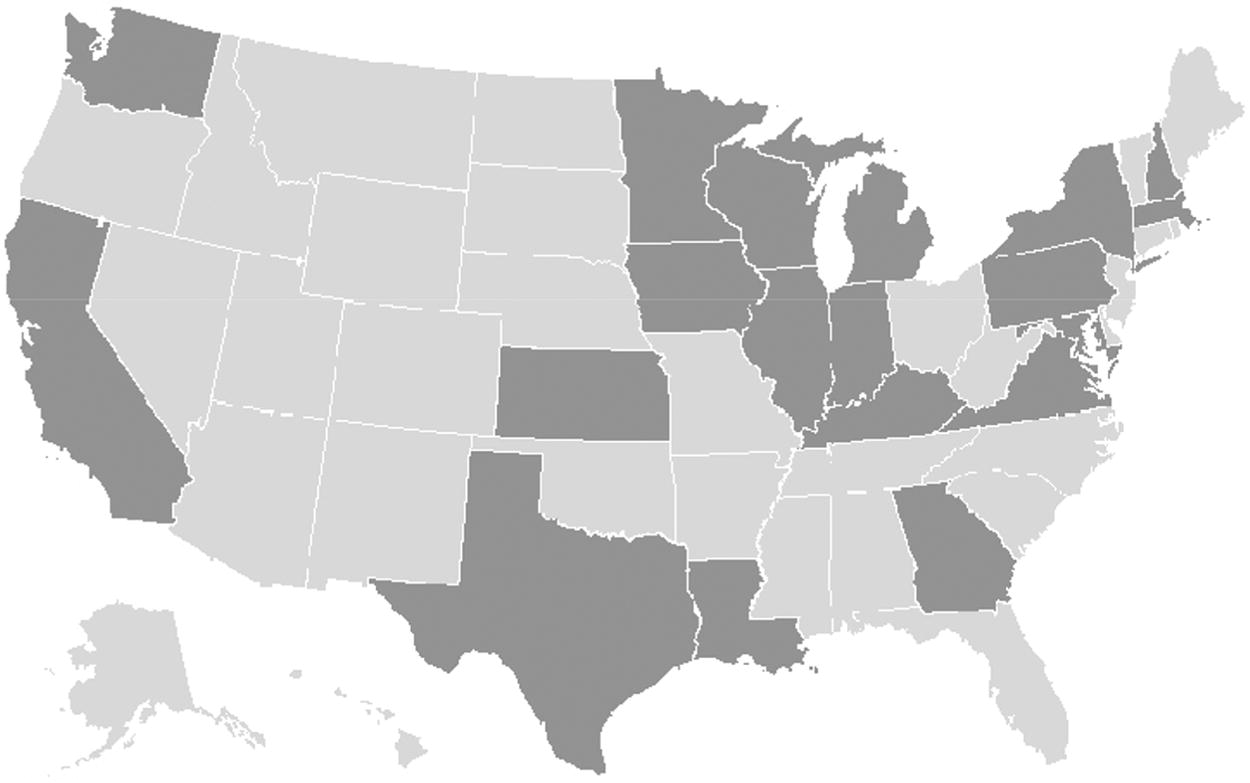
Location of respondents (identified by shaded states)
From these 62, we recruited respondents via email invitations followed by phone calls, yielding a response rate of 68% (n = 42 elite interviews). Our response rate is notably high in comparison to other studies of active policymakers in the United States, in which response rates ranging from 10% to 30% for active policymakers are considered quite reasonable (Browne, 1999; Purtle et al., 2018). Our recruitment did not mention anything about the R1 university or policy engagement; it only mentioned that we wanted to talk about their collaborations. Our respondents included 32 municipal officials and 10 county officials. Among respondents, the average locality population was 202,424 for municipalities and 1.99 million for counties, respectively, indicating a majority suburban and urban sample. 3
Respondents were statistically indistinguishable from nonrespondents in terms of whether they were a county or municipal official, whether the TRUCEN school near them was public or private, and the local percentage who voted for Biden in 2020. There were directional differences in the county-level median income and education, though they pointed in opposite directions. 4
We employed a semi-structured interview protocol (see Appendix A1). First, we asked officials to share up to three of their top climate adaptation or mitigation challenges based on their role as a sustainability professional. Then, for each challenge, we asked a series of stepwise questions, as depicted in Figure 2. We queried whether and how research could be helpful for addressing it and then, if so, whether the locality is currently collaborating with the local TRUCEN university on that challenge and the type of collaboration. In terms of collaboration type, we distinguished between informal collaboration oriented toward knowledge exchange and formal collaboration oriented toward projects with shared ownership, decision-making authority, and accountability, and we asked separately about both. If they said they were not engaged in any collaboration, we queried whether it would be welcome. This last question was our direct measure of unmet desire, and we phrased it in terms of welcoming outreach from a researcher at the local TRUCEN university to explore collaboration opportunities (again distinguishing between informal and/or formal collaboration). After asking all our questions about one challenge, we proceeded to the next challenge with the same set of questions. In sum, for each policymaker we obtained a list of up to three sustainability challenges they are facing, details on whether and how research would be useful for each one, and if they were already collaborating or would like to collaborate with a researcher at the local TRUCEN university on each one.
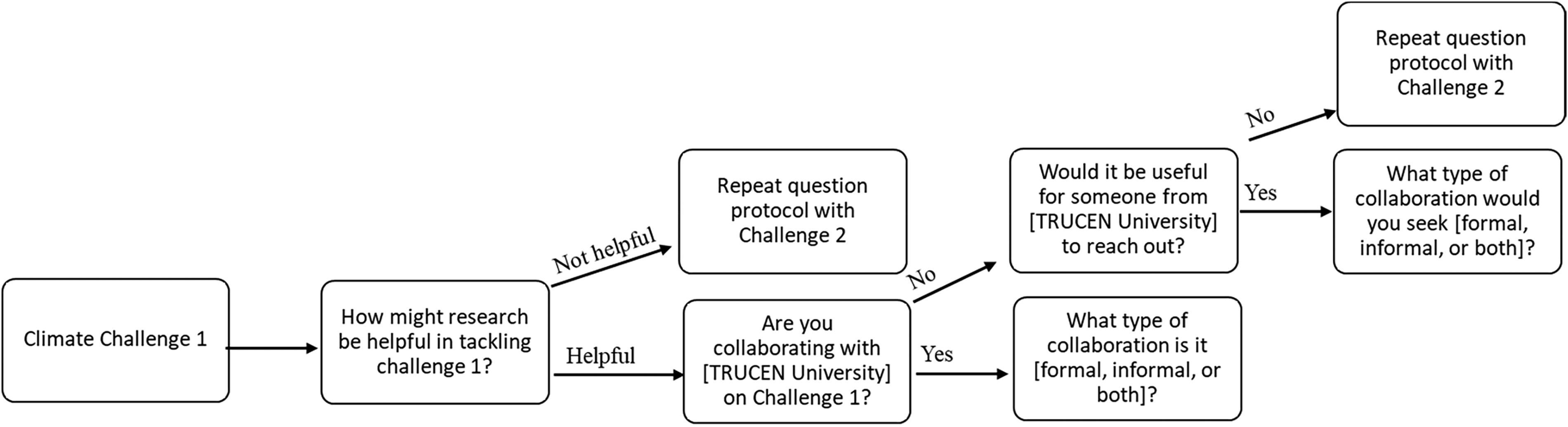
Interview protocol
Interviews lasted approximately 30 minutes each. Afterward, we transcribed each and gave all respondents pseudonyms. The coding team consisted of the first author and a second coder (outside the research team) who was a postdoctoral scholar from our interdisciplinary research institute. Our second coder specialized in inductive qualitative analysis that matched our methodological and paradigmatic approach. We employed in vivo (or inductive) coding that allowed for the voices of our respondents to emerge within themes (Saldaña, 2013). We used the qualitative analysis software Dedoose (SocioCultural Research Consultants, 2021) and Microsoft Excel to identify themes for each challenge and, if applicable, the research needs expressed. Each coder independently analyzed all identified challenges and, if applicable, the research needs to identify themes. As we identified themes, we wrote memos to explain what we were observing. Once we reached the end of the transcripts, we reanalyzed all transcripts according to the themes until no new themes emerged (saturation). We then compared each analysis and identified any discrepancies in the themes we identified. In total, we identified 18 discrepancies. We then discussed each theme, the codes attributed, and reconciled discrepancies as a team. Of note is that at times one coder would attribute more than one theme to a given response, whereas the second coder limited themselves to one theme. For discrepancies resulting from more than one theme, we chose to allow multiple themes attributed to a given response to allow the rich texture of respondents’ answers to emerge rather than diluting them to one thematic code. For this reason, in the findings below, the frequencies of themes will be greater than the number of challenges/research needs.
To ensure rigor, we followed Lincoln & Guba’s (1985) guidelines to establish trustworthy findings in qualitative research. First, our second coder was an independent scholar who could provide an outside analytical perspective that limited bias. Second, we engaged a scholar who is a peer, someone neither higher nor lower in experience. For this reason, both coders were postdoctoral scholars. Third, following each coder’s analysis (along with memos and detailed methodological notes), we debriefed on our findings to discuss emerging themes. Once the coding was complete, the second author conducted a separate audit of the findings to review the data and themes. Fourth, we circulated findings among respondents to “member check” by asking them to provide feedback on the identified themes. Fifth, we followed guidelines for “thick description” by including raw quotations from the data in our findings section. Lastly, to achieve dependability and confirmability, we provide an outline of our methodological steps, including the instrument for replicability purposes.
Findings
In what follows we include several respondent quotations, and for each one we include their census region followed by their population rounded to the nearest thousand. All 42 respondents mentioned either two or three policy challenges they were facing in their work. Thirty-seven respondents mentioned three challenges, and five mentioned two, for a total of 121 challenges mentioned. In addition, 41 respondents (i.e., all but one) saw research as helpful for at least one of their policy challenges, and overall respondents said that research would be helpful for 101 of the challenges they shared. Twenty-three of our respondents (55%) indicated that they were already engaged in a collaborative relationship with someone at the local R1 university on at least one of their top three challenges.
There was also widespread unmet desire; 81% of our respondents (34 policymakers) indicated that they would value a new collaborative relationship with a local researcher on one or more of their challenges. One respondent, Jackson (South 1,150,000), put it well, “This conversation is reminding me … we ought to seek [local university’s] advice, ‘how do we make change in their backyard?’’’ In addition, as noted in Figure 2, when respondents expressed unmet desire on a given challenge, we asked about whether they would like informal collaboration (knowledge exchange) and/or formal collaboration (a project with shared ownership, decision making authority, and accountability). We found that in virtually all cases, respondents were interested in both. While we believe this is an interesting finding in its own right, we also do not believe it warrants further examination in each section below, and thus, we omit its mention.
Sustainability Challenges
Next, we delve more deeply into what respondents said about their sustainability challenges and research needs. To begin, Figure 3 displays the most common challenges respondents identified regardless of whether they were perceived as research relevant, and then Figure 4 displays the most common challenges on which respondents expressed a need for research and unmet desire for new collaboration. Across both figures, the pattern is similar: the most common themes included challenges related to resources, political support and governance, process issues, effective communication, and the need for green infrastructure. We next describe each of these themes in more detail, focusing on examples in which respondents expressed unmet desire.
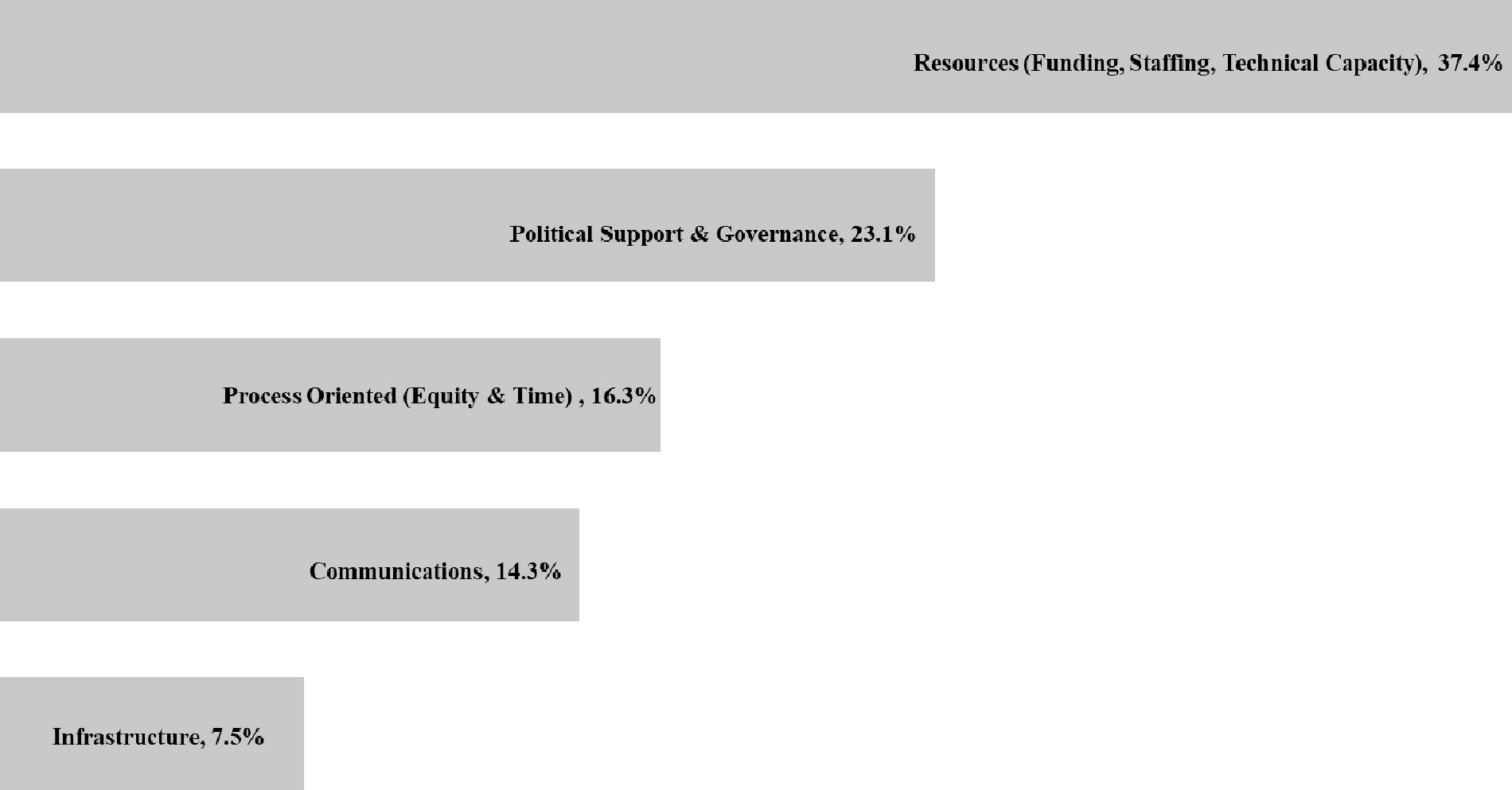
Policymakers' most common sustainability challenges. Respondents expressed 121 challenges they are facing in their work, and from that we identified 147 total themes. The denominator for the percentages is thus 147
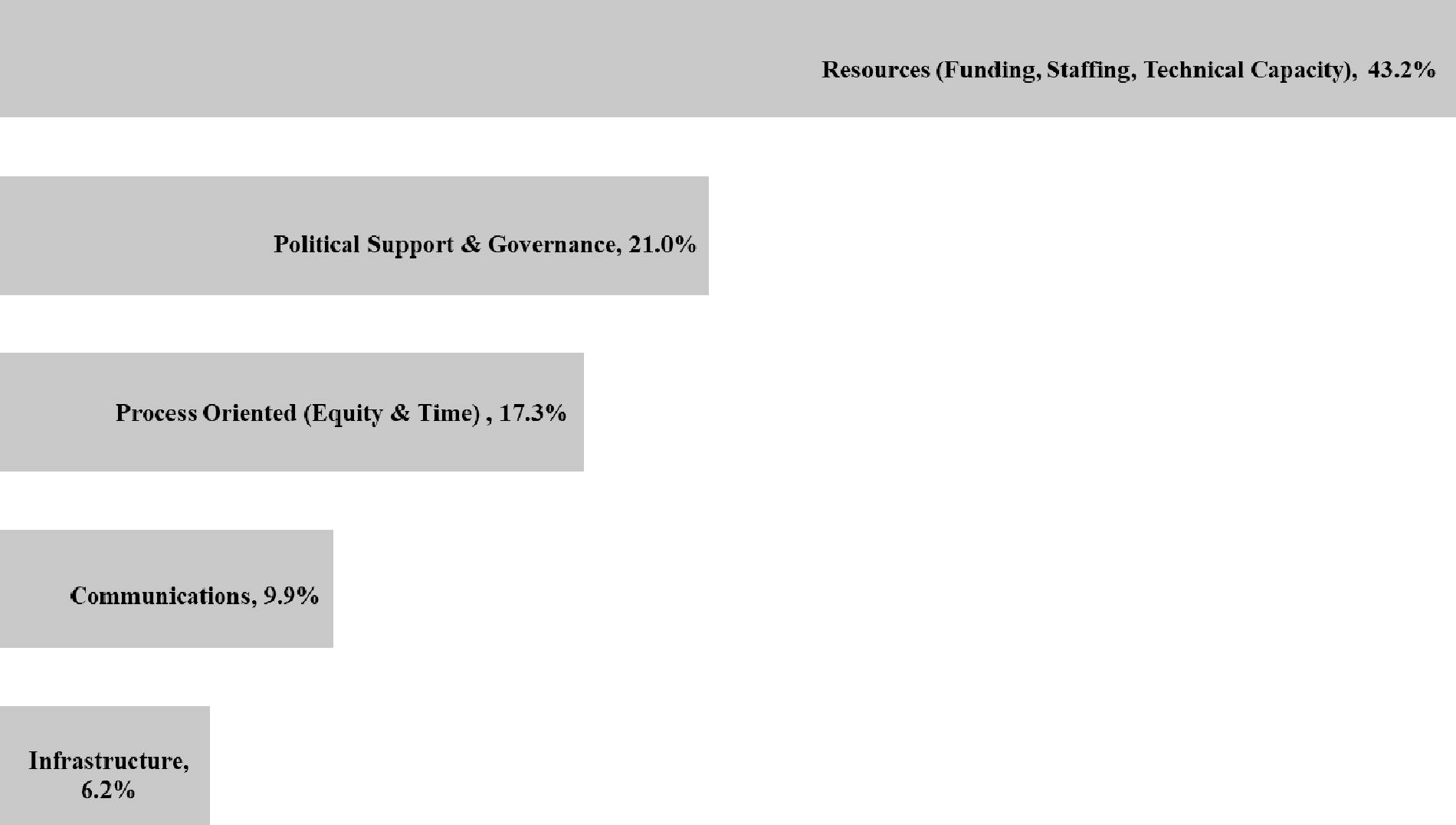
Policymakers’ most common sustainability challenges on which they express unmet desire to collaborate. Respondents expressed unmet desire on 67 challenges they are facing in their work, and from that we identified 81 total themes. The denominator for the percentages is thus 81
Resource-Related Challenges
Resource related challenges largely included funding climate policy action (n = 22), staffing shortages (n = 8), and limitations in staff technical capacities (n = 5). For example, Carys (West, 68,000) noted, “Funding: it is very expensive to address climate change, and since it is such a long scale horizon issue, it is hard to see the immediate benefit of infrastructure investments.” Dillon (West, 92,000) indicated that funding is the final barrier to action: “The will is there, the policy is there, and the players are here. We know what things we need to do, but the funding to accomplish and implement is astronomical.”
Courtney’s response (Midwest, 78,000) highlighted the interaction between funding and staffing capacity:
We have ambitious goals as a part of our climate action resilience plan. And … there wasn’t a considerable increase in staffing or budget as a result of adopting a really ambitious plan. We also declared a climate emergency just last year, [which] didn’t come with any staff or budget changes. So, I would say capacity of both budget and staff is the number one [challenge].
Keeton (West, 10,000,000), who is at the largest locality in the sample, linked funding, staffing, and technical capacity together:
We’re considered a high-capacity entity, we have over 100,000 employees, but we find that we don’t have the staff or expertise to put together high-quality applications for all the federal infrastructure money. We’re turning down opportunities because people are unavailable to write grants.
Political Support and Governance Challenges
Respondents mentioned four types of political support and governance challenges, including local political will (n = 6), state political will (n = 3), the scale of change coupled with internal governance silos (n = 5), and prioritizing action (n = 3).
Regarding local political will, Cindy (South, 108,000) lamented the lack of city council support: “…I thought city council had my back, but in a recent meeting, it’s clear that [they] did not.” Marley, (Midwest, 114,000) echoed this about charging stations:
[The] number one challenge is there is still hesitancy to commit. The last city council meeting I attended is a pretty good example, [they] had a discussion about electric vehicle charging stations, and there were a couple of comments that it’s still too soon for this type of investment or infrastructure.
Challenges reflecting state-level political will took several forms, such as the political limitations placed on localities. Tanner (Northeast, 105,000) identified “structural barriers … as a county, we have limited authority on what we can do in [our] state. We are a home rule state, and so much of the power to do meaningful change is devolved to local municipalities.” Zander (South, 1,000,000) offered: “We’re at the whim of state politics, federal politics, and a much larger ecosystem of things happening around us.”
Multiple respondents also spoke of the challenges associated with being a blue locality in a red state, reflecting not only political will but also partisanship. Kim (Midwest, 561,000) offered:
Our top challenge is that we are a blue [locality] interested in climate action in a state where the legislature is very red and has a history of preemption, particularly when they see something happening in [our locality]. Compared to local governments, in a lot of the U.S., we have relatively few, [if] no policy tools to make. We can’t set our own building codes, we can’t do a regional transit authority, and we can’t ban plastic bags.
Gary (South, 383,000) echoed Kim: “We are a blue [locality] in a red state. The state likes to pre-emptively pass laws to stop us from doing climate initiatives … they passed a law stating that we could not ban the use of natural gas.”
The third challenge that respondents mentioned related to political will reflected internal governance issues and, in particular, the fact that sustainability efforts are siloed but the scale of climate change is not. For example, Adrienne (Northeast, 1,600,000) put it as “a governance issue, working across silos. Adaptation has to happen holistically. It has to happen at a city level, and it’s hard enough to work within one department across silos and work plans.”
Others discussed the scale of changes needed to achieve climate impacts even when political will exists. Jordan, (South, 690,000) named “the scope and the scale of the challenge ahead.” Carter (West, 59,000) reflected:
Changing the status quo … to hit these targets would require some transformative [changes]. You’re fighting entrenched … infrastructure or ways of thinking. Even in a city where we have lots of commitment, energy, and political will.
The fourth political will-related challenge was about prioritizing climate work among other government priorities and in terms of planning. Keeton (West, 10,000,000) noted, “I can’t say there’s a lack of political will. It’s just there are so many other competing political interests … that are more pressing.” Touching on the planning and prioritization intersection, Jillian (Midwest, 270,000) indicated: “Prioritization … understanding what it is that we need to do and staging our work in the most strategic or effective way. We’re always looking for tools to help us prioritize.”
Process-Oriented Challenges
Process-oriented challenges include two subthemes: equity and inclusive engagement (n = 3) and slow bureaucracy (n = 5). Equity and inclusive engagement focused on ensuring those who are most affected by climate change receive the support needed and a related theme of attending to larger issues such as housing affordability that are compounded by the climate crisis. Illustrating this, Katie (Northeast, 81,000) described the challenge of “electrification … in a way that allows everyone to benefit from it and mitigates, and at the very least minimizes, the impacts to the affordable housing crisis we are currently experiencing.” Diane (Midwest, 5,275,000) said, “Equity and environmental justice … the folks who are most impacted, who really need it, are going to be hurt the most by the changes we’re seeing and are already facing generations of issues in our area.”
The second process-oriented challenge reflected the tension between a sense of urgency to attend to climate change and the slow pace of bureaucracy. Zander (South, 1,000,000) articulated: “Time and urgency are of the essence. … I don’t think we’re acting at the right speed to match the urgency.” Similarly, Simon (Northeast, 118,000) mentioned: “The timescale of climate change and the fact that impacts occur gradually over time. [It is] tricky to plan for long term impacts with actions we’re trying to do today.” Finally, Tanner (Northeast, 105,000) spoke specifically of the challenge of bureaucracy that slows progress:
The pace of how things go. Our green facilities project, we started planning for it two years ago, [and we are] just embarking on phase one this week. There’s a lot of planning [and] oversight, a lot of these things are in place for a reason, we don’t begrudge them, but it does mean that any action we want to take is going to be protracted, we don’t move quickly.
Public Communication and Behavioral Change
Communicating to the public and encouraging behavioral change (n = 14) was another type of challenge that respondents shared. Erin (Midwest, 90,000) offered that “behavior change is really hard. You’re asking people to adopt new behaviors or do something where it’s hard to see the cause and effect.” Jackson (South, 1,150,000) similarly reflected on the challenge of provoking action without government incentives, “getting people, including businesses, because people run businesses, [to make] change happen without waiving tons of money.” Finally, Elizabeth (Midwest, 933,000) offered: “We need everybody’s buy in not just spot buy in. I think we need a mind shift in general on the entire population.”
Green Infrastructure
Several respondents also shared challenges relating to making the shift to, and investment in, green infrastructure (n = 11). In some ways, this theme overlaps with the resources one mentioned earlier, yet we separate it out because in these cases respondents specifically named green infrastructure. For instance, this might include the infrastructure needed for electric vehicles, retrofitting buildings, and energy transitions. Jillian (Midwest, 270,000) summarizes how expensive infrastructure work is:
It is the job of the city to maintain a lot of infrastructure, and infrastructure only gets more expensive as time goes on. We know that adaptation is a good investment today, and it saves money down the road. Funding those updates today can be challenging, especially in places where I think cities feel the pressure of declining tax revenue and expanding need.
Mindy’s (Midwest, 79,000) commentary focused on vehicle fleet: “Our biggest challenge is getting the fleet transition plan in place … and how to budget for those.”
Shelby (West Coat, 93,000) noted that their building codes have made an impact among newer builds, but older infrastructure remains an issue. Her commentary contrasts with those whose state preempted barring natural gas:
We have an electric preferred reach code and an all-electric code requirement. Newer buildings are saving money, improving air quality, and addressing the challenges with burning methane for heating and electricity. But our existing building stock is old and hard to get at.
In sum, when prompted to share up to three top challenges they are facing in their work, sustainability officers shared an agenda that largely reflected not having enough resources, lacking political will, process-oriented challenges, communications challenges, and concerns specifically around green infrastructure. The top agenda items were the same when we focused on all challenges mentioned as well as when we only focused on those in which they expressed unmet desire to collaborate with their local TRUCEN university.
Research Needs to Tackle Challenges
Next, we examine what kind of research policymakers viewed as helpful for addressing their top policy challenges. Overall, policymakers stated that research would be helpful for 101 of the 121 total challenges that they shared. The four most common ways policymakers found research to be helpful for their policy challenges are displayed in Figure 5. Among those 101 challenges with research needs, policymakers also expressed unmet desire on 67 of them (an average of 1.6 challenges with unmet research needs per policymaker). We display the four most common ways that policymakers found research to be helpful for tackling this subset in Figure 6.
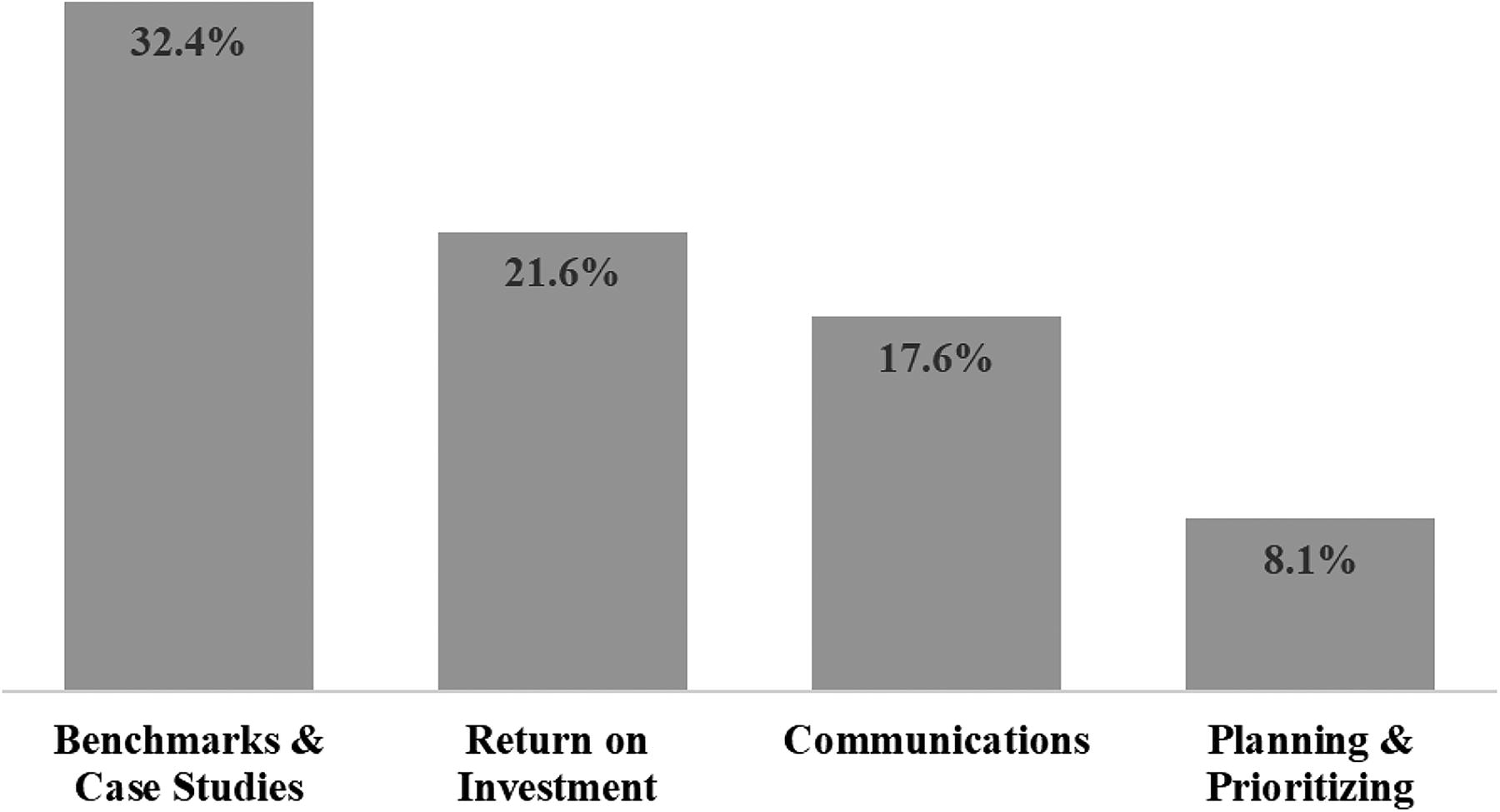
Policymakers’ most common research needs for addressing sustainability challenges. Respondents expressed research needs for 101 of the challenges they mentioned, and from that we identified 108 total themes. The denominator for the percentages is thus 108
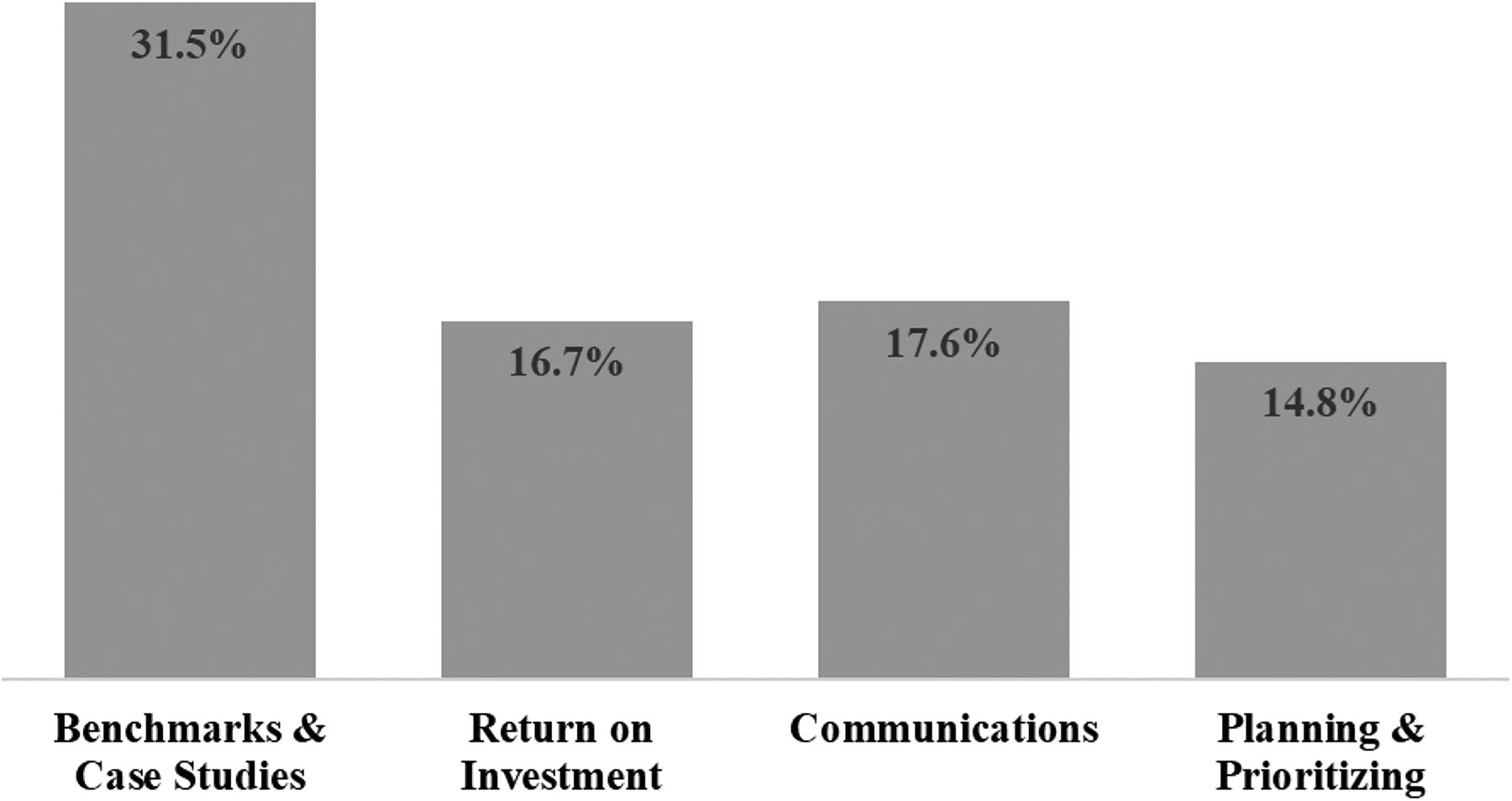
Policymakers’ most common research needs for addressing sustainability challenges on which they expressed unmet desire to collaborate. Respondents expressed research needs and unmet desire to collaborate on 67 challenges they are facing in their work, and from that we identified 74 total themes. The denominator for the percentages is thus 74
In both cases we find that the most common research needs are development of local case studies and benchmarking of other localities to inform their own practice, research to identify return on investment for climate actions, research on effective communication that would encourage climate action, and assistance with planning and prioritizing. In what follows, we present examples of the research needs in which policymakers also expressed an unmet desire to collaborate with researchers from their local R1 university.
Benchmarks and Local Case Studies
Overarchingly, the need to know what others are doing and how to implement it in their localities guided this theme. Jama (West, 152,000) sought information on:
What other cities spend on climate and sustainability work in terms of staffing and budgets … I think the bigger question is: the cities that are on a good trajectory to reduce their greenhouse gas emissions, how are they doing that? What are they spending? What are the big things they’ve done?
Juliet (South, 1,050,000) also offered the need for benchmarking to address funding challenges: “Information on the amount of money that local governments invested and how they met their goals.”
Others like Ginger (West, 73,000) expressed a need for “location specific case studies.” Cindy (South, 108,000) noted: “Our council really likes to know what others are doing.” Reflecting locally specific needs related to financing green infrastructure, Rachel and Charlotte (Northeast, 54,000) articulated the need for a case study on how to establish and fund a green bank:
A green bank is something that we really need, but how to set that up is a challenge. There are a lot of hyper-specific research projects that I think would be helpful: identifying how to build a green bank building and where that money would come from to help support low-income individuals or renters around electrification.
Benjamin (Northeast, 89,000) also spoke of a locally specific need on passing an ordinance:
We’re trying to implement Building Emissions Reduction and Disclosure Ordinances (BERDO) [to] require all buildings over 20,000 square feet … to reach zero by 2050 … we’ve been holding discussion sessions with building owners about what the ordinance would look like. The thing that keeps coming up is we really need some case studies. How to implement a BERDO reduction plan? … How do you develop the plan? What does the plan look like? What is it going to cost? What measures do you implement over the next 30 years? And how do you pay for it?
Gary (South, 384,000) described his struggle with passing climate ordinances and the need “to understand how other [localities] have done that in a similar political environment.”
Return on Investment
This theme captured sentiments addressing the best course of action with the highest impact. For example, Finn (Midwest, 153,000) noted: “Any numbers over the long term, not just something over a two-year period; how does [climate] investment matter?” Diane (Midwest, 5,275,000) sought comprehensive impact evaluation:
Showing the benefits that a complete transformation for a community can have on residents and the economy versus piecemeal projects is really helpful. Long term research would be beneficial, like air quality, overall health … people are really receptive to the health indicators right now.
Carter (West, 59,000) spoke of the need to “[make] the case for climate actions. You know, [quantify] resilience as economic. [Compare] prevention versus dealing with disaster related or health related [and] societal impacts. Speak the same language that people are speaking, put it in dollars and cents.”
Dillon (West, 92,000) addressed business directly, “research showing climate action is not going to kill business.” Lastly, Amelia (Northeast, 9,000) spoke of the need to quantify vagaries in political support:
Using research to attribute the economic impact around the lack of consistency [in climate policy] is really important … quantify the impact of not adopting the most recent delivery energy code. We’re really struggling to articulate that data to action linkage so that it can inform policy.
Communicating for Climate Action and Behavioral Change
The need for research on effective communication related to how to motivate people to engage in sustainable, climate friendly actions. Cindy (South, 108,000) spoke of how to convey the importance of action without sounding hyperbolic, “how to convey that critical action is needed, and it’s just not because we’re being overly dramatic.” Simon (Northeast, 118,000) also commented on the need for research to attend to urgency and short-term planning: “Research can help people address temporal challenges, the psychology of planning ahead, and how that informs short term decisions. Providing recommendations around communicating strategies and other engagement.”
Others spoke more specifically to behavioral change research such as Marley (Midwest, 114,000): “[We need to understand] how people work, I just attended a conference called behavior, energy, and climate change. I wanted to attend that because it had behavior change called out.” Jama (West, 152,000) queried how we might entice behavioral change that lasts:
How do you really make [climate action] happen? … [I]t’s not all about the projects, the widgets, and how much energy we saved. It’s also how do you create that culture to make sure everyone has a shared vision, and they stick with that?
Planning and Prioritizing
This theme speaks to how much action is needed. Selena (Northeast, 39,000) indicated prioritization as a vital research question: “Prioritization … that really is the crux of ‘why are we doing this? How are we going to get there?' Always going back to ‘what do we need to prioritize’?” Ginger (West, 73,000) illustrated the need for research to clearly indicate that “we know for a fact if we’re going to meet our goals, this is exactly where we need to focus.”
Jordan (South, 690,000) requested a need for assistance updating their climate plan:
Our last climate adaptation strategy was developed in 2016, and the climate projections are from 2013. So, we’ve been noting that it’s time to take a look at those again and see what’s still valid and where do we need to update? … Making sure we have a really strong grounding in the science behind what we’re asking people to do.
To sum up, respondents expressed several different types of research needs that captured benchmarking/case studies, return on investment, communication, and how to prioritize.
Discussion
Our descriptive study reveals new data and possibilities for university-based policy engagement related to sustainability at the local level in the United States, particularly among a set of universities for whom sustainability policy engagement was identified as important. We mentioned earlier that our aim with collecting data on research needs and the possibility of unmet desire was to yield information that would be actionable. As one example of this point, following the close of our data collection in 2023, we presented the findings to university researchers and engagement specialists at TRUCEN universities and facilitated dialogue on how these results, and our needs assessment approach, could be useful to their universities.
Notably, some of our findings reinforce challenges and research identified in the literature. For example, Amsler & Vieilledent’s (2021) work investigated state preemption of municipal climate actions. They uncovered many instances of preemption and how municipalities require additional support to navigate legal boundaries. In their examination of North Carolina local government climate communications, Reid & colleagues (2023) argue for additional research, beyond their case study, to investigate how climate communication strategies might mobilize climate action among residents. The repeated research needs for local case studies, prioritization, and studies showing return on investment underscore recommendations elsewhere that universities can best support municipal climate action by addressing solution-oriented research questions (Keeler et al., 2019).
Beyond this, our results point to several other interesting implications. First, while sustainability policymakers may often struggle to translate their challenges into research (Pauer et al., 2020), it is noteworthy that our sample was often able to clearly identify how research could be helpful to them. Moreover, they defined research needs through the lens of local challenges. Some of their needs likely match the peer-reviewed journal articles that researchers would typically think of (e.g., studies on effective communication), whereas their desire for benchmarking studies and policy analysis on cost–benefit and return on investment would likely fall outside that scope (Day & Bogenschneider, 2023; Ouimet et al., 2024). In short, our findings underscore how policymakers’ definition of research may vary and fall outside what university-based researchers may typically think of as research.
Second, it is noteworthy that many of the policy challenges that our respondents expressed would benefit from transdisciplinary research projects, especially at the interface of sustainability policy and several social sciences such as economics, political science, communication, and others. This suggests, as Watts (2017) advises, that universities may wish to consider building more well-coordinated multidisciplinary teams to tackle relevant issues and incentivizing researchers to join them. Since some of these research needs may not ultimately be appropriate for traditional disciplinary peer-reviewed journals, it becomes imperative that university resources be made available to support transdisciplinary initiatives and that incentive structures value such engagements (Trencher et al., 2014). For instance, in setting up these efforts, it is helpful to create a dedicated unit to managing university–locality collaborations, being explicit with expectations, leveraging existing data, and ensuring dialogue is ongoing (Allen et al., 2017).
Third, it is also noteworthy that many of the research needs would likely be satisfied strictly through informal collaboration (i.e., knowledge exchange). That is to say, many localities sought resources, guidance, or information based on the existing state of research rather than more resource-intensive formal collaboration (i.e., new projects). They also sought locality-specific case studies, with the caveat that it is important to consider how much well-documented experiences from elsewhere could generalize to new places (Mullin, 2021). The upshot is that our findings reinforce the importance of distinguishing between informal and formal collaboration as distinct goals and ensuring that collaborative relationships can be oriented toward both goals (Levine, 2024; Cairney & Oliver, 2020; Haynes et al., 2011).
Conclusion
Having surfaced unmet collaborative desire, questions immediately arise about whether and how sustainability researchers (and policymakers) should meet it. Several considerations are relevant. First, it is important to acknowledge that within both local government as well as universities, rigid institutional structures do not always incentivize these collaborative relationships and actors may have both limited capacity and uncertainty about how to relate to each other (which itself may reflect a wide variety of factors such as poor prior experiences, stereotypes, limited authority, etc.; Keeler et al., 2023; Trencher et al., 2014; Weakley & Waite, 2022). Among those who are interested in new collaborative relationships, they may also be uncertain how to proceed. To address this uncertainty, one place to start is to examine case studies of collaborative relationships between local researchers and local sustainability officers that describe in detail how and why they began, what goals they pursued (and how that changed over time), who was involved (including as boundary spanners and as participants), and what outcomes arose (e.g., Keeler et al., 2019, 2023). Another source of guidance is research on the science of collaboration in civic life, which focuses on how to form new collaborative relationships between people with diverse forms of expertise, and tests practical strategies for doing so (Levine, 2024). Throughout, it is important to acknowledge that research findings (which themselves may be contested and open to multiple interpretations and frames) are only one factor among many that influence policymakers’ decisions (Cairney & Oliver, 2020; Oliver et al., 2022).
Lastly, we acknowledge limitations to our research design, with a call for further data collection along the lines we report here. While our response rate was quite high, our findings do not allow us to generalize to all R1 universities or all localities across the United States. Our sample was skewed toward higher-population urban and suburban communities as well as localities representing Democratic-leaning populations. Climate change affects all communities regardless of size, and climate impacts occur along inequitable lines. For example, there is insufficient capacity among rural localities to respond to climate change (Headwaters Economics, 2024). Recognizing this inequality of capacity, we suggest further research investigate rural and Republican-leaning communities to understand how, if at all, challenges and research needs vary according to geography and capacity. University extension offices, given their extensive expertise in meeting local needs, especially in rural agricultural communities, are particularly helpful here. We also acknowledge that community engagement, research output, and associated resources are not limited to R1 universities. To attend to this, we encourage the expansion of this research to include other institutions such as teaching-intensive, liberal arts, non-R1 land grants, community colleges, and other institutions with or without R1 status as they may play a significant role within their communities’ sustainability endeavors.
Footnotes
Acknowledgment
The authors wish to acknowledge Emily B. Campbell for her assistance as a second coder for the qualitative analysis.
Authors’ Contributions
L.R.K.-J.: Conceptualization (equal), investigation (lead), formal analysis (lead), writing original draft (lead), and writing—review and editing (equal). A.S.L.: Conceptualization (equal), formal analysis (supporting), and writing—review and editing (equal).
Author Disclosure Statement
No competing financial interests exist.
Institutional Review Board Approval Statement
This study was reviewed by the Institutional Review Board of Johns Hopkins University (20214) and found to not qualify as human subjects research as defined by Department of Health and Human Services’ regulations 45 CFR 46.102.
Funding Information
This work was supported by the Rita Alen Foundation under the Civic Science Fellows Program.
Appendix A1: Semi-Structured Unmet Desire Interview Protocol
[Repeated for all challenges mentioned in response to the first question.]
1
Note that throughout the article, we use the term “sustainability challenge” as shorthand for “climate adaptation or mitigation challenge.” In our interviews our respondents frequently used such terms interchangeably, and thus, we decided it is appropriate for this article both substantively and for readability.
2
In advance we recognized that many localities are too small to support a full-time sustainability position, yet it was unclear ex ante how to define “too small.” We proceeded by conducting a small pilot study in which we gathered information on all nearby localities for three randomly chosen TRUCEN schools and found that 58,780 was the median population of the ones that had sustainability officers. We then used that as our cutoff for the full study, which means that our study is largely focused on policymakers in nearby counties and relatively large, nearby municipalities.
3
Our sample reflected higher population centers in part because the 2021 TRUCEN population, on which our study population was built, was majority urban or suburban. Only one of 34 universities was classified as rural, whereas the rest were classified as suburban or urban.
4
Among respondents, 23.8% were county officials, as compared with 20.0% among nonrespondents (p = .74; all reported p-values are two-tailed). In addition, among respondents 47.6% were near a TRUCEN school that was public, whereas 60.0% were near a TRUCEN school that was private (p = .36). In terms of distance from the TRUCEN school, respondents were on average 7.07 miles away, whereas nonrespondents were 12.4 miles (p = .05). Average Biden vote was 71.2% in respondents’ counties, as compared with 70.2% in nonrespondents' counties (p = .64). Median county-level income was $80,316.67 for respondents, as compared with $92,578.75 for nonrespondents (p = .12). Percentage of individuals with a college degree in the county was 56.4 for respondents, as compared with 49.7% for nonrespondents (p = .07).