






Abstract
The effects of anthropogenic climate change have become increasingly prevalent. There is thus a need both to prevent climate change or soften its effects (mitigation) and to address and deal with effects that are already occurring (adaptation). To facilitate climate action in a creative way, new forms of collaboration are needed, which will lead to increased transformative potential for individuals, for the economy, and for society as a whole. Against this background, community-academic partnerships can serve as an innovative format for collaboration. However, to ensure that these partnerships develop to their full potential, they must be designed in such a way that all involved can participate effectively. Consequently, the question arises of what the success factors and conditions for effective practices are for community-academic partnerships focusing on climate change adaptation and/or mitigation. To answer this question, a Delphi study was conducted with a panel of experts on cocreation processes and climate change adaptation and/or mitigation under the auspices of the European project TeRRIFICA. The results of the study show how community-academic partnerships should be structured and designed to ensure that all stakeholders are involved in the entire process and that positive contributions to climate change adaptation and mitigation can be made. Overall, the results confirm existing findings on success factors for community-academic partnerships, but the relevance of hands-on activities and supportive tools is emphasized much more clearly than in the existing literature.
Introduction
A global increase in anthropogenic greenhouse gas emissions and climate impacts has occurred despite the introduction of measures to mitigate climate change in many parts of the world. The effects of anthropogenic climate change are increasingly visible (International Panel on Climate Change, 2019; UN Environment Programme, 2019). There is thus a need both to prevent climate change or soften the effects of climate change (mitigation) and to address and deal with the effects of climate change that are already occurring (adaptation) (UN Environment Programme, 2019).
Adaptation means anticipating the adverse effects of climate change and taking appropriate action to prevent or minimize the damage it can cause, or taking advantage of opportunities that may arise. Examples of adaptation measures include: more efficient use of scarce water resources; consideration of fresh air corridors in urban planning to improve air quality in cities; and setting aside land corridors to help species migrate. The ability to cope and adapt differs across populations, economic sectors, and regions.
Mitigation refers to a wide variety of efforts to reduce or even prevent greenhouse gas emissions. These efforts range from changing consumer behavior to boosting the efficiency of outdated equipment to the use of green technologies and renewable energies. This means that mitigation often involves fundamental changes in the way individuals and societies as a whole produce and use energy. Taken together, adaptation and mitigation can be considered complementary strategies constituting a response to climate change and its effects (Laukkonen et al., 2019).
Top-down as well as bottom-up strategies have the capacity and the opportunity to contribute to climate action in many different ways. A great deal of scientific information is available concerning climate change and its effects, including theoretical models of how the impact will shape our future (Intergovernmental Panel on Climate Change, 2019; UN Environment Programme, 2019). The issue of climate change has meanwhile also reached the general public, and many possible actions have been developed at all levels from the individual to the political.
Nevertheless, there remain a variety of obstacles to putting actions into practice. On the one hand, most citizens do not actively engage with climate action until they are personally affected by climate change. On the other hand, the challenges arising from climate change demand far-reaching revision of the modus operandi of research and innovation (Von Schomberg, 2013). Responsible Research and Innovation (RRI), a concept used by the EU to describe scientific research and technological development processes that take into account (potential) impacts on the environment and society, is needed to enable universities and other research institutions to support climate change adaptation, and mitigation.
In order to develop creative approaches to preventing the effects of climate change, new forms of collaboration are needed to increase the transformative potential of individuals, the economy, and society as a whole. Here, community-academic partnerships—understood as collaboration between community stakeholders and researchers (Drahota et al., 2016)—are seen as a potentially innovative format (Hall et al., 2015; Pettibone et al., 2018; Scholz, 2020). However, if they are to develop to their full potential, they must be designed in such a way that all those involved can participate effectively.
Different approaches to partnerships between academia and the community include: Participatory Action Research, Indigenous/Local Knowledge, Transdisciplinarity, and Citizen Science (Knapp et al., 2019). Comparing the different approaches, Knapp et al. (2019) highlight that one key element is the origin of the prior knowledge/practice approach in question. Given the traditional bias toward the academic side of the partnership, thorough planning and reflection is needed on how to guarantee an “unbalanced problem ownership” (Lang et al., 2012). These considerations are part of the first phase (collaboratively framing the problem and building a collaborative research team) of the ideal-typical conceptual model of a transdisciplinary research process introduced by Lang et al. (2012). The second phase is the actual coproduction of knowledge, followed by the integration phase in which the knowledge generated is transferred back into societal and scientific practice (Lang et al., 2012).
There is still an ongoing debate on how exactly to define the success and effectiveness of community-academic partnerships (Luthe, 2017). Using the conceptual framework of Lang et al. (2012), Luthe (2017) evaluated the success of five transdisciplinary research cases, identified criteria for defining success, and derived design principles complementing the existing framework. Furthermore, indicators of success within partner and partnership characteristics, processes, resources, capacity, partnership outcomes, and relations between partners have been identified through literature reviews (Brush et al., 2020; Drahota et al., 2016).
These findings can support community-academic partnerships in measuring their performance and reflecting on possible or essential adjustments in order to improve the effectiveness of the partnership or the action in question. Analyses from the health sector and from climate change-related fields indicate that key elements to be considered are a focus on the local context, capacity building by all partners, careful treatment of the knowledge of all partners, and a trustful and respectful partnership structure (Loo, 2014; Stewart et al., 2013; Wiseman & Williamson, 2010).
In the research on community-academic partnerships, however, there remain few findings on whether the success criteria can also be applied to climate change-related community-academic partnerships or whether special issues need to be taken into account. Against that backdrop, this article addresses the following research question: What are the success factors and conditions for effective practices in community-academic partnerships focusing on climate change adaptation and/or mitigation? A Delphi study was conducted in the context of the European Territorial Responsible Research and Innovation Fostering Innovative Climate Action (TeRRIFICA) project to provide an answer to this question. The following sections describe the methodology, research process, and main results of the Delphi study, and highlight key learning points, limitations, and remaining questions.
Materials and Methods
The general idea of the TeRRIFICA project derives from the theme of Supporting the Development of Territorial Responsible Research and Innovation within the Science with and for Society (SwafS) work program in the EU's Horizon 2020 call. The TeRRIFICA partner organizations themselves represent a transdisciplinary community since the consortium includes universities and civil society organizations from six European countries (Belarus, France, Germany, Poland, Serbia, and Spain).
TeRRIFICA seeks out best practices, identifies approaches for adapting to the effects of climate change, and develops solutions to withstand it—in a cocreation process involving civil society, science, local administrations, and policy makers. Accordingly, its goals are to develop action plans for six pilot regions in the aforementioned countries on the implementation of climate change adaptation and mitigation measures with the involvement of diverse stakeholders. Additional objectives are to transfer the measures to other regions and to broaden experience with a range of collaboration formats that seek to awaken interest in climate change adaptation and mitigation within different target groups. TeRRIFICA works to create regional networks in order to establish new forms of citizen engagement focused on mitigating or adapting to climate change.
In the first ten months of the TeRRIFICA project, the partner organizations undertook desk research and interviewed stakeholders in the six pilot regions in order to collect data. Additionally, a content analysis was conducted of 17 case studies relating to ongoing current cocreation projects or actions selected by the partner organizations (TeRRIFICA, n.d.). This analysis identified some initial effective practices in community-academic partnerships and worthwhile cocreation processes. The principles of cocreation and the success factors from the case studies were also discussed in two international online conferences.
A Delphi study is a group facilitation technique designed to transform individual opinion into group consensus (Hasson, 2000; Hsu & Sandford, 2007; Scheibe et al., 2011). To validate this first phase of the TeRRIFICA project, a Delphi study was run with the aim of identifying relevant practices in community-academic partnerships on climate change adaptation and mitigation. This Delphi study focused on collaborative work on definitions and the assessment of pre-formulated statements on various cocreative climate actions. It was also open to participants to elaborate their views through open-ended questions that allowed for a broader perspective on community-academic partnerships.
The statements for the first round of the Delphi study were developed on the basis of the findings of the aforementioned existing work in the TeRRIFICA project. Draft statements were phrased and underwent several revision loops within the project consortium to optimize clarity and ensure general understanding. The first round of the questionnaire provided broad categories. It was reasoned that responses to partially-open questions and text fields could then be used to generate further statements that subsequently could be tested for consensus in the second round of the Delphi study. The SoSci Survey web application was used to set up the questionnaires and distribute them to the experts. The functionality of the first questionnaire was pilot tested by the project consortium.
To form the sample for the Delphi study, all members of the project consortium were asked to name experts on cocreation and/or climate change adaptation and/or mitigation they knew from their respective countries, and also to ask these experts to name additional experts. This kind of snowball sampling is very typical of Delphi studies (Häder, 2000). On the basis of the suggestions, 52 experts were invited to participate in the Delphi study. The selection of the experts was grounded in the assessment and experience of all project partners and the aim was to include international experts from all areas of the quadruple helix.
In the first round of the Delphi study in December 2019, the participation rate among the experts was 27 percent (n=14), dropping to 13 percent (n = 7) in the second round, held in February 2020. Experts' professional roles first round and second round, respectively, were: Science & Education (n=6; n=4), Business (n = 2; n=0), Civil Society Organization (n=3; n = 1), Policy Maker (n=2; n=1), and other (n=1; n=1). Climate protection experience varied from one to 10 years (n=10; n=3) over 11 to 25 years (n=3; n=3) to more than 25 years (n=1; n=1), while the experience with cocreation ranged from one to 10 years (n=10; n=6) to 11 to 20 years (n=3; n=1), with one person with no experience of cocreation participating in the first round. All experts had experience in at least cocreation or climate change adaptation/mitigation. The experts came from Belarus (n=4; n=1), France (n=1; n=1), Germany (n=0; n=1), Ireland (n=1; n=0), Poland (n=4; n=2), Serbia (n=1; n=1), and Spain (n=2; n=0).
Since the Delphi study was conducted anonymously, it was not known which experts from the sample had participated in the first round. Therefore, all 52 experts were invited again for the second round. Thus it was also possible for experts to participate in the second round who had not taken part in the first round. However, the data suggest that this applied to only a small number of respondents.
The data generated were extracted from the SoSci Survey web application for descriptive analysis (including standard deviation, average, modal value, median, and variance) to identify whether or not consensus had been reached for each statement. Responses to the open questions and from the open text fields were subjected to thematic qualitative content analysis, a systematic, rule-governed process built around analytical categories that are used to compress and summarize data (Kuckartz, 2014). After the second Delphi round, 70 percent group consensus was reached. Given that a certain stability in the responses had already been achieved, an additional, third Delphi round was not conducted (Häder, 2002; Linstone, 1978; Vorgrimler & Wübben, 2003).
Results and Discussion
As a final step in the knowledge-base phase of the TeRRIFICA project, the Delphi study and its comprehensive expert feedback allowed for a more profound assessment of relevant definitions and practices for community-academic climate action partnerships.
Participants in the first Delphi round were initially asked to indicate their agreement to definitions of success, effectiveness, and institutionalization of cocreative climate action. The research team provided the definitions shown in Figure 1, based on previous findings from the TeRRIFICA project.
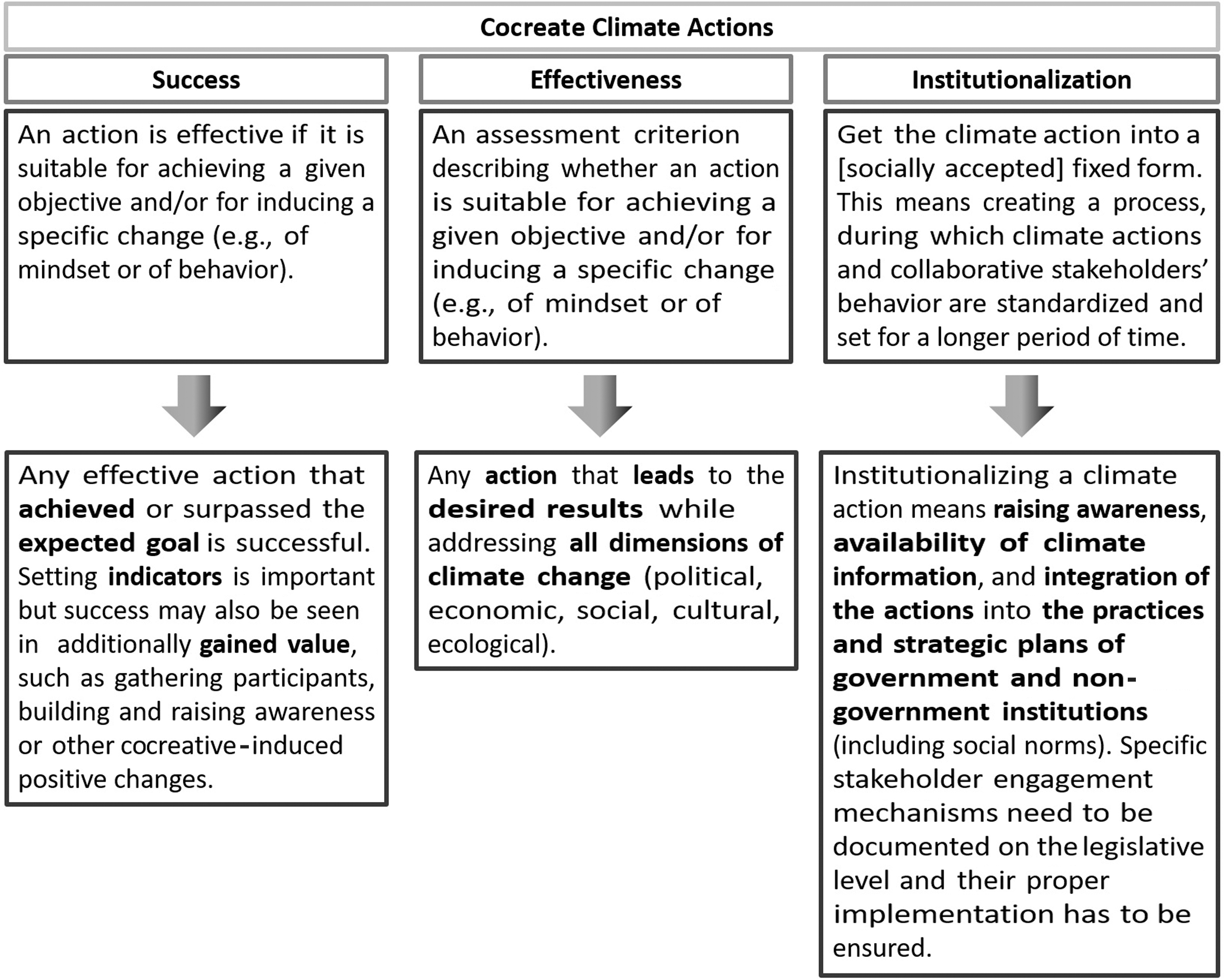
Proposed definitions for three main aspects regarding cocreative climate actions and their reformulations including the remarks of the Delphi study panelists
The question about whether these proposed definition of success conformed with participants' personal views and experience led to a variety of responses. Three participants agreed without commenting on the definition, while one respondent disagreed and two others did not provide an answer on this item. Two experts stated that identifying issues in a cocreative process should already be seen as a form of success and two other individuals indicated that targeted changes or objectives do not have to be set before the start of the action. This already shows the importance of ensuring a cocreative process is in place from the very beginning. In addition, two participants agreed that setting criteria was a challenge and another emphasized the importance of maintaining stakeholder motivation during this early stage of negotiation.
Participants also commented on how the definition of effectiveness (see Figure 1) conformed with their personal views and/or experiences. Again, two participants did not answer at all. The level of agreement was slightly higher compared to the definition of success, with seven experts making no further remarks on the proposed definition. Four participants stated that there was an additional need for actions to be efficient and for stakeholder participation to be ensured. The complexity of finding and assessing criteria in this context was emphasized in the following statement, which was added as a comment to the definition of effectiveness:
The main challenges (scientific and political) start when defining criteria and collecting data in order to monitor and assess them, especially taking into account qualitative criteria that are difficult to measure. A classic dilemma for climate policy is the struggle to develop universally comparable criteria for successful adaptation while simultaneously trying to ensure they are context-relevant.
As far as the definition of institutionalization (see Figure 1) was concerned, a similar distribution of answers was found: Two experts chose to give no answer at all and six participants agreed with the proposed definition without adding comments. The remarks that were made emphasized the longer time period for institutionalization of a cocreative climate action given that long-term strategies and policy are important factors here. Additionally, “addressing all actors and dimensions” was mentioned by four participants as an important factor requiring consideration in this context. All comments and remarks from the Delphi study panelists were taken into account and the initial definitions of success, effectiveness, and institutionalization were modified accordingly (Figure 1).
The addition of a definition of efficiency as an important part of the cocreation of climate actions was suggested by two panelists in the first Delphi round. The following definition was thus included in the second Delphi round: “Efficiency should take account of short-term, medium-term, and long-term effects.” Five participants agreed with this in the second round; just one expert disagreed while another chose to not answer this question. Additional comments on this definition were: “The cocreation of climate action is an important part of climate actions as a whole. Its efficiency should also be defined,” and “For me, efficiency is about the level of implementation; how much of the planned action is achieved and enabled.”
Overall, the elaboration of these definitions showed that even in a group of experts with a similar field of expertise, personal understanding of basic expressions—success, effectiveness, and institutionalization—varies widely. Wiseman and Williamson (2010) propose “principles for effective climate change community engagement policy and practice” based on roundtables and interviews with community engagement practitioners and policy makers (TeRRIFICA, n.d.). However, the term “effective” is not further specified, which can lead to misunderstandings or misinterpretation between the partners. Thus, for a new partnership or a newly planned action, discussion of these expressions can be considered a crucial initial step and the reformulated definitions from this Delphi study may serve as a supportive base for this negotiation process. They also represent a contribution to the ongoing debate on how precisely to define the success and effectiveness of community-academic partnerships (Luthe, 2017).
The major part of the Delphi study comprised proposed statements, and participants indicated their level of agreement on a Likert scale ranging from “strongly disagree” to “strongly agree.” Consensus was defined by the research team as 70 percent or more of the responses falling within “strongly agree” and “agree” (Scheibe et al., 2011). Overall, consensus was achieved for 15 out of 27 statements in the first Delphi round (56%), with an increased percentage of consensus in the second round, in which 102 out of 146 statements (70%) reached a consensus level of higher than 70 percent.
The statements were clustered into categories, and comparison of the categories revealed specific priorities as early as the first Delphi round (see Figure 2): All the proposed statements in Communication, Hands-On Activities, and Supportive Tools categories reached 70 percent consensus in the first Delphi round.
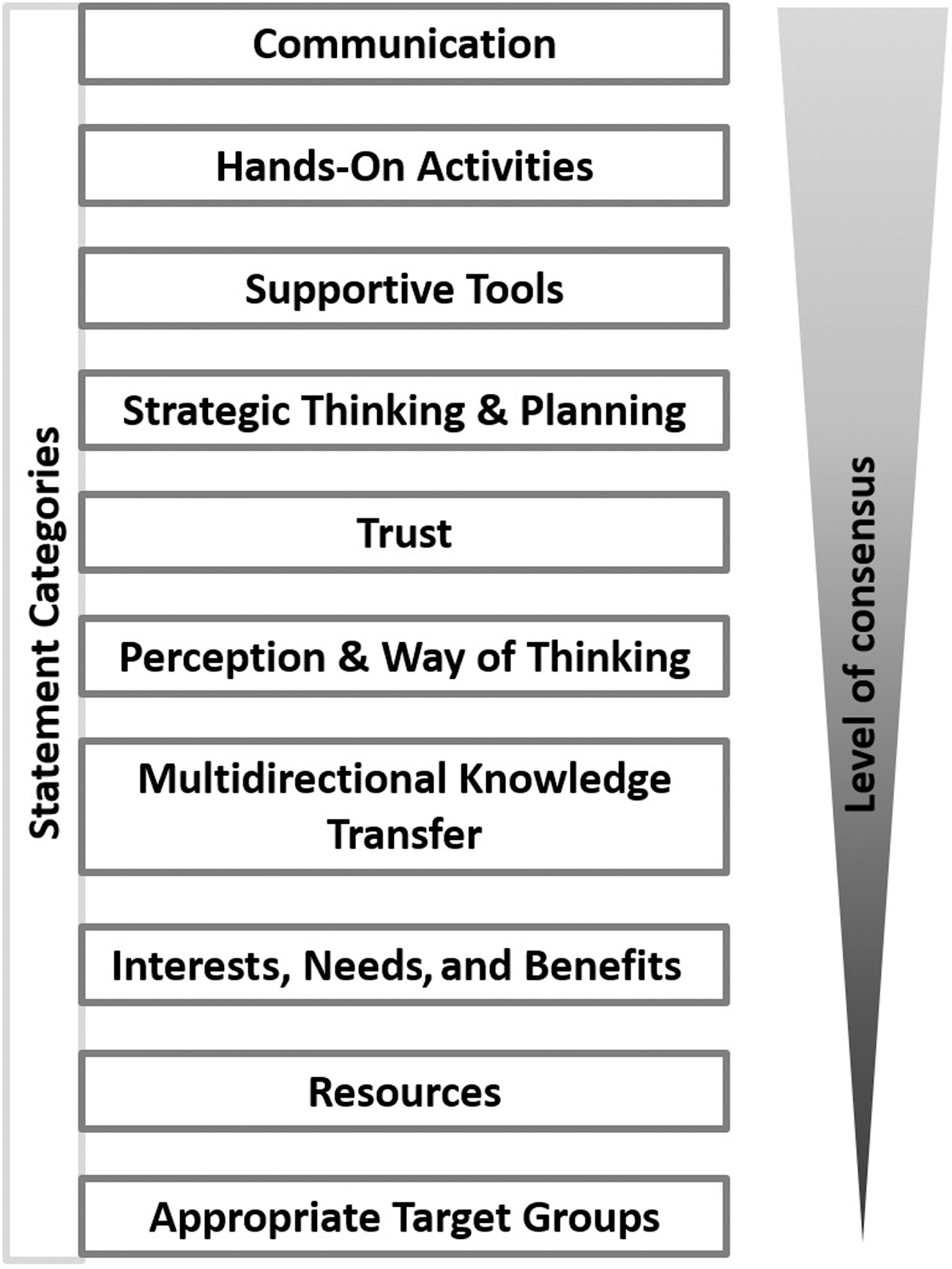
Overview of statement categories and the overall level of consensus on the corresponding statements
In addition to the Likert scales, participants could add comments in open text fields after each block of statements for a category. Comments in the first Delphi round focused primarily on the proper interpretation of scientific information for everyone engaged in an action, on increasing scientific capacity building, and on the importance of local circumstances and the sectors in question.
This focus goes hand in hand with the statement originating from the Trust category, which reached an overall consensus of 86 percent:
For cocreation climate actions all participants need to have confidence in the scientific background of the topic, but the difference between experts and nonexperts has to be taken into account. Interpretation of climate information for nonexperts should be part of the process.
Scientific capacity building seems to be a key aspect in the context of climate action. However, it also implies that researchers have to learn how to properly communicate scientific knowledge and also to accept other forms of knowledge contributed by community partners (Stewart et al., 2013).
All the comments and remarks made by participants in the first Delphi round were edited and included in the second Delphi round to investigate the level of consensus among all participants. Consequently, the second questionnaire consisted of 146 items (compared to a total of 27 statements in the first round), with which the experts were again asked to indicate the extent of their agreement on a Likert scale. Ultimately, 19 of the original statements—some slightly modified—achieved consensus in the second Delphi round (see Table 1).
The results are in line with Brush et al. (2020) and Drahota et al. (2016), stressing the importance of partnership characteristics, processes, and capacity as well as partnership outcomes and relations between the partners. They also confirm the importance of focusing on the local context, capacity building by all partners, careful treatment of the knowledge of all partners, and a trustful and respectful partnership structure (Loo, 2014; Stewart et al., 2013; Wiseman & Williamson, 2010). However, the relevance of Hands On-Activities and Supportive Tools is much more prominent than in the literature. This was also emphasized in the additional comments in the first Delphi round. Figure 3 illustrates the original statements combined with remarks from the first Delphi round, which also achieved consensus in the second Delphi round.
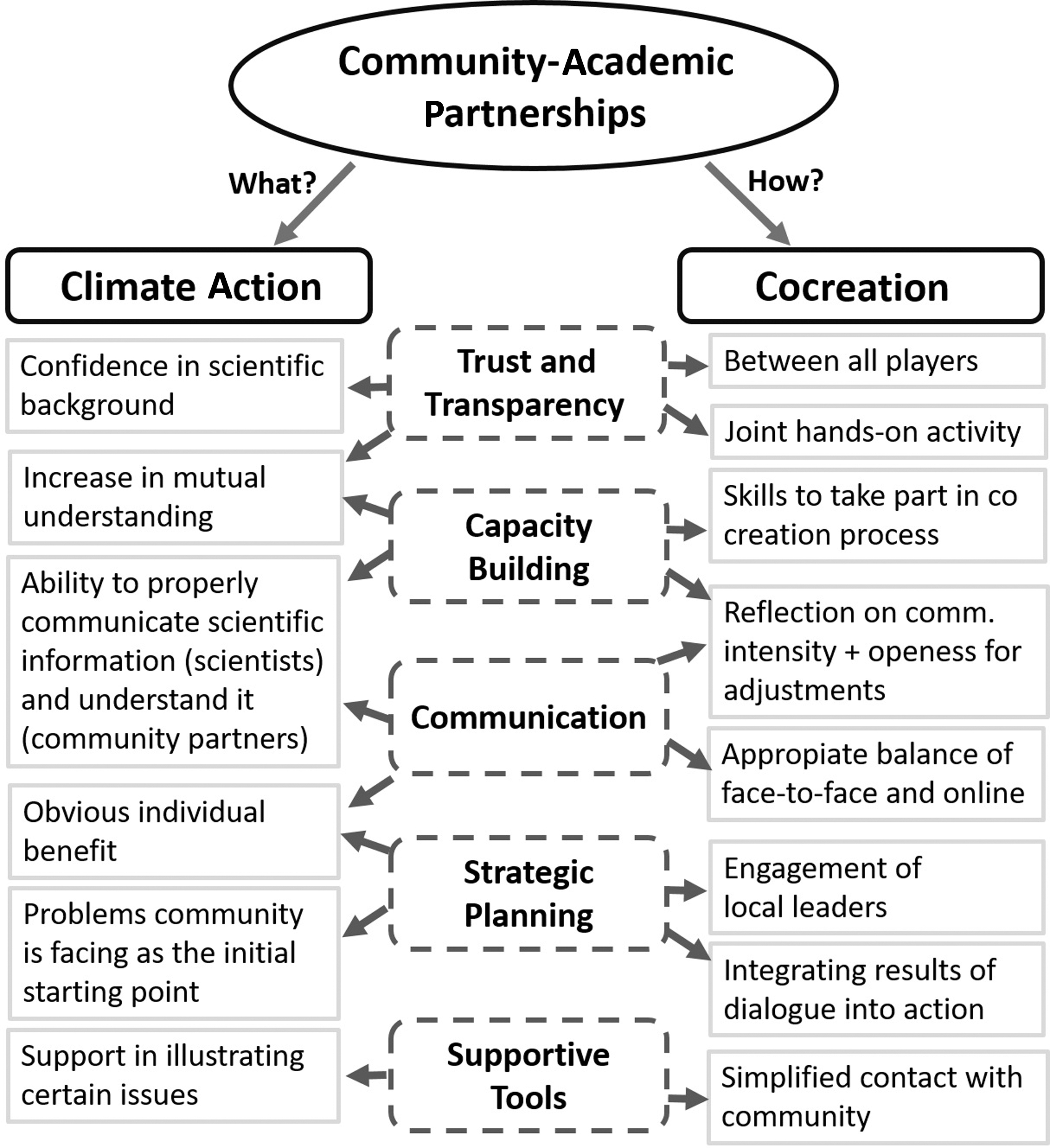
Visualization of the key findings of the Delphi study and their relevance with regard to climate action and cocreation
In deviation from Brush et al. (2020) and Drahota et al. (2016), notably, little consensus was achieved in relation to statements in the Resources category. This might be explained by the only statement that actually achieved consensus in this category: “Solutions to the climate challenge are quite numerous and diverse. The means to put them into practice vary greatly among the sectors concerned” (86%). While climate change adaptation and mitigation without financial resources was considered rather ambitious/unlikely, there is strong potential and a clear opportunity to advance cocreative climate adaptation and mitigation throughout the EU and beyond. As one panel member stated: “With creativity it would be possible to find innovative solutions, but without financial resources, most of them probably won't be developed.”
Reflection on the Research Design and Limitations
Best practices for the conduct of consensus studies were followed throughout this Delphi study. The engagement achieved decreased as the rounds progressed. Many, and often detailed, comments were received from participants to justify their responses, especially in areas of non-consensus. The panel members represented a spectrum of professional fields including science, education, civil society organizations, policy makers, and business. Snowball sampling involving the project partner ensured that the experts came from different European countries. All participants had distinct experience in at least cocreation or climate change adaptation/mitigation, and were therefore well suited to dialogue via the Delphi study and capable of coming to common conclusions.
However, there are also some limitations to consider. Despite all efforts, not all proposed panel members participated in the study. Additionally, since the questionnaires were not directly linked to the individual panel members, there is the possibility that panel members participated in the second round without having taken part in the first round. Most participants worked in the field of science and education, which also might have affected the results. Given the key roles of policy makers—especially when it comes to the implementation of cocreative climate action—their comparably low involvement can also be seen as a limitation. These limitations may have resulted in skewed findings, potentially limiting the generalizability of the results.
Conclusion
The results of the study show how community-academic partnerships may be structured and designed to ensure that all stakeholders are fully involved and positive contributions to climate change adaptation and mitigation can actually be made. Overall, the results confirm existing findings on the success factors for community-academic partnerships and are also applicable to partnerships concerned with climate change adaptation and mitigation. However, the relevance of hands on-activities (supporting horizontality between all stakeholders) and supportive tools (such as apps or a mapping system to make certain issues visible and tangible for local stakeholders) is much more prominent than in the literature.
Thus, to move forward in effective community-academic partnerships on climate change mitigation and adaptation, this research revealed that, besides a thoughtful communication strategy, activities in which community members and academics work side-by-side need to be included. This supports an equal partnership and cooperation at eye level. In addition, the complexity of climate change issues and the existing different perceptions of them have to be addressed and reflected within the working process of the partnership ensuring a common knowledge base. For this, the state of the art digital tools and visualization techniques should be taken into account. Finally, the results of the Delphi study revealed that a conscious negotiation process on the common understanding of success, effectiveness, efficiency, and institutionalization is crucial to facilitate the community-academic partnership.
Further research should analyze more closely whether the results can be generalized to other world regions (Lang, et al., 2012). Follow-up studies with experts from countries outside Europe are therefore required, as are evaluation studies that follow community-academic partnerships on climate change adaptation and mitigation over a longer period of time.
Footnotes
Acknowledgments
We would like to thank two anonymous reviewers for their feedback on an earlier version of this article. We would also like to thank all colleagues from the TeRRIFICA project who helped to implement the study and the experts involved in the Delphi study.
Authors’ Contributions
All authors have read and agree with the published version of the manuscript. Conceptualization, M.R., K.B. and H.H.; methodology, M.R., K.B. and H.H.; validation, M.R., K.B. and H.H.; formal analysis, K.B.; writing—original draft preparation, M.R. and K.B.; writing—review and editing, M.R. and H.H.; visualization, K.B. and H.H.; supervision, M.R.; project administration, M.R.; funding acquisition, M.R.
Funding Information
This research was funded by the European Union's Horizon 2020 research and innovation programme under grant agreement No. 824489.
Author Disclosure Statement
No competing financial interests exist.