






Abstract
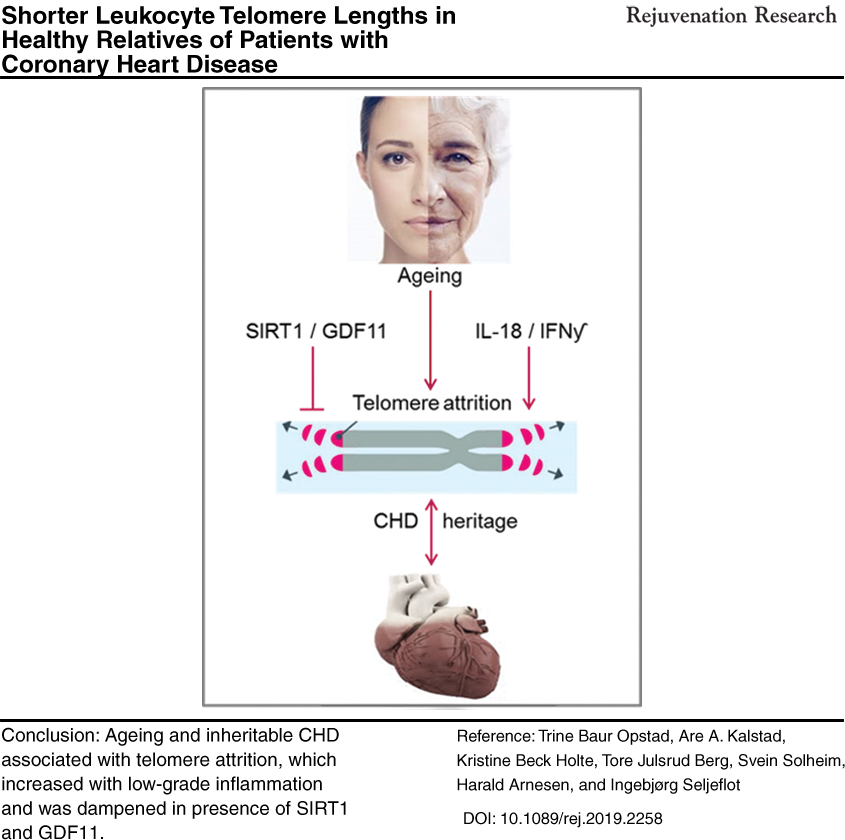
Telomere length (TL), sirtuin (SIRT) 1, growth differentiation factor (GDF) 11, as well as inflammaging have been related to age-related diseases. In healthy subjects, we aimed to investigate whether leukocyte TL (LTL) associated with family history of coronary heart disease (CHD), age, sex, and lifestyle, and further potential covariations between LTL, GDF11, SIRT1 and selected proinflammatory markers. In 118 healthy subjects (18–81 years, 58% females), whole blood was collected for DNA and RNA isolation and polymerase chain reaction relative quantification of LTLs and gene-expression of SIRT1, GDF11, interleukin (IL)-18, and interferon (IFN)ƴ, respectively, and serum SIRT1 and IL-18 analyses. Shorter LTLs were associated with a seven-fold higher frequency of hereditary CHD in subjects with LTLs in quartile (Q)1 compared with Q2–4 (odds ratio = 7.5, 95% confidence interval: 2.5–21.6, p < 0.001, adjusted). We also observed that LTLs in Q4 compared with Q1–3 associated with higher leukocyte expression of SIRT1 and GDF11 (p = 0.052 and p = 0.058), lower IFNƴ expression (p = 0.009), and lower circulating IL-18 levels (p = 0.027). SIRT1 and GDF11 expression were strongly intercorrelated (Spearman's rho = 0.85, p < 0.001). Overall, smoking, snus, and alcohol consumption were not associated with LTLs. The observed shorter LTLs in association with elevated expression of SIRT1 and GDF11 and dampened inflammation in hereditary CHD subjects, suggest impending risk of disease. More research are warranted to shed light on early lifestyle interventions targeting these mechanisms, to promote healthier aging in individuals with hereditary burden.
Graphical Abstract
Color images are available online.
Get full access to this article
View all access options for this article.
References
Supplementary Material
Please find the following supplemental material available below.
For Open Access articles published under a Creative Commons License, all supplemental material carries the same license as the article it is associated with.
For non-Open Access articles published, all supplemental material carries a non-exclusive license, and permission requests for re-use of supplemental material or any part of supplemental material shall be sent directly to the copyright owner as specified in the copyright notice associated with the article.
