






Abstract
Background:
Previous cases reported that oocytes were characterized by indented zone pellucida (ZP) and narrow perivitelline space (PVS) with low oocyte maturity or all metaphase I (MI) like oocytes which usually be abandoned. These MI-like oocytes can be fertilized and develop embryo. The genetic analysis of blastocyst from MI-like oocytes with indented ZP and narrow PVS is still unknown.
Methods:
In this report, patient collected all immature MI-like oocytes with indented ZP and narrow PVS. Intracytoplasmic sperm injection (ICSI) proceed to these oocytes directly. The MI-like oocytes can fertilization, and developed blastocyst. The patient got pregnant after transfer 2 embryo on day 3. Blastomere biopsy, genome amplification, copy number variation (CNV) and single nucleotide polymorphism (SNP) analysis was performed.
Results:
CNV analysis showed that genotype was 46,XX, with mosaic of multiple chromosomes and SNP results showed that part of the chromosomes belong to triploids, and some belong to quadruplicate copies based on the B-allele frequency (BAF) value combined with the LogR Ratio. It is speculated that the cell is in the early stage of the first meiosis.
Conclusion:
MI like oocytes with indented ZP and narrow PVS can developed blastocyst and pregnancy after ICSI. Genetic analysis of blastocyst showed mosaic of multiple chromosomes.
Introduction
The metaphase I (MI) oocytes from patients with a normal number of MII oocytes can be fertilized, and pregnancy preformed with intracytoplasmic sperm injection (ICSI).1–3 However, the cases previously reporting recurrent retrieval of all immature MI oocytes underwent invitro maturation (IVM) and ICSI without further maturation or fertilization.4–8
Some studies reported all oocytes with indented zone pellucida (ZP) and narrow perivitelline space (PVS) presenting significantly low oocyte maturity or even all MI oocytes in light microscopy.9,10 Narrow PVS was usually observed in immature oocytes, and it was rare that all oocytes retrieved were companied with narrow PVS in one invitro fertilization (IVF) cycle.9
The MI oocytes from patients with a normal number of MII oocytes can be fertilized, and pregnancy performed after ICSI.11 We present a case of blastocyst genetic analysis of all oocytes characterized by immature MI-like stage with indented ZP and narrow PVS fertilized after ICSI.
Case Report
A 25-year-old patient and her 26-year-old husband came to our center for reproductive medicine and infertility in June 2021 with a 2-year history of primary infertility. She had irregular menstrual periods with a cycle length of 30–60 days and was diagnosed to polycystic ovary syndrome (PCOS) by ultrasound and hormone and obstruction of the left fallopian tubes by hysterosalpingography. A chromosomal analysis indicated a normal female chromosomal complement (46,XX). Her husband’s semen analysis showed normozoospermia. After two cycles of intrauterine insemination, she underwent controlled ovarian stimulation (COS) according to our routine IVF protocol. Antagonist protocol was started after doing baseline day 2 scan and hormonal profile. Day 2 follicle-stimulating hormone (FSH) was 3.61 mIU/ml (reference interval: 3.08–8.08), luteinizing hormone was 3.24 mIU/ml (reference interval: 1.80–11.78), and estradiol was 29 pg/ml (reference interval: 21–251). She was stimulated with urine FSH (uFSH) 150 IU. Antagonist was started from day 7. She received 10 days of stimulation. Total gonadotrophin dose given was 1,800 IU. Trigger was given on day 10 of stimulation with recombinant human chorionic gonadotropin, 0.25 mcg subcutaneously. She had three follicles of 18 mm, and four follicles of 16–17 mmsize on the day of trigger. Transvaginal ultrasound-guided oocyte retrieval was carried out 36 h after the trigger administration. The cumulus-oocyte-complex was small and difficult to retrieve. Eight oocytes were retrieved during oocyte pick up. Short-time fertilization and rescue ICSI (Re-ICSI) were performed (Fig.1).

Allocation of retrieved oocytes.
ICSI, Embryo Culture, and Biopsy
Eight oocytes were all at MI like with indented ZP and narrow PVS after removing the surrounding cumulus cells (Fig.2). Re-ICSI was performed to all MI-like oocytes. These oocytes can be normally fertilized and developed blastocyst (Fig.2). Two embryos were transferred on day 3. The other embryos continued to cultivate and developed one blastomere on day 5. Observation of the gestational sac and fetal heart by B ultrasound at 35 days after implantation was diagnosed as clinical pregnancy.

Fertilization, embryo, and blastocyst of MI-like oocytes with indented ZP and narrow PVS.
A blastomere biopsy was performed using a laser beam (Hamilton Thorne, Beverly, MA, USA) (Fig.2). The blastomere was aspirated from the embryo and released into the medium for amplification (YK001B, Yikon, China). The amplification results were detected by copy number variation (CNV) analysis and next-generation sequencing (Illumina, San Diego, CA, USA). The results showed that CNV analysis indicated a genotype of 46,XX,+5(×3,mos,∼38%),+6p(×3,mos,∼36%), +7(×3,mos),+12(×3,mos,∼49%),+15(×3,mos,∼44%), +17(×3,mos) (Fig.3), SNP indicated that part of the chromosomes of the sample belongs to triploids, and chr4, 5, 6, 7, 12,15, and 17 belong to quadruplicate copies based on the BAF value (Fig.4).12

CNV results: 46,XX with mosaic of multiple chromosomes.
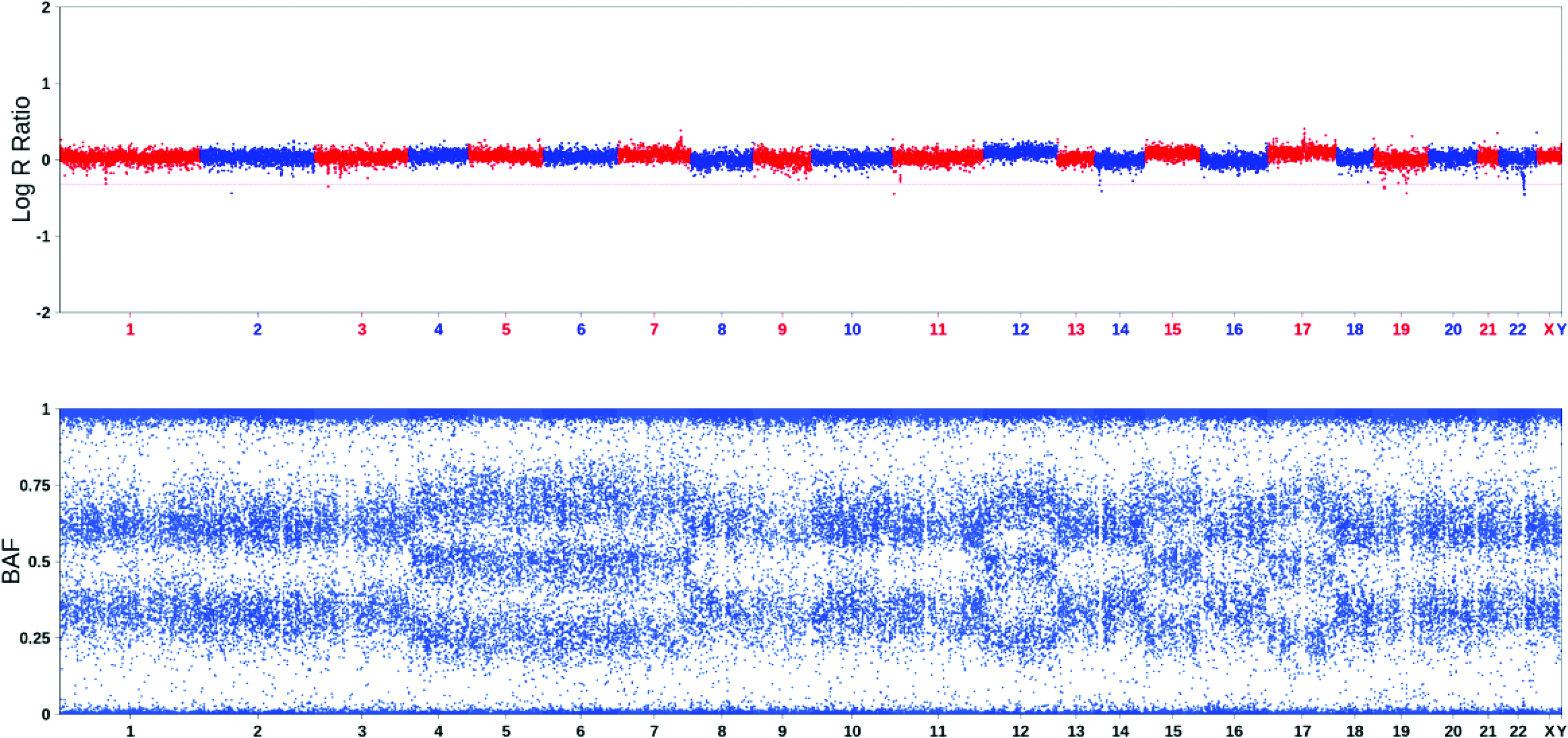
SNP results.
The participant gave a written informed consent, and the Fourth Hospital of Shijiazhuang ethics committee approved this study (ethical approval number: 20210081).
Discussion
The oocytes classified germinal vesicle (GV), MI, and MII after COS in IVF. Approximately 17–20% of oocytes collected for IVF are meiotically immature, probably because of the stimulation of multiple follicles.5
These MI oocytes have capability to reach MII stage following rescued IVM after different incubation periods. ICSI was performed in IVM-MII and the remainder MI oocytes. The embryos originating from MI oocytes after incubation periods have a high rate of chromosomal aneuploidy. No chromosomally normal embryos were found after 24 h of incubation of their corresponding oocytes.1
Compared with IVM-MII, though ICSI performed on MI oocytes immediately after denudation resulted in lower fertilization rates,2,13 it was associated with significantly higher rates of blastocyst development.3 The MI oocyte can complete the extrusion of its PB after ICSI in human,11 which also be found in MI oocytes of mouse.14
However, it is extremely rare for complete oocyte maturation failure to occur in IVF treatment.6 The reason for MI arrest is unknown. Ultrastructural analysis demonstrated that MI arrest oocyte had irregular chromatin condensation, disrupted spindle formation, and/or distorted/stunted microvilli protruding to the PVS.5 Aberrant spindle structures responsible for recurrent human MI oocyte arrest with attempts to induce meiosis artificially.8 Chen etal. found different mutations in TUBB8 that could result in variability in oocyte/embryo phenotypes, including oocyte maturation arrest, first polar body (PB1) oocytes that cannot be fertilized, and PB1 oocytes that can be fertilized but arrest at an early embryonic stage.15 Cytogenetic analysis revealed that the oocytes failed to reach meiotic MII stage had successfully resumed meiosis. Germinal vesicle breakdown was also indicated, and chromosomes were at MII stage of development. However, meiotic reduction of those chromosomes failed.16 During IVF, ovarian stimulation in patients affected by particular conditions, such as endometriosis and PCOS.17,18 In this case, the patient was PCOS and collected all immature MI-like oocytes with indented ZP and narrow PVS after ovarian stimulation.
MI oocytes from patients with a normal number of retrieved MII oocytes have capability to reach MII stage following IVM and increase the number of embryos available for transfer,1–3,14 while previous cases reporting recurrent retrieval of all immature MI oocytes underwent IVM and ICSI without further maturation or fertilization.4–8
In this case, the oocytes were clinically treated as immature oocytes because it is difficult to observe the PB1 due to narrow PVS and intended ZP. The human ZP is an extracellular glycoprotein matrix that surrounds the oocyte with a paracrystalline three-dimensional network structure. It serves several functions, such as to mediate sperm binding, induce the acrosomal reaction, prevent polyspermy, and protect the embryo until implantation.10
Li etal. reported a kind of heterogeneous zona pellucid (HZP) with narrow PVS, which had significant low oocyte maturity, no fertilization during conventional IVF treatment, and low fertilization rate in the ICSI cycle.9 Sousa also reported cases that all oocytes were MI oocytes presenting an indented ZP without further treatment, and no embryo transfer and the patient have to cancel cycle.10
Because of narrow PVS and HZP, the polar body was usually difficult to differentiate, and the MII oocytes rate may not be conclusive.9 How to identify the oocytes maturation stage without considering the polar body? What would happen if all of the oocytes without clear polar bodies were given ICSI? Can these MI oocytes with indented ZP and narrow PVS fertilization?
In this case, though absence of resistance to ZP and oolemma penetration, and low ooplasm viscosity during microinjection,10 these MI-like oocytes with indented ZP and narrow PVS can be fertilized, develop embryo, and perform pregnancy after ICSI.
We further analyze that blastocyst CNV results showed 46,XX with mosaic of multiple chromosomes, SNP results showed that part of the chromosomes belongs to triploids, and chr4, 5, 6, 7, 12, 15, and 17 belong to quadruplicate copies based on the BAF value. It is speculated that the cell is in the early stage of the first meiosis. The patient got pregnant after transfer of fresh embryo without preimplantation genetic testing (PGT). The only blastocyst PGT results showed mosaic embryo. The further research focuses on transfer of mosaic embryos developed from MI-like oocytes.
Limitations
We transfer the embryo without PGT, and the patient got pregnant. However, we are not sure about genetic counseling of the blastocyst with mosaic PGT results.
Conclusion
MI-like oocytes with indented ZP and narrow PVS can be developed blastocyst and perform pregnancy after ICSI. Genetic analysis of blastocyst showed mosaic of multiple chromosomes.