






Abstract
Introduction
In the past few decades, US institutions such as universities and large academic medical centers have increasingly helped build a culture of health in their respective communities; for example, by offering affordable housing and improving public education. 1 Often referred to as “anchor institutions,” they are unlikely to move to other places and therefore are relatively immobile. Examples of anchor institutions include the University of Pennsylvania, whose investments in the West Philadelphia Initiative led to higher median household incomes and a lower poverty rate, 2 and the Greater University Circle Initiative in Cleveland, Ohio that has made great progress in addressing persistent poverty. 3
Although less researched, for-profit institutions also increasingly implemented initiatives to promote a community culture of health, 4 many of which are “anchored” to surrounding communities because of investments, employment, customers, or suppliers. For example, The Wonderful Company, famous for its pistachios and citrus fruits, has spent millions of dollars each year to support the well-being of the residents of Lost Hills, California by establishing primary care clinics, promoting healthy lifestyles, supporting education, building public housing, paving roads, and building parks. 5
Given the resources controlled by for-profit institutions and their great potential to invest in communities, it is important to understand which for-profit institutions can be considered as “anchor businesses” and why they invest in community well-being. Thus, the Robert Wood Johnson Foundation launched an initiative to understand anchor businesses (
Existing Definitions for Nonprofit Institutions
Although there is no consensus on a definition, prior literature suggests that anchor institutions meet the following 4 conditions: relative spatial immobility, significant influence on surrounding communities, nonprofit status, and a social purpose mission or the potential to acquire one. 1 The first 2 conditions are closely related in that there is a strong interdependency between an anchor institution and its surrounding community. Anchor institutions rely heavily on local communities because of large local fixed investments or their dependence on local customers, employees, or suppliers. Moving to another location may damage an anchor's financial status severely or even threaten its survival. But local communities also depend on anchor institutions for employment and broader economic development. Essentially, an anchor institution's interests are aligned with those of surrounding communities. The last 2 conditions of the anchor definition are related to the purpose and mission of an institution. Conceptually, serving a larger purpose than just financial benefits would lead to a lower chance of leaving the community and therefore also anchors an institution.
Differences Between Nonprofit and For-profit Institutions
Nonprofit and for-profit institutions are similar along several dimensions included in existing anchor institution definitions. Both can be largely spatially immobile because of the immobility of their core assets (eg, real estate companies, agricultural farms, retail chains, banks, utility companies, local newspapers, radio or television stations). Also, both types of institutions can have a significant influence on the surrounding community, often related to their size. In addition, many for-profit companies include corporate social responsibilities as part of their mission to protect the environment, improve societal well-being, give back to the community, and promote company goodwill.
Nonetheless, for-profit companies operate under different financial constraints – they have to earn a return on investment for investors – whereas nonprofits only need to break even. The need to earn profits gives less room for for-profit companies to pursue community development or a social purpose mission than nonprofits, which also receive tax exemptions and charitable donations. For-profit companies also have larger capital mobility than nonprofits because of an existing capital market. Without a satisfying return to investors, for-profit companies may be acquired or go bankrupt, and their assets may go through a reorganization, although ownership change is unlikely to affect the spatially immobile nature of core assets. For example, an agricultural farm stays where it is even if it has a new owner.
Proposed Definition for Anchor Businesses
Considering the similarities and differences between for-profits and nonprofits, we propose an exploratory definition: anchor businesses are (a) placed-based for-profit entities that are (b) unlikely to move to a different place, 6 (c) have relatively significant local or regional influence, and (d) have invested in the well-being of surrounding communities. First, anchor businesses have to be place-based for-profit entities. They have a relatively sizable physical presence in a community, which excludes companies whose employees or resources are scattered thinly across a large geographic area. Second, they are rooted in the surrounding community often because of deep local economic relationships and, sometimes, tradition and company origin. Third, anchor businesses have significant local influence because of their size and economic ties to the community. Lastly, for-profit companies satisfying the first 3 criteria can be considered only as potential anchor businesses. Instead of including a social purpose mission in the definition, we propose that a true anchor business must invest in local community development.
Practical Implications
Applying the proposed definition to identify anchor businesses is likely to be the first step to leverage their resources to build a culture of health in surrounding communities. Operationalizing the definition, however, is challenging. Although local influence can be approximated by employment or revenue relative to that of the community, quantifying spatial immobility is much more difficult. Prior research has examined the time needed for an industry's center to move from one place to another (eg, food stores taking much longer than manufacturers of electronic equipment); such results can be used to quantify spatial immobility. 6 Figure 1 illustrates an operationalization of the definition, and anchor businesses can be identified in the northeast quadrant of the chart.
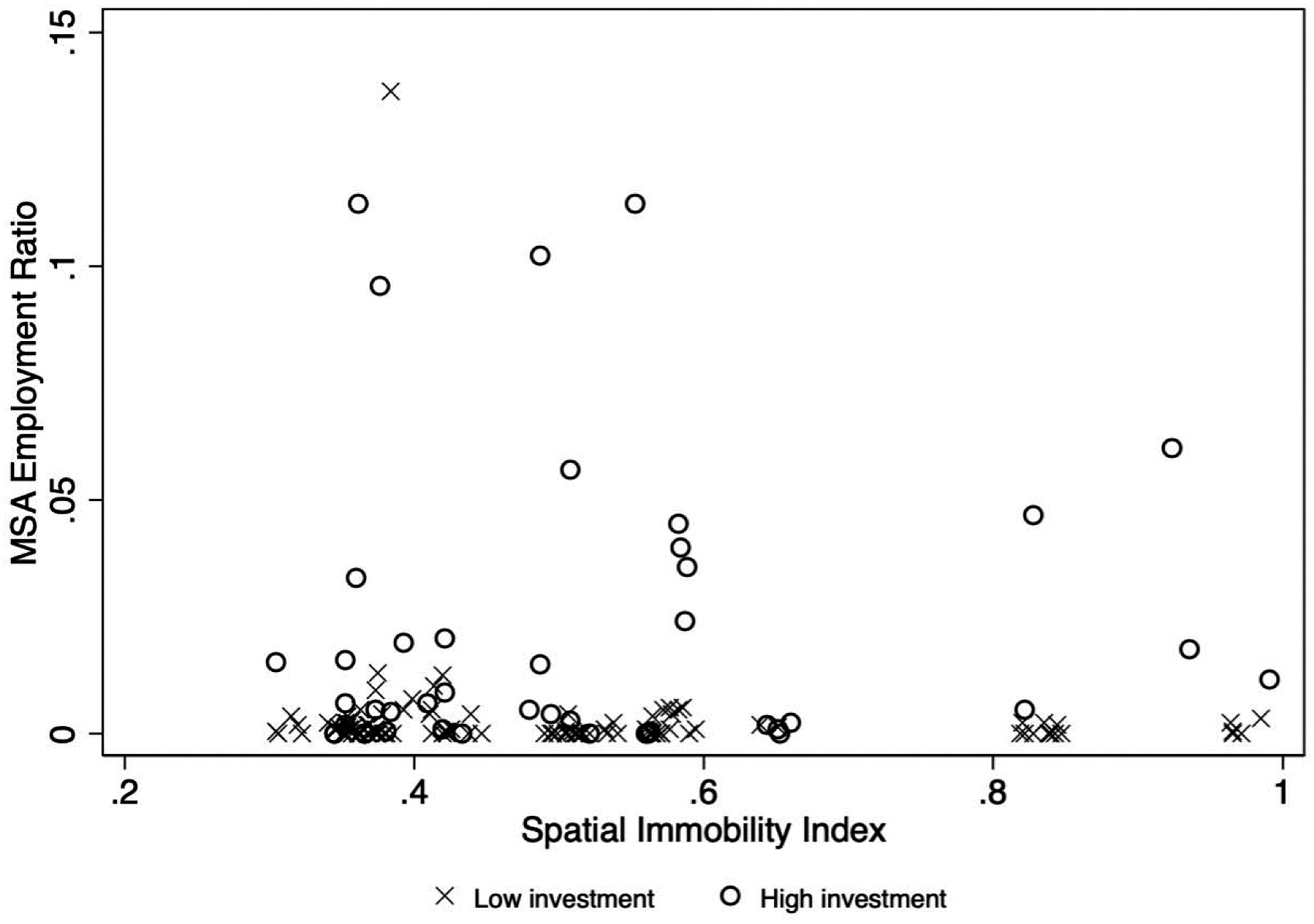
Economic scale, spatial immobility, and community investment. Note: Thirty businesses were identified that have invested in community development and randomly selected 123 comparable companies by industry and headquarters' Metropolitan Statistical Area (MSA) location using the Dun & Bradstreet database. MSAs were the geographic unit of analysis as they encompass commuting areas that define the “community” of the company's headquarters. The standard industry code as defined by Duranton 6 was used to graph the ratio of total business employment to the MSA employment and relative spatial immobility. The investment information came from the DonorSearch database. High investment was classified as having invested at least $50,000 in the community surrounding the US headquarters during 2015–2019.
Drawing a line between business activities and community development is critical to operationalizing the definition. One solution is to define community development as initiatives that provide less than 100% of direct return on investment to the company, with the rest going to surrounding communities (ie, there is some charitable component). For example, a local manufacturer may donate money to a public school to set up an educational program. In contrast, a sportswear store's sponsorship of high school football games and the establishment of health clinics by retail chain stores are not community development initiatives because the entire return belongs to the companies. Similarly, obtaining a Leadership in Energy and Environmental Design certification by a real estate company is not community development unless it passes savings to local residents or businesses.
Contributions to community development may take different forms: direct participation, donations through their philanthropic arm or foundations, or executing company policies to hire local residents or buy from local suppliers. Also, the size of community investments matters. There may be a relevant threshold for investment magnitude, which could scale with the size of a company or the community and warrants future empirical research.
Related largely to the interdependence between anchor businesses and their surrounding communities, they could have a positive impact on community health directly through investing in health programs (eg, primary care, health promotion) or indirectly through improving local infrastructure (eg, education, housing, food, transportation, environment). The proposed definition may help identify potential and true anchor businesses and encourage such investments.
Footnotes
Authors' Contributions
All authors have made substantial contributions to the conception or design of the work. Mr. Qureshi led data acquisition and data analysis. All authors contributed to interpretation of data. Further, led by Dr. Cohen, all authors participated in drafting the work and revising it critically for important intellectual content.
Author Disclosure Statement
The authors declare that there are no conflicts of interest.
Funding Information
This work was supported by the Robert Wood Johnson Foundation.