






Abstract
Background:
Paradoxical darkening is a well-known complication with laser therapy for tattoos. However, there are limited reports of other color shifts after treating tattoos with laser. The aim of this study is to characterize cases of unusual eyebrow tattoo color change after laser.
Methods:
All cases of eyebrow tattoo color change after laser therapy from two dermatology clinics were reviewed.
Results:
A total of 10 females with unusual lighter color change after laser were identified. This was noticed by all patients within a few days after the first laser session. The color shift occurred after picosecond (PS) 755 nm (n = 5), PS 1064 nm (n = 4), and Q-switched 1064 nm (n = 1) laser therapy. The initial color shift was red or orange-red in eight patients and yellow in two patients. Treatment of color change was performed in six patients, with significant improvement. Two were treated with PS 755 nm laser and four were treated with PS 532 nm laser. After the first PS 532 nm laser session, the tattoo turned yellow in three patients. None of the patients developed paradoxical darkening of the light-colored tattoo after additional laser treatment.
Conclusions:
Some eyebrow tattoos might turn red, orange, or yellow after laser therapy. This color shift usually responds to subsequent therapy with PS 532 nm laser.
Introduction
Tattoos are removed primarily by laser due to its selectivity. Laser selectively targets tattoo particles without affecting the surrounding normal skin. 1,2 The most commonly used lasers for tattoo removal are the 755 nm alexandrite laser, 532 nm potassium titanyl phosphate laser, and 1064 nm laser. Lasers most commonly deliver short pulses in the nanosecond domain. More recently, picosecond (PS) lasers were introduced with promising efficacy and safety profile. 3
Although laser is the treatment of choice for tattoo removal, certain complications might occur. 4,5 Paradoxical darkening of certain tattoos is a well-known complication after laser therapy. 6,7 Darkening most commonly occurs with pink, red, skin-colored, and white tattoos. 8 This occurs due to a chemical reaction between laser and iron or titanium within those tattoos. Because this side effect can be very distressing to patients, a laser test spot is highly recommended before treating the whole tattoo.
Apart from paradoxical tattoo darkening, other tattoo color changes after laser are not well-emphasized in the literature. 9,10 We have observed that the color of some eyebrow tattoos changes from black or dark brown to red, orange, or yellow. The aim of this study is to describe cases of unusual color changes of eyebrow cosmetic tattoos after laser therapy.
Methods
This is a retrospective chart review conducted at two dermatology clinics. The study was approved by the institutional ethics committee at King Abdullah International Medical Research Center (Number IRB/1170/22). The requirement for informed consent was waived by the committee due to the retrospective design of the study. The study was conducted in accordance with the Declaration of Helsinki and all data were anonymized to ensure patient confidentiality.
All eyebrow tattoo cases that turned red, orange, or yellow after laser therapy were included. Variables comprised age, gender, skin type, tattoo type (classical vs. microblading), and the number of tattoo layers done in the same area. Other collected data were the exact color change, laser parameters that induced the color change, and period between laser session and development of color change. In addition, laser parameters that were used to treat the resulting color change were documented.
Results
A total of 10 females with unusual lighter color change after laser were identified (Table 1). The mean age was 33.4 years. Most patients had only one tattoo session. Only three patients did their tattoos using microblading.
Characteristics of 10 Females with Unusual Lighter Color Shift After Eyebrow Laser Treatment
NA, not applicable; PS, picosecond; QS, Q-switched.
The tattoo color change was noticed by all study patients within a few days after the first laser session. Color change occurred after PS 755 nm (n = 5), PS 1064 nm (n = 4), and Q-switched (QS) 1064 nm (n = 1) laser therapy. The initial color shift was red or orange-red in eight patients (Figs. 1 and 2) and yellow in two patients (Fig. 3).
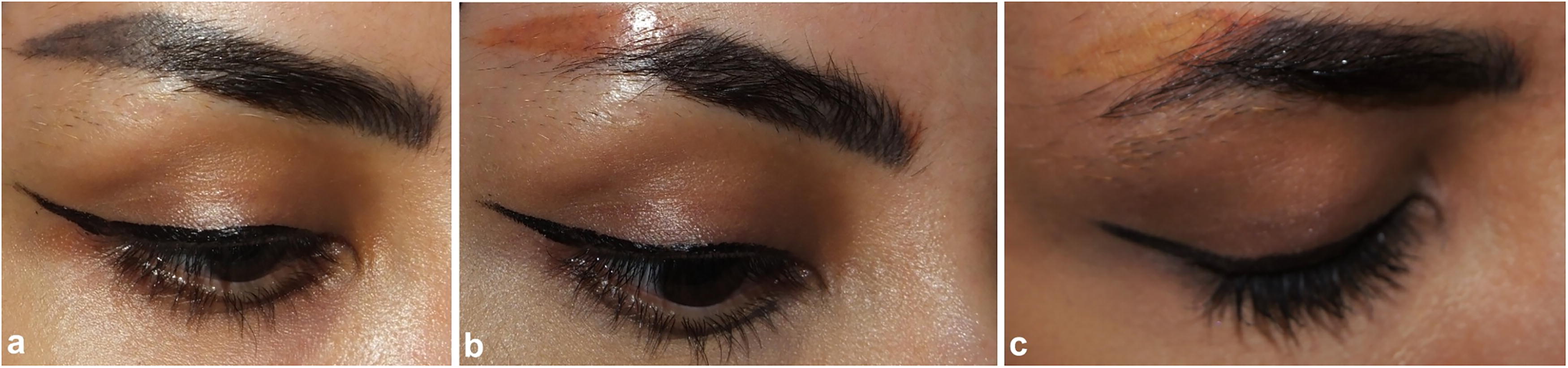
Patient number 7.
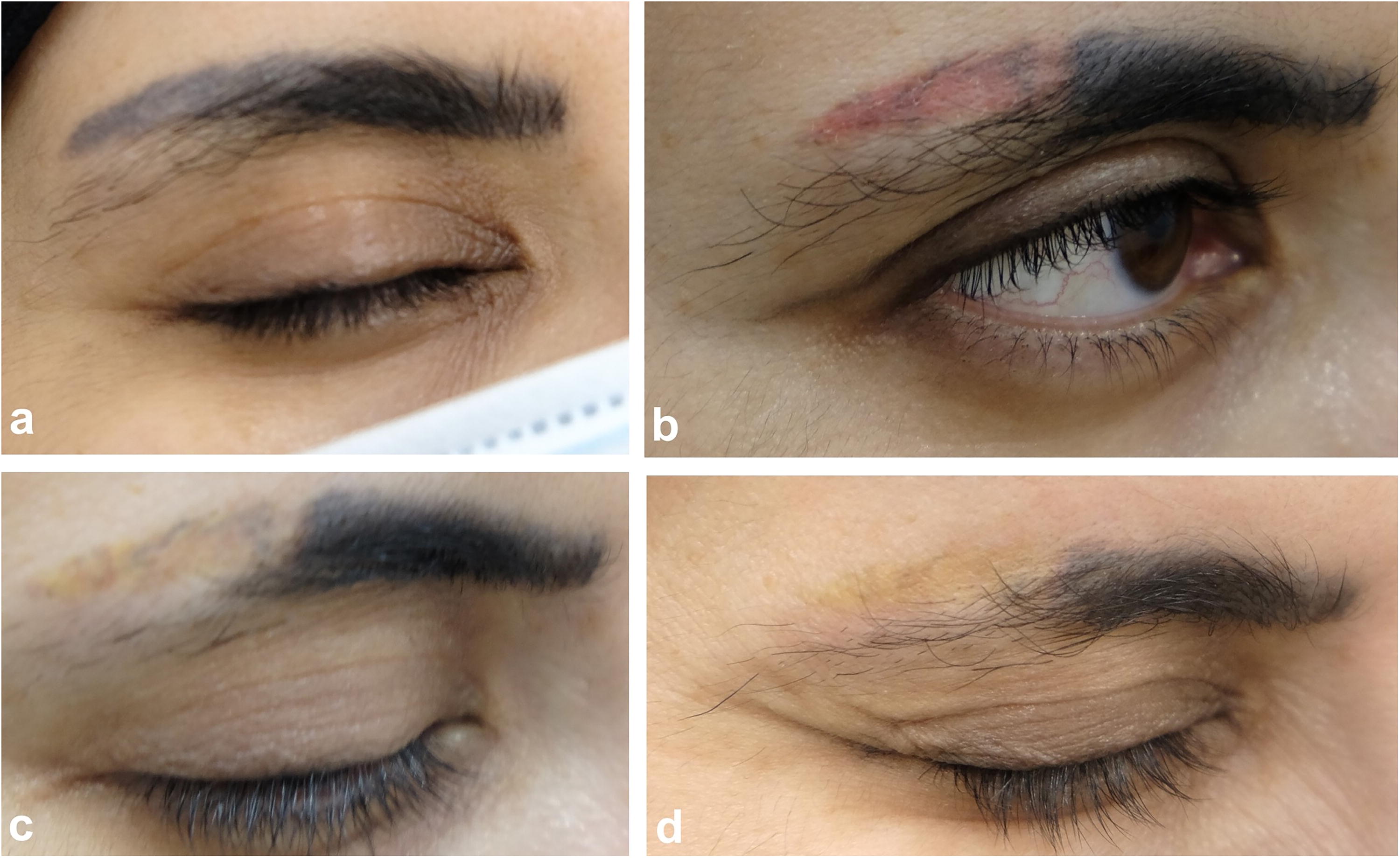
Patient number 8.
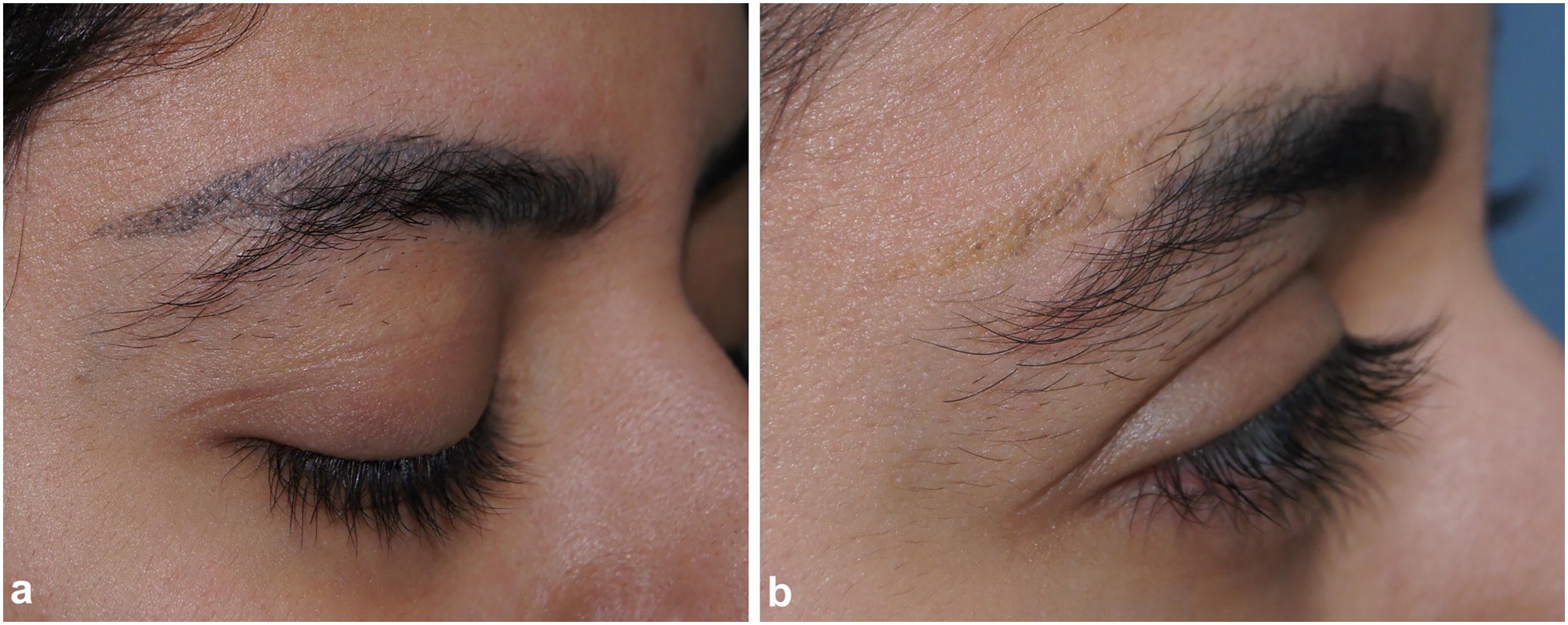
Patient number 9.
Treatment of color change was performed in six patients, all had red or orange-red color change. PS 755 nm laser was used in treating the remaining black color from the original tattoo in two patients. In one of them, this significantly improved the underlying orange–red color as well. Four patients were treated with PS 532 nm laser with >75% clearance. After the first PS 532 nm laser session, the tattoo turned yellow in three patients. None of the patients developed paradoxical darkening of light-colored tattoo after additional laser treatment.
Discussion
This study shows a unique lighter shift in color of eyebrow tattoos after laser. Color changes in tattoos after laser therapy can be very distressing to patients. Therefore, knowledge of such color changes is important for proper patient counseling and subsequent management. Paradoxical darkening of tattoos is a well-recognized complication that occurs with the treatment of certain tattoo colors especially in cosmetic tattoos. 4,5 Paradoxical darkening is mainly described after treatment with QS nanosecond lasers and more recently after PS lasers. 11 It can be treated by either ablative laser resurfacing 12 or further treatment with QS 13 or PS lasers. 14
Other color changes to tattoo after laser treatment are rarely reported. 9,10 We report unusual lighter color changes of eyebrow tattoos in 10 patients which occurred within a few days of the first laser session. A red or orange–red color was observed in eight patients, while the remaining two developed a yellow color. In a recent study by Hartman et al., 15 33 patients with cosmetic tattoos were treated with PS Nd:YAG laser. Of the 21 cases of eyebrow tattoos, 9 (43%) developed unusual color changes similar to the ones observed in our study after the first session with PS 1064 nm laser. The color shift was noted after approximately 20 min (after disappearance of the immediate whitening response). The majority had orange–red color shift while a few who developed yellow or pink color. This color shift was not seen with eyeliner or lip tattoos. In another study of 76 patients with eyebrow and eyelid tattoos, 26.3% developed a shift of color to red, orange, yellow, green, or blue after the first laser session. 16 Most tattoos were initially treated with PS 755 nm laser, PS 532 nm/1064 nm laser, or both.
The exact mechanism of the lighter color change is not clear. Eyebrow tattoos tend to have a mixture of inks to give them the black-brown color. 15 This mixture usually includes black, red, and yellow inks. Consequently, laser might remove only the black color and leaves (unmasks) the orange–red or yellow color behind. 16 Most of our patients did their tattoos with the classical (traditional) method. This makes the use of microblading a less likely contributing factor to the color change. Another potential explanation for this abnormal reaction could be the unknown composition of the tattoo inks used in our patients.
The duration of tattoo might also be important. It is known that eyebrow tattoos can fade with time to orange–red color. 17,18 It is possible that older tattoos are more likely to develop this color change after laser as compared with more recent tattoos. Another potential predisposing factor is the pulse duration. The unique color shift occurred mostly after PS laser in our cases and those previously reported. 15,16 The very short pulse duration of PS laser could have contributed to the selective removal of the black color. However, one of our patients developed orange–red color after treatment with QS nanosecond 1064 nm laser. Further, Jimenez G et al. reported an orange–green eyebrow tattoo color shift after QS 1064 nm laser. 9
Although this unique phenomenon was distressing to our patients, those treated with PS 532 nm laser were generally satisfied with the result. A similar improvement with PS 532 was noted in previous reports. 15,16 The orange–red color in our cases commonly turned yellow after the first session of PS 532 nm laser. The yellow color improved with subsequent treatment sessions. This is in agreement with a recently published report of a woman with an eyebrow tattoo that turned yellow after laser. Treatment of the yellow color with PS 532 nm laser led to almost complete resolution after four sessions. 19
Our study has several limitations. The number of cases is limited and only cases that developed the unusual color changes after laser were included. Since the total number of cases for eyebrow tattoos treated with laser is unknown, we were unable to calculate the prevalence of this complication. Another limitation is the unknown duration of tattoos that developed this color change, which can be a risk factor. Identifying risk factors and causes of this phenomenon is important. Future studies with larger sample sizes may help address this gap by comparing patients with and without this color shift. Additional valuable insights could be gained through the use of noninvasive diagnostic methods, such as diffuse reflectance spectroscopy, 20,21 Raman spectroscopy, 22 and multiphoton microscopy. 23
In conclusion, we report several cases of unusual eyebrow tattoo color shift after laser. This phenomenon appears to be underreported and could potentially be multifactorial. Further research into this color shift might help gain more understanding to improve the overall management of cosmetic eyebrow tattoos.
Footnotes
Authors’ Contributions
A.M., M.G.T., F.M.A., and N.A.: Conceptualization. M.I.A.: Formal analysis. M.I.A., Y.A.G., A.M., A.A., and N.A.: Investigation. M.I.A., Y.A.G., and N.A.: Methodology. M.I.A. and Y.A.G.: Project administration. M.I.A.: Supervision. M.I.A. and Y.A.G.: Visualization. M.I.A.: Writing—original draft. Y.A.G., A.M., M.G.T., F.M.A., A.A., and N.A.: Writing—review and editing. Funding acquisition, data curation, resources, software, and validation: Not applicable.
Data Availability Statement
The data supporting the findings of this study are available upon reasonable request.
Author Disclosure Statement
No competing financial interests exist.
Funding Information
No funding was received for this article.