






Abstract
Lies and disinformation have always existed throughout human history. However, disinformation has become a “pandemic within a pandemic” with convergence of COVID-19 and digital transformation of health care, climate emergency, and pervasive human–computer interaction in all facets of life. We are living through an era of post-truth. New approaches to fight disinformation are urgently needed and of paramount importance for systems science and planetary health. In this study, we discuss the ways in which extractive and entrenched epistemologies such as technocracy and neoliberalism co-produce disinformation. We draw from the works of David Collingridge in technology entrenchment and the literature on digital health, international affairs, climate emergency, degrowth, and decolonializing methodologies. We expand the vocabulary on and interventions against disinformation, and propose the following: (1) rapid epistemic disobedience as a critical governance tool to resist the cultural hegemony of neoliberalism and its master narrative infinite growth that is damaging the planetary ecosystems, while creating echo chambers overflowing with disinformation, and (2) a two-tiered taxonomy of reflexivity, a state of self-cognizance by knowledge actors, for example, scientists, engineers, and physicians (type 1 reflexivity), as well as by chroniclers of former actors, for example, civil society organizations, journalists, social sciences, and humanities scholars (type 2 reflexivity). This article takes seriously the role of master narratives in quotidian life in production of disinformation and ecological breakdown. The infinite growth narrative does not ask critical questions such as “growth in what, at what costs to society and environment?,” and is a dangerous game of brinkmanship that has been testing the planetary ecological boundaries and putting at risk the veracity of knowledge. There is a need for scholars and systems scientists who break ranks with entrenched narratives that pose existential threats to planetary sustainability and are harmful to knowledge veracity. Scholars who resist the obvious recklessness and juggernaut of the pursuit of neoliberal infinite growth would be rooting for living responsibly and in solidarity on a planet with finite resources. The interventions proposed in this study, rapid epistemic disobedience and the expanded reflexivity taxonomy, can advance progressive policies for a good life for all within planetary boundaries, and decolonize knowledge from disinformation in ways that are necessarily upstream, radical, rapid, and emancipatory.
“The truth is rarely pure and never simple.”
—Oscar Wilde (1854–1900)
The Stealth Pandemic: Disinformation
Disinformation is false information created and spread deliberately with the intention to mislead public, obscure truths, and cause damage. Although lies and disinformation have always existed throughout human history, disinformation has become a “pandemic within a pandemic” by obliteration of the critical public spaces with COVID-19 and the rise of pervasive human–computer interaction in all facets of life.
Digital technologies can amplify and spread disinformation at extremely high speeds. Nowadays, anyone, a qualified expert or not, and with Internet access, can become an author and self-publisher. Moreover, permanent and uncritical integration of digital technologies into everyday civic life—health, education, academia, work, and beyond—has been intensively discussed by governments, universities, and technology actors since the beginning of COVID-19. These discourses, by and large, materialized in neoliberal assemblages that prioritized market efficiency over human rights and public interests (Brabazon, 2021; Friedman, 2020; Furr-Holden et al., 2020; Klein, 2020). Meanwhile, the COVID-19 pandemic also called into question the legitimacy, relevance, and resilience of the existing instrumental and ahistorical approaches to governance for health and society (Akar, 2020; Horton, 2020; Kickbusch et al., 2020; Özdemir, 2021; Roy, 2020; Springer, 2020).
Two years into the COVID-19 pandemic, digital transformation of health moved on to the mainstream to achieve the twin goals of social distancing and remote health care delivery. Notwithstanding the disparities in patients' access, and lack of data on long-term outcomes of digital versus analog medical care, digital health has nonetheless been catapulted to clinical practice in a COVID-19-stricken world. Digital health encompasses electronic health, computing science, big data, artificial intelligence (AI), machine learning, and the Internet of Things (IoT), to name but a few technical components (Food and Drug Administration, 2020; World Health Organization, 2019).
Digital health followed on previous waves of digital transformation, in engineering and manufacturing in particular, by popularization of the concept of cyber-physical systems (CPS) before COVID-19 (NSF, 2019). CPS enable and bring together the physical and digital worlds in spatial and temporal proximity. The CPS have roots, in part, in the concept of Industry 4.0, which was launched in the 2011 Hannover Fair, as a digital high-tech strategy of the Federal Government in Germany, and in response to anticipated digital transformation of the manufacturing sector where Germany had a historically dominant position (Kagermann et al., 2013). Industry 4.0 has since expanded beyond Germany, across the Atlantic and globally, acquiring other framings such as the Fourth Industrial Revolution (Schwab, 2017). The CPS is a key conceptual frame for digital health, and builds on three pillars (Özdemir, 2019a):
Extreme planetary scale digital connectivity by the IoT, Embedded sensors connected through wireless networks and collaborative robots (cobots) working in tandem with humans, Big data and real-time, real-life, and large-scale data analysis and sense-making tools such as AI.
Despite its promises for digital health, CPS and associated pervasive digital connectivity and population surveillance technologies pose risks for disinformation by concentration of political power, and loss of critical public spaces that are essential to scrutinize emerging data and information. Maintaining a space for legitimate critical inquiry and public dialog in the face of extreme digital transformation in health care and COVID-19 lockdowns is more important than ever. Notably, before COVID-19, there were already over 8 billion smart objects (excluding phones and computers) by 2017, that is, more devices than people on the planet (Gartner, 2017).
These sociomaterial changes brought about by new scales, speeds, and qualities of human–computer interaction support, on the one hand, democratization of information and health care, and on the other hand, deepen the current disinformation pandemic. Of note, governance-by-disinformation (GBD) is a worrisome and antidemocratic ruling that is on the rise within nation-states as well as in international affairs. GBD has direct and adverse consequences for the flow of accurate health-related information and principled collaborations in medical sciences.
GBD emerged in parallel to regressive populist authoritarian leaders and regimes in both the global North and the global South over the past decades (Geiselberger, 2017; Rankin, 2020), and is a major threat to veracity of knowledge, not to mention to global science and democracy. GBD appeals to peoples' emotions by capitalizing on fears and long-standing structural precarities in society. Importantly, GBD is layered on the globally dominant, decades-long, neoliberal forms of extractive governance that claims authority through technocracy and extreme commodification.
To date, efforts to fight disinformation have neglected this broader multilayered history and intersectional context, the entanglement of GBD, and neoliberal governance of science, and instead focused uncritically on downstream band-aid technocratic solutions after a falsehood/lie is already in circulation. These include, for example, solutions to correct an algorithm used to spread disinformation with another algorithm, or strategic communication approaches such as “truth sandwiches” where material facts are underlined and lies are called out (Lakoff, 2020).
Disinformation is inherently and by definition political. Technological fixes will not suffice. While the SARS-CoV-2 virus causing COVID-19 can be diagnosed with laboratory tests, disinformation is sinister, stealthy, and as damaging to planetary health and society as the virus. We are living through an era of post-truth (Özdemir, 2020a; Somay, 2021). New approaches informed by critical social sciences and humanities are urgently needed and of paramount importance to fight the disinformation pandemic (Giordani et al., 2021; Springer and Özdemir, 2022).
Specific Aims and Structure of the Article
We propose in this article two interventions to strengthen critical governance in contemporary science and medicine, and fight the disinformation pandemic upstream, before it is produced:
Epistemic disobedience as a critical governance intervention to decolonize, in the current decade we live in, 2022–2030, the hegemony of neoliberalism and its master narrative infinite growth that are damaging the planetary ecosystems, while creating echo chambers overflowing with disinformation.
An expanded two-tiered taxonomy of reflexivity, a state of self-cognizance by knowledge actors, for example, nurses, physicians, dentists, scientists, and engineers (type 1 reflexivity), as well as by chroniclers of the former actors, for example, civil society organizations, historians, journalists, social sciences, and humanities scholars (type 2 reflexivity).
We draw from the works of David Collingridge in technology entrenchment (Collingridge, 1980; Genus and Stirling, 2018), and an interdisciplinary synthesis of literature on international affairs (Albert, 2020; Carr, 1939; Levitsky and Way, 2002; Manahan and Kumar, 2021); climate emergency; global governance and degrowth (Buxton and Fries, 2021; D'Alisa et al., 2014; Ehrenreich, 2021; Hickel, 2019; Hickel et al., 2021; IPCC, 2021; Kallis, 2019; PA Media, 2021; Steinberger, 2019; Wood, 2002); decolonializing methodologies (Mignolo, 2009, 2011); prefigurative politics and radical democracy (Farber, 2014; Monticelli, 2021; Springer, 2011, 2014, 2017); and civil disobedience (Thoreau, 1963). These references are useful for OMICS readers interested in critical studies of disinformation.
This article aims to expand the vocabulary and analytical lens on disinformation, while building on our recent analysis of technocracy and essentialism as drivers of the current disinformation pandemic (Springer and Özdemir, 2022). Epistemic disobedience and the expanded reflexivity taxonomy discussed here are critical governance tools to buttress prefigurative politics (Breines, 1982; Farber, 2014; Springer, 2011, 2014) and radical democracy to decolonize our thinking, imaginations, and knowledge practices from disinformation in a time of converging ecological, social, and digital crises.
When we discuss epistemic disobedience and reflexivity, we challenge, therefore, the “business as usual,” and do so in science as well as social sciences and humanities. In particular, we add a new dimension, the hitherto missing timescapes for epistemic disobedience and reflexivity. We think this is essential to delink from the untenable and ethically wrong infinite growth narrative that is driving both disinformation and climate emergency. With the absence of rapid decolonization from the infinite growth narrative, disinformation will deepen, as with climate change in this decade we live in, 2022–2030. We may then witness, unfortunately, run away climate events, further irreversible ecological breakdown, social conflict, mass displacement, migration, and existential threats unleashed by mindless anthropocentric extraction of the planet (Zaitchik, 2020).
In this sense, this article is written by the two authors not only for the present moment but also as a time capsule for the survivors of various pandemics, disinformation included, in the 21st century. We hope that the epistemic disobedience and an expanded reflexivity taxonomy will help empower the political agency of actors in science and society to leave the entrenched extractive epistemologies and master narratives that are the causes-of-causes for disinformation in digital society.
Shifting Our Gaze on Disinformation
From downstream to upstream
We argue disinformation is a symptom, emanating from a two-pronged crisis in both knowledge and epistemology. Epistemology is concerned with the question, “how do we know what we know?,” and refers to “the ways of knowing,” frames, overarching storylines, and master narratives in which knowledge is conceived and co-produced. To fight disinformation in ways that are principled and enduring, we ought to unpack and intervene on its systemic and upstream, epistemological, causes-of-causes.
Ghosts in the machine: epistemologies and master narratives
Disinformation is often a consequence of extractive epistemologies and their master narratives deployed for knowledge production. Epistemology refers to scaffolds that come before knowledge as an upstream dimension in knowledge provenance and production. The role of epistemologies and their master narratives has been overlooked in critical studies of disinformation, although they markedly influence the contents, production methods, actors, and legitimacy of knowledge. Epistemologies have political agency (Özdemir, 2019b), and if left unchecked, they can evolve to become the causes-of-causes for disinformation and loss of trust in science, and knowledge more generally.
If the epistemologies in which we generate knowledge are false and unjust, then, the knowledge products generated within such knowledge scaffolds will also be unjust and laden with disinformation.
For example, astute photographers know that the frames and framings matter for the image captured and produced in a photograph. Imagine you are visiting northern California or British Columbia to photograph the old-growth forest ecosystems. A beautiful 400-year-old tree will not be in the picture if it is intentionally left outside the photograph frame. Moreover, if the tripod holding your camera is made unmovable or fixed (entrenched) in its position permanently in a granite rock, then the camera frame cannot be corrected to include the beautiful old-growth tree in the photograph. The image output from the camera will then disinform the viewers as though the old-growth trees do not exist in that forest.
Therefore, what is excluded or erased matters greatly (Barad, 2011), especially if the acts of omission and erasure are committed knowingly, and to sustain structural and historical social injustices and power asymmetries. This principle applies to the complex processes of knowledge production and veracity as well. Oftentimes, in data science, integrative biology and technology governance, we tend to focus on the knowledge itself, and overlook the frames, narratives, and epistemologies in which a body of knowledge is situated, produced, made sense of, and implemented (Özdemir, 2019c). To the extent that disinformation causes marked, and often irreversible, damages to human and nonhuman lives on the planet, the omission of the contribution of extractive epistemologies such as technocracy and neoliberalism to the disinformation pandemic is a form of violence.
Key to this understanding is examining the power relationships that structure the framing of a distinct set of circumstances. So for example, who profits from a pandemic being presented in a particular way and with a specific public health response? Early in the COVID-19 pandemic, we saw vaccines quickly put forward narrowly as the only “way out” with very little focus on the terrain (i.e., differences in illness experienced across age, gender, class, or ethnicity) or inadequate focus on other conceivable planetary health interventions such as existing drugs that could be repurposed toward a potential prophylactic response. Public discourse became so constrained around the singular narrative of vaccines, that any suggestion to broaden potential health interventions was quickly subsumed into divisive partisan politics, and by othering those asking questions as either “anti-vaxxers” or “conspiracy theorists.”
The public's role became so scripted toward accepting a singular response instead of a systems medicine and planetary health lens that there was almost no critically informed questioning, even among “critical” academics, of the human values that have long underpinned health care innovations such as the profit imperative rather than health as a human right. Neoliberalization of health care that framed the 40 years leading up to the pandemic was entirely sidelined as one of the causes-of-causes for inadequate, noninclusive, and nonequitable pandemic responses. In short, we witnessed how the entrenched master narrative of profit-motivated health care by way of neoliberalism shaped the course of the pandemic. As we discuss later in the article, these narratives silenced and omitted a reading of health as a universal human right (United Nations, 2008).
Overcoming the current pervasive disinformation on health as a commodity, rather than a universal human right, offers new possibilities to reimagine, broaden, and reorganize the COVID-19 pandemic responses in ways that are both principled and effective. COVID-19 is likely a “dry run” for other ecological crises on the horizon in the 21st century. This is a real and worrisome prospect, given the long-standing neoliberal and anthropocentric extraction of nature, encroachment of nonhuman animal habitats by humans, and the false binaries such as nature versus humans that collectively continue to disinform the co-dependence of human and nonhuman animal health and lives. The COVID-19 pandemic, or others in the future, will not be prevented or end promptly and equitably unless we exit the entrenched master narratives and disinformation echo chambers, and recognize health for all as a planetary public good (PPG) and universal human right (United Nation, 2008).
We define here a master narrative as the set of core value(s) that represents an epistemology. A focus on the master narrative can be a more productive approach to understand and map the ways in which an entrenched and extractive epistemology produce disinformation. Values are usually more durable as internalized social constructs that produce and reproduce knowledge (and disinformation) across time, spaces, places, and generations. The next two sections discuss how technocracy and neoliberalism, and their respective master narratives, essentialism, and infinite growth, offer explanations and potential targets for interventions against the disinformation pandemic.
Case Study 1
How technocracy and its master narrative essentialism contribute to disinformation
In a companion article on the disinformation pandemic (Springer and Özdemir, 2022), we have examined technocracy as a dominant epistemology that is by design ahistorical and decontextualized, and thus “locks in” the modernist science to narrow and uncritical intellectual confines since the age of Enlightenment in the 17th century. Technocracy and its master narrative essentialism create a fertile ground for disinformation and weaken robust science. For example, technocracy is embedded in claims such as “science is not political, and value-free” that approach knowledge and scientific discovery as though they are solely technical practices (Özdemir, 2020b). However, the illusion of value-free science and scientists evaporates within 15 min by anyone who steps into a science and engineering laboratory, and who is an astute and critically informed observer.
From funding and design to quotidian laboratory practices, science is an inherently value- and power-laden practice (Guston, 2019; Guston et al., 2009; Sarewitz, 2016; Sclove, 2020; Thorp, 2020). Technocracy brackets out the fact that knowledge is a product of human values and historical, structural, and systemic power asymmetries attendant to, for example, class-, colonialism-, racism-, patriarchy-, homophobia-, and market efficiency-driven decisions in science and society. In doing so, technocracy substantially increases the political risks, and by extension, vulnerability to disinformation on the knowledge and innovation trajectory.
Essentialism is the master narrative, and the running thread, in the fabric of technocracy. Essentialism is a type of reductionism that attributes overwhelming and unwarranted significance to a particular technical artifact or type of knowledge, for example, quantitative knowledge over qualitative situated knowledge. Essentialism is evident and embedded in, for example, decision making in health care solely by laboratory test results without considering patients' values and preferences; by the attribution of major depression narrowly and exclusively to changes in a certain brain chemical such as serotonin without adequately discerning the cause versus consequence relationships; or without acknowledging the social determinants of depression such as poverty.
Attempting to understand complex multifactorial health outcomes entirely through a biological lens, while bracketing out ecological and political determinants of health and disease, is one type of essentialism. With the rise of digital health, essentialism also lurks under certain types of “toxic optimism,” hype, and claims, for example, that robots can have feelings only if we were to write the right software or algorithm. All in all, essentialism does not bode well with rigorous, ethical, and critically grounded robust scientific inquiry.
Insofar as the disinformation pandemic is concerned, it is should be evident that a culture of technocracy and essentialism eliminates systems thinking, and the social and political dimensions of knowledge that are so crucial to scrutinize emerging data, claims of truth, and discovery in science (Fig. 1). Moreover, disinformation is not limited to the knowledge contents. Disinformation can also manifest in false assumptions and omissions. Omission or undervaluing of social and political determinants of health is a common mechanism by which technocracy and essentialism contribute to disinformation, as discussed in the next section.
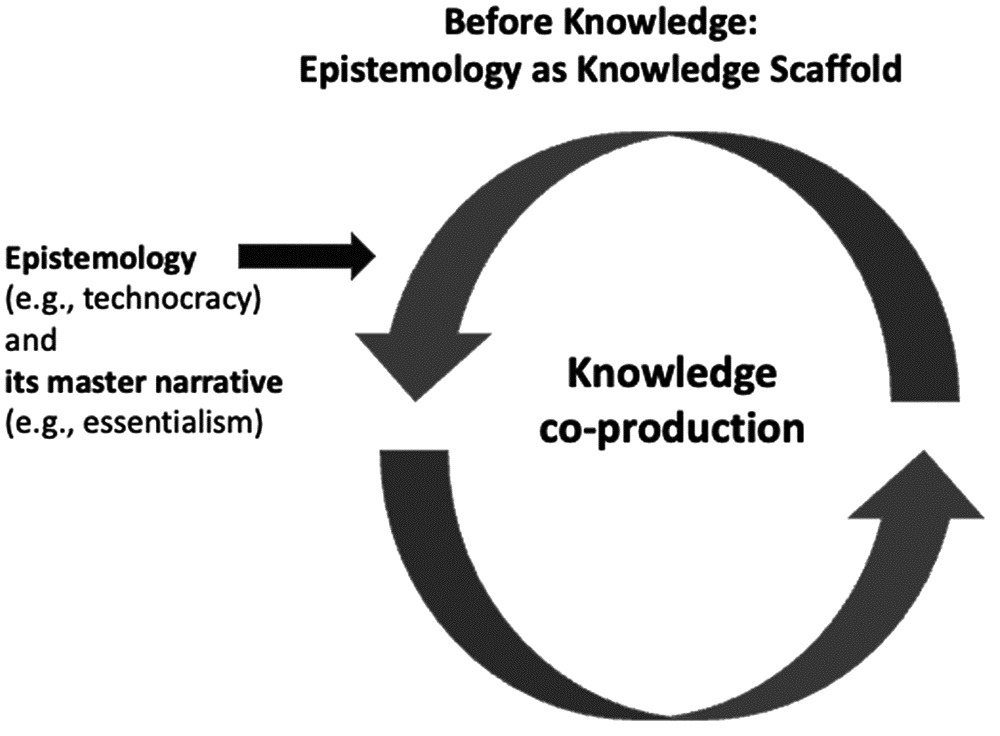
Epistemologies (e.g., technocracy) and their master narratives (e.g., essentialism) are powerful scaffolds that come before knowledge and shape the knowledge trajectory from conception and emergence to practice.
Lessons from disinformation on harmful health effects of tobacco smoke
One of the deadliest artifacts and epidemics in human history is cigarette and its harmful health effects such as lung cancer and respiratory system diseases. Of note, the lung cancer catapulted from being a relatively uncommon disease to a global epidemic after mechanization, high-speed production, and mass marketing of cigarettes by the end of the 19th century. The evidentiary base for the cigarette and the lung cancer epidemics was established already in the 1940s and 1950s. This was disputed by cigarette manufacturers of the time, however, through disinformation campaigns to salvage the cigarette sales and profits (Proctor, 2012). As a consequence, and not surprisingly, the acceptance of the linkage between cigarettes and lung cancer among the physicians was slow in the 1960s.
In a historical analysis of the cigarette-lung cancer link, Robert Proctor notes that the “tobacco industry insiders by the mid 1950s clearly knew their product was dangerous,” while also sharing the following apt observation on the adversarial power of disinformation campaigns in the mid-20th century, long before digital health and the COVID-19 pandemic. Proctor refers to an interesting context offered by Charles S. Cameron, Medical and Scientific Director of the American Cancer Society at that time, who suggested in a 1956 overview for the Atlantic Monthly, “that if the same level of evidence had been arrayed against, say, spinach, no one would have objected to the banning of that plant from the national diet” (Cameron, 1956; Proctor, 2012).
Addictive, harmful, and highly profitable products such as cigarettes with additional prospects of mass consumption exemplify how omission of the social and political pillars of knowledge production under the rubric of technocracy (e.g., “just trust science and scientists”) can pave the way for disinformation through unchecked human values, institutional hubris, and power.
Global disinformation campaigns by the tobacco industry to contest the overwhelming material evidence on the harmful health effects of tobacco smoke continued and extended to the second-hand (passive) smoke exposure in the 1980s (Barnes and Bero, 1998). For example, evidence in the 1980s supported the conclusion that passive smoking, too, has numerous harmful health consequences such as lung cancer and respiratory disorders (National Academy of Sciences, 1986; U.S. Department of Health and Human Services, 1986). Despite this, many articles continued to suggest that passive smoking is not detrimental to human health.
In a multiple logistic regression analysis of the review articles published from 1980 to 1995, Barnes and Bero (1998) showed, after controlling and accounting for article quality, peer review status, article topic, and year of publication, that “the only factor associated with concluding that passive smoking is not harmful was whether an author was affiliated with the tobacco industry (odds ratio: 88.4; 95% confidence interval: 16.4–476.5; p < 0.001).”
The latter finding speaks to the fact that (1) disinformation is inherently political in nature and (2) insisting on technocracy and essentialism in science does not permit us to recognize and address the political forces that affect knowledge veracity such as the source of research funding. Barnes and Bero (1998) further underline that “for a wide range of industries, publications based on industry-funded research tend to draw pro-industry conclusions” (Davidson, 1986; Lundh et al., 2018; Rochon et al., 1994). Industry funding, if it is left unchecked, can shift and drift research frames and agendas away from those that are most relevant for planetary health (Fabbri et al., 2018a, 2018b). To evaluate the veracity of knowledge, we need more than technical skills, and be prepared to ask questions such as: whose evidence, produced and funded by whom, to serve what ends?
The next section invites us to rethink science beyond technocracy and essentialism to fight the disinformation pandemic.
What is science?
At the root of systemic issues that underpin disinformation is a misunderstanding, a momentous and foundational blind spot, of what science and politics are. For starters, science is never “just science” (Özdemir, 2019c; 2020b). Nor does science take place in a vacuum outside society. Science is not an activity performed by value-free machines or alien robots from outer space, but by human beings with values, politics, emotions, empathy, and care, as well as hubris and power over other human beings, nonhuman animals, and nature.
Similarly, technologies in the scientific laboratory are not value free in that they are operated by value-laden human beings. Yet, the dominant master narrative of science taught in many, if not all, Science, Technology, Engineering, Mathematics-based programs is markedly different: that science and scientists are apolitical, value-neutral observers of phenomena in the nature and the human body, unaffected from culture, power, and human values (Feyerabend, 2011).
To this end, Robert Frodeman asks, “are we giving our children the skills they need for the future they will face?” (Frodeman, 2020a). He expresses valid concerns: “the humanities and most of the social sciences (except economics) were put on the back burner,” and that “education changed in the last decades of the 20th century. The focus turned to the practical fields, science and technology, and business, and away from the woolly-headed humanities. With America leading the world in technology, students were told that well-paying jobs would be available in fields like physics (electronics), biology (genetics and health care), computer science (the Internet), business and marketing, and in the allied health professions.”
“Science is sacred” is another common false assumption that exemplifies the essentialist approach to science. Once science is labeled as sacred and the scientists are declared as heroes, they become institutions and actors closed to criticism, skepticism, and independent inquiry, and instead open to dogma and disinformation.
Technocracy and essentialism are resistant to progressive change, and deeply entrenched within scientific cultures, in part, because they have existed and dominated how science was conceived for the past several centuries. Old habits die hard. Julia Steinberger summarizes the long-range historical context of technocracy:
“The scientific endeavor, since at least Enlightenment & Newton, tries to see its contributions as existing outside history and culture. If something is scientifically true, it should be true before it was “discovered” and for all eternity after. This is a lovely idea in theory, but with devastating consequences. Because no matter the eternal truth of a scientific finding: its interpretation and translation into understanding and action relies upon the cultural and historical context surrounding its discovery. So scientists disregarded history at great peril to the uptake of their findings. And the historical context of the late 20th century should have been taken much, much, much more seriously by scientific institutions and communities, because it included an ominous domination of neoclassical economic thinking in politics and culture, and a circumscribed, idealized role for scientists in public pronouncements and public life. Both of these will have to be challenged full-frontally before progress can be achieved.” (Steinberger, 2019).
While science has been falsely indoctrinated as a value-free practice since the age of Enlightenment in the 17th century, technocracy has intensified with narrowly conceived neoliberal policies since the 1980s, turning citizens to customers (Sclove, 2020) and science to a massive commodification apparatus. Unless we approach disinformation as a dual crisis in knowledge and epistemology, and are willing to tackle both, disinformation will deepen further in our age of pervasive human–computer interactions and ecological crises. And this is precisely where the entrenched and extractive epistemologies of technocracy and neoliberalism co-produce and synergize with each other, deepening the disinformation pandemic (Figs. 2 and 3).
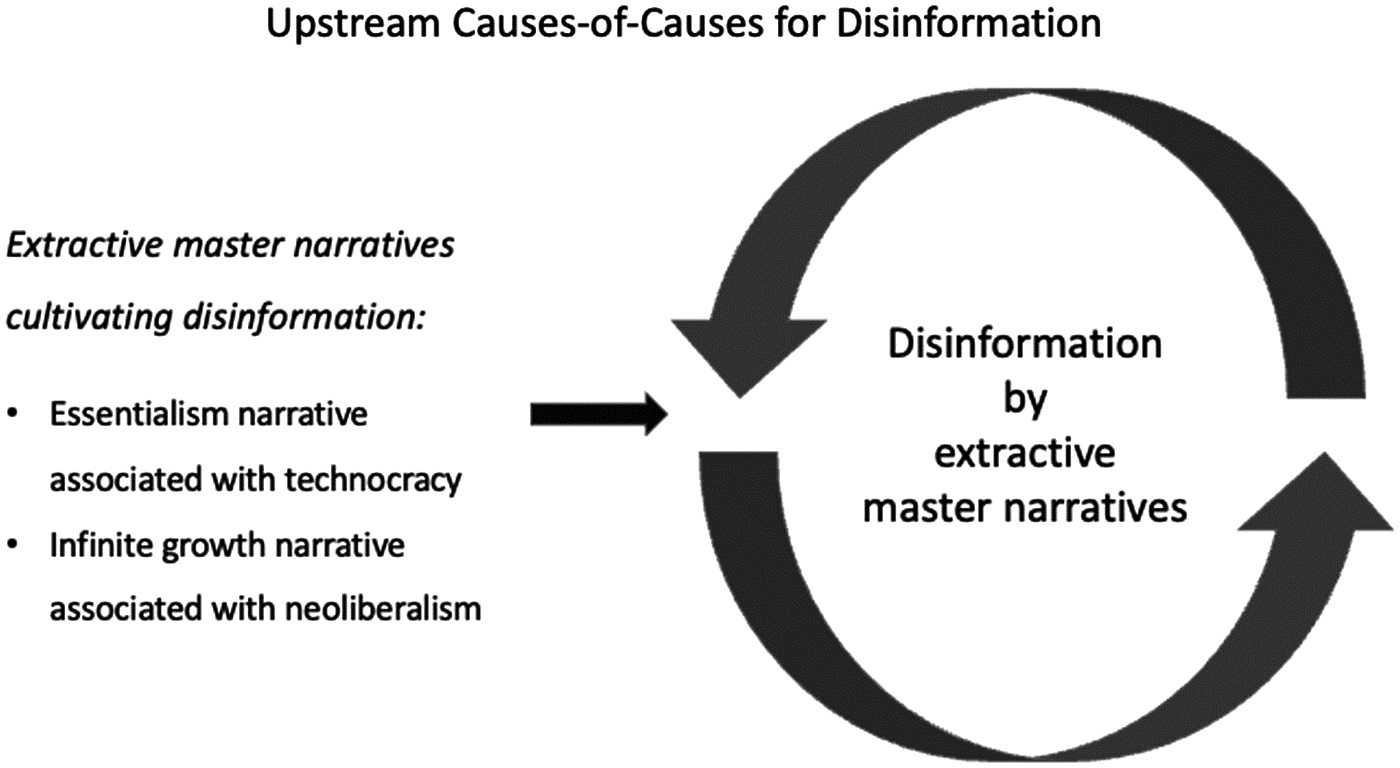
Extractive master narratives such as essentialism and infinite growth, discussed in this article, play an “upstream” role as causes-of-causes in creation, sustenance, and reproduction of disinformation across time, spaces, places, and generations.
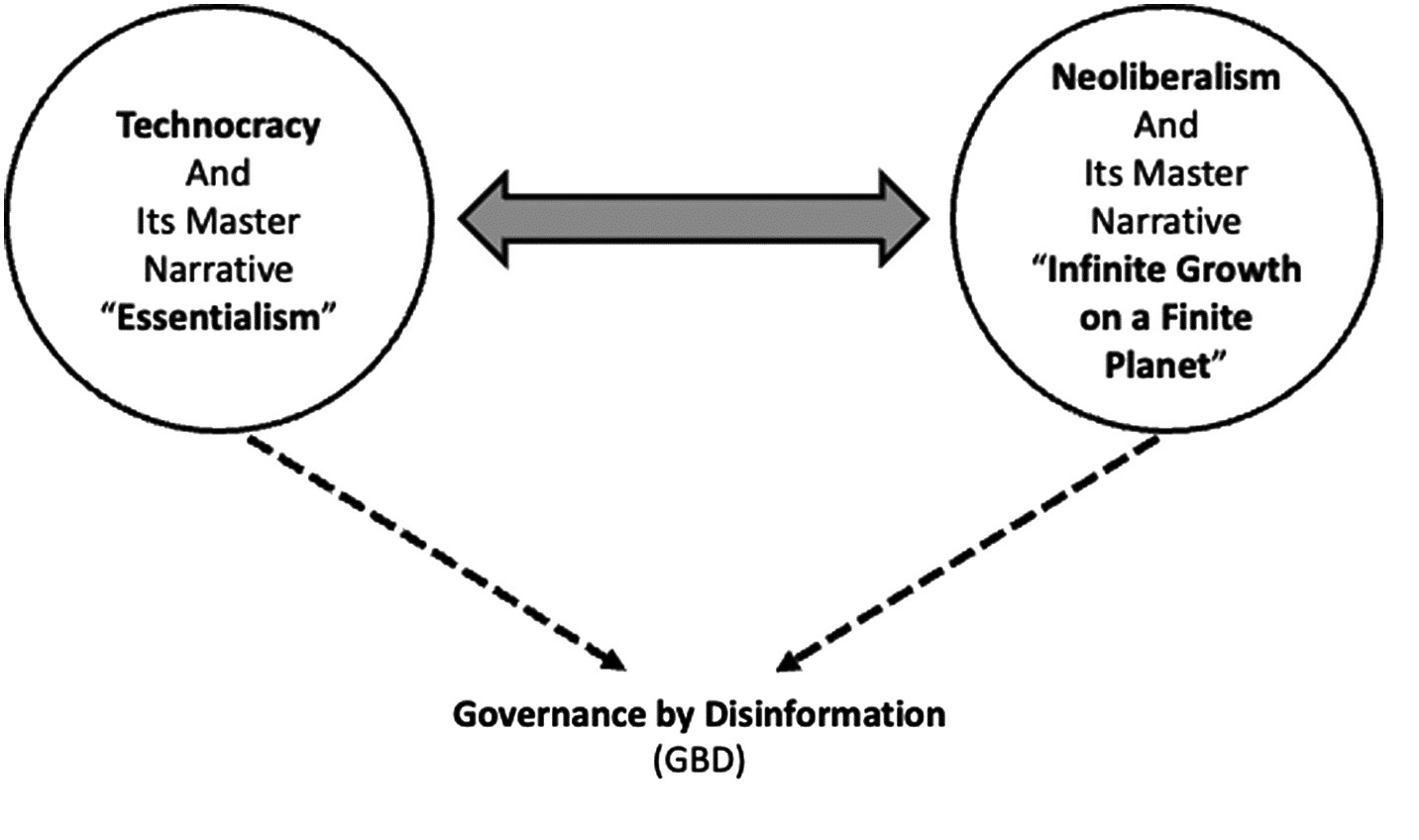
A nefarious epistemic collaboration: essentialism and infinite growth, as extractive master narratives, display synergy in empowering each other's disinformation capabilities in health care in a digital society, while also co-producing regimes of governance-by-disinformation in an age when authoritarian leaders and populist governance are worrisomely on the rise, weakening global democracy. Erosion of democracies and critical public spaces are directly linked to the rise of disinformation pandemic.
Recap on politics as the elephant in the science laboratory
Science is inherently political, and always has been. There was no immaculate conception for science. It was and remains an embedded epistemology. Politics is concerned with power asymmetries, current, historical, and structural, among others, in which knowledge is embedded from conception to production and dissemination. Leaving the politics outside our gaze creates an elephant in the laboratory that substantially adds to uncertainties and disinformation on the knowledge trajectory. Besides an instrumental concern, ignoring the politics embedded in science and knowledge production is normatively problematic because it produces social injustices in the way that science exists, is practiced, and is reproduced over time, spaces, places, and generations.
And yet, science has been interpreted as being outside of, and immune to politics, culture, human values, and historical and structural social injustices. The false maxim, “all one has to do, is to work hard!” has been the dominant narrative in science and scientific institutions. There are hierarchies in the laboratory, including exploitative practices around authorship and ownership of ideas, which translate into an uneven pattern of who receives grants, gets jobs, and therefore who ultimately becomes the future practitioners of science. So clearly, science is never just science, as discussed for decades by social science and humanities scholars (Feyerabend, 2011), and in a recent editorial in Science (Thorp, 2020). The latter is important and welcome, especially considering that it is coming from inside the cloistered epistemic fortresses of the Enlightenment's grandest project: science.
Denying the value-laden nature of science and scientists means setting ourselves up for immense political risks, and by extension, further disinformation, in the 21st century. There is hope for progressive cultural change in science, however. The dogma of science as an apolitical and undemocratic enterprise detached from and unaccountable to society is being challenged from inside the scientific community: “the notion of the apolitical scientist, I think, is clearly outdated” says, H. Holden Thorp, the Editor-in-Chief of Science (Devega, 2020).
A history that is as relevant, and more recent than the Enlightenment project of the 17th century, is the works of Vannevar Bush (1890–1974). Bush, an electrical engineer, was the driving force for the Manhattan Project and the atomic bomb; he also played a formative role in the creation of the U.S. National Science Foundation in 1950. Bush's report, Science, the Endless Frontier (Bush, 1945), continues to shape how many, if not all, scientists continue to think about science today. There has been amnesia, a political disconnect in how Bush's report is recalled, however, within the citadels of the scientific establishment:
“Although Bush is often held up as a model for keeping politics out of science, his writing and efforts were unmistakably political. “Science—The Endless Frontier” is first and foremost a masterwork of political persuasion.” (Thorp, 2020).
For example, Bush deployed politically expedient narratives, “For the War Against Disease” and “For Our National Security,” both of which were instrumental in leveraging support for biomedical research and the atomic bomb, respectively. These narratives that bracket out the ever-present politics and power asymmetries that contribute to scientific practice continue to dominate scientific thinking today. This speaks to the power of narratives in shaping individual and collective action in epistemic communities such as science. Such depoliticized, decontextualized, and ahistorical narratives of science also result in accrual of political risks that remain unaccounted, and thus amplifying disinformation as well as social injustices and other normative deficits in science. Taken together, science has never been apolitical: “It wasn't for Galileo. It wasn't for Darwin. It wasn't at Los Alamos.” (Devega, 2020).
There is a way out of this mess, and the apolitical narratives of science detached from reality, however. If we cannot separate the knowledge from the knower (e.g., scientists), and their values and political context, we need to think about the politics of knowledge so as to hold the value-laden nature of science and scientists (and indeed, of all knowledge actors) to account, and so they are less susceptible and resilient to disinformation. This takes us to another question: what is politics? And how is that related to, or different than political science, a type of critical social science that studies specifically power?
We answer these questions and broaden the concepts and definitions of politics in the next section.
What is politics? And political science?
As we seek new ways of thinking about and decolonizing knowledge upstream from disinformation, we need to think about what politics means. When faced with this question, many scientists answer adamantly that they are not political; some will further say that they resent politics, a “dirty thing” that ruins science, and that politics has no place in science or its governance. However, scientists are not immune to partisanship (Guston, 2004, Guston et al., 2009), and deeply political as with any and all human activity is.
Such “political claims of being apolitical” across various science cultures are not surprising, given that technocracy and its master narrative essentialism reduce knowledge to a narrow and false technical realm. Nor is this reductionism recent. Science, by its very design and framing from its early days in the 17th century Enlightenment project, has approached knowledge outside history, culture, and structural and systemic political factors that co-produce knowledge. The latter political factors include colonialism, racism, patriarchy, xenophobia, and homophobia, among others. This long history of reductionism, in the order of several centuries, is a fault line that manifests and remanifests itself as disinformation in quotidian science and society. The disinformation in the 20th century on the linkages between tobacco smoke and its harmful health effects attests to importance of political determinants of knowledge production and legitimacy.
Knowledge of these historical examples of the influence of unchecked politics in science should give us reason to pause and then embolden us to ask critical questions around contemporary health measures and responses. In the COVID-19 pandemic, we clearly saw how the downstream was political as partisan politics played themselves out in how masking, lockdowns, and vaccines were received (Boschele, 2021), but few were willing to look upstream at how the science of these responses was being produced, by whom it was being articulated, and what interests were being served.
Notably, this base-level threshold for critical inquiry was not being met, even as the relevant data were being purposefully withheld (Doshi, 2022). The neoliberal orientation of our societies was suddenly and inexplicably unworthy of examining, despite commodification of health having an inordinate amount of power in determining the science that would ultimately shape the course of the pandemic or whether health should be a PPG or not.
As discussed later, health is and has been a universal human right since the mid-20th century, a knowledge that did not come to the fore as much as it should have been in the pandemic discourses. Technocratic censorship, self-censorship, and the pressures of social conformity worked in concert to ensure that there was a single narrative around the response to the pandemic, and anyone unwilling to toe the line was ostracized as a delusional, conspiracy-minded heretic.
Meanwhile, “scientific progress is thwarted by the ownership of data and knowledge because industry suppresses negative trial results, fails to report adverse events, and does not share raw data with the academic research community” (Jureidini and McHenry, 2022), and we are somehow supposed to look away from these consequences of our entrenched neoliberal worldview as unimportant, and simply “trust the science” without checking the social and political determinants of planetary health. This is a version of science that is deeply political insofar as it is beholden to shareholder interest, good optics by public relationships, and brand fidelity, not the PPG and the universal human right that health is and always has been since the mid-20th century.
A second reason why politics is dismissed by scientists is a momentous misunderstanding of what politics is, and where it is situated. Politics refers to various ways of participating in distribution of shared resources and power. Politics is ever present. Political engagement is absolutely crucial in any shared collective social activity, be it in the parliament and the congress, or a university, family, commune, workplace, public transport, and on the street. Absent political engagement, a slippery slope is formed toward authoritarianism and totalitarian forms of governance in science and society. Political engagement of scientists is important for democracy, social justice, and the fight against disinformation.
In this article, we argue that technocracy is an epistemology, precisely because it (1) determines the “ways of knowing, and how we know” in science, (2) limits decisions to technical expertise, and (3) dismisses the nontechnical dimensions of science governance such as representation, diversity, and equally importantly, the structural and historical power asymmetries in society. A technocrat scientific leader would make appointment and hiring decisions based on apparent technical skills and publication metrics of a university job applicant, dismissing the fact that academic success is co-produced by class, inherited social capital, gender, sexual identities, and migration, among other systemic factors that are often not acknowledged (see, for further discussion, Domínguez, 2021; Ramirez, 2021).
Technocratic leaders can be deceptive (and are deeply political), too, deploying token appointments as though serving diversity, but without questioning the structural, systemic, and historical social injustices, or the ways in which the infinite growth narrative of neoliberalism (e.g., as evident in the oppressive “publish or perish” policies) is destroying both planetary ecosystems and veracity of knowledge in the 21st century.
It also does not help that for technocratic and neoliberal governance narratives, when people ostensibly fail in a given salient task such as making a living or having academic tenure, it is invariably the individual's fault, and not the unchecked structural and systemic social injustices such as racism and colonialism they have been subjected to generation over generation. It is important, therefore, that extractive epistemologies such as technocracy and neoliberalism are held to account, not least because these epistemologies are major, upstream, colonizers of the knowledge production trajectory, and thus deepening the disinformation pandemic. Technocracy and neoliberalism ought to be examined together (Fig. 3), for they feed into and feed off each other, bolstering the extractions produced by each epistemology.
Third, politics is dismissed by scientists because it is understood as an activity that is confined exclusively to the government, parliament, congress, or policy institutions. Politics is perceived as a realm separate than science or everyday life, an activity that one can choose to enter or not. This binary conceptualization of science versus politics is demonstrably false. Politics is present everywhere, not only in governments but also in any collective social sharing of resources and power; politics is not something that one can choose to abstain.
Even an innocent-looking smile can be political if it is intended to garner social capital to exploit others and exert influence on others (Özdemir, 2020c). Ignoring politics results in weakening of science and human rights, defunding of certain types of valuable research and scholars who ask critical, epistemological questions of relevance to our ways of knowing, how we live, play, and do research every day. Decontextualized, ahistorical, and depoliticized science is a serious vulnerability for disinformation. This keeps reproducing the aforementioned historical and current structural social injustices in science that serve as catalysts for disinformation.
Finally, politics is dismissed in science cultures due to another momentous misunderstanding: in this case, of what political science is. Political science is a type of social science that examines power in particular. Human geography and other critical social sciences are also relevant to the current fight against disinformation because they bring about the much-needed transparency, and thus accountability to the backstage of and power asymmetries in science. Critical social sciences and humanities are antidotes to the unchecked human power in science and society. They offer the methods and means of liberation from disinformation, oppression, and the historically antidemocratic design of the modernist scientific project since the age of Enlightenment in the 17th century.
To be sure, what one should be afraid of is not politics, political science, or critical social sciences and humanities, but unchecked human power and social injustices that are not held to account in science and society. Disinformation thrives when science and publics are pacified and rendered uncritical through depoliticization, and when democracies are weak or obliterated. Leftwich (2009) offers a broad definition of politics below (Kickbusch, 2015). The definition bodes well for a principled and effective resistance to disinformation by rethinking politics as an inseparable and essential part of all human and social activity, including science:
“[P]olitics is a pervasive process found in and between the smallest groups and across all spheres of society. It is a fundamental, necessary and functional process which is found not only in the formal arenas and sites of public politics and public policy (parties, elections, legislatures, etc.), but is at the heart of all collective social activity, whether this is formal or informal, public or private. As a process which finds expression wherever two or more people are engaged in some collective endeavor, however small-scale, however limited in scope and petty in its implications, politics is thus a feature of all human groups, organizations and societies, not just some of them: it always has been and always will be.” (Leftwich, 2009).
With our proposal of rapid epistemic disobedience to decolonize from technocracy and neoliberalism in the current decade 2022–2030, this article aims to broaden the definitions of politics to decolonize knowledge upstream, at the level of unchecked epistemologies and narratives.
The next section dives deeper in this context, and presents a case study of neoliberalism as another entrenched epistemology, and the ways in which its master narrative infinite growth creates a thick fog over knowledge veracity, thus fanning the flames of disinformation.
Case Study 2
How neoliberalism and its infinite growth master narrative contribute to disinformation
Economics has salience for “omics” systems science. Its importance is not rooted in the “omics” suffix or a particular omics technology, however. Economic systems and the master narratives they embody (e.g., infinite growth) are relevant to research on disinformation precisely because they impact on how, and with what motivations, values, and pressures, we produce and attach meanings to knowledge. Economics shapes the dominant research cultures and human values, and impacts on both the means and the ends of knowledge production, and by extension, on the extent to which knowledge has veracity or not.
Economics based on the infinite growth imperative needs reforming to prevent disinformation as well as to have a planet that is still habitable in the coming decades. Neoliberalism, the dominant modality of capitalism in the present, has been sought after by scholars as an economic system and analytical context to explain, for example, the rampant ecological destruction, infectious outbreaks, social conflicts, and the growing gaps between the rich and the poor (Bargu and Bottici, 2017; Springer, 2012a, 2012b, 2015). This contrasts, however, with relative paucity of analyses that examine the linkages between neoliberalism and the disinformation pandemic in a world undergoing pervasive digital transformation.
Neoliberalism has a direct influence on the question “how do we know what we know?.” Its master narrative, the infinite growth imperative, is pervasive and ever present day and night.
Consider the following real-life examples and contexts: whether you are working in a business office cubicle or the neoliberal university where scholarly conference travel might be cut under the false pretenses of institutional efficiency; having permission for only a short lunch break when you need to eat fast so you can return to the factory working floor expeditiously; need to visit the washroom in an AI-powered oligarch owned “smart factory” where such necessary work breaks are limited under a disinformation campaign labeled under an assortment of factory efficiency rhetoric; and the infinite growth narrative dictates what we value and prioritize in the way we live, work, play, and produce knowledge. How can such a pervasive and oppressive narrative, an upstream relentless force field placed on the means and the ends of knowledge, be overlooked in critical studies of disinformation?
In a 60-sec video, Jason Hickel explains how the unchecked narratives of infinite growth, especially without their social and environmental costs and consequences, are destroying the human and nonhuman worlds and the planetary ecosystems (BBC Newsnight, 2017); the video is also relevant to research on disinformation and post-truth studies. For our purposes in this article, (1) because the epistemologies and the narratives we live by have political agency and power on us and (2) power and knowledge are inextricably intertwined (Foucault, 1980), efforts to understand and resist disinformation will always be incomplete and inadequate unless the political agency of unchecked epistemologies such as neoliberalism and technocracy and narratives such as infinite growth are held to account. The power of entrenched epistemologies on knowledge and its veracity are often overlooked, a gap which this article is aimed at.
Neoliberalism as an external and internal lever
As an external lever on disinformation, neoliberal cultures dictate the scale and speed of knowledge production in and outside academia, in public and private sectors (Springer, 2016, 2017). Oftentimes, the pressures for rapid and infinite growth, be it scientific publications or profits in the market place, are so immense that there is simply no adequate time for critical deep reflection on the knowledge production trajectory or to check the sensitivity/frailty of the assumptions made in scientific designs and experiments. These fault lines are, unfortunately, the well-known ingredients for disinformation.
The drive to satisfy the narrow end of infinite growth in neoliberal metrics prevails over veracity of knowledge at the end of a neoliberal day in a neoliberal institution in a neoliberal digital society.
Neoliberal science policies enact on scientists and research cultures to enforce the infinite growth master narrative (e.g., “publish or perish”), legitimize hypercompetition and hubris in the face of insincere double-talks for teamwork and collaboration, and reduce scientific quality to numbers without a social, historical, and political context. A recent article amid the COVID-19 pandemic in OMICS has highlighted similar concerns:
A 2013 study estimated that Australian scientists collectively spent more than five centuries of time preparing 3727 proposals in 2012 (Bollen, 2018; Herbert et al., 2013). The current rewards and incentives system for scientists has a heavy reliance on use of quantitative bibliometrics that chase researchers on their research productivity (San Francisco Declaration on Research Assessment, 2012). This results in a paradox of scientific productivity. The more individual scientists become productive (in terms of the current system), the less productive the scientific system becomes in terms of actually delivering on societally relevant and desirable outputs. This paradox becomes particularly visible against the current background of addressing an ecological crisis such as COVID-19. (Von Schomberg and Özdemir, 2020).
Under a neoliberal governance regime, science moves toward an “ends justify the means” ethos where the methods and the means of knowledge production bear much less weight, and detach from the ends of knowledge (Fig. 4). When the methods of knowledge production become invisible or pushed back to a secondary significance by the infinite growth narrative, knowledge production becomes unaccountable. The methods of production are then closed to critical scrutiny, and rendered open to disinformation.
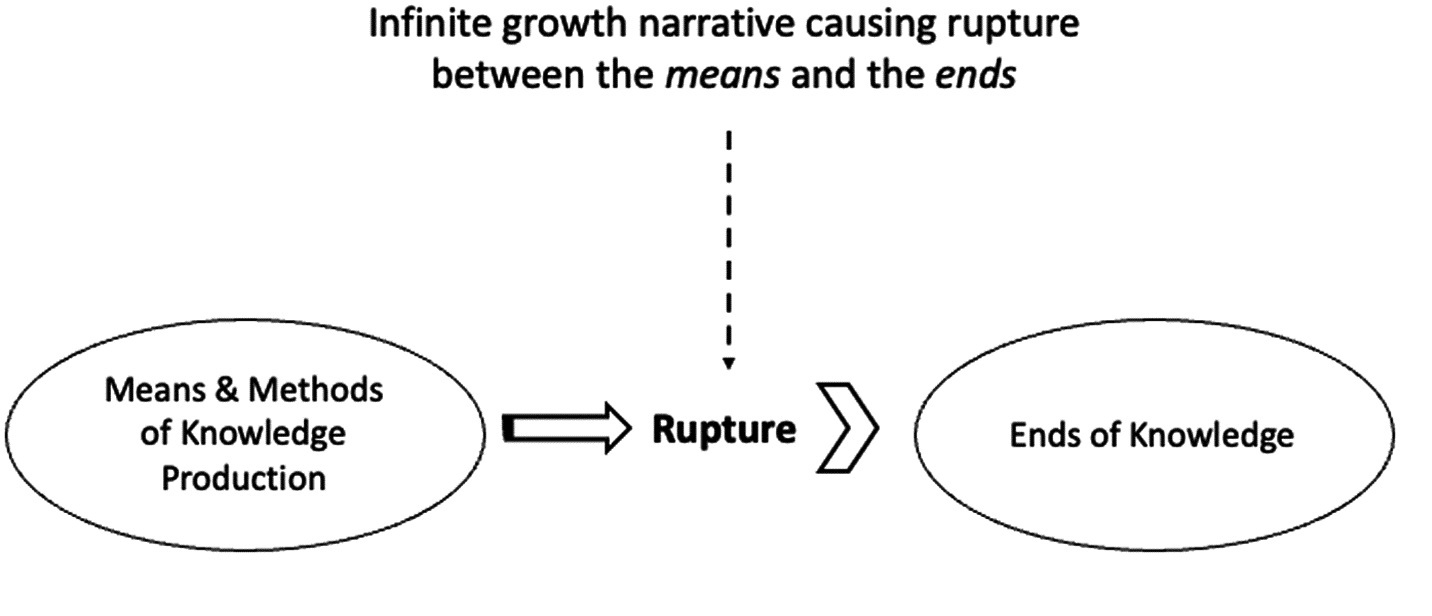
Under a regime of infinite growth, the means and the methods of knowledge production are ruptured from and become discontinuous with the ends of knowledge. This renders the provenance of knowledge, especially its production means/methods, invisible, opaque, unaccountable, and thus susceptible to disinformation.
As an internal lever on disinformation, neoliberalism serves as creator and catalyst of partisanships and regimes of fear among scientists as well as social science and humanities scholars. It promises to the “neoliberal-self” individual prestige, influence, hubris and power, all factors that can undermine the veracity, means and ends of knowledge. Questions such as “how many million dollars have you actually raised?” begin to bear more salience than original ideas and authentic scholarly hypotheses that serve public interest.
The rise of the neoliberal university and institutions generates much existential fear, precarity, and survivalist psychologies and cultures among the already “atomized,” isolated, and neoliberalized individuals and faculty who are no longer able to establish solidarities, and submit instead to the untenable demands for infinite growth in their academic outputs for self-preservation. These cultural settings markedly increase the potentials for compromises to knowledge veracity, not to mention to the personal health and welfare of the neoliberalized knowledge workers who are placed on a Ferris wheel programmed for perpetual motion to deliver the impossible infinite growth.
All in all, neoliberalism cultivates a cultural and political milieu of violence, one that is very fertile to the sparks of disinformation, which can light up easily and amplify to seismic proportions, especially in the face of pervasive human–computer interactions discussed earlier. Those who resist neoliberalization under the unchecked narrative of infinite growth are often subjected to derision and character assassinations with an eye to silence them. It is not uncommon that an assortment of disinformation campaigns is deployed by neoliberal actors through double-talk regimes that embody, for example, a toxic unjustified optimism from neoliberalism, despite decades of evidence showing its destructive effects on transparency in means and methods of responsible and reflexive knowledge production.
The role of double-talk as a method of creating confusion that weakens critical thinking of the public, and thus facilitates disinformation, is often inadequately recognized. This makes resistance to upstream disinformation mechanisms such as double-talk, extractive narratives, and epistemologies all the more challenging. However, this is also the very reason why we need to fight disinformation at its upstream causes-of-causes by decolonizing from entrenched epistemologies, for example, technocracy, neoliberalism, and narratives such as infinite growth.
Infinite growth narrative: an actionable target to fight disinformation
It is so important to have a deep scrutiny on “provenance of knowledge” when we attempt to understand the reasons for and imagine new interventions against disinformation (Fig. 4). We define the provenance of knowledge as the processes and the sociomaterial contexts in which an idea emerges, and coalesces into knowledge through nonlinear and discursive processes and iterations of sensemaking. Narratives serve as both sociomaterial contexts and processes that influence the emergence and production of knowledge in any domain of lived experience and scholarship.
We suggest, therefore, expanding the scholarly inquires and research on disinformation from downstream to upstream, to unpack the entrenched epistemologies that lurk underneath disinformation. Yet, there is more to the upstream dimension of disinformation. Master narratives embodied by epistemologies, too, warrant attention as actionable upstream targets. Just like we need new molecular targets for innovation in drug discovery, social sciences and humanities research aimed at finding novel interventions against disinformation also require new and actionable targets. There are several reasons to think that master narratives offer promising avenues for new interventions to decolonize knowledge from disinformation.
First, let us consider neoliberalism as an entrenched epistemology, argued here as an upstream catalyst for disinformation. Foucault was one of the first social theorists to interpret neoliberalism in his lectures on biopolitics at the Collège de France (1978–1979), before the two fierce proponents of neoliberalism took office, Margaret Thatcher in Britain and Ronald Reagan in the United States (Foucault, 2008). Neoliberalism is not only an economic system but also a form of active governmentality. Notably, Foucault distinguished neoliberalism from classical liberalism. He underlined that neoliberalism is not a “laissez-faire,” free play of market forces. Instead, Foucault interpreted neoliberalism as a form of governmentality where markets were actively created to commodify every sphere of life, animate and inanimate (Emre, 2021; Springer, 2012a).
Neoliberalism has also been conceptualized, for example, as “the restoration of elite class power; a political project of institutional change; a set of transformative political-economic ideas; an international development policy paradigm; and an epistemic community or thought collective” (Birch and Springer, 2019). We suggest that infinite growth, as a master narrative, offers a crosscutting thread that can bridge various conceptualizations and analytical applications of neoliberalism, particularly as an economic system and an active form of governmentality. Hence, the infinite growth narrative offers utility as a tool to track and intervene on neoliberalism in diverse contexts where it contributes to disinformation.
There are additional reasons why a narrative focus may be fruitful in disinformation research. In the case of infinite growth, it captures the adversarial effects of neoliberalism on knowledge veracity both as an external and internal lever and relates well to psychosocial construction of disinformation by both politics and human emotions such as fear of precarity and the hubris of hypercompetition highly prevalent in neoliberal systems.
As upstream catalysts of disinformation, neoliberalism and technocracy reinforce each other as extractive epistemologies (Fig. 3). Reorienting disinformation research toward their respective master narratives, infinite growth, and essentialism allows for a complementary layer of scholarly inquiry to track their interactive effects on disinformation creation and sustenance. For all these reasons, there are formidable prospects for narrative research to decipher the upstream mechanisms of and interventions against disinformation.
We discuss below examples on how the pursuit of infinite growth is often the invisible and yet substantive upstream mechanism associated with disinformation.
Convergence: digital transformation, infinite growth, and disinformation
“Connect until everything else is connected to everything else” is the motto adopted (uncritically) to implement the digital technologies of this era. We live in a hyperconnected world driven by the infinite growth narrative; this includes human–computer interactions. A discourse of Industry 4.0, the Fourth Industrial Revolution and CPS—discussed in the introduction—which places the physical and digital worlds in close spatial and temporal proximity, is ever present in quotidian science and society. The notion of the Fourth Industrial Revolution was embraced as an alleged new chapter in human development in the World Economic Forum. Yet, this is far from certain. Not everyone agrees on whether we are truly witnessing the dawn of a fourth industrial revolution (Garbee, 2016): “The term “fourth industrial revolution” has been reportedly in existence for more than 75 years. It was introduced in 1940 in Albert Carr's article entitled “America's Last Chance” (Carr, 1940).”
Toxic optimism: a hitherto underrecognized neoliberal instrument
The motto to connect everything to everything else also reflects a toxic optimism (Sclove, 2020) when it is not accompanied by critical reflection on emerging technologies and human–computer interaction. The use of optimism is a common neoliberal governance instrument to silence opposing views and dissent. Hence, it is important to recognize that optimism can also be toxic if it is preconceived as an antidemocratic backstage to silence critical analyses that are necessary in democracies. Let us bear in mind that extreme digital connectivity lends itself to population surveillance, concentration of political power, and loss of critical public spaces.
Moreover, the promise of Industry 4.0 to bring together the physical and digital worlds so as to benefit humanity did not, after all, happen in a symmetrical manner. That is, the reliance on digital networks has become so dominant and pervasive that the analog-material-physical public spaces are nearly obliterated amid COVID-19. The Internet and the media, far from being free, are increasingly controlled by politics and power concentrated in the hands of big tech, oligarchs and the rise of autocratic leaders around the world. Schiffrin (2021) has recently analyzed the “media capture,” that is, how hitherto independent institutions and journalism that are so crucial for democracy and to scrutinize claims of knowledge have been steadily falling under the control of governments and plutocrats.
The infinite growth narrative lurks underneath these sociomaterial transformations: the drive for extreme digital connectivity; the discourses of Industry 4.0 and the fourth industrial revolution; and the media capture. They collectively create fertile grounds for the rise and sustenance of disinformation pandemics, now and in the future. A discourse of toxic optimism presents these nefarious social changes as though they are benevolent so as to silence dissent and critical studies of digital technologies.
Echo chambers and epistemic bubbles
Because digital media has enormous geographical and spatial (24/7) outreach, it can repeat falsehoods at extremely high speeds, resulting in what social scientists and philosophers call epistemic bubbles and echo chambers. Among these predicaments, the latter is more nefarious than the former. An epistemic bubble refers to a situation where an individual or community is lacking access and exposure to other relevant “outside” voices and information. An echo chamber, on the other hand, emerges when “other relevant voices have been actively excluded and discredited” (Nguyen, 2020).
While epistemic bubbles can “burst” by exposure to hitherto inaccessible relevant information and arguments, echo chamber residents are like cult members because they are systematically taught to distrust all outside sources (Nguyen, 2020). Exposure to accurate information does not necessarily eliminate disinformation in the case of echo chambers. It is, therefore, very difficult to “unlock” an echo chamber once it is formed, and once its members are locked into accepting disinformation. The infinite growth narrative is one of the chief levers of extreme digital transformation in numerous sectors, and by extension, elevating the propensity for epistemic bubbles and echo chambers overflowing with disinformation.
Personalization of current and future user experiences based on past experiences in hyperconnected digital networks is yet another mechanism by which unchecked human–computer interactions and the infinite growth narrative silently and nefariously serve as upstream drivers of disinformation. In this context, there is a race to collect big data from digital technology users by the Industry 4.0 paradigm of human–computer interaction under an infinite growth (in big data) narrative. This creates veritable risks for disinformation as well as research cultures and echo chambers closed to a broader range of creative ideas and possibilities for scientific discovery:
“[P]ersonalization of online searches by the Internet giants such as Google and Facebook based on where we login, what we have searched for in the past, and other user attributes are creating filter bubbles that increasingly define (and narrow) the range of our online experiences, exposure to alternative epistemologies, and how we consume data and information (Pariser, 2011). Such personalization of online experiences by Internet firms brings experiences that are familiar to and consistent with our past preferences. However, the filter bubbles and online networks that are personalized based on past preferences also limit the creative sparks from chance encounters with people and ideas that are unprecedented or markedly different than our own.” (Özdemir and Hekim, 2018).
Importantly, the infinite growth narrative does not ask critical questions such as “growth in what, to what ends, and funded by whom?,” and is a dangerous game of brinkmanship that has been testing the planetary ecological boundaries and putting at risk the veracity of knowledge. It is interesting to note in this context that cancer is uncontrolled unchecked cellular growth, but although one that is to be prevented and remedied for health. In other words, it is important to ask, “growth in what?” and “at what social and environmental costs?.”
Yet, the infinite growth master narrative of neoliberalism transforms knowledge production into a cancerous growth with opaque provenance, lacking checks and balances on the means, methods, and ends of production. The only way to satisfy the infinite growth narrative is growth akin to a cancerous proliferation. And both cancers and infinite growth without provenance run the risk of irreversibly damaging their hosts, human body, and the planetary ecosystems, respectively.
In effect, the drive for infinite growth creates momentous blind spots, echo chambers, and lack of accountability by silencing the provenance of knowledge. This renders the methods of growth, including knowledge production, silent, irrelevant and invisible. For liberation from disinformation, we need to reinstate the provenance of knowledge and make it accountable by decolonizing from the infinite growth narrative (Fig. 4).
There is no baby in the bathwater
In this moment in 2022, the infinite growth juggernaut as a master narrative and entrenched value system is so pervasive that it is embedded in both private and public sectors, including the governments around the world that seek infinite extraction of nature and fossil fuels, despite clear evidence that the planet is on a collision course unless our ways of living, working, and relating to each other and the nature are radically and rapidly transformed (Hickel et al., 2021; Kallis, 2017, 2019). In the meantime, this raises further questions. How do publics make a living, and in what kind of institutions, without being co-opted by the infinite growth narrative that is irreversibly destroying the planetary ecosystems and turning knowledge and its veracity akin to a cancerous growth?
As we mention further at the end of this article, if we were to live free, emancipated, and in solidarity on a rapidly warming planet with finite material resources, without being agents and pawns of technocracy or the infinite growth narrative, we need critical governance in science and society such as the prefigurative politics of mutual aid, direct action, and voluntary association. To achieve this, scientists and publics need to call out the entrenched master narratives that are harmful to knowledge veracity and planetary sustainability. Those who resist the obvious recklessness of the pursuit of technocracy and neoliberal infinite growth are not reckless, but actually helping to decolonize knowledge from disinformation. The latter acts of direct action also contribute to living responsibly and in solidarity with both current and future generations amid the climate emergency (O'Neill et al., 2018).
As with Technologies, Narratives, Too, Get Entrenched
The relationship between science and society was technocratic by its very design from the early days of the Enlightenment project in the 17th century. Bush's (1945) report Science, the Endless Frontier remains a dominant technocracy narrative, and one that is deeply political, presenting scientific practices falsely, as though they are apolitical. However, the technocratic approach to science and society relationship was not without its critics even in the early days of the 20th century, and there were always voices divergent from the narrow and straight jacket of technocracy. Frederick Soddy, a recipient of the Nobel Prize in chemistry in 1921 for contributions to the chemistry of radioactive substances, and the origin and nature of isotopes, reflected on broader implications of science and technology.
In 1915, Soddy had the prescient foresight, and discussed publicly, the future dangers of atomic war, a thinking rather unusual for his time and well outside the toxic optimism and expectations of his fellow scientists from new technologies and scientific discoveries. Notably, Soddy's insights and broader lens on science and society relationship were informed, for example, by contemporary politics and history, knowledge domains that are traditionally considered and dismissed as “nonscientific knowledge” within technocratic communities and science cultures (Sclove, 1989).
Yet, as we discussed earlier in the case of tobacco smoke and its harmful health effects, and in the context of a singular health response to the COVID-19 pandemic that was tied very closely to designing vaccines for profit rather than people, a sound knowledge of the political determinants of science is crucial to have checks on knowledge provenance and for resilience against disinformation (Attiah, 2021; Mazzucato et al., 2020). In Soddy's case, his broad take on science allowed him to think beyond technocracy and immediacy of his times, long before the perils of the World War II and the atomic bomb became apparent.
It is noteworthy in this context that even though many social scientists and humanities scholars ordinarily examine science from a critical political science lens, when a scientist employs a critical theory lens to examine her/his own trade, that is, science, other scientists and subscribers to technocracy are often unkind, to put it mildly, to those who ostensibly depart from the epistemic tribe of technocracy and its echo chambers. Soddy died in relative obscurity in 1956, despite the Nobel Prize in 1921 and contributions to science and society (see also, Sclove, 1989, for a detailed account of this fascinating history of science outside technocracy in the early 20th century).
Later, in the 20th century, David Collingridge published a prescient book on technology governance (Collingridge, 1980). The book was concerned with “increasing social agency over technology—away from incumbent interests in what have come to be called ‘innovation systems’” (Genus and Stirling, 2018). Collingridge articulated a “dilemma” in this context. He noted that there is often insufficient information about an emerging technology in its early stages about attendant social consequences. In this early emerging stage, technologies are, however, corrigible and open to alternative development scenarios.
Conversely, by the time the broad social consequences are apparent during the advanced stages of development, technologies become noncorrigable or “entrenched” in a complex web of social, economic, and political relationships and interdependencies, including clientelism. An entrenched technology is not responsive to social values, needs, and priorities, and thus difficult and costly to steer toward alternative trajectories and futures. The Collingridge dilemma articulates the tensions among the timescapes, sociotechnical consequences, and corrigibility of emerging technologies (Collingridge, 1980).
For our purposes on new concepts and ways to fight disinformation in an era of extreme digital transformation, there are lessons to be drawn from Collingridge's work on technology governance, social agency, and entrenchment. We argue that epistemologies and their core values in the form of master narratives, too, become entrenched. This is relevant for future interventions against disinformation. To the extent that narratives such as infinite growth serve as upstream generators and catalysts of disinformation, an entrenched narrative is even more difficult to overthrow and decolonize from individuals' psyche and quotidian science and society. Hence, whatever interventions against disinformation are imagined, designed, and tested in the future, they would be well poised to address the entrenchment of narratives, as much as the narratives themselves.
In this article, we discuss later that being open to “epistemic ruptures” and discontinuities, rather than seeking incremental solutions, are worthwhile and legitimate considerations for effective interventions against disinformation. This is particularly the case in the current context of climate emergency when the infinite growth narrative and attendant practices such as fossil fuel consumption need to be decolonized rapidly in the current decade, before further irreversible damages to the planetary ecosystems materialize (Albert, 2020; Harvey, 2022; IPCC, 2021).
Time, duration of exposure, and intersectionality matter in narrative entrenchment
Technocracy has a convoluted history dating back to the 17th century Enlightenment project, as we noted on many occasions in this article. Such long history of exposure to technocracy is not easy to decolonize, especially in the short time frame required in an age of climate emergency. Technocracy and essentialism often co-exist with neoliberalism and its infinite growth narrative (Fig. 3), which contribute to their respective entrenchments.
Neoliberalism legitimizes infinite growth, for example, through technocratic metrics that are de-politicized and stripped from structural, historical, and systemic social injustices such as colonialism, racism, patriarchy, and class. The apolitical approach of technocracy helps neoliberalism to silence dissent which, in turn, contributes to reproduction and entrenchment of neoliberalism and infinite growth narrative across generations, spaces, places, and timescapes.
The engine for the juggernaut of growth and competition is discussed by Jason Hickel in relationship to the enclosure movement in England dating back even centuries earlier, and subjecting humans to artificial scarcity:
Ellen Eiksins Wood (1999) has argued that the origins of capitalism lay in the enclosure movement in England, during which wealthy elites—empowered by the Statute of Merton of 1235—fenced off commons and systematically forced peasants off the land in a violent, centuries long campaign of dispossession. This period saw the abolition of the ancient “right to habitation,” once enshrined in the Charter of the Forest, which guaranteed ordinary people access to land, forests, game, fodder, waters, fish and other resources necessary for life. In the wake of enclosure, England's commoners found themselves subject to a new regime: in order to survive they had to compete with each other for leases to farm on newly privatized land. Leases were allocated on the basis of productivity, and were reassessed at regular intervals. In order to retain their leases, peasants had to find ways to intensify their production vis-à-vis their competitors (with whom they used to relate convivially and in cooperation as kin and neighbours), even if it was in surplus to their actual needs or even desires. Those who fell behind in the productivity race would lose their access to land and face starvation.” (Hickel, 2019; Wood, 2022).
The impossibility of infinite growth on a finite planet has been noted for digital products as well, for they also depend on the analog world and material resources:
There's no form of economic activity that can be completely divorced from the finite materials provided by the Earth, regardless of who governs it: wealth is intrinsically tied to material resources. Some economic activities are more obviously dependent on materials. Agricultural production, for instance, is very obviously bound by material limits. There's only so much arable land area, only so much ammonium nitrate, and only so many hands to till the land. […] There are other kinds of economic activity that are less obviously material, like digital tech companies, or services like barber shops, or entertainment industries like sports teams. But the bodies of the people who drive this kind of economic activity are also dependent on finite resources, the time people have to use their bodies for these activities is limited by physical resources, and all the tools used in these activities, whether datacenters or fiber optic cables, footballs or scissors, are also dependent on limited resources (McDonald, 2019).
Zaitchik (2020) underlines that “even just one more century of growth—which so far has shown no sign of taking a less destructive form—will require multiple earths” (Hickel, 2020).
The invisible, but very real “nefarious epistemic collaboration” between technocracy and neoliberalism helps legitimize their mutual existence, political agency, and unchecked power over publics. Technocracy, neoliberalism, and violence converge intersectionally, leading to psychological oppression, regimes of fear, land grabs, appropriation of the commons, and loss of critical public spaces. Cultures and practices of pervasive human–computer interactions in the current era only add to this volatile epistemic and narrative mix, all ingredients that lend to pacified publics and fertile grounds for disinformation.
A growth in public transportation, universal health care, and education is desirable for a good and sustainable life on planet Earth. Conversely, we have already noted that seeking growth in ways that are unreflexive and entrenched, without asking, growth in what?, and at what costs to environment and society?, is a dangerous game of brinkmanship that lends itself to both disinformation and ecological destruction.
There are other miscellaneous reasons for entrenchment of extractive epistemologies and narratives that are covered elsewhere. We refer the interested reader, for example, to recent works on global governance and international affairs (Buxton and Fries, 2021; Manahan and Kumar, 2021), and how a combination of nativism and multistakeholderism has dislocated the locus of key policy decisions from the multilateral system (https://www.tni.org/en/publication/the-great-takeover). These regressive changes in global governance undoubtedly have an influence to further entrench the infinite growth narrative, thereby amplifying the susceptibilities for the disinformation pandemic.
Intervention 1: Rapid Epistemic Disobedience
We need to rethink everything under the sun and the moon
Our ways of living and relating as humans have been deeply extractive, especially over the past 300 years of industrial transformation. We have extracted other nonhuman animals, human beings and their labors, nature, and all life, and inanimate material in planetary ecosystems. We need new approaches that describe and distill the ethos of “pulling the emergency brakes” on the narrative of infinite growth that is currently locked in extraction, and competition to the point of extinction. We need to steer toward a “radical exit” to emancipated care societies (Harvey, 2022; IPCC, 2021), and demonstrate a willingness to listen to and learn from Indigenous knowledge that has long rejected the cult of growth (Nirmal and Rocheleau, 2019).
The new decade we live in, 2021–2030, has existential significance for all life on Earth, and is a critical period to prevent irreversible damages to planet Earth and reinstate our abilities for sensemaking that are being destroyed by disinformation. To achieve change at systems' scale in such a short time, we need to rethink everything.
Stemming the disinformation pandemic is not possible with band-aid solutions that do not radically question and consider systems change. Frodeman notes, for example:
Creating a new future means changing our institutions and social relations. But it also means reviewing what philosophers call our fundamental ontology—the basic categories we use to think about our challenges, and the basic ways we find meaning in our lives. Otherwise we're in danger of returning to the behaviors that brought us to the current crisis. (Frodeman, 2020b).
Rapid epistemic disobedience
In the 19th century, Henry David Thoreau refused to pay his state poll tax as a protest against slavery, the extermination of Native Americans, and the war against Mexico. Thoreau is widely credited for the term civil disobedience (Thoreau, 1963). There is a case to be made in democracies in support of civil disobedience when, for example, the existing laws and constitutions are actually discriminatory and in breach of universal human rights. Civil disobedience is then enacted as a nonviolent and public protest with an eye to bring about a change in laws, constitution, and government policies.
In the past, disobedience has also been discussed, for example, as epistemic disobedience in a context of decolonializing methodologies (Mignolo, 2009, 2011) and education (Domínguez, 2021; Ramirez, 2021); in human rights, health care and neoliberalism (Yamin, 2019); and digital cultures (Stingl, 2015).
Epistemic disobedience in relation to the current disinformation pandemic—and with an eye to new arts of resistance to entrenched extractive master narratives in medicine and data science where technocracy, neoliberalism, and the infinite growth narrative continue to dominate—opens up brand new possibilities. The latter include the prospects for upstream interventions aimed at massive disinformation in the digital age, and original lines of inquiry for liberation from technocratic and neoliberal governance in science and society.
We propose “rapid epistemic disobedience” as a critical governance intervention to decolonize the knowledge practices from technocracy and neoliberalism, and do so in the current decade we live in, 2022–2030. We propose this precisely because new, upstream approaches are crucial to fight the disinformation pandemic in the face of converging planetary health, ecological, social, and digital crises.
We define rapid epistemic disobedience as a peaceful, nonviolent direct action to resist and decolonize from the cultural hegemony of extractive narratives and epistemologies. Epistemic disobedience is an invitation to think beyond continuationism (Albert, 2020), and be open to ruptures to break free from sticky epistemologies such as technocracy and neoliberalism that turned our everyday lives into stifling echo chambers of disinformation and tyranny. We argue epistemic disobedience is a form of prefigurative politics aimed at broadening the concepts and practices of politics and democracy beyond the parliament, congress, or other policy institutions. Importantly, epistemic disobedience is not a difference of opinion among colleagues or an individual and an institution; it is enacted when broad or irreversible social consequences are at stake such as threats to planetary sustainability and the PPGs such as clean air, water, and planetary health, among other PPGs (Von Schomberg and Özdemir, 2020).
Epistemic disobedience is a principled objection, refusing to be part of extractive narratives and epistemologies that threaten many communities in the current historical moment of COVID-19 and extreme digital transformation (Table 1). Epistemic disobedience is also a call for solidarity with future generations and so as to be able to leave habitable ecosystems for future human and nonhuman animal life on planet Earth.
Conditions and Contexts in Which Epistemic Disobedience Can Serve as a Mechanism to (1) Expressly Reject Extractive Narratives That Generate, Catalyze, and/or Sustain Disinformation and (2) Help Radically Imagine Prefigurative Politics of Direct Action, Mutual Aid, and Voluntary Association, and by Extension, Help Fight the Disinformation Pandemic
The late David Graeber, anthropologist and activist, has hinted at feasibility of remaking the world as we know it, by being cognizant of individual and collective agency. To fight disinformation, we need to dismantle the extractive epistemologies and their master narratives.
There are numerous examples of actual, demonstrated, and imaginable forms and formats for epistemic disobedience. Young people skipping school and striking for climate action in global North (Watts, 2019) and global South (Unigwe, 2019) and the 2755 scientists and academics who recently called for a Fossil Fuel Non-Proliferation Treaty (https://fossilfueltreaty.org/open-letter) on the eve of the United Nations General Assembly, urging governments to tackle the climate crisis at its source, fossil fuels, all share the common thread of disobedience against infinite growth narrative and endless extraction of nature that is damaging the planetary ecosystems; and it is the same master narrative of infinite growth that is fanning the flames of disinformation.
An academician who refuses to apply for funding to a neoliberal funder or a neoliberal job that is driven for infinite growth and commodification of everything under the sun is in essence displaying an act of epistemic disobedience, thereby helping preserve her/his personal agency, reflexivity, and critical thinking skills to scrutinize emerging data and knowledge practices.
In a hyperconnected digitally transformed pandemic-stricken world, the analog public spaces are obliterated and face-to-face meetings for critical deliberations and reflections have become a rarity and even a secondary interest. Not owning a smart phone and insisting instead for a landline (only) phone connection may actually be the smart thing to do, and a veritable form of epistemic disobedience to the motto “connect until everything is connected to everything else.” This could conceivably help reinstate the political agency of the public to meet in person and critically debate the latest science, COVID-19 responses of the governments, universities, and institutions that manufacture the COVID-19 vaccines and medicines. In these seemingly major and minor, but nonetheless significant acts of epistemic disobedience and direct action, the policy spaces are usefully broadened and the agency of individuals and communities is strengthened by decolonizing from exploitive narratives and ways of knowing.
Epistemic disobedience can be practiced by all publics seeking emancipation and total liberation from disinformation and the oppressive narratives that cultivate them. Artists and poets in particular refuse to be contained, and work beyond the fact and value divides. They are well poised to address the psychosocial, political, and subjective pillars of progressive social change sorely needed to stem disinformation and build new robust democracies. This is precisely the context where the legacy of the late poet and artist Lawrence Ferlinghetti (1919–2021) offers hope (https://www.agos.com.tr/en/article/25656/ferlinghettis-legacy-the-freedom-outside-echo-chambers) for everyday practices of epistemic disobedience for systems change against extractive narratives:
In 1953, Ferlinghetti and Peter D. Martin co-founded the City Lights bookstore in the North Beach neighborhood of San Francisco. Their newly minted bookstore had the foresight to create a democratizing ‘format innovation’. They began publishing poetry and literature in an inexpensive paperback format, making quality books and prodemocracy ideas accessible to many. Ferlinghetti created safe places and spaces for publics to move from being subjects of regressive change to agents for progressive change. A decade and half before 1968, Ferlinghetti began to open up the stifling echo chambers of the mid-20th century America. Ferlinghetti's works foreshadowed the upcoming sea change in world politics in the late 1960s by preparing beforehand cultural and physical infrastructures where prodemocracy publics could flourish. Without Ferlinghetti's venerable efforts for building democracy infrastructures, places and spaces, where the right to freedom of expression and progressive radical ideas could flourish, Ginsberg and other icons of the beat generation would have faced greater barriers. Sometimes, a seemingly small effort by an independent progressive bookstore might form a veritable seed for new democracies to come to life.
In 2014, the late poet and writer Ursula Le Guin (1929–2018) made the prescient observation that is quite telling for the need for epistemic disobedience in our current era of massive disinformation, echo chambers and extractive narratives that can co-opt and pacify independent scholars and institutions: “We will need writers who can remember freedom. Poets, visionaries—the realists of a larger reality” (Baker, 2014).
This article takes the role of knowledge frames and narratives such as infinite growth, and attendant precarity in science and society seriously. In a recent study of a nationwide network of precarious researchers in Germany and using frame analysis, Vatansever suggests “precarity evidently transcends spatial boundaries and logistic limitations to workers' organizing, as it virtually collectivizes work-related grievances among a spatially, institutionally, and contractually diversified workforce” (Vatansever, 2022). Seen in this light, epistemic disobedience to infinite growth (e.g., the publish or perish discourse of the neoliberal university), which lurks underneath pervasive precarity and hypercompetition, can help develop coherent approaches to resistance in the workplace and beyond, to reinstate human agency and by extension, ways out from both precarity and the current disinformation pandemic.
All in all, epistemic disobedience aims to address a foundational omission in current research on disinformation: that the transactional/instrumental relationships and ossified rituals that typify the contemporary nation-states and the neoliberal university are unfit for critical governance of knowledge in an era of converging ecological, social, and digital crises.
Epistemic competence and prefigurative politics as essential ingredients for epistemic disobedience
To carry out epistemic disobedience, one has to have adequate reflexivity and awareness of the narratives and epistemologies in which a given body of knowledge is produced. We have defined the concept of epistemic competence to capture such state of cognizance before epistemic disobedience can be deployed. Accordingly, epistemic competence is defined as “the ability and willingness to examine the frames and framings in which knowledge is produced” (Özdemir et al., 2020).
Rapid epistemic disobedience to stem disinformation in planetary health and digital society has synergy with and expands the toolbox for prefiguration politics of direct action, mutual aid, and voluntary association. This is essential to transform science and society toward radical democracies that are capable of decision-making processes, which do not play to populism, but are informed by the values, ideas, knowledge, and interests of communities who comprise them (Springer, 2014; Springer and Özdemir, 2022).
Prefigurative politics involves “ongoing opposition to hierarchical and centralized organization that requires a movement that develops and establishes relationships and political forms that “prefigure” the egalitarian and democratic society that it seeks to create,” and importantly new definitions of community, for example, as “a network of relationships that are more direct, more total, and more personal than the formal, abstract, and instrumental relationships that characterize contemporary state and society” (Farber, 2014; see also, Breines, 1982; Springer, 2014). Prefigurative politics is also important to support scholars and public who carry out epistemic disobedience for their livelihoods might be threatened by the entrenched regimes of infinite growth and technocracy.
Intervention 2: An Expanded Reflexivity
The value-neutral assumption of the knower and knowledge producing actors has to be challenged, not only in science but also in social sciences and humanities. The latter fields of scholarship and the knowledge chroniclers therein are very important to veracity of knowledge. And yet, as with scientists, they are not impartial observers, outside of and unaffected from the dominant master narratives such as the infinite growth and the emerging strings-attached neoliberal research funding policies in social sciences and humanities. In funding applications, the “National Interest Test” is often demanded as a requirement of funding. However, who defines that interest? Whose interests are represented in the idea of “the nation?”
With current rise of authoritarian, nativist, jingoist, and populist governance regimes around the world, it is even more important to recall the astute words of the late political scientist Benedict Anderson and many other scholars, who underscored that a nation is a socially constructed “imagined community” (Anderson, 2016).
There is an important corollary here; no agent is above the fray by virtue of positions as a knowledge actor (e.g., scientist, physician) or chronicler (e.g., social scientist, philosopher) and that reflexivity is something that applies not only to scientists but also to the knowledge chroniclers, something that needs broader recognition to fight the epistemic crises embedded in the current disinformation pandemic.
Prolonged exposure to neoliberalism can entrench individuals' mindsets to narrow, lackluster echo chambers that seek mindless infinite growth in any and every human activity, and in ways stripped from social and political contexts. In echo chambers, perceptions and falsehoods take over material facts (Nguyen, 2020). It is not uncommon that one may witness a friend or colleague who hitherto advocated for critical thinking and solidarity become entrenched and atomized as a neoliberal-self in echo chambers of individualism, succumbing to pressures from the external and internal levers of neoliberal economic systems highlighted above.
Reflexivity, to date, has been rightly noted by social sciences and humanities scholars as a quality often missing in technocratic science practices and yet, has not received commensurate emphasis within the social sciences and humanities communities. This article names this asymmetry as “social sciences and humanities exceptionalism in reflexivity” that places social sciences and humanities inquires above the fray regarding reflexivity deficits, and thus can pave the way for disinformation.
Because social sciences and humanities have a crucial role to broaden the discourse in science and knowledge-making to a larger societal realm addressing human power and values, reflexivity deficits within the social sciences and humanities can have far-reaching impacts on veracity of knowledge, and by extension, on disinformation. The growing trend for strings attached neoliberal funding of social sciences and humanities research since the 1980s under an overarching narrative of “helping commodify science and technology” has, at times, resulted in hyper-instrumentalization of social sciences and humanities to the point that innovation policies became laden with realpolitik and normative deficits detrimental to trustworthiness of knowledge (Jimenez and Roberts, 2019; Özdemir, 2019b, 2021; Özdemir and Hekim, 2018).
Neoliberalization in science as well as social sciences and humanities (from research funding to institutional governance) since the 1980s cannot be overemphasized (Brabazon, 2021; Halffman and Radder, 2015; Lopez and Lunau, 2012; Lundh et al., 2018; Özdemir, 2019b, 2021; Springer, 2016, 2020). This has resulted in a particular type of amnesia (Özdemir, 2021):
that manifests itself with a significant neglect of the normative, structural, systemic and historical dimensions in governance over the past four decades of neoliberalism, and product/commodification focused framing of technology and innovation (Akar, 2020; Garvey, 2021; Özdemir, 2021; Schadt and Zobel, 2021; Sclove, 2020; Springer, 2016; Viner, 2020; White, 2018; Zaitchik, 2020). Technology ethics, too, have been worrisomely impacted by a loss of essential critical cutting edge through this neoliberalism-induced amnesia in governance scholarship, and product focused narrow conceptual frames on governance (Özdemir, 2019b, 2019c; Springer, 2016).
The rise of a multipolar new world order and populist authoritarian leaders in early 21st century is a further challenge for accountable knowledge production and sensemaking. Populism often co-exists with neoliberalism and clientelism, and hence, creates a fertile ground for disinformation, while weakening critical scholarship in social sciences and humanities. The field of critical studies is an endangered species in the first quarter of the 21st century (Özdemir, 2021).
In response to strings-attached generous neoliberal funding, scholars in social sciences and humanities, scientists included, have begun to “mimic neoliberalism” as a subversive attempt to obtain funding for survival in the neoliberal university that requires neoliberal commitments. On the other hand, every time we mimic what we critique, for example, the claims and promises of infinite growth to a neoliberal funder, we run the risk of becoming, insidiously and unreflexively, a neoliberal. In other words, there are upper-bound limits to subversion as an art of resistance to neoliberalism. Sometimes it is best to break ranks and refuse neoliberal funding applications and neoliberal offers entirely as an act of epistemic disobedience and to preserve reflexivity and critical lens on disinformation.
As one transitions from graduate school to the neoliberal university academic ladder where hypercompetition and “each is to its own” ethos dominates, hitherto critically astute scholars may evolve into agents of neoliberalism after prolonged exposure to a discourse of neoliberal innovation (Jimenez and Roberts, 2019), the infinite growth narrative, and its perils. Yet, like fish in water, one might be completely unaware of losing their reflexivity and agency or alternatively, in some cases, may exercise a self-serving political choice/expediency to become part of a neoliberal governance regime for self-preservation and survival, however detrimental it might be to their agency and dignity.
Staying in the neoliberal echo chamber long enough can be infectious, too, and result in transmission of the extractive narratives to scholars who were formerly concerned with and critiqued neoliberalism. Such loss of reflexivity and human agency under regimes and echo chambers of infinite growth serves only to deepen the disinformation in science and society.
For all these reasons, we propose here an expanded reflexivity taxonomy that systematically recognizes the importance of reflexivity across all knowledge-making actors, the producers (type 1 reflexivity), and the chroniclers (type 2 reflexivity) alike.
Conclusions and Outlook
To date, disinformation has tended to be treated as a technical risk and those who commit acts of disinformation as “bad apples.” We contend that disinformation is a much larger, systemic and historical issue, which needs attention to its upstream causes-of-causes. While there are individual actors who insistently spread disinformation, and technologies that are more prone to be exploited to deliver disinformation, research on disinformation and post-truth warrants attention to narrative and epistemic entrenchment as hitherto overlooked salient mechanisms.
This article and our previous companion analysis (Springer and Özdemir, 2022) approached risk, disinformation, and uncertainty as culture and as seen through a lens of unchecked human values, narratives, and epistemologies.
In addition to recent rise of zoonotic infections that jump from animals to humans, climate change, and ecological breakdown, we argue that one of the grandest challenges of the 21st century science and society is an inability to reject entrenched narratives and epistemologies extracting nature, all life on Earth, and self-destructing human societies. The outcome of this predicament is not preordained, however. The futures are still in the making. The current decade is absolutely critical to decolonize from extractive narratives to stop the disinformation pandemic and climate change. Epistemic disobedience offers a new avenue to de-colonize our collective imaginations from extractive master narratives such as infinite growth, and imagine instead new ways of co-existing in solidarity with all life, current and future generations yet unborn, so as to live sustainably within planetary boundaries.
For the staunch defenders of the neoliberalization of health care, and even though the destructive nature of this epistemology is known since the early days of the enclosure movement centuries ago, we highlight the importance of reading health from a human values and rights lens, as discussed in our companion article (Springer and Özdemir, 2022).
“In debates about market-based approaches to health innovation, we tend to forget that health is ‘part of the right to an adequate standard of living’ as recognized by the 1948 Universal Declaration of Human Rights. The right to health was also recognized as a human right in the 1966 International Covenant on Economic, Social, and Cultural Rights (United Nations, 2008).”
When health becomes a commodity by neoliberalization, it is no longer a human right, but a product for trade and profit. The narrative shift on health from a human right to a commodity undermines the human rights of all people, poor and rich, more for the former than the latter. Yet, we see health being framed under a rubric of commodity-amid COVID-19, including access to vaccines and medicines (Nolan, 2021). We might take note that new variants like Delta and Omicron are inevitable under the current model of health as a commodity instead of a universal human right in planetary health.
The lesson for our purposes in this article is that disinformation is not only an act of pushing false information knowingly but is also present when essential facts are intentionally omitted. In other words, disinformation can be present in acts of commissions as well as omissions. When the established fact that health is a universal human right is intentionally omitted in debates around how best to stop COVID-19 for all people, that is an act of disinformation. If we are to unpack disinformation mechanisms comprehensively, attention to both commissions and omissions is required.
In the COVID-19 pandemic, if we cared to look, we would clearly see the master narrative of neoliberalism playing a prominent role. Vaccines have not been designed and approached as a PPG even though some of them had received significant public funding for their development. It is not surprising that as for-profit commodities in vastly neoliberalized planetary health care driven by the infinite growth master narrative (Ehrenreich, 2021; Mazzucato, 2022), a geographically uneven and highly inequitable distribution system has emerged with no end in sight to the pandemic as of the first quarter of 2022. This model based on the—survival of the richest—has only served to highlight and exacerbate entrenched structural and historical inequalities and social injustices.
Most of us would find commodification of the air that we breathe every second, a PPG, unacceptable—just imagine that fresh air is sold in bottles to public in a city or land polluted with coal mining. Neither should we accept the extractive narratives on planetary health, especially in times of pandemics.
We need new narratives on health beyond commodification and as a privilege by those who can afford it, and pandemics as the survival of the richest. If anyone is still in doubt, then we should take notice of a recent manifesto by the WHO Council on the Economics of Health for All:
Health is a fundamental human right. A healthy population is not to be seen as human and social capital, an input, or by-product, toward economic growth. Investing in health is not a means to increase [Gross Domestic Product] GDP or economic productivity; economic activity must be in service to human and planetary health […] health continues to be viewed as a variable in the economic equation, a peripheral concern of economic policies or a cost, disassociated from its contribution to the social fabric and dynamics of a thriving and resilient society (The WHO Council on the Economics of Health for All, 2020).
Mariana Mazzucato further expands on this line of systems thinking:
In an economy that treats gross domestic product as the ultimate end, people and the planet are mere means, and much of the work that sustains society is ignored entirely. This status quo is not only pathological, unsustainable, and bad for our health; it is also entirely unnecessary.
Rapid epistemic disobedience: long overdue
Epistemic disobedience, a version that we advocate here as “rapid” and to be enacted in the order years and not decades, offers promise to de-link our ways of living, working, and playing from infinite growth and other extractive narratives. Epistemic disobedience is a useful concept advocated in other contexts and applications as noted earlier. In the case of disinformation in data and systems science and extreme digital transformation in planetary health, rapid epistemic disobedience offers much promise to reinstate or strengthen human agency and critical lenses on disinformation research. Broadening the existing reflexivity taxonomy to include all knowledge actors and chroniclers displays synergy with rapid epistemic disobedience in the fight against disinformation.
Carr aptly noted in 1939, the dawn of the World War II, that “political science is the science not only of what is, but of what ought to be” (Carr, 1939). Social sciences usefully broaden the descriptive inquires in science, technology, and disinformation. Yet, this is not enough. It is equally important to include normative scholarship; it is in this very context that rapid epistemic disobedience offers an additional normative layer of scholarly inquiry on disinformation and post-truth. Merely describing in silence and complacency the extractive social phenomena, while the planetary ecosystems, future generations' right to exist in a habitable and equitable planet, and knowledge veracity are collectively threatened by the infinite growth juggernaut, technocracy, and the disinformation pandemic, is unacceptable; this also undermines and weakens the normative dimension of the valuable critical lens offered by social sciences and humanities.
There is a choice to be made ahead. We either take seriously the entrenched extractive narratives and reject them rapidly in the next several years before further damages accrue to knowledge veracity and the planetary habitats, and thereby be the agents of progressive social change, or face the very real prospects of chaos and tailspin in a world when knowledge would then be deeply embedded in a sea of disinformation and no longer makes sense, and the planet becomes uninhabitable for us and those who are yet to be born. The latter people, future generations, and the current youth, will not forgive us if we choose the second option instead of the first.
However, most importantly, we will not forgive ourselves, for example, in 2050 (those of us who are still alive then), if we do not take action now, let our agency slip to the way side and pseudo-comforts of complacency, and watch the planetary ecosystems, living species, and knowledge veracity disappear into the ether.
The interventions proposed here, rapid epistemic disobedience, and the expanded reflexivity taxonomy can advance progressive policies for a good life for all within planetary boundaries, and decolonize knowledge from disinformation in ways that are necessarily upstream, radical, rapid, and emancipatory.
Disinformation is important and detrimental to everyone: patients, citizens, physicians, scientists, policymakers, research funders, social scientists, and humanities scholars, among others. It is time we fight the disinformation pandemic at the source, and call out the upstream stealth narratives contributing to the disinformation pandemic and the climate emergency in the 21st century.
Footnotes
Disclaimer
Views expressed are the personal opinions of the authors only and do not necessarily reflect the views of the affiliated institutions.
Author Disclosure Statement
The authors declare they have no conflicting financial interests.
Funding Information
No funding was received for this article.