






Abstract
The contribution of sleep disturbance to persistent cognitive symptoms following a mild traumatic brain injury (mTBI) remains unclear. Obstructive sleep apnea (OSA) is very common, yet its relationship between risk factors for developing OSA and cognitive performance in those with history of mTBI has not been investigated. The current study examined OSA risk levels and its association with cognitive performance in 391 combat-exposed, post-911 veterans and service members (median age = 37 years) enrolled in the Chronic Effects of Neurotrauma Consortium (CENC) prospective multi-center study. Participants included those with and without mTBI (n = 326 and 65, respectively). When using clinical cut-offs, those with history of mTBI were more likely to be categorized as high risk for OSA (mTBI positive = 65% vs. mTBI negative = 51%). After adjustment for TBI status and demographic variables, increased OSA risk was significantly associated with worse performance on measures of complex processing speed and executive functioning (Wechsler Adult Intelligence Scale Fourth Edition Coding, Trail Making Test, part B) and greater symptom burden (Neurobehavioral Symptom Inventory). Thus, OSA, a modifiable behavioral health factor, likely contributes to cognitive performance following mTBI. Accordingly, OSA serves as a potential point of intervention to improve clinical and cognitive outcomes after injury.
Introduction
Traumatic brain injury (TBI) is a major public health concern of special interest to the Departments of Defense (DoD) and Veterans Affairs (VA). 1 The most current surveys find that over 410,000 U.S. military service members (SMs) have experienced a TBI, with estimates of roughly 23% of those returning from Operation Iraqi Freedom/Operation Enduring Freedom/Operation New Dawn (OIF/OEF/OND). 2,3 The vast majority of those injuries are classified as mild by DOD-VA criteria (82.8%). 2
Sleep disorders are common among active duty SMs with history of TBI. 4 –8 Obstructive sleep apnea (OSA) is cited as the most frequently diagnosed sleep disorder among military cohorts and is commonly reported in veteran samples. 9,10 Sleep apnea is a sleep-related breathing disorder characterized by repeated cessation (i.e., apnea) or near cessation (i.e., hypopnea) of ventilation during sleep. The most prominent subtype of sleep apnea is the obstructive type (OSA). OSA is diagnosed when there is repetitive collapse or obstruction of the airway that results in oxygen desaturation (hypoxemia) and/or disturbance of sleep (arousals [< 15 sec] or awakenings [> 15 sec]), resulting in sleep fragmentation and non-restorative sleep.
Despite the high rates of comorbidity, the higher incidence of sleep apnea after TBI is poorly understood. However, large population-based studies suggest that sleep apnea may increase risk for TBI. Studies conducted on large samples demonstrate that the ill effects of sleep apnea were detectable several years prior to clinical diagnosis and treatment, and they are associated with behaviors that increase the risk of TBI, including work injuries and motor-vehicle accidents. 11,12 For example, Young and colleagues conducted a national survey with 913 non-clinic based, employed individuals and reported severe sleep apnea was associated with a 7-fold increased risk of multiple auto-accidents in the 5 years prior to diagnosis. 12 One Canadian study attributed 810,000 collisions and 1400 fatalities to sleep apnea, for a total cost of $15.9 billion. 13
The presence of sleep apnea may also complicate our understanding of secondary injury cascades and recovery after TBI. Animal and human studies have shown that sleep–wake cycle disturbances may alter neurotransmitters and receptor systems, neuronal activation, and related signaling molecules, as well as physical functioning, mood, cognition, and behavior. 14 –17 Zunzunegu and colleagues demonstrated the moderating effects of sleep on several endogenous brain repair mechanisms in an animal model of brain injury. 18 The hypoxemia of untreated sleep apnea and frequent disruptions of sleep due to awakenings from apneic events may impede the restorative benefits of sleep. The benefits of continuous restorative sleep were highlighted by a recent study showing greater accumulation of beta-amyloid proteins and other neurotoxins associated with neurodegenerative disorders with insufficient sleep. 19 –22 One mechanism for this benefit may be deep-sleep associated cerebrospinal fluid (CSF) clearance of neurotoxins. Indeed, the sleeping brain exhibits waves of CSF flow on a macroscopic scale, which are in turn interlinked with neural and hemodynamic rhythms. 23 These rhythms may represent a biomarker of glymphatic clearance of tau protein and other metabolic byproducts from the brain that are associated with neurodegeneration. 24,25
Collectively, chronic nighttime hypoxemia and frequent awakenings due to cessation of breathing may serve as mechanisms to potentiate and worsen outcomes following TBI. 26,27 Cognitive sequelae of OSA include impairments in memory, attention, executive dysfunction, and response time. 28 –31 Additionally, neuroimaging has revealed changes in gray matter morphometry, 32 white matter integrity, 33 resting state connectivity, 34 perfusion, 35 and cerebrovascular response 34 associated with OSA. Successful treatment of OSA with positive airway pressure therapies has been associated with improvement in cognition and reversal of white matter lesions following prolonged treatment. 36,37
Cognitive disorders are common following moderate-to-severe TBI. 28,38 Cognitive complaints following mild TBI (mTBI) also are common, 39,40 despite the resolution of cognitive performance difficulties within 3 months of injury in studies comparing mTBI groups to control groups. 31 –43 It may be that some individuals are more vulnerable to persistent cognitive impairment after mTBI that are masked in group comparisons. One potential vulnerability is OSA. However, research into the role of OSA in cognitive symptoms and/or cognitive performance after mTBI is underdeveloped. To date, one study has shown worse cognitive performance (e.g., poorer sustained attention, delayed recall) for those with OSA in a small sample (n = 35) with mixed TBI severity. 44 Therefore, the purpose of this paper is to examine the incidence of OSA risk and association with cognitive outcomes in both mTBI and non-TBI control participants leveraging the DOD- and VA-funded Chronic Effects of Neurotrauma Consortium (CENC) multi-center study.
Methods
Participants were veterans and service members across four U.S. Veterans Affairs Medical Centers enrolled in the first data-release sample of the CENC longitudinal study between January 2015 and August 2016. CENC inclusion criteria included: 1) history of deployment as part of OEF/OIF/OND or related follow-on conflicts; 2) history of combat exposure of any level on the Deployment Risk and Resiliency Inventory Section D 45 ; and 3) ≥ 18 years of age. Exclusion criteria were: 1) any lifetime moderate or severe TBI or 2) history of a major neurologic disorder resulting in significant decrease in functional status or loss of independent living capacity (e.g., stroke, spinal cord injury) or severe psychiatric disorder (e.g., schizophrenia). All participants provided written informed consent to participate, and all sites received approval from and followed the ethical standards of their respective institutional review boards and other required regulatory bodies.
Of participants enrolled, additional inclusion criteria for these secondary analyses included completion of baseline enrollment data on formal cognitive testing, self-reported cognitive functioning, and sleep apnea risk measures, as well as credible symptom reporting and cognitive performance data. Thus, additional exclusion criteria included failure of one or more embedded and/or stand-alone measures suggestive of invalid neuropsychological or self-report data.
Measures
TBI history
A modified version of the Ohio State University TBI Identification screening instrument was employed to identify lifetime potential concussive events (PCEs). 46 PCE information was captured by asking participants to identify any time when their head or neck was injured or possibly injured. Mechanism of injury for each PCE was documented as blast related (e.g., improvised explosive device, landmine) or non-blast related (e.g., motor vehicle accident, fall). Each PCE was then interrogated by detailed structured interview, the Virginia Commonwealth University retrospective Concussion Diagnostic Interview (VCU rCDI), which contains an embedded algorithmic preliminary diagnosis based on the DoD/VA common definition of mTBI. 47 As described in more detail elsewhere, further vetting of this algorithm against medical records and rCDI free-text content was performed at the site level, as well as centrally to determine a final diagnosis. 47 For the purpose of this analysis, mTBI history was labeled dichotomously (yes/no) and continuously (i.e., number of mTBIs).
Obstructive sleep apnea risk
A modified version of the STOP-BANG questionnaire was utilized for this study to avoid redundancy with other measures and minimize participant burden. 48 Specifically, items from the Pittsburg Sleep Quality Index 49 questionnaire were used as proxies for the first two STOP items, “Snoring” and “Tired,” and an item from the Behavioral Risk Factor Surveillance System 50 questionnaire was used as a proxy for the last STOP item “Pressure” (Table 1) to reduce participant burden. For the BANG portion, actual measurements were used for “Body mass index” and “Neck” size instead of self-report. The other items, “age” and “gender,” were captured from the demographics form, using self-identified sex for “gender.” Items are summed with higher scores conveying greater risk. 48 High risk was classified as STOP-BANG ≥3, consistent with published clinical guidelines. 48 Considering the overrepresentation of males in the current sample, additional analyses also were conducted in which high risk was classified at STOP-BANG ≥4.
Comparison of STOP-BANG Questions and those Administered as Part of the CENC Project
CENC, Chronic Effects of Neurotrauma Consortium.
Cognitive functioning
Measures examining cognitive domains most commonly impacted by OSA and mTBI were chosen for analyses from the larger neuropsychological battery. Brief descriptions of these measures are provided below with more thorough descriptions in Table 2. 48 –60 Memory was dichotomized into verbal and visual domains. Verbal learning and memory were captured with the California Verbal Learning Test-II (CVLT-II). 61 Visual learning and memory were captured with the Brief Visual Memory Test-Revised. 62 Processing speed was measured using the Trail Making Test A (TMT A) 63 for simple processing speed and the Coding subtest of the Wechsler Adult Intelligence Scale Fourth Edition (WAIS-IV) 64 for complex processing speed. Executive functioning was broken down into set-shifting, working memory, and mental inhibition. The Trail Making Test, part B (TMT B), 63 Digit Span Backwards subtest of the WAIS-IV, and Flanker Inhibitory Control Test of the National Institutes of Health Toolbox Cognition Battery 65 were used to measure each ability respectively. Finally, the Neurobehavioral Symptom Inventory (NSI) 60,66 cognitive subscale was used to query self-reported post-concussive cognitive symptoms. Examination of effort includes use of the Medical Symptom Validity Test, Reliable Digit Span Index from the Digit Span Subtest of the WAIS-IV, and the Mild Brain Injury Atypical Symptoms addition to the NSI.
List and Description of Measures
TBI, traumatic brain injury; WAIS-IV, Wechsler Adult Intelligence Scale 4th Edition.
Statistical analysis
All statistical analyses were conducted using IBM SPSS Statistics. 67 Descriptive statistics (percentages, means, quartiles) for participant, injury, and sleep apnea risk characteristics were used to describe participants retained in the analyses and those excluded. Chi-squared tests, Kruskal-Wallis Tests, and independent sample t-tests were used for comparing those retained and excluded. Multi-variate linear regression was used to evaluate the effect of OSA risk (continuous STOP-BANG score) after adjustment for mTBI status (dichotomous variable) and demographic variables known to affect cognitive performance (i.e., age, gender, race, education) across all cognitive performance and self-reported cognitive problems measures. Univariable linear regression also was calculated to permit examination of unadjusted effects for each predictor. Effects were reported as beta scores with confidence intervals. All statistical tests were two-sided tests of significance with an exploratory alpha level of 0.05.
Results
Sample characteristics
This dataset consisted of the first 492 participants completing baseline evaluations. Participants were retained in analyses with complete cognitive and sleep apnea risk data resulting in a sample of 470 participants. Cases with failure of one or more performance effort or symptom exaggeration validity measures were additionally excluded, resulting in a final analytic sample of 391 participants with complete and reliable data (Fig. 1). Table 3 summarizes the overall sample stratified by TBI status (n = 326 for mTBI positive). Retained participants were predominantly male (88%) with a high school education (61%) and a median age of 37 years (interquartile range [IQR], 22 to 69). The median number of mTBIs was 2. (IQR range, 1 to 3) for the overall sample, with non-blast TBI more commonly observed (Table 3). No differences on demographic variables (age, gender, education, race) were observed between those with and without mTBI. Similarly, excluded participants did not differ from those retained in the overall sample on the same demographic variables. However, excluded participants compared with the retained overall sample had a trend toward increased number of mTBIs (p = 0.055).
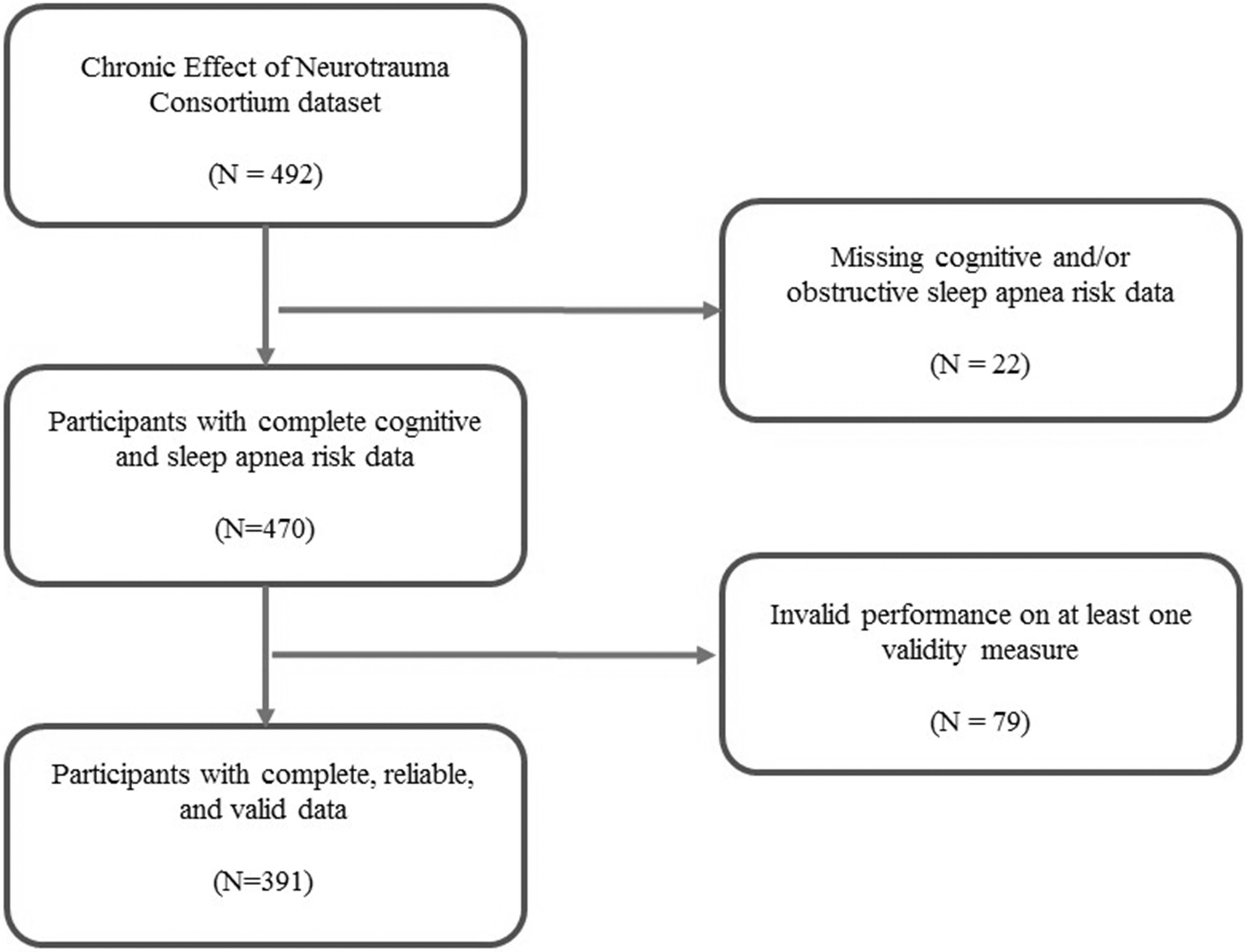
Flow diagram of participants.
Characteristics of Participants and those Excluded
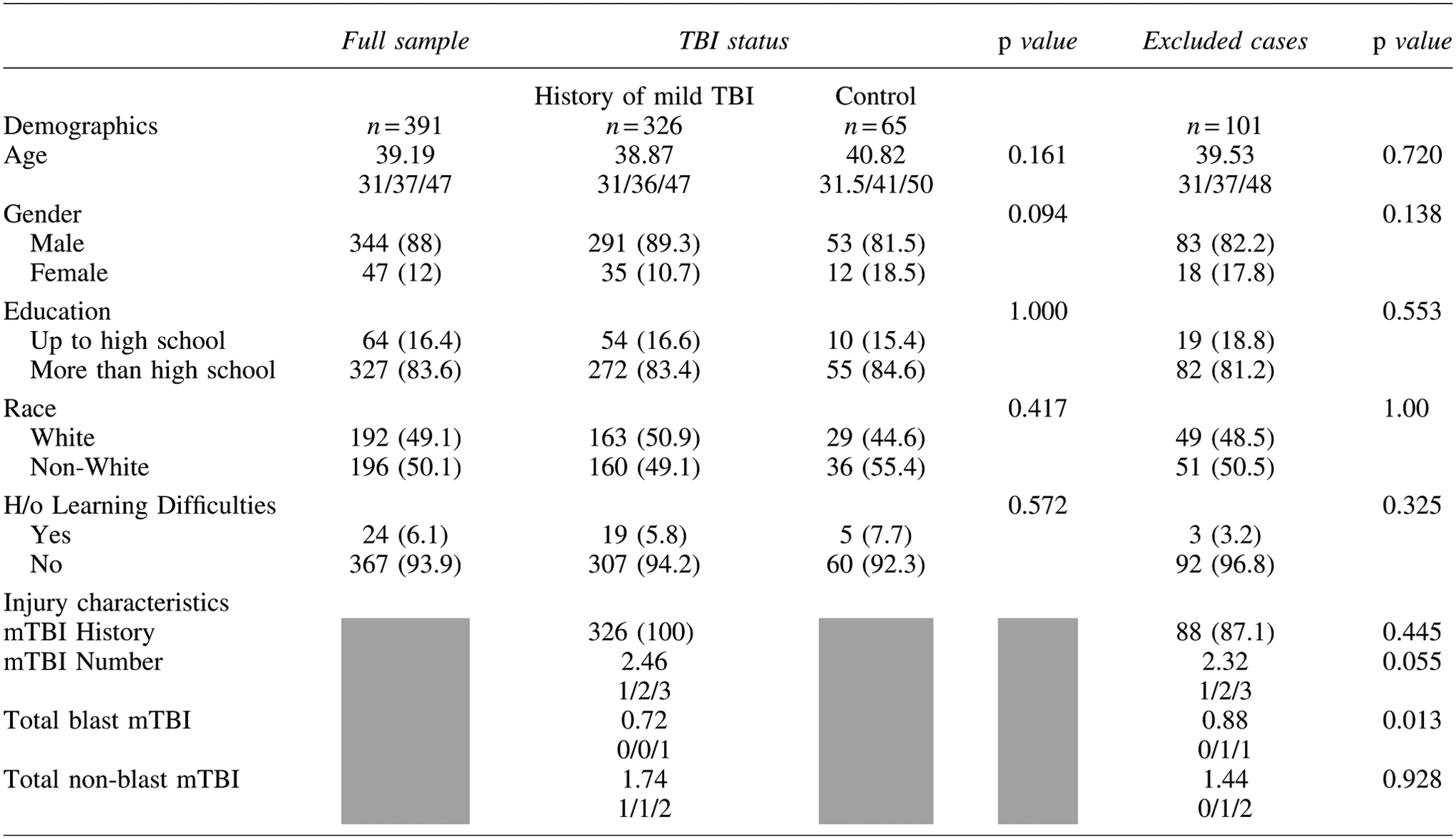
Continuous data presented as [mean, 25/50/75]. Categorical data presented as [n (%)].
TBI, traumatic brain injury; mTBI, mild traumatic brain injury.
Sleep apnea risk
Tables 4 and 5 summarize the individual risk items, subscales, and total STOP-BANG scores. Participants with an mTBI history had more risk factors for OSA compared with TBI negative controls (p = 0.006). When using recommended clinical cut-off scores for high risk (STOP-BANG ≥3), 65% of those with a history of mTBI were identified as high risk compared with controls at 51% (p = 0.035). When examining a more stringent cut-off to account for the high number of males in this sample (STOP-BANG ≥4), 44% of those with a history of mTBI were identified as high risk compared with controls at 26% (p = 0.008). When the measure was examined more specifically, those with history of mTBI demonstrated higher risk on the sleep risk factors (i.e., STOP portion of STOP-BANG) compared with controls (p = 0.009). This finding was primarily driven by a higher prevalence of hypertension (i.e., STOP-BANG Item 4) in this population (p = 0.039). Those with history of mTBI also were more likely to have a thicker neck circumference (STOP-BANG Item 7; p = 0.037). Items reflecting observed apneic events, age, and gender trended towards significant difference between groups (with the mTBI group demonstrating higher risk on all items), but they remained under the threshold for statistical difference.
Description of OSA Risk by STOP-BANG Total Score, Subscales, and Individual Items
Continuous data presented as [Mean, 25/50/75]. Categorical data presented as [raw number, percentage].
The p value was determined by χ 2 test for dichotomous variables and independent sample t-test (normally distributed data) or Kruskal-Wallis Test (non-normally distributed data) for continuous variables.
OSA, obstructive sleep apnea; TBI, traumatic brain injury; BMI, body mass index; SD, standard deviation.
Univariate and Multi-Variate Models of Memory Performance
Estimates are presented as beta values.
CI, confidence interval; CVLT, California Verbal Learning Test-II; BVMT-R, Brief Visual Memory Test-Revised.
Univariable analyses of outcomes
Univariable logistic regression analyses were performed for known predictors of cognition (age, gender, race, and education), TBI history, and OSA risk. Results of regression analyses showing unadjusted (univariable) beta score are presented in Tables 6–8. As expected, age significantly predicted performance across all measures of memory, attention, processing speed, and executive functioning, with varying effects noted for race and education across tasks. Given the predominantly male sample, no effect was observed for gender. History of mTBI was associated with lower complex processing speed (WAIS-IV Coding, confidence interval [CI] = -8.170 to −0.649) and higher number of self-reported cognitive problems (NSI Cognitive, CI = 0.365 to 0.874). In contrast, OSA risk, as measured by the STOP-BANG score, significantly predicted worse performance on all cognitive performance tasks and higher number of self-reported cognitive problems (p < 0.05; Tables 5–8).
Univariate and Multi-Variate Models of Attention/Executive Functioning Performance
Estimates are presented as beta values.
CI, confidence interval; TMT B, Trail Making Test B; TBI, traumatic brain injury; WAIS-IV, Weschler Adult Intelligence Scale 4th Edition.
Multi-variable analyses of outcomes
Multi-variable linear regression was performed with all demographic predictors, TBI status, and OSA risk in the model simultaneously. Results showing the adjusted effect of each predictor (i.e., adjusted effect after accounting for other predictors in the model) are presented in Tables 5–8. After adjustment for other variables in the model, age and race were most consistently associated with cognitive performance, with variability across tasks for gender and education. In the adjusted model, both TBI status and OSA risk were associated with worse performance on measures of complex processing speed (WAIS-IV Coding, p < 0.05; Table 7) and executive functioning (TMT B, p < 0.05; Table 6). They also were both associated with higher self-reported cognitive problems (NSI cognitive, p < 0.001; Table 8). The results remained unchanged when history of learning difficulties was entered into multi-variable models (data not presented). In other words, OSA risk is uniquely associated with some aspects of cognitive performance (speed of performance and executive functioning–cognitive sequencing) and perception of cognitive problems after adjustment for mTBI status in this cohort.
Univariate and Multi-Variate Models of Processing Speed Performance
Estimates are presented as beta values.
CI, confidence interval; TMT A, Trail Making Test A; TBI, traumatic brain injury; WAIS-IV, Weschler Adult Intelligence Scale 4th Edition.
Univariate and Multi-Variate Models of Subjective Cognitive Complaints
Estimates are presented as beta values.
CI, confidence interval; NSI, Neurobehavioral Symptom Inventory; TBI, traumatic brain injury.
Discussion
This study found a high rate of OSA risk in the CENC longitudinal study population using a proxy STOP-BANG questionnaire. This is consistent with studies demonstrating high rates of OSA in military and veteran samples. 68 A greater number of OSA risk factors was observed for those with a history of mTBI compared with controls without mTBI. Examination of risk status using traditional risk cut-off scores (≥ 3) revealed 65% of those with a history of mTBI were at high risk of OSA compared with 51% among controls. Using a more stringent cut-off (≥ 4), participants with a mTBI history (44%) continued to evidence a differential risk compared with controls (26%). These findings are consistent with the other single military study demonstrating that OSA is an especially prevalent co-morbidity of mTBI. 69
Cognitive dysfunction is commonly reported after mTBI, 41 –43 with attribution often made to non-modifiable factors (i.e., TBI status). This study examined the association of a modifiable target (OSA risk) on cognitive performance and self-reported cognitive problems. Significant effects were found for OSA risk across all univariable analyses of cognitive outcome. After adjustment for demographics and TBI status, OSA risk was significantly associated with worse performance on certain measures of complex processing speed and executive functioning/cognitive sequencing and speed of responding combined. Both tasks are challenging and involve higher order cognitive processes. In other words, task complexity is especially sensitive to OSA as measured by our proxy.
The exact mechanism underlying the relationship between OSA and task complexity in this population is still unclear. Multiple physiological processes have been implicated in general cognitive changes in uninjured adults with OSA, including effects of brief intermittent hypoxia. 70 Indeed, OSA is linked to multiple neurological changes. 32 –34 Most relevant is evidence that OSA preferentially impacts gray matter volume of the medial frontal lobe, a region critical for cognitive control processes. 32 OSA is also linked to white matter lesions and altered integrity, which are implicated in processing speed and general executive functioning. Together, these neurological changes likely impact complex tasks that rely on efficiently processing information and engaging multiple cognitive processes. Effects of these changes may be exacerbated in those with prior history of mTBI due to neurologic vulnerability, mTBI-related sleep disturbance, altered glymphatic clearance, or some combination of the above.
To date, only one study has examined the effects of OSA in a small sample (n = 35) of civilians with predominantly moderate-to-severe TBI. 44 The current study extends the literature by examining the association of a common, treatable TBI comorbidity (OSA risk) on cognitive complaints often attributed to mTBI. Findings demonstrated elevated risk among those with mTBI, although etiology of this relationship remains understudied. Within the general active duty military sample, prevalence of OSA has been associated with increasing age, sex, and body mass index. 9 However, specific relative risk with respect to mTBI history is still poorly understood, and additional research utilizing diagnostic polysomnography will be important moving forward.
Given the known benefits of treatment of OSA treatment on cognitive and underlying neuropathology, 71 research is needed to examine treatment benefit in the chronic mTBI population. To our knowledge, a single study has examined this potential mechanism for cognitive improvement in the TBI population. Castriotta and colleagues reported treatment of post-TBI sleep disorders (collapsing across OSA, hypersomnia, narcolepsy, and periodic limb movements) was associated with decreased self-reported sleepiness with limited neuropsychological benefit. 72 Given the small sample of OSA in this study (n = 13) with poor injury characterization and variable time elapsed since injury, the efficacy of OSA treatment remains underinvestigated.
Findings are of particular interest to the military population for which military readiness is crucial, particularly in this current era of prolonged conflicts. Untreated OSA is associated with daytime sleepiness and fatigue. These symptoms have both been identified across investigations as key aspects of decisional readiness in the military setting. 73,74 In this study, complex processing speed and cognitive sequencing/multi-tasking (an executive functioning task) was uniquely associated with OSA status. These cognitive skills are crucial to active-duty SMs optimal functioning in the field. Moreover, sleep has been identified as a key element to fitness and resilience in the military. 75 Finally, the sequelae of untreated OSA is associated with increased risk of workplace and motor vehicle accidents. 12,13 Collectively these findings highlight the important of early identification and treatment of OSA in this population to optimize military readiness.
Strengths of this study include the large sample size recruited from a multi-center trial promoting generalizability of the results. Analyses included post-deployed participants with history of mTBI, as well as TBI-negative controls. The use of a standardized, comprehensive battery of neuropsychological tasks and perception of cognitive functioning promoted exploration of effects across cognitive domains. Finally, given the controversial nature of chronic mTBI sequelae, participants whose scores indicated invalid cognitive performance and/or symptom exaggeration on measures embedded during formal assessment were excluded to increase the validity of findings.
However, there are several limitations associated with this study. This study was specifically investigating the relationship between OSA risk and cognitive outcome. Some aspects of cardiovascular functioning, including hypertension and BMI, are included in the characterization of risk. As such, we did not duplicate their presence in the multi-variate models. This study also does not include potential mental health co-morbidities in the model. Although depression has an independent effect on cognitive functioning, depression and OSA are not independent disease processes. A growing literature demonstrates that OSA can cause or exacerbate depressive symptoms, primarily through brain changes related to vascular burden and intermittent hypoxia. 76,77 To avoid circular analyses, depression was excluded from the final model. Similarly, examination of current alcohol consumption, chronic pain, and medications that may also contribute to overall functioning after injury were not included in the model.
Additionally, this study examined OSA risk as opposed to clinical diagnosis of OSA, which would require diagnostic polysomnography. The STOP-BANG is a recommended measure of OSA risk in clinical guidelines and has been used in evaluation of OSA outcomes. 78 Further, our modified version of the STOP-BANG may alter the determination of OSA risk. Nonetheless, significant associations were found between OSA risk and cognition. Other OSA-relevant factors (actual diagnosis, current or prior treatments, other sleep disorders, history of alcohol misuse) were not evaluated as they were not part of CENC data collection. Generalizability of findings to female military cohorts is limited due to the predominantly male sample.
Importantly, because this study utilized the STOP-BANG measure to determine sleep apnea risk, findings are interpreted within the context of obstructive sleep apnea rather than central sleep apnea (CSA). The latter is characterized not by a collapse or obstruction of the airway, but rather by a lack of drive to breathe during sleep. 79 The current study is limited to investigation of OSA risk specifically, as the STOP-BANG has not demonstrated accurate CSA detection. 80 However, CSA remains relevant when considering sleep-disordered breathing in individuals following TBI, as it has been linked to long-term opioid use. 79 A study of hospitalized individuals with TBI demonstrated that chronic pain (for which opioids may be prescribed) is the most prevalent co-morbidity at follow-up, suggesting that opioid-induced sleep-disordered breathing resulting in CSA may be relevant in some. 81 The focus on OSA risk in this study is supported by recent evidence highlighting primarily OSA, not CSA, diagnosis after TBI in both single and multi-center clinical trials. 82,83 Nevertheless, future diagnostic studies of this population are needed that improve understanding of the inter-relationship of sleep-disordered breathing and prevalent behavioral health co-morbidities on risk/outcome.
To conclude, this study found a unique association between OSA risk and cognition among current and former SMs. Future studies with diagnostic polysomnography are needed to determine the exact association of OSA disease severity and subsequent treatment benefits with sequelae commonly attributed to mTBI. Although polysomnography and other biometrics of sleep quality were not available in this cohort, replicating these findings with multiple sources of diagnostic data will be critical for understanding these complex relationships. To this end, our research is first step in identifying OSA as a modifiable risk factor following mTBI, and suggests that OSA serves as a potential point of intervention to improve clinical and functional outcomes after injury.
Footnotes
Acknowledgments
The authors would like to acknowledge the work of Deveney Ching in the preparation of this manuscript.
The views expressed in this manuscript are those of the authors and do not necessarily represent the official policy or position of the Defense Health Agency, Department of Defense (DOD), Department of Army/Navy/Air Force, Veterans Health Administration (VHA), U.S. Government, Defense and Veterans Brain Injury Center (DVBIC), or any other U.S. government agency. No official endorsement should be inferred.
Unclassified.
Funding Information
This work was prepared under Contract W91YTZ-13-C-0015/ HT0014-19-C-0004 with VHA Central Office VA TBI Model Systems Program of Research/DHA Contracting Office (CO-NCR) HT0014 and, therefore, is defined as U.S. Government work under Title 17 U.S.C.§101. Per Title 17 U.S.C.§105, copyright protection is not available for any work of the U.S. Government. For more information, please contact
Author Disclosure Statement
No competing financial interests exist.