






Abstract
The concept of the “Calorie” originated in the 1800s in an environment with limited food availability, primarily as a means to define economic equivalencies in the energy density of food substrates. Soon thereafter, the energy densities of the major macronutrients—fat, protein, and carbohydrates—were defined. However, within a few decades of its inception, the “Calorie” became a commercial tool for industries to promote specific food products, regardless of health benefit. Modern technology has altered our living conditions and has changed our relationship with food from one of survival to palatability. Advances in agriculture, food manufacturing, and processing have ensured that calorie scarcity is less prevalent than calorie excess in the modern world. Yet, many still approach dietary macronutrients in a reductionist manner and assume that isocalorie foodstuffs are isometabolic. Herein, we discuss a novel way to view the major food macronutrients and human diet in this era of excessive caloric consumption, along with a novel relationship among calorie scarcity, mild cold stress, and sleep that may explain the increasing prevalence of nutritionally related diseases.
Introduction
I
Today, we are faced with an unprecedented obesity pandemic that is propelling a dramatic rise in chronic age-related diseases. In fact, individuals who are overweight worldwide now outnumber those undernourished. 3 Furthermore, information regarding nutrition has never been more voluminous or accessible. Numerous books, blogs, and guidelines provide not only recommendations for how to eat, but also discuss the underlying biology supporting their claims. Traditional scientists and physicians, along with a cadre of citizen scientists, are also earnestly struggling to understand the etiology of the obesity epidemic and its attendant consequences, and how the rise in chronic overnutrition and nutritionally related diseases might be reversed.
The “Calorie”
In the 1800s, a fundamental change occurred in the relationship between people and food. Historically, food was simply seen as sustenance. But, in an attempt to understand how food and air functioned to produce work and heat, our current scientific notions of nourishment and nutrition began to develop. Lavoisier overturned the century-old phlogistic doctrine in the late 18th century with his discovery of the role of oxygen in combustion and respiration. Within 50 years, his general ideas of carbon and hydrogen fuel were replaced by Liebig's proposal of specific organic molecules, such as starch or sugars, fats, and albumin, fibrin, and “proteines.” 4 These advancements then led to the explanation of the millennium-old curiosities of Aristotle and Galen on the source of “innate heat.” 5 By the close of the 19th century, a Calorie (technically a kilocalorie or ∼4.2 kilojoules) was defined.
Food
Scientific advances made during the 1840s marked the beginning of modern nutritional science. Food was now classified as proteins, carbohydrates, or fats based on the majority macronutrient, deemphasizing the fact that whole food typically contains a mixture of constituents. Food went beyond sustenance and now had a designation outside of hunger. In 1875, having worked with the German nutritional scientists Carl von Voit, Max von Pettenkofer, and Max Rubner, Atwater established a laboratory at Wesleyan University to evaluate systematically the various components of foodstuffs. By 1877, government funding to promote agriculture by scientific investigation and experiments reached $5000 per year. In 1887, 16 of these laboratories existed and the US Congress furthered the work by appropriating $15,000 to each state having such a facility; by 1888, their appropriations grew to ∼$1,000,000 annually, with ∼25% coming from nongovernment donations. The promotion of food through food science had become big business. 6
At these laboratories, the macronutrient ratios of protein, carbohydrates, and fats in over 4000 foods were measured by calorimetry. Atwater popularized the nutritional equivalency of food through the concept of the Calorie, and while retaining the general protein plus fuel paradigm begun by Justus von Liebig, he sought to normalize the nutritive economy of food, while not making any statements per se about health. 7 Over the next two decades, the US Department of Agriculture stakeholders promoted food products to a starving nation; it was now known that expensive foods were not necessarily more “nutritious” than less expensive foods. For example, beans and rice were equally, if not more nourishing, than more expensive meat. 8
Protein, Carbohydrates, and Fat
The business of food was flourishing by the time of Atwater's death and the last published edition of his Principles of Nutrition and Nutritive Value of Food in the early 1900s. 9 The macronutrient-based marketing of food, particularly protein-based marketing, was exemplified in the following decade by beef versus wheat advertising campaigns, each claiming theirs was the best economic value for protein. 10 The discovery of vitamins in the 1920s then led to new marketing campaigns aimed at advertising a food's utility based on vitamin content. This approach to food was even adopted in the early 20th century US foreign policy as an economic tool to control food in times of peace and war. 10,11
However, whole food simply does not fit these labels well. For example, few realize that the common potato, although typically considered a carbohydrate, can be a significant dietary source of protein. 12 Moreover, the perceived prevalence of protein deficiency and the emphasis that historically had been given to the role of protein in human undernutrition was clarified in Donald S. McLaren's 1974 commentary, “The great protein fiasco.” 13 Even kwashiorkor has been shown not to be due to simple protein deficiency, but rather a more complicated gut microbiome–diet relationship. 14 –16
Interestingly, a recent study using a nutritional geometric framework and state–space modeling approach found that folivorous (leaf-eating) mountain gorillas in Uganda prioritize the intake of nonprotein energy (NPE). 17 Specifically, NPE intake was found to be invariant throughout the year, whereas protein intake was determinant on its availability. The concentrations of protein consumed in relation to total energy when leaves were the major portion of the diet for the gorillas were close to the maximum recommended for humans and similar to high-protein human weight-loss diets. Alternatively, the concentrations of protein in relation to total energy when the gorillas ate fruit-dominated diets were similar to those typically recommended for humans. Gorillas live in a world where Calorie scarcity and abundance change with the season. We have created an environment of ubiquitous, cheap, and tasty Calories and have developed social paradigms that frequently revolve around food.
The Food Triangle
From the mid-19th century, food has been conceptualized and promoted as protein plus fuel. And, during times of protein and calorie scarcity, this paradigm makes sense. However, because relatively few societies exist today that suffer from severe protein and calorie deficiencies, a new paradigm may be useful.
Our version of the Food Triangle (Fig. 1) organizes food using an energy density paradigm. It recognizes that essential amino acids (i.e., proteins) are not limiting nutrients in any whole food diet that meets daily energy needs. Rather, plant- or animal-sourced amino acids, in excess of daily requirements, along with carbohydrates and fat, all become fuel. Moreover, since the presence of combined fuels in a meal creates an oxidative priority that affects one's postprandial respiratory quotient (RQ) and resting metabolic rate (RMR), 18,19 it may be conceptually easier to separate them on the basis of fuel source rather than majority macronutrient composition. This organization of energy density further permits individuals to address their micronutrient requirements (the apex of the triangle) without driving overnutrition (the bottom vertices of the triangle). Not surprisingly, many popular diet schemes fall along one of the descending sides of this food triangle, often eliminating one or more food groups (e.g., “red” meat, fruit, dairy, “white” starches, etc.).
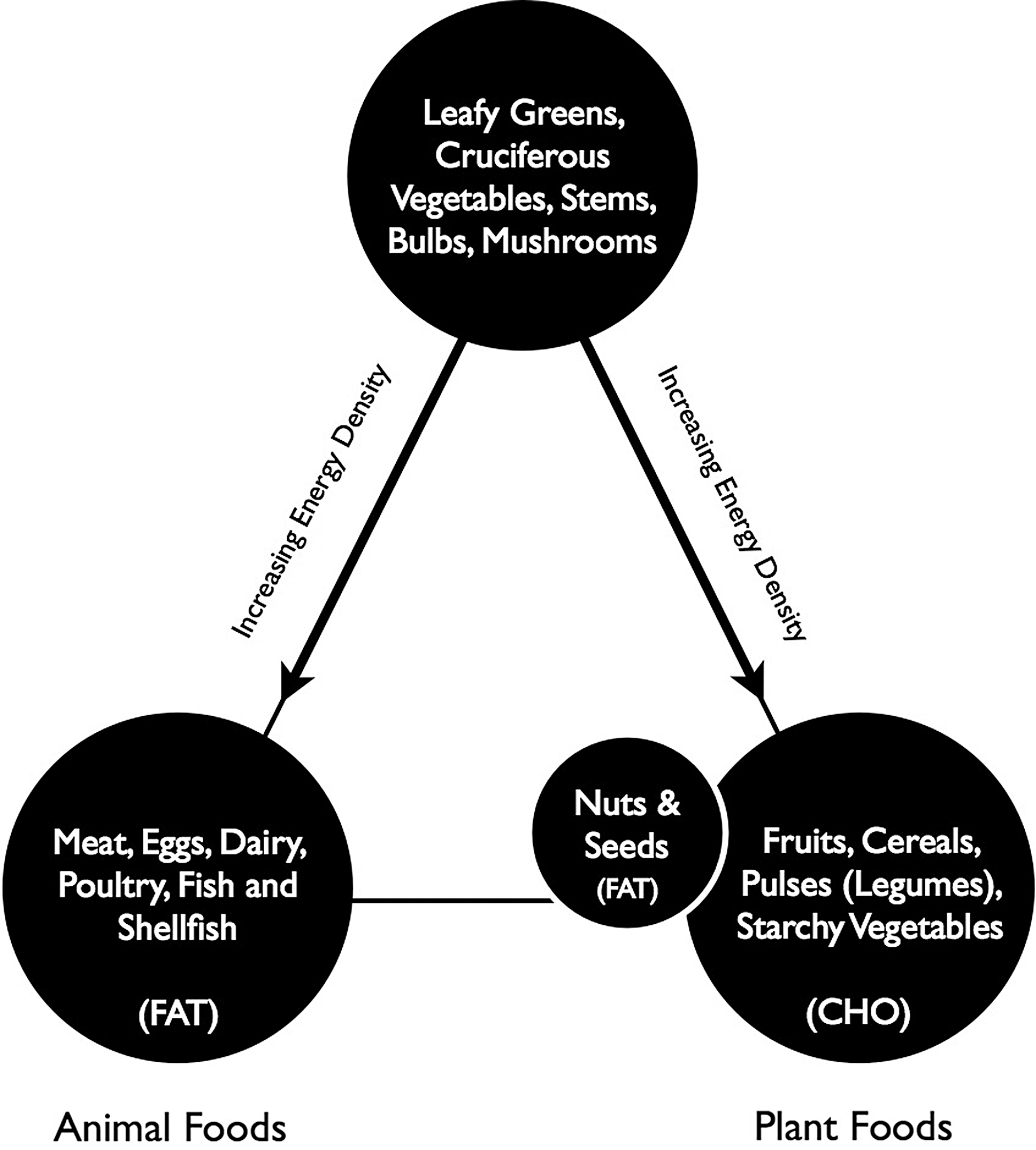
The Food Triangle. The Food Triangle organizes whole food using an energy density paradigm. It recognizes that essential amino acids (i.e., proteins) are not limiting nutrients in any whole food diet that meets daily energy needs. Rather, vegetable- or animal-sourced amino acids, in excess of daily requirements, along with carbohydrates (CHO) and fat (FAT), all become fuel. This organization of energy density permits individuals to address their micronutrient requirements (the apex of the triangle) without driving chronic overnutrition (the bottom vertices of the triangle). These foods become the nutritional foundation of daily meals, rather than the more energy-dense alternatives. They also provide a rich source of phytonutrients and can be eaten in nearly unlimited quantities. It further places emphasis on foods that are increasingly important for healthy gut microbiota. With the exception of nuts and seeds (plant-sourced fats, which can provide the required ∼1%–3% of dietary essential fatty acids), foodstuffs and fuel source may be more easily recognized by classified as either “animal-based” foods or “plant-based” foods based on their nonprotein energy source. CHOs may also drive dietary fat storage through shifts in postprandial respiratory quotient (RQ)/resting metabolic rate (RMR). In addition to increased fat storage, it may be more difficult to recognize energy excesses when crossing over from primarily CHO-sourced fuel to fat-sourced fuel or vice versa. Highly refined oils and fats, sugars, and grains are not listed, as they are not whole foods and should be consumed in limited quantities.
One problem with the macronutrient-based organization of food is that it legitimizes certain foodstuffs as equivalent and nourishing as whole food. It additionally focuses consumers on often confusing goals (i.e., eating low-glycemic, complex carbohydrates) rather than simple messages (i.e., eat carrots). It also neglects Atwater's 19th century warnings of acquired appetite and does not account for the impact diet plays on both the gut microbiome 20 –23 and macronutrients in excess of their requirement, while neglecting calorie-limited and vitamin-, mineral-, and phytonutrient-rich plant foods. 24 –28
Calories and Mitochondrial Dysfunction
At a cellular level, mitochondrial stress and bioenergetics have been linked to chronic overnutrition affecting overall cellular redox circuits. 29 –31 Excess alcohol, branched-chain amino acids (BCAA), fructose, and trans fats have all been shown to affect mitochondrial function and enhance intrahepatic fat when energy replete, 32,33 and although numerous studies have demonstrated that de novo lipogenesis does not significantly contribute to obesity per se, 34 –39 the general “sugar turns to fat” myth prevails, detracting focus from the negative metabolic effects these substrates have on the liver.
Contrary to overnutrition and calorie excess, calorie restriction typically delays diseases of aging and extends life span. 40,41 Whether in yeast or mammals, a reduction in calories by 30%–40% from ad libitum feeding triggers a network of genes that evolved to protect organisms during times of food scarcity (i.e., “longevity” genes). Alternatively, excessive intake of macronutrients, for example, the essential amino acid methionine, is negatively correlated with longevity. 42,43 This “longevity survival network” includes insulin/insulin-like growth factor-1 (IGF-1) signaling, mammalian target of rapamycin (mTOR), AMP-activated protein kinase (AMPK), and the seven sirtuins (SIRT1–7), a family of cellular energetics and defense enzymes. 44 –46 In fact, sirtuin-activating compounds (STACs), such as resveratrol and fisetin, and other calorie restriction mimetics, such as metformin, are thought to derive the majority of their health benefits not from antioxidant properties or by inducing a cellular damage response (hormesis), but rather from interacting with conserved regions in enzymes that have evolved to sense molecules in the environment. 47,48 The “xenohormesis hypothesis” suggests that STACs act as an advance warning generated by plants in times of stress or deteriorating environmental conditions, and that these stress-signaling molecules may coordinate sirtuin-mediated defenses across species. 49 –52
Metabolic Winter
Sirtuins function to maintain homeostasis and secure an organism's survival when exposed to internal or external perturbations, and there is an abundant literature demonstrating their role(s) in obesity, metabolic syndrome, diabetes, cancer, inflammation, and cardiovascular disease. 53 –59 SIRT1, in particular, is a key regulator of energy homeostasis and metabolism via peroxisome proliferator-activated receptor-gamma coactivator 1α (PGC-1α) 60 and hypoxia-inducible factor 1-α (HIF-1α), 61 all of which are critical mediators of mitochondrial biogenesis and possibly responsible for many of the health benefits of dieting and exercise. Interestingly, the other main function of PGC-1α involves another survival trait, nonshivering thermogenesis, 62 during which individual mitochondrion bypass adenosine triphosphate (ATP) production and instead create heat by activating uncoupling protein 1 (UCP-1). 63 This is a very efficient mechanism to replace the immediate response to cold, shivering, with a mechanism that produces heat directly through the recruitment of mitochondria.
Although all skeletal muscle cells are associated with adaptive thermogenesis, 64 brown adipose tissue (BAT) is also a key player in metabolism. Humans are born with more fat than any other species and have significant amounts of BAT; but, until recently, it was thought to be lost by adulthood. 65,66 New studies suggest that not only can adults have significant amounts of BAT, 67 –69 but that exercise-induced production of irisin causes an increase in BAT and an associated increase in energy expenditure. 70 These findings support the notion that modern humans evolved to cope with seasonally cool temperatures (cold stress) and periodic periods of food scarcity (calorie restriction).
Sleep and Body Temperature
Our current society is one that is chronically sleep deprived. Links between sleep and metabolic dysfunction can be found in early Roman medicine, and too little sleep is associated with obesity and many cardiometabolic diseases. 71 –74 Early observations ranging from Australian aborigines to the cold climate of the Scandinavian nomadic Lapps demonstrate how adaptable humans are to mild cold stress during sleep. 75 –77 Adaptation also occurs for nonnative inhabitants after repeated exposure. 78 Furthermore, until the 20th century, winter was characterized by long nights without artificial light and generally cooler sleeping conditions.
Importantly, much of the same biology that allows winter adaptation for cooler environments, including sleep, overlaps the underlying metabolic mechanisms involved in adaptations to calorie scarcity. 79 For example, increased sleep in cool environments and long nights of winter in the absence of excess artificial light and warmth may work synergistically to promote the conservation of valuable calories in a time of year when they are naturally scarce. 80 Melatonin, a hormone associated with sleep, acts to lower the core body temperature, 81 –84 and a steep rate of decline in core body temperature is associated with both sleep onset and quality. 85,86 In contrast, reduced sleep leads to impaired glucose tolerance and insulin resistance, 87 increased appetite through changes in leptin and ghrelin levels, 88 and reduced energy expenditure. 89 One might conceptually associate winter's cold, dark, and still environment as a natural balance to summer's warm, bright, and active environment. Very few of us now sleep in the cold, and studies have even shown an association between weight gain and average room temperature. 90
Furthermore, “longevity” genes are central to the regulation of biological circadian rhythms, including those that regulate sleeping, eating, and hormone and neurotransmitter secretion. 91,92 Importantly, perturbations of the internal clock system and sleep are established risk factors for obesity, diabetes mellitus, and cardiovascular disease and are associated with metabolic dysfunction. 93 –95 Moreover, there appears to be a reciprocal relationship between circadian rhythms and metabolism: Although the circadian clock indeed regulates multiple metabolic pathways (including glucose and cholesterol metabolism), metabolites and feeding behavior can also regulate the circadian clock. 96 Thus, disruption of genes regulating circadian rhythms, including the “longevity” genes, either alone or in combination with diet-induced changes in systemic metabolites and feeding behavior, may underlie the molecular link between sleep deprivation and altered sleeping patterns such as rotating shift work and cardiometabolic disease.
Putting It All Together
It appears that we have an evolutionary discordance between our biology that evolved to counter seasonal calorie scarcity and mild cold stress and our modern world of ubiquitous calories and excess warmth. When discussing solutions to the obesity pandemic, the almost universal mantra is “eat less, move more.” While no one loses weight by eating more total calories, it has been demonstrated that the average daily energy expenditure of traditional hunter-gatherers was no different than that of modern day Western (United States and European) counterparts. 97 This suggests that dramatic differences in lifestyle activity have minimal effects on total energy expenditure and that variances in obesity prevalence among populations result primarily from differences in energy intake rather than expenditure. Moreover, obese people generally have a higher RMR and energy expenditure than the nonobese. 98 Although it seems reasonable to assume that obesity is a result of less activity, several studies have shown the fallacy of expecting exercise to promote significant weight loss without dietary changes. 99,100 Thus, it might be reasonable to consider that many of the health benefits of physical activity are actually adaptive responses related to times of cold stress and shivering. In nature, animals do not intentionally participate in high levels of activity to mitigate excess calorie ingestion—available calories are limited and animals conserve activity. In fact, the main factors influencing energy expenditure are body mass and ambient temperature, not activity. A recent study even demonstrated that energy expenditure from physical activity in humans has not declined since the 1980s and matches energy expenditures of wild mammals. 101 Thus, since energy expenditure from physical activity has not significantly declined over the same period of time that obesity rates have risen and modern daily energy expenditure in humans is comparable to that of current mammals in the wild, decreased energy expenditure is unlikely to have fueled the obesity epidemic.
These observations do not negate the myriad health benefits of exercise or discourage physical activity, nor do they suggest that significant lifestyle changes (including changes to both energy intake and expenditure) cannot impact overall weight; but, increasing exercise time may not be a major factor in obesity prevention for the general public. Simply increasing activity through exercise in the absence of a significant lifestyle dietary modification is unlikely to have a significant impact. On the other hand, lifestyle modifications involving diet alone can significantly impact both obesity and chronic disease.
Which brings us full circle with respect to food. Hippocrates pondered the need for one or two meals a day, and yet now society tends to eat throughout the entire day. Following a meal, postprandial shifts occur in RMR/RQ for at least 4 hr to accommodate the calories consumed 102 ; only then do we then resume using “stored” energy. Moreover, skipping meals does not cause a decrease in metabolism; in fact, an increase in metabolism occurs during the first 4 days of a fast. 103
The nutrition paradigm of protein plus fuel that began in the mid-19th century changed the perception of eating food from one of sustenance to one of seeking specific nutrition. It popularized marketing campaigns designed to promote the nutrient content of foodstuffs, ignoring the potential for consuming excess calories. In a world of calorie scarcity, the drive for ubiquitous, cheap, and tasty calories was a noble goal. The problem seems to be that we succeeded in combatting malnutrition and now are faced with the reality of chronic overnutrition, with the best advice to prevent overnutrition-related disease being “eat less, move more.” Perhaps the most important meal of the day is not to break fast in the face of obesity, but instead to center our plate on nutrient-dense, calorically poor vegetables and fruits. At the very least, we should heed Atwater's advice and not be “…influenced too much by taste” or “let natural instinct be overruled by acquired appetite.”
Conclusions
In this review, we have discussed a novel way to view the major food macronutrients and how the characterization of the nutritional content of food in the human diet may have unintentionally driven excessive caloric consumption, along with a novel relationship among calorie scarcity, mild cold stress, and sleep that are relevant to obesity, metabolic syndrome, and diabetes. In an effort to keep the essay concise and focused, we intentionally did not address each disease entity (i.e., obesity, metabolic syndrome, and diabetes) separately; however, subsequent reviews are forthcoming.
Our 7-million-year evolutionary path was dominated by two seasonal challenges—calorie scarcity and mild cold stress. In the last 0.9 inches of our evolutionary mile, we solved them both. Refrigeration and transportation have fundamentally changed the food to which we have access and the environments in which we live. We also sleep less and are exposed to considerably more artificial light, particularly in the winter months. Obesity and chronic disease are seen most often in people and the animals (pets) they keep warm and overnourished. Similar to the circadian cycle and like most other living organisms, it is reasonable to believe we also respond to the seasons and carry with us the survival genes for winter. Maybe our problem is that winter never comes.
Footnotes
Acknowledgment
This work received funding support from National Institutes of Health (NIH) grant R01 AG028730 to DAS.
Author Disclosure Statement
No conflicting financial interests exist.
The contents of this article represent the authors' views and do not constitute an official position of the National Institutes of Health or the United States Government.